
 Buy Crypto
- Markets
 Futures
- Spot
- Copy Trade
- Earn
- More
2 Days 20x, How Big Can the Legendary Golden Dog Snowball's "Auto-Compound" Snowball Grow?

Original Title: "2 Days 20x, Quick Look at the Automatic Market Maker of the New Gold Dog snowball"
Original Author: David, Shenzhen TechFlow
The crypto market in December is as cold as the weather.
On-chain transactions have been dormant for a long time, and a new narrative has also been difficult to produce. Just look at the arguments and gossip in the Chinese CT community in recent days, and you will know that there are hardly any people playing in this market anymore.
But the English community has been discussing something new in the past few days.
A meme coin called Snowball, launched on December 18 on pump.fun, saw its market capitalization surge to $10 million in just four days, reaching a new all-time high; yet hardly anyone in the Chinese community mentioned it.
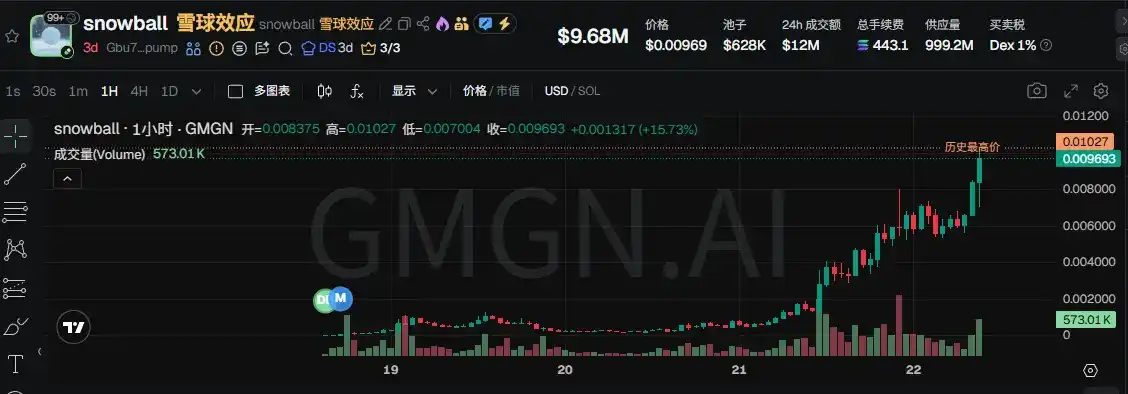
In the current environment where there are no new narratives and even meme coins are not attracting interest, this is one of the few things that have caught people's attention, displaying a kind of localized wealth effect.
And the name Snowball itself translates to the "snowball effect," which is the story it aims to tell:
A mechanism that allows the token to "grow bigger on its own as it rolls."
Turning Transaction Fees into Buybacks, Snowball Market Rolling
To understand what Snowball is doing, you first need to know how tokens on pump.fun typically make money.
On pump.fun, anyone can spend a few minutes creating a token. Token creators can set a "creator fee," which is essentially a percentage taken from each transaction and sent to their own wallet, usually between 0.5% and 1%.
This money can theoretically be used for community development and marketing, but in practice, most Devs' choice is: exit scam when they have accumulated enough.
This is also part of the typical life cycle of meme coins. Launch, pump, harvest fees, exit. Investors are not betting on the token itself but on the developer's conscience.
Snowball's approach is to not take this creator fee money.
More precisely, 100% of the creator fee does not go into anyone's wallet but is automatically transferred to an on-chain market-making bot.
This bot performs three actions at regular intervals:
First, use the accumulated funds to buy tokens on the market, creating buying pressure;
Second, add the purchased tokens and corresponding SOL to the liquidity pool to improve trading depth;
Third, burn 0.1% of the tokens on each operation to create deflation.
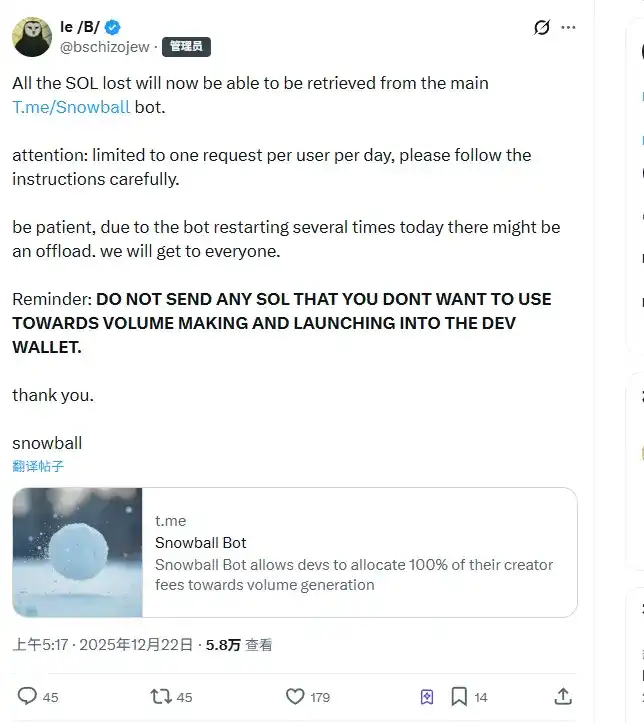
At the same time, the proportion of creator fees collected by this token is not fixed and will fluctuate between 0.05% and 0.95% based on market capitalization.
When the market capitalization is low, a higher fee is charged to rapidly accumulate ammunition for bots; when the market capitalization is high, the fee is reduced to minimize trading friction.
To summarize the logic of this mechanism in one sentence, every time you trade, some money automatically becomes buying pressure and liquidity, rather than going into the developer's pocket.
Therefore, it is easy to understand the snowball effect:
Trading generates fees → Fees become buying pressure → Buying pressure drives up the price → Price attracts more trading → More fees... theoretically, it can roll on its own.
On-Chain Data
Now that the mechanism is explained, let's look at the on-chain data.
Snowball was launched on December 18 and has been four days since then. The market cap surged from zero to $10 million, with a 24-hour trading volume exceeding $11 million.
For a meme coin on pump.fun, this performance is already considered long-standing in the current environment.
In terms of token distribution, there are currently 7270 holder addresses. The top ten holders together own about 20% of the total supply, with the largest single holder owning 4.65%.
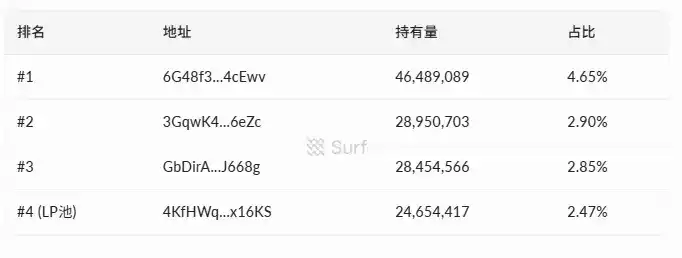
(Data Source: surf.ai)
No single address holds a significant share of two or three, indicating a relatively decentralized distribution.
Regarding transaction data, there have been over 58,000 transactions since launch, including 33,000 buys and 24,000 sells. The total buy amount is $4.4 million, sells amount to $4.3 million, with a net inflow of approximately $100,000. Buys and sells are roughly balanced, with no significant selling pressure.
There is approximately $380,000 in the liquidity pool, half in one token and half in SOL. For this market cap size, the depth is not considered deep, so large orders in and out will still experience significant slippage.
Another point worth noting is that shortly after the launch, Bybit Alpha announced the listing of the token in less than 96 hours, which to some extent also confirms its short-term popularity.
Perpetual Motion Machine Meets Bear Market
After taking a look around, it can be seen that the English community's discussion of Snowball mainly focuses on the mechanism itself. Supporters' logic is very straightforward:
This is the first meme coin that locks 100% of creator fees into the protocol, so developers cannot rug pull. At least structurally, it is more secure than other meme coins.
The Dev is also in line with this narrative. The developer wallet, liquidity pool bot wallet, and transaction logs are all public, emphasizing "on-chain verifiability."
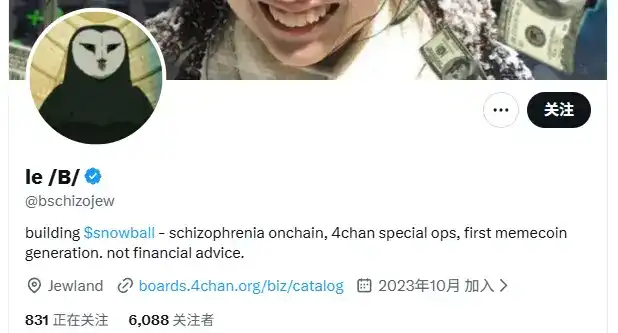
@bschizojew labels himself as "on-chain schizophrenia, 4chan special forces, first-generation meme coin veteran," exuding a self-deprecating degenerate vibe that is very much in line with the taste of the crypto-native community.
But mechanism security and profit-making are two different things.
The premise of the Snowball effect is to have enough trading volume to continuously generate fees, which are then fed to the bot to execute buybacks. The more the transactions, the stronger the bot's ammunition, the stronger the buy pressure, the higher the price, attracting more people to trade...
This is also the ideal state for any meme coin's buyback flywheel to start spinning in a bull market.
However, the flywheel needs external power to start.
What is the current state of the crypto market? On-chain activity is low, overall interest in meme coins is declining, and funds willing to ape into meme coins are already scarce. In this context, if new buy pressure cannot keep up, trading volume shrinks, the bot receives less and less in fees, the buyback strength weakens, price support diminishes, and trading interest further declines.
The flywheel can spin forward but also backward.
More realistically, the mechanism addresses only the risk of "developer rug pulls," but meme coins face risks far beyond that.
Whale dumping, insufficient liquidity, narrative fatigue — if any of these occur, the impact of 100% fee buyback is very limited.
Everyone is scared of being rugged. A prominent figure in the Chinese community summarized it well:
Play around, but don't get too involved.
More Than One Snowball Rolling
Snowball is not the only project talking about this automated market-making story.
Also in the pump.fun ecosystem, there is a token called FIREBALL doing a similar thing: automatic buyback and burn, packaging it as a protocol that other tokens can plug into. But its market cap is much smaller than Snowball's.

This indicates that the market is currently responsive to the direction of "mechanism-based meme coins."
The traditional practices of shilling, pumping, and community hype are finding it increasingly challenging to attract funds. Telling a "structural security" story through mechanism design may be one of the recent strategies of meme coins.
However, when it comes to artificially creating a mechanism, it's not a new play.
In 2021, OlympusDAO's (3,3) is the most typical case, using game theory to package a staking mechanism, telling a story of "if everyone holds, everyone gains," with the peak market cap soaring to tens of billions of dollars. The eventual outcome, as everyone knows, was a downward spiral, with a drop of over 90%.
Going back a bit further, there is Safemoon's play of "taxing each transaction and distributing it to holders," which was also a narrative of mechanism innovation, but eventually led to an SEC lawsuit, with the founder being charged with fraud.
Mechanisms can be excellent narrative hooks, able to attract funds and attention in the short term, but mechanisms themselves do not create value.
When external funds cease to flow in, even the most intricate flywheel will come to a halt.
Finally, let's clarify what this little Shiba Inu is up to:
Turning the meme coin's creator fee into an "automated market-making robot." The mechanism itself is not complex, and the problem it solves is very clear: preventing developers from directly taking the money and running.
Developers not running away doesn't mean you will make money.
If you find this mechanism intriguing after reading and want to participate, remember one thing: it is first and foremost a meme coin, and secondly an experiment with a new mechanism.
You may also like

Found a "meme coin" that skyrocketed in just a few days. Any tips?

TAO is Elon Musk, who invested in OpenAI, and Subnet is Sam Altman

The era of "mass coin distribution" on public chains comes to an end

Soaring 50 times, with an FDV exceeding 10 billion USD, why RaveDAO?

1 billion DOTs were minted out of thin air, but the hacker only made 230,000 dollars

After the blockade of the Strait of Hormuz, when will the war end?

Before using Musk's "Western WeChat" X Chat, you need to understand these three questions
The X Chat will be available for download on the App Store this Friday. The media has already covered the feature list, including self-destructing messages, screenshot prevention, 481-person group chats, Grok integration, and registration without a phone number, positioning it as the "Western WeChat." However, there are three questions that have hardly been addressed in any reports.
There is a sentence on X's official help page that is still hanging there: "If malicious insiders or X itself cause encrypted conversations to be exposed through legal processes, both the sender and receiver will be completely unaware."
No. The difference lies in where the keys are stored.
In Signal's end-to-end encryption, the keys never leave your device. X, the court, or any external party does not hold your keys. Signal's servers have nothing to decrypt your messages; even if they were subpoenaed, they could only provide registration timestamps and last connection times, as evidenced by past subpoena records.
X Chat uses the Juicebox protocol. This solution divides the key into three parts, each stored on three servers operated by X. When recovering the key with a PIN code, the system retrieves these three shards from X's servers and recombines them. No matter how complex the PIN code is, X is the actual custodian of the key, not the user.
This is the technical background of the "help page sentence": because the key is on X's servers, X has the ability to respond to legal processes without the user's knowledge. Signal does not have this capability, not because of policy, but because it simply does not have the key.
The following illustration compares the security mechanisms of Signal, WhatsApp, Telegram, and X Chat along six dimensions. X Chat is the only one of the four where the platform holds the key and the only one without Forward Secrecy.
The significance of Forward Secrecy is that even if a key is compromised at a certain point in time, historical messages cannot be decrypted because each message has a unique key. Signal's Double Ratchet protocol automatically updates the key after each message, a mechanism lacking in X Chat.
After analyzing the X Chat architecture in June 2025, Johns Hopkins University cryptology professor Matthew Green commented, "If we judge XChat as an end-to-end encryption scheme, this seems like a pretty game-over type of vulnerability." He later added, "I would not trust this any more than I trust current unencrypted DMs."
From a September 2025 TechCrunch report to being live in April 2026, this architecture saw no changes.
In a February 9, 2026 tweet, Musk pledged to undergo rigorous security tests of X Chat before its launch on X Chat and to open source all the code.
As of the April 17 launch date, no independent third-party audit has been completed, there is no official code repository on GitHub, the App Store's privacy label reveals X Chat collects five or more categories of data including location, contact info, and search history, directly contradicting the marketing claim of "No Ads, No Trackers."
Not continuous monitoring, but a clear access point.
For every message on X Chat, users can long-press and select "Ask Grok." When this button is clicked, the message is delivered to Grok in plaintext, transitioning from encrypted to unencrypted at this stage.
This design is not a vulnerability but a feature. However, X Chat's privacy policy does not state whether this plaintext data will be used for Grok's model training or if Grok will store this conversation content. By actively clicking "Ask Grok," users are voluntarily removing the encryption protection of that message.
There is also a structural issue: How quickly will this button shift from an "optional feature" to a "default habit"? The higher the quality of Grok's replies, the more frequently users will rely on it, leading to an increase in the proportion of messages flowing out of encryption protection. The actual encryption strength of X Chat, in the long run, depends not only on the design of the Juicebox protocol but also on the frequency of user clicks on "Ask Grok."
X Chat's initial release only supports iOS, with the Android version simply stating "coming soon" without a timeline.
In the global smartphone market, Android holds about 73%, while iOS holds about 27% (IDC/Statista, 2025). Of WhatsApp's 3.14 billion monthly active users, 73% are on Android (according to Demand Sage). In India, WhatsApp covers 854 million users, with over 95% Android penetration. In Brazil, there are 148 million users, with 81% on Android, and in Indonesia, there are 112 million users, with 87% on Android.
WhatsApp's dominance in the global communication market is built on Android. Signal, with a monthly active user base of around 85 million, also relies mainly on privacy-conscious users in Android-dominant countries.
X Chat circumvented this battlefield, with two possible interpretations. One is technical debt; X Chat is built with Rust, and achieving cross-platform support is not easy, so prioritizing iOS may be an engineering constraint. The other is a strategic choice; with iOS holding a market share of nearly 55% in the U.S., X's core user base being in the U.S., prioritizing iOS means focusing on their core user base rather than engaging in direct competition with Android-dominated emerging markets and WhatsApp.
These two interpretations are not mutually exclusive, leading to the same result: X Chat's debut saw it willingly forfeit 73% of the global smartphone user base.
This matter has been described by some: X Chat, along with X Money and Grok, forms a trifecta creating a closed-loop data system parallel to the existing infrastructure, similar in concept to the WeChat ecosystem. This assessment is not new, but with X Chat's launch, it's worth revisiting the schematic.
X Chat generates communication metadata, including information on who is talking to whom, for how long, and how frequently. This data flows into X's identity system. Part of the message content goes through the Ask Grok feature and enters Grok's processing chain. Financial transactions are handled by X Money: external public testing was completed in March, opening to the public in April, enabling fiat peer-to-peer transfers via Visa Direct. A senior Fireblocks executive confirmed plans for cryptocurrency payments to go live by the end of the year, holding money transmitter licenses in over 40 U.S. states currently.
Every WeChat feature operates within China's regulatory framework. Musk's system operates within Western regulatory frameworks, but he also serves as the head of the Department of Government Efficiency (DOGE). This is not a WeChat replica; it is a reenactment of the same logic under different political conditions.
The difference is that WeChat has never explicitly claimed to be "end-to-end encrypted" on its main interface, whereas X Chat does. "End-to-end encryption" in user perception means that no one, not even the platform, can see your messages. X Chat's architectural design does not meet this user expectation, but it uses this term.
X Chat consolidates the three data lines of "who this person is, who they are talking to, and where their money comes from and goes to" in one company's hands.
The help page sentence has never been just technical instructions.
Parse Noise's newly launched Beta version, how to "on-chain" this heat?

Is Lobster a Thing of the Past? Unpacking the Hermes Agent Tools that Supercharge Your Throughput to 100x

Declare War on AI? The Doomsday Narrative Behind Ultraman's Residence in Flames
Crypto VCs Are Dead? The Market Extinction Cycle Has Begun
Claude's Journey to Foolishness in Diagrams: The Cost of Thriftiness, or How API Bill Increased 100-Fold

Edge Land Regress: A Rehash Around Maritime Power, Energy, and the Dollar
Arthur Hayes Latest Interview: How Should Retail Investors Navigate the Iran Conflict?
Just now, Sam Altman was attacked again, this time by gunfire

Straits Blockade, Stablecoin Recap | Rewire News Morning Edition
From High Expectations to Controversial Turnaround, Genius Airdrop Triggers Community Backlash


 App
App