
 Buy Crypto
- Markets
 Futures
- Spot
- Copy Trade
- Earn
- More
A Day Gathering Wall Street's Old Money: LayerZero's "Mainnet Transition" Narrative

Original Title: "LayerZero Convenes Wall Street Old Money in One Day, as the Cross-Chain Leader Begins to Tell the Story of 'Wall Street Public Chain'"
Original Source: Deep Tide TechFlow
On February 10, LayerZero launched Zero in New York.
This is a self-developed Layer 1 public chain aimed at supporting transactions and settlement in the institutional-grade financial market.
LayerZero refers to it as the "Decentralized Multicore World Computer." Let me translate that for you: a chain specifically designed for Wall Street.
At the same time, various Wall Street institutions have begun to openly support it, with some responding by making direct investments.
Among them, Citadel Securities strategically invested in the ZRO token.
This company handles approximately one-third of U.S. retail stock orders. CoinDesk, in its coverage of this event, specifically pointed out that direct purchase of crypto tokens is not a common practice for Citadel, a traditional Wall Street financial institution.
ARK Invest also acquired equity and tokens of LayerZero, with Cathie Wood directly joining the project's advisory board; Tether announced a strategic investment in LayerZero Labs on the same day, but the amount was not disclosed.
Beyond token purchases and equity investments, there is a quieter signal.
DTCC (the central clearinghouse for U.S. stock trades), ICE (parent company of NYSE), and Google Cloud have also signed a joint exploration agreement with LayerZero.
So, for a project transitioning from a cross-chain bridge, to simultaneously secure endorsements in clearing, trading platforms, market makers, asset management, stablecoins, and cloud computing along this industry chain is quite a collective endorsement.
Traditional institutions have added another move to their blockchain financial pipeline strategy.
After the news was announced, ZRO saw an intraday gain of over 20%, currently trading around $2.3.
No Longer a Bridge, but a Pipeline?
LayerZero's activities over the past three years have been straightforward:
Move a token from one chain to another. Its cross-chain protocol currently connects over 165 blockchains, with USDt0 (the cross-chain version of the Tether stablecoin) going live less than a year ago and handling over $700 billion in cross-chain transfers.
It's a mature business, but the ceiling is visible.
A cross-chain bridge is essentially a tool: whoever is cheaper and faster, users will use that. However, with the overall crypto market shrinking and transaction volumes decreasing, cross-chain is essentially a pseudo-demand, so it is understandable why LayerZero chose to change lanes.
Moreover, it has the capital to make the switch. a16z and Sequoia Capital have led the project, with total funding exceeding $3 billion and a previous valuation of $30 billion.
The investment portfolios of these two firms are essentially Wall Street's contact list. Citadel and DTCC are now willing to sit at the table to support LayerZero, perhaps because of the significant backing behind the scenes.
Returning to this new L1 released by LayerZero, Zero, it doesn't seem to be designed for DeFi players or meme traders.
Zero's architecture is different from existing public chains. Most chains have one road for all traffic, but Zero splits the chain into multiple independently running partitions, which LayerZero calls Zones.
Each Zone can be individually optimized for different use cases without interfering with each other.
At launch, three Zones were opened: a generic environment compatible with Ethereum smart contracts, a privacy payment system, and a dedicated trading matching environment.
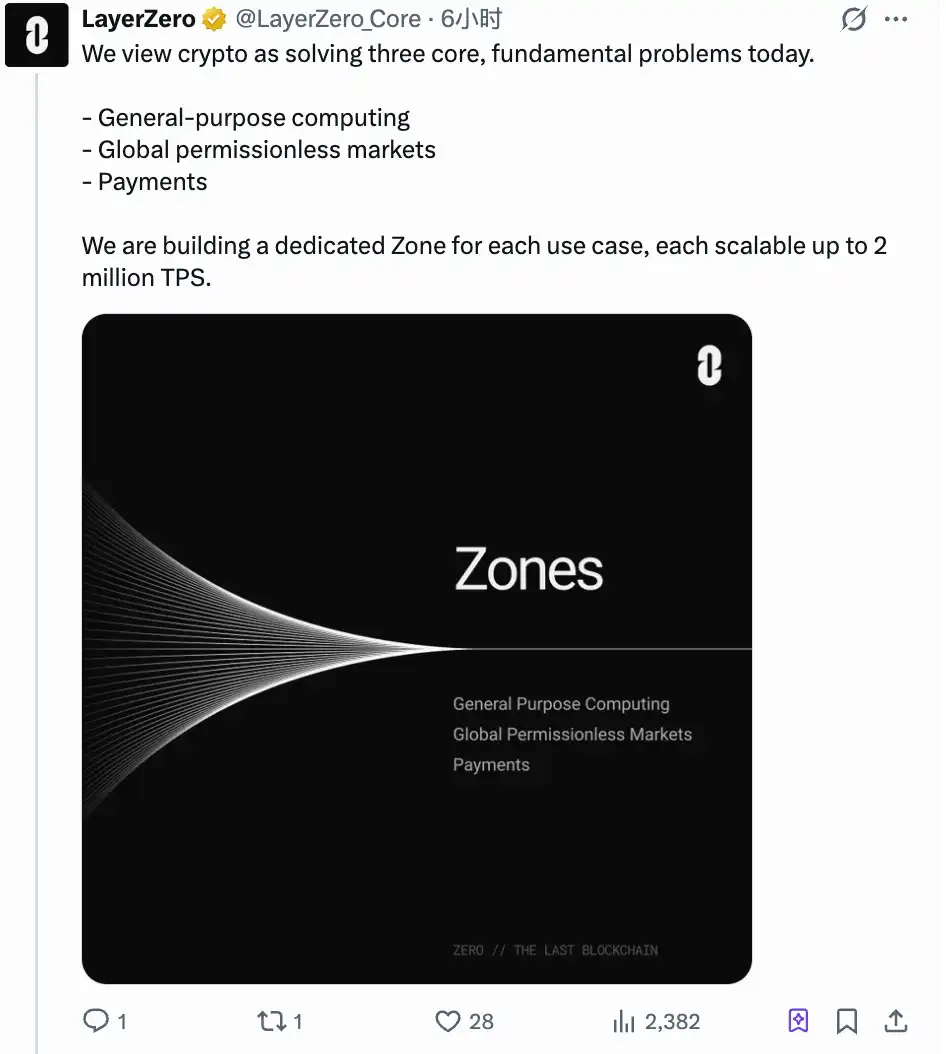
These three Zones target three types of customers.
The generic EVM environment retains existing crypto developers with low migration costs. The privacy payment solution addresses an age-old issue for institutions: when trading on Ethereum, counterparties can see your position and strategy, leading to large funds not wanting to swim naked.
The dedicated trading Zone aims more directly at resolving matching and settlement post-securities tokenization.
Looking back at the guest list, it's easy to understand. DTCC clears trillions of dollars in securities transactions annually and wants to know if clearing can be faster. ICE operates the NYSE, which only trades on weekdays; it wants to try 24/7 trading. Citadel handles massive order flow, and every step faster in the post-trade process is money.
So taken together, these are not needs of the crypto industry, but rather Wall Street's own pain points.
CEO of LayerZero, Bryan Pellegrino, put it bluntly in a public interview:
"It's not that existing things are not good enough; it's that there are truly scenarios that need 2 million transactions per second, belonging to the future global economy."
By the way, this new chain called Zero claims to achieve 2 million TPS in a test environment, which can indeed meet the needs of traditional financial production-grade. But the performance narrative of public chains has long been played out; how high the performance is, in fact, the author finds it not surprising.
The story can remain the same, but the audience for the story can change, and this time it's the old money's turn.
Wall Street Wants to Move Trades onto Chain, but Ethereum Can't Keep Up
The institutional rush into LayerZero is not due to a crypto bull market, but rather Wall Street itself promoting tokenization.
BlackRock's BUIDL Fund issued on Ethereum last year, with a scale exceeding $5 billion. JPMorgan's Onyx platform runs on Ethereum technology and has already processed trillion-dollar scale repo transactions.
Wall Street used Ethereum for a proof of concept, demonstrating the feasibility of tokenization. The next step is to find a place that can handle production loads.
Zero's three Zones are targeting this gap. EVM compatibility means that assets and contracts on Ethereum can be migrated over.
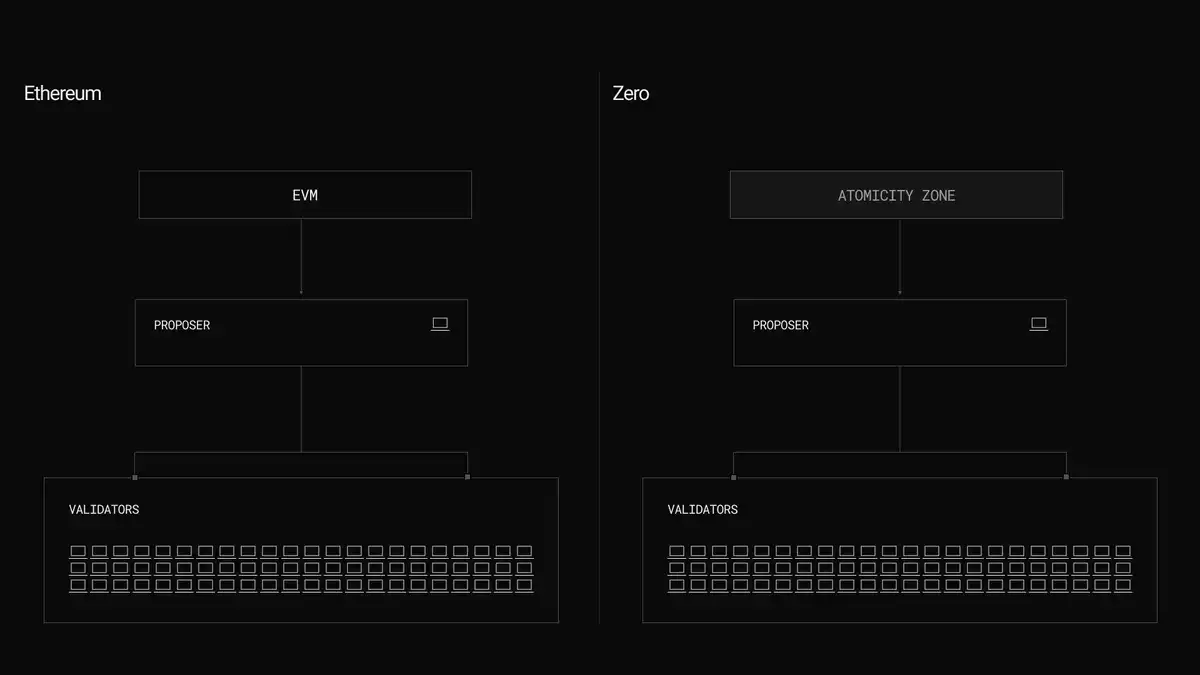
Perhaps this is the real divide between LayerZero and Ethereum.
Currently, Ethereum is using standards like ERC-8004 to stake out its definition rights, providing on-chain identity for AI agents, and establishing rules for the future on-chain economy...
LayerZero's current move is to build pipelines regardless of definition, telling institutions that their transactions can run here.
One is writing a rulebook, and the other is laying pipes. They are betting on different things.
Ethereum is betting on its irreplaceability as a trust layer, with TVL scale, security audit ecosystem, and institutional recognition as the foundation. LayerZero is betting on the substitution demand at the execution layer: Wall Street needs speed, privacy, and throughput, and whoever provides them first will be used.
Whether the two paths will eventually cross is unclear at this point. But the flow of capital has already provided a directional signal.
What Does $ZRO Mean?
The previous positioning of ZRO was simple: the governance token of the LayerZero cross-chain protocol. With a total supply of 1 billion, it was used for voting and staking, and that's about it.
After the release of Zero, the story of this token changed.
ZRO is the native token of the Zero chain, anchoring network governance and security. If Zero indeed becomes institutional-grade financial infrastructure, the valuation logic of ZRO will no longer be based on "how much transaction volume is on the cross-chain bridge" but rather on "how many assets are running on this chain."
There are two valuation anchors, as you all understand, with the ceiling differing by several orders of magnitude. But while the narrative is one thing, several hard variables will determine the future trend of ZRO.
Supply Side: Eighty percent of the tokens are still locked.
Currently, the circulating supply of ZRO is approximately 200 million tokens, accounting for just over 20% of the total supply. According to CoinGecko data, around 25.71 million ZRO will be unlocked on February 20, worth about $50 million, representing 2.6% of the total supply, and will be distributed to core contributors and strategic partners. The entire unlocking period will extend until 2027.
This unlocking on February 20 is the first supply shock after the release, and whether the market can absorb it will be a litmus test of short-term sentiment.
Demand Side: The fee switch has not been turned on yet.
Currently, ZRO does not have a direct value capture mechanism. In December of last year, there was a governance vote proposing a fee on each cross-chain message, with the income used for ZRO buyback and burn, but it did not pass due to insufficient voter turnout. The next vote is scheduled for June this year.
If passed, ZRO will have a burning mechanism similar to ETH, reducing the circulating supply with each transaction. If it fails again, the token's "governance right" will only be a voting right without cash flow support.
So overall, players interested in ZRO may want to keep an eye on three key points:
1. In June, the second vote on fees. Approval will directly determine whether ZRO has inherent demand.
2. In the fall of this year, the Zero mainnet launch.
3. It will not be until 2027 that the ZRO token is fully unlocked. Until then, each unlocking phase is seen as pressure, compounded by the current bear market in the crypto space, where positive news may not necessarily drive ZRO's price.
Lastly, LayerZero refers to Zero as the "decentralized multicore world computer," clearly a concept aiming to benchmark against Ethereum's world computer, seeking to play a more significant role in the settlement layer, especially in financial settlement, while transitioning away from and cutting across the thin narrative of cross-chain bridges.
However, the official statements from several partners are intriguing.
Citadel refers to its involvement as "evaluating how the architecture can support high-throughput workflows"; DTCC mentions "exploring scalability in tokenization and collateralization aspects."
In translation, it means we think this thing might be useful, but we haven't sealed the deal yet.
Wall Street money is smart, so smart that they will place many small bets at the same time to see which one takes off first. Therefore, when a project attracts various star institutions, it does not necessarily imply a full commitment but rather acts more as a short-term bullish catalyst.
What LayerZero has received may be a ticket to enter, or it may just be an interview opportunity.
You may also like

Potential Bitcoin Crash Below $60K May Delay Recovery to 2027
Key Takeaways: Bitcoin’s deep drawdown phase may extend recovery to the second quarter of 2027. Historical data shows…

BTC USD Price Drops Below $67K Amid Rising Treasury Yields
Key Takeaways: BTC USD slumped to $66,300, its first drop below $67K since March 9, driven by macroeconomic…

Second Bill Targets Insider Trading in Prediction Markets
Key Takeaways: The Public Integrity in Financial Prediction Markets Act of 2026 prohibits government officials from using insider…

India Apprehends Key Figure in Myanmar Crypto Fraud Complex
Key Takeaways: India’s Central Bureau of Investigation (CBI) arrested a key player in a scam that trafficked Indian…

Bitcoin and Profit Metrics: Will History Repeat Itself?
Key Takeaways: Historical patterns reveal that when Bitcoin’s supply in profit falls below 50%, significant price rallies ensue.…

Bitcoin ‘Compression’ Outcome Could Propel BTC Towards $80K: An Analyst’s Perspective
Key Takeaways: Bitcoin’s price is testing a critical $71,500 level, hinting at a possible rally to $80,000. Traders…
Data Points to Accelerating Ether Supply Crunch: Will ETH Price Follow?
Key Takeaways: As of now, 33.1% of Ethereum’s circulating supply is staked, resulting in a tighter liquid supply.…

XRP Risk-Reward Improves as Whale Accumulation Surges: Will the Price Mirror This Trend?
Key Takeaways: XRP’s Sharpe Ratio turned positive on March 26, 2026, indicating a potential for returns outweighing associated…

Cryptocurrency Price Predictions for March 27: BTC, ETH, BNB, XRP, SOL, DOGE, HYPE, ADA, BCH, and LINK
Key Takeaways: Bitcoin is struggling to maintain its position above the $66,000 threshold, amplifying concerns of a further…
Bitcoin ETFs Face Capital Outflow as Market Treads with Caution
Key Takeaways: Bitcoin ETFs experienced a $296 million outflow, ending a four-week inflow run. Total net assets for…

Crypto Market Predictions: BTC, ETH, BNB, XRP, SOL, DOGE, HYPE, ADA, BCH, LINK
Key Takeaways: Bitcoin struggles at the $72,000 level as bulls aim for $80,000, while resistance remains strong. Ethereum…

Bitcoin Returns to $71K as Oil Prices Plummet with Trump Halting Iran Strikes
Key Takeaways: Bitcoin rallies 5% to surpass $71,000 following Trump’s delay of US military action against Iran. Liquidations…

Ether Taker Volume Reaches Three-Year Peak: Can ETH Sidestep a 19% Price Drop?
Key Takeaways: An Ether on-chain indicator has surged to its highest in over three years, signaling potential stabilization…

Bitcoin Spot Volumes Reach 2023 Lows While BTC Rallies Stay News-Driven
Key Takeaways: Bitcoin’s price surged to $71,600 during a US market open, but the rise lacked consistent spot…
Unifying Ethereum: Tackling Fragmentation and Embracing Onchain Trading
Key Takeaways: Ethereum developers propose a groundbreaking ‘Economic Zone’ to address fragmentation in layer-2 networks. Onchain commodity trading…
Lummis Affirms CLARITY Act as DeFi’s Strongest Shield Yet
Key Takeaways: The CLARITY Act is touted by Senator Cynthia Lummis as providing unparalleled protections for DeFi developers.…
US Probes Bitmain over Security Concerns Amidst Crypto Mining Dominance
Key Takeaways: US authorities have initiated “Operation Red Sunset” to investigate potential security threats posed by Bitmain’s Chinese-manufactured…

Google and Banks Rally Behind $5 Billion Texas Data Center for Anthropic
Key Takeaways: Google has partnered with a consortium of banks to finance a $5 billion data center in…
Potential Bitcoin Crash Below $60K May Delay Recovery to 2027
Key Takeaways: Bitcoin’s deep drawdown phase may extend recovery to the second quarter of 2027. Historical data shows…
BTC USD Price Drops Below $67K Amid Rising Treasury Yields
Key Takeaways: BTC USD slumped to $66,300, its first drop below $67K since March 9, driven by macroeconomic…
Second Bill Targets Insider Trading in Prediction Markets
Key Takeaways: The Public Integrity in Financial Prediction Markets Act of 2026 prohibits government officials from using insider…
India Apprehends Key Figure in Myanmar Crypto Fraud Complex
Key Takeaways: India’s Central Bureau of Investigation (CBI) arrested a key player in a scam that trafficked Indian…
Bitcoin and Profit Metrics: Will History Repeat Itself?
Key Takeaways: Historical patterns reveal that when Bitcoin’s supply in profit falls below 50%, significant price rallies ensue.…
Bitcoin ‘Compression’ Outcome Could Propel BTC Towards $80K: An Analyst’s Perspective
Key Takeaways: Bitcoin’s price is testing a critical $71,500 level, hinting at a possible rally to $80,000. Traders…


 App
App