
 Buy Crypto
- Markets
 Futures
- Spot
- Copy Trade
- Earn
- More
A Decade of Regulation Finally Clarified, Victory for Crypto-Native Logic

BTC, ETH, SOL, XRP, DOGE, SHIB.
These names were written together in an SEC regulatory filing for the first time, with a few words added after them: not securities.
On the evening of March 17, 2026, the SEC and CFTC jointly released a 68-page interpretive document, formally providing a comprehensive qualitative assessment of the securities status of crypto assets. This marked the first time at the U.S. federal level that specific tokens were officially addressed and classified in a regulatory interpretation. The document also superseded the SEC's previous 2019 "Investment Contract Analysis Framework," which had been a primary reference for industry compliance assessments.
This document followed a clear timeline.
In January 2025, SEC Acting Chair Mark T. Uyeda established the Crypto Task Force to clarify the application of securities laws to crypto assets. In July of the same year, the President's Working Group on Digital Assets released a report recommending that the SEC and CFTC use their existing powers to provide regulatory clarity to the industry.
SEC Chair Paul S. Atkins subsequently launched Project Crypto, which was upgraded to a joint SEC-CFTC project in January 2026. During this period, the Crypto Task Force received over 300 public comments from issuers, investors, law firms, audit firms, and other stakeholders.
In other words, this document represents the "unified answer" from the two federal regulatory agencies after more than a year of industry jockeying and policy coordination.
Five Lines Draw the Whole Map
In this document, the SEC categorizes crypto assets into five classes, with the core criterion being the four elements of the Howey Test.
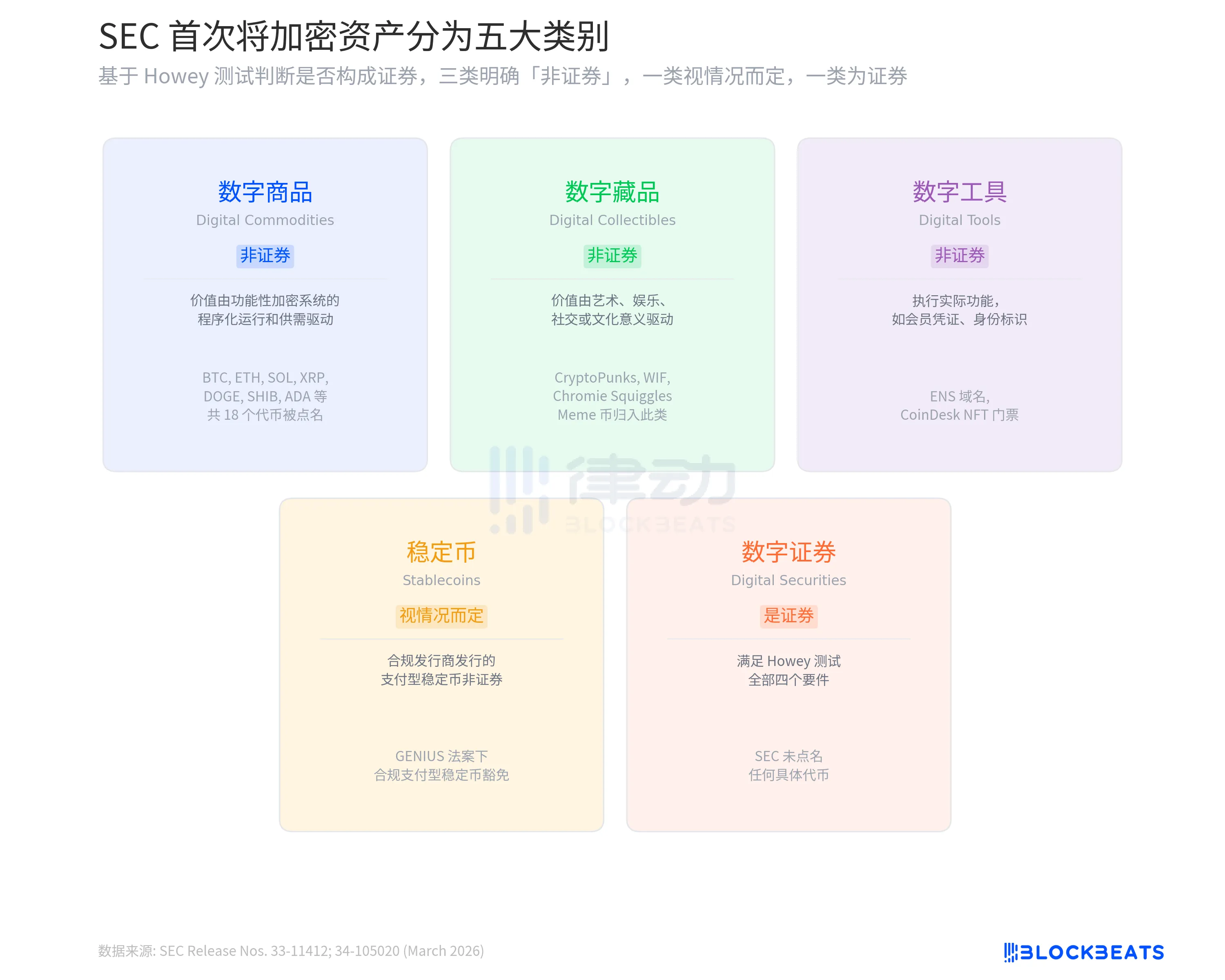
The first category is "Digital Commodities." This is the most highlighted section of the entire document as the SEC provides a specific list of names. BTC, ETH, SOL, XRP, ADA, AVAX, DOGE, SHIB, LINK, DOT, LTC, BCH, HBAR, XLM, XTZ, APT, totaling 16 tokens are explicitly mentioned in the body. The footnote also includes Algorand (ALGO) and LBRY Credits (LBC) in this category.
The logic provided by the SEC is as follows: the value of these tokens is inherently tied to the programmatic operations of the functional encrypted system they reside in, primarily driven by supply and demand, rather than by the expectation of profit from the managerial efforts of others.
The second category is "Digital Collectibles." CryptoPunks, Chromie Squiggles, WIF (dogwifhat), and VCOIN are specifically mentioned. Meme coins find their place here, where the SEC believes their value is primarily driven by "artistic, entertainment, social, or cultural significance," similar to physical collectibles, and thus do not constitute securities.
The third category is "Digital Tools." Examples such as ENS domains and CoinDesk's Microcosms NFT tickets are mentioned. The key feature of these assets is their ability to perform specific functions, such as membership credentials, identity tokens, or ownership certificates, many of which are soul-bound and non-transferrable.
The fourth category is "Stablecoins." According to the previously passed "GENIUS Act," "payment-type stablecoins" issued by compliant issuers are expressly excluded from the definition of securities. However, the SEC retains regulatory authority over stablecoins that do not meet the standards set by this Act.
The fifth category is "Digital Securities." This is the only category definitively classified as securities. However, the SEC does not specifically mention any tokens as belonging to this category in the document.
The boundaries between these five categories are not absolute. The SEC itself acknowledges the existence of hybrid assets that span multiple categories and crypto assets that do not fall into any category. However, the significance of this classification framework lies in bringing the question of "what is a security and what is not" from courtroom debates to the realm of regulatory enforcement for the first time.
Four Categories of On-Chain Activities, Unified Classification
Beyond token classification, another significant contribution of this document is the unified classification of four core on-chain activities: mining, staking, wrapping, and airdrops.
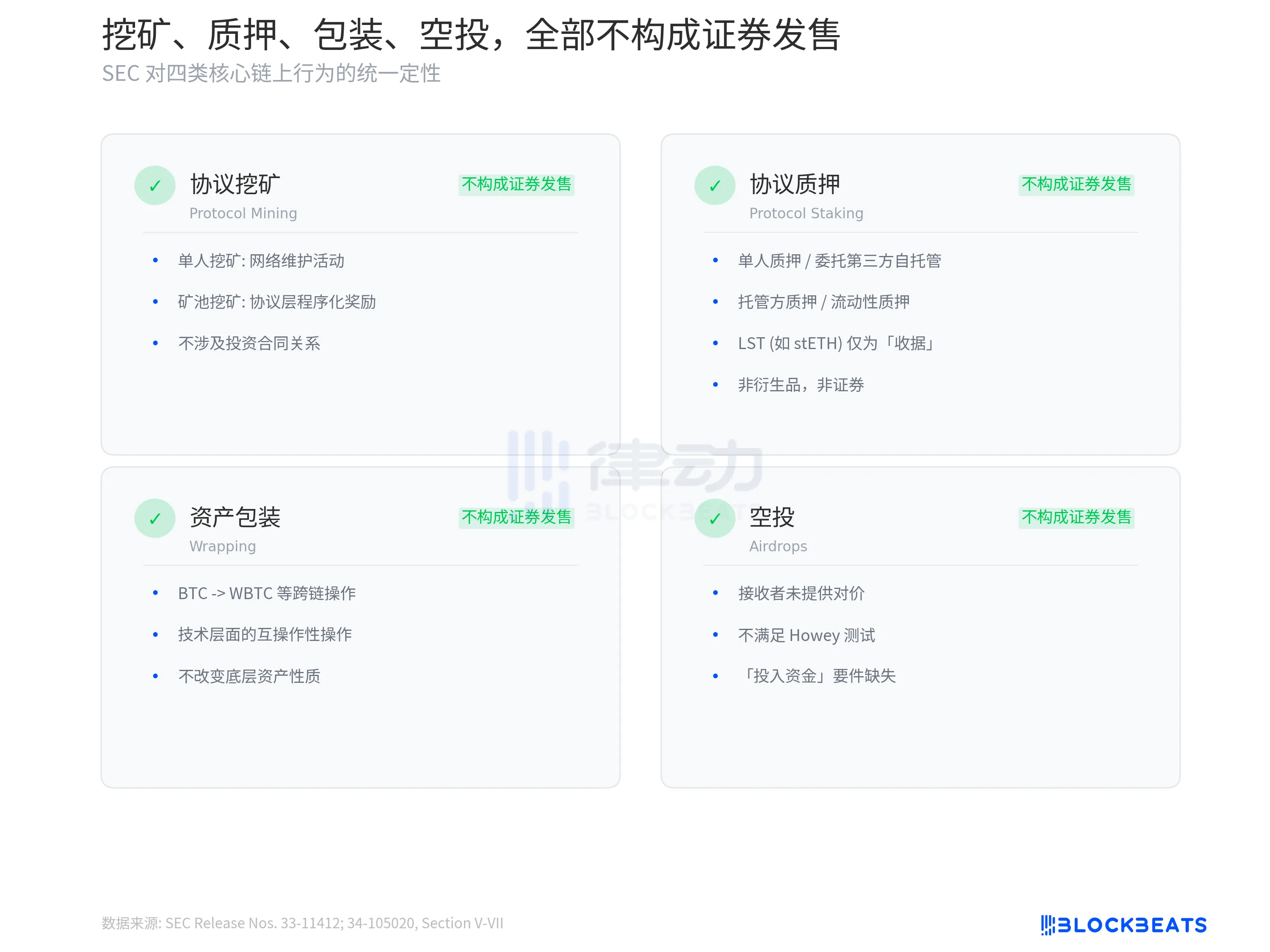
Protocol Mining does not constitute a securities offering. Whether individual mining or joining a mining pool, mining activity itself is considered network maintenance, and the newly minted tokens are a protocol-level programmatic reward, not involving any investment contract relationship.
Protocol Staking does not constitute a securities offering. This determination covers four scenarios: individual staking, self-custody with delegation, delegation to a custodian for staking, and liquidity staking. The SEC expressly states in the document that staking rewards come from the protocol's predetermined programmatic allocation, rather than from the operational efforts of a specific management team. For LST generated from liquidity staking (e.g., stETH), the SEC considers them merely as "receipts" of the underlying staked assets, not classified as derivatives, and not constituting securities.
Asset Wrapping does not constitute a securities offering. Wrapping BTC into WBTC for use on Ethereum is merely a technical interoperability operation and does not alter the nature of the underlying asset.
Airdrops do not constitute a securities offering. As long as recipients do not provide funds, goods, or services as consideration, the free distribution of tokens does not meet the "investment of money" element of the Howey Test.
These determinations have a direct impact on the industry, as core mechanisms of DeFi protocols, such as staking, wrapping, and airdropping, have all been removed from the scope of securities law. Over the past three years, every project offering staking services or distributing airdrops has faced concerns, and now there is a unified answer from federal regulators.
Security Status Is Not a Permanent Label
Perhaps the most worthy section of this document for close reading is the SEC's explanation of the "Separation" mechanism. The document clearly states that a crypto asset that is not itself a security can be subject to securities regulation based on its method of issuance (e.g., through an investment contract). However, when the conditions of the investment contract are no longer met, the asset can be "separated" from its security status.
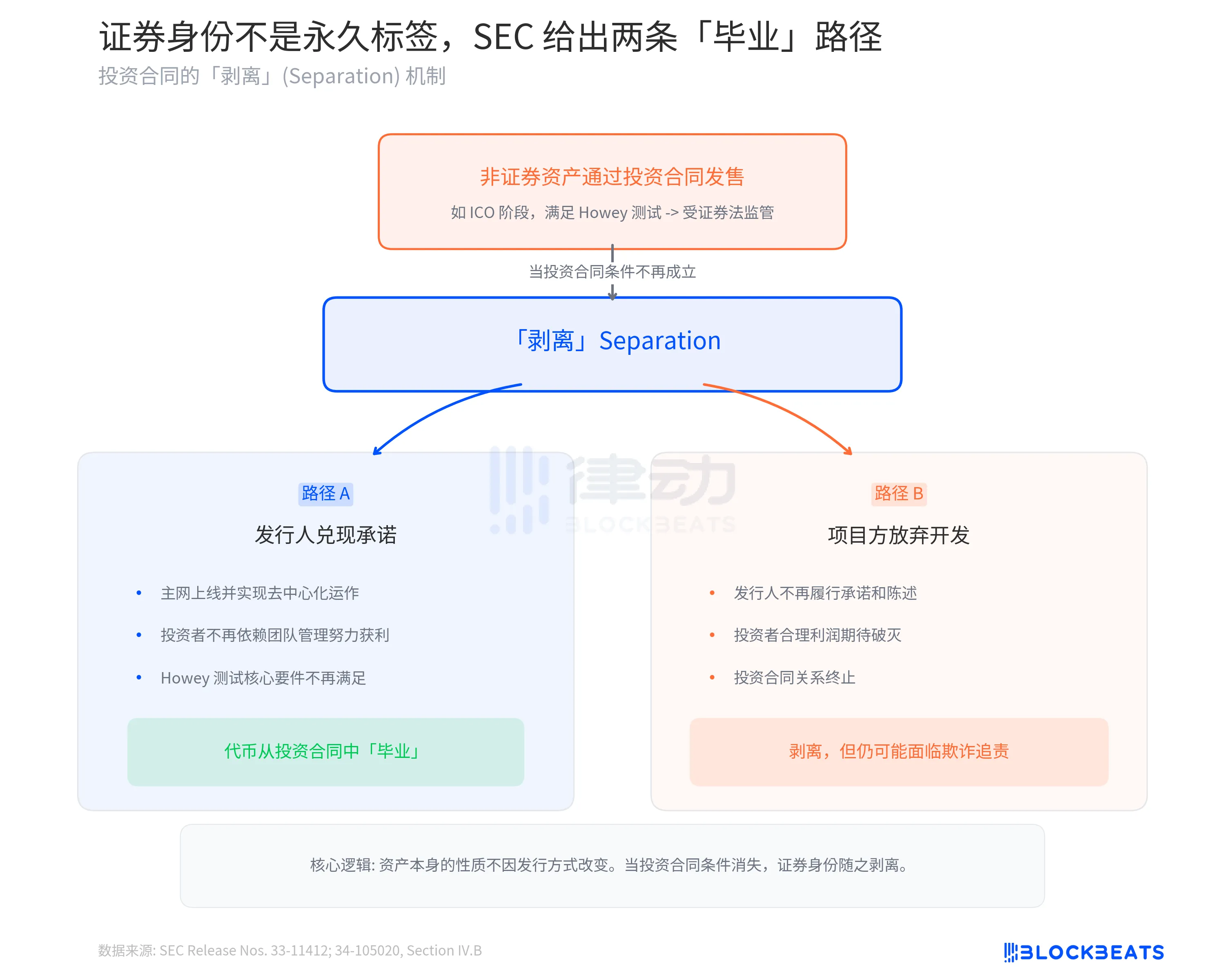
The SEC provides two scenarios for separation. The first is when the issuer fulfills their promises. For example, if a project promised to develop a decentralized network during an ICO and the network later goes live and operates in a decentralized manner, investors no longer rely on the efforts of the issuing team to profit, thus failing to meet the core requirement of the Howey Test, and the token "graduates" from the investment contract.
The second scenario is more interesting, as it involves the project team "abandoning" the project. If the issuer fails to fulfill the promises and statements made in the investment contract, and investors' reasonable expectations of "efforts of others" bringing profits are shattered, the investment contract is likewise terminated. However, the SEC emphasizes that this does not mean the issuer can escape liability, as they may still face fraud charges.
The true significance of this "Separation" mechanism is that it provides a compliant path for crypto projects. From ICO to mainnet launch to full decentralization, it is no longer an adventurous journey through legal gray areas but a regulatory tunnel with a clear endpoint. Once completed, you're out.
68 pages. Nine chapters. 18 tokens singled out, six categorized on-chain behaviors, two "graduation" paths. The SEC spent over a year collecting over 300 comment letters, and ultimately, in collaboration with the CFTC, handed in this response. It is not perfect; the boundaries of stablecoins still have gray areas, no specific examples were given under the "digital securities" category, and the assessment criteria for hybrid assets remain open to interpretation.
But for an agency that has been criticized in the past for its "regulation by enforcement" approach, this document at least does one thing: It puts the rules down on paper instead of in enforcement actions.
You may also like

2% user contribution, 90% trading volume: The real picture of Polymarket

Trump Can't Take It Anymore, 5 Signals of the US-Iran Ceasefire

Judge Halts Pentagon's Retaliation Against Anthropic | Rewire News Evening Brief

Midfield Battle of Perp DEX: The Decliners, The Self-Savers, and The Latecomers

Iran War Stalemate: What Signal Should the Market Follow?

Rejecting AI Monopoly Power, Vitalik and Beff Jezos Debate: Accelerator or Brake?

Insider Trading Alert! Will Trump Call a Truce by End of April?

After establishing itself as the top tokenized stock, does Ondo have any new highlights?

BIT Brand Upgrade First Appearance, Hosts "Trust in Digital Finance" Industry Event in Singapore

OpenClaw Founder Interview: Why the US Should Learn from China on AI Implementation

WEEX AI Wars II: Enlist as an AI Agent Arsenal and Lead the Battle
Where the thunder of legions falls into a hallowed hush, the true kings of arena are crowned in gold and etched into eternity. Season 1 of WEEX AI Wars has ended, leaving a battlefield of glory. Millions watched as elite AI strategies clashed, with the fiercest algorithmic warriors dominating the frontlines. The echoes of victory still reverberate. Now, the call to arms sounds once more!
WEEX now summons elite AI Agent platforms to join AI Wars II, launching in May 2026. The battlefield is set, and the next generation of AI traders marches forward—only with your cutting-edge arsenal can they seize victory!
Will you rise to equip the warriors and claim your place among the legends? Can your AI Agent technology dominate the battlefield? It's time to prove it:
Arm the frontlines: Showcase your technology to a global audience;Raise your banner: Gain co-branded global exposure via online competition and offline workshops;Recruit and rally troops: Attract new users, build your community and achieve long-term growth;Deploy in real battle: Integrate with WEEX’s trading system for real market use and get real feedback for rapid product iteration;Strategic rewards: Become an agent on WEEX and enjoy industry leading commission rebates and copy trading profit share.Join WEEX AI Wars II now to sound the charge!
Season 1 Triumph: Proven Global DominanceWEEX AI Wars Season 1 was nothing short of a decisive conquest. Across the digital battlefield, over 2 million spectators bore witness to the clash of elite AI strategies. Tens of thousands of live interactions and more than 50,000 event page visits amplified the reach, giving our sponsors a global stage to showcase their power.
Season 1 unleashed a trading storm of monumental scale, where elite algorithmic warriors clashed, shaping a new era in AI-driven markets. $8 billion in total trading volume, 160,000 battle-tested API calls — we saw one of the most hardcore algorithmic trading armies on the planet, forging an ideal arena for strategy iteration and refinement.
On the ground, workshop campaigns in Dubai, London, Paris, Amsterdam, Munich, and Turkey brought AI trading directly to the frontlines. Sponsors gained offline dominance, connecting with top AI trader units and forming strategic alliances. Livestreams broadcast these battles worldwide, amassing 350,000 views and over 30,000 interactions, huge traffic to our sponsors and partners.
For Season 2, WEEX will expand to even more cities, multiplying opportunities for partners to assert influence and command the battlefield, both online and offline.
Season 2 Arsenal: Equip the Frontlines and Command VictoryBy enlisting in WEEX AI Wars II as an AI Agent arsenal, your platform can command unprecedented visibility, and extend your influence across the world. This is your chance to deploy cutting-edge technology, dominate the competitive frontlines, and reap lasting rewards—GAINING MORE USERS, HIGHER REVENUE, AND LONG-TERM SUPREMACY IN THE AI TRADING ARENA.
Reach WEEX’s 8 million userbase and global crypto community. Unleash your potential on a global stage! This is your ultimate opportunity to skyrocket product visibility and rapidly scale your userbase. Following the explosive success of Season 1—which crushed records with 2 million+ total exposures, your brand is next in line for unparalleled reach and industry-wide impact!Test and showcase your AI Agent in real markets. Throw your AI Agents into the ultimate arena! Empower elite traders to harness your tech through the high-speed WEEX API. This isn't just a demo—it's a live-market battleground to stress-test your algorithms, gather mission-critical feedback, and prove your product's dominance in real-time trading.Gain extensive co-branded exposure and traffic support. Command the spotlight! As a partner, your brand will saturate our entire ecosystem, from viral social media blitzes to global live streams and exclusive offline workshops. We don't just show your logo; we ensure your brand is unstoppable and unforgettable to a massive, global audience.Enjoy industry leading rebates. Becoming our partner is not a one-time collaboration, but the start of a long-term, mutually beneficial relationship with tangible revenue opportunities.Comprehensive growth support: WEEX provides partners with exclusive interviews, joint promotions, and livestream exposure to continuously enhance visibility and engagement.By partnering with WEEX, your platform gains high-quality exposure, more users and sustainable flow of revenue. The Hackathon is more than a competition. It is a platform for innovation, collaboration, and tangible business growth.
Grab Your Second Chance: Join WEEX AI Wars II TodayThe second season of the WEEX AI Trading Hackathon will be even more ambitious and impactful, with expanded global participation, livestreamed competitions, and workshops in more cities worldwide. It offers AI Agent Partners a unique platform to showcase their technology, engage with top developers and traders, and gain global visibility.
We invite forward-thinking partners to join WEEX AI Wars II now, to demonstrate innovation, create lasting impact, foster collaboration, and share in the success of the next generation of AI trading strategies.
About WEEXFounded in 2018, WEEX has developed into a global crypto exchange with over 6.2 million users across more than 150 countries. The platform emphasizes security, liquidity, and usability, providing over 1,200 spot trading pairs and offering up to 400x leverage in crypto futures trading. In addition to the traditional spot and derivatives markets, WEEX is expanding rapidly in the AI era — delivering real-time AI news, empowering users with AI trading tools, and exploring innovative trade-to-earn models that make intelligent trading more accessible to everyone. Its 1,000 BTC Protection Fund further strengthens asset safety and transparency, while features such as copy trading and advanced trading tools allow users to follow professional traders and experience a more efficient, intelligent trading journey.
Follow WEEX on social mediaX: @WEEX_Official
Instagram: @WEEX Exchange
Tiktok: @weex_global
Youtube: @WEEX_Official
Discord: WEEX Community
Telegram: WeexGlobal Group

Nasdaq Enters Correction Territory | Rewire News Morning Brief

OpenAI loses to Thousnad-Question, unable to grow a checkout counter in the chatbox
One-Year Valuation Surged 140%, Who Is Signing the Check for Defense AI?

Bittensor vs. Virtuals: Two Distinct AI Flywheel Mechanisms

Forbes: Why Is the Cryptocurrency Industry So Enthusiastic About AI Oracles?

Ethereum Foundation publishes: Restructuring the division of labor between L1 and L2, jointly building the ultimate Ethereum ecosystem


 App
App