
 Buy Crypto
- Markets
 Futures
- Spot
- Copy Trade
- Earn
- More
A single tweet caused a 17% crash in oil prices, who's not a Meme yet

In 1974, then U.S. Secretary of State Henry Kissinger flew to Riyadh and reached a deal with Saudi Arabia that would change the global landscape: Saudi agreed to sell oil exclusively in exchange for U.S. dollars, which would then be recycled to purchase U.S. Treasury bonds.
At that time, Nixon had just severed the link between the dollar and gold, the U.S. was facing runaway inflation, the dollar reserves were dwindling, gold was flowing out in massive quantities, and the Bretton Woods system collapsed. Many believed that the golden era of the dollar was over.
However, the deal Kissinger struck with Saudi Arabia established what would later be known as the "Petrodollar" system. It was this system that allowed the dollar to survive for half a century after the collapse of the gold standard.
It is also for this reason that whenever someone threatens to block the oil lanes, it is not just an energy issue for the U.S., but also an assault on the foundation of the entire dollar system. This is why the Strait of Hormuz, a narrow waterway like a throat, has always been seen by the U.S. as a key point that must be defended over the past fifty years, even if it means using military force if necessary.
Understanding this historical background, fifty years later, helps us better understand today's situation.
Early this morning, while most people in China were still asleep, a violent tremor lasting less than an hour had already wiped out billions of dollars in market value on the global crude oil futures market.
It all started with a social media post.
U.S. Energy Secretary Chris Wright posted on Platform X, saying, "The U.S. Navy has successfully escorted an oil tanker through the Strait of Hormuz to ensure the continued flow of oil to the global market."
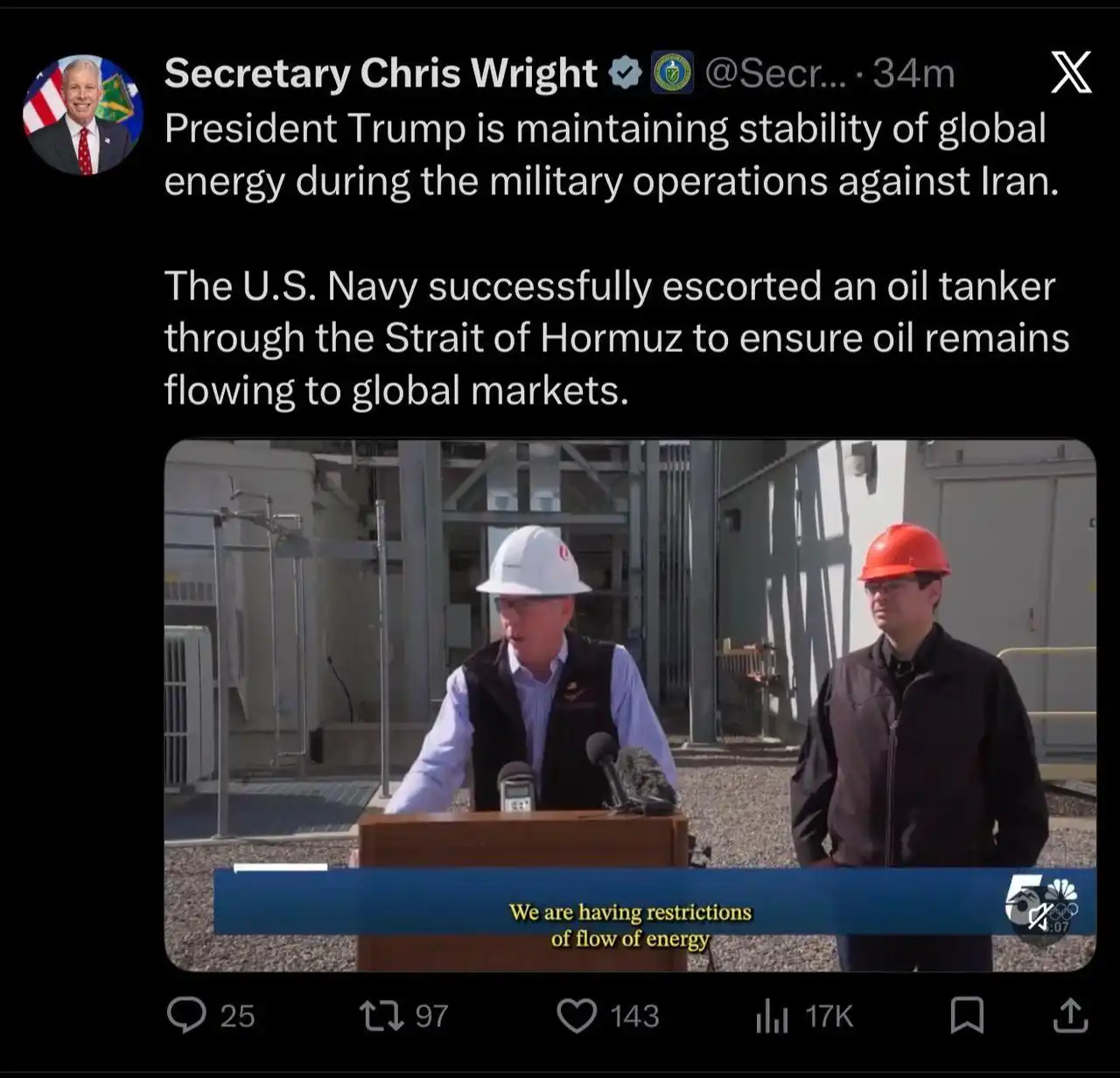
After this tweet, the WTI crude oil price plummeted in a few minutes, with a drop of up to 17%, briefly falling below $80 per barrel. In the previous weeks, due to the tense situation in the Middle East, Brent crude had just soared from $70 to $120.
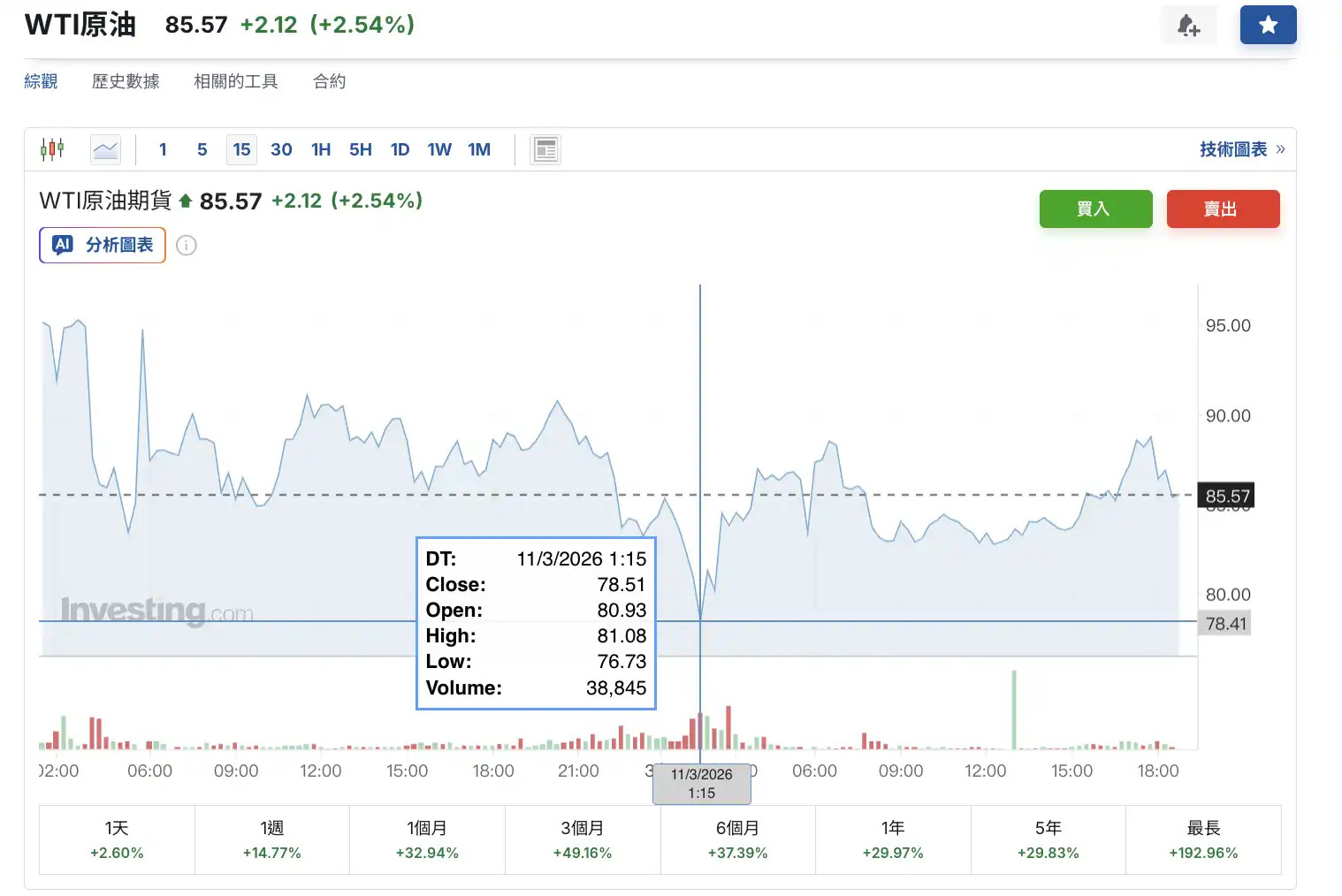
For those traders betting on further oil price increases, this moment was a nightmare.
However, the plot quickly reversed.
Less than an hour later, White House Press Secretary Karoline Leavitt urgently clarified during a press briefing: the U.S. Navy is currently not escorting any oil tankers. Subsequently, Energy Secretary Chris Wright quietly deleted the post without any explanation. The oil price then rebounded but could not return to its initial position.
A post, from publication to deletion, took less than sixty minutes. But the impact it left on the global financial market is far more than just that one hour.
Since the escalation of the US-Iran conflict at the end of February, the game around oil has continued to intensify. Especially after Iran announced the blockade of the Strait of Hormuz, this narrow waterway that handles about one-fifth of global oil transportation suddenly closed, causing a significant impact on the global energy market. As the situation escalated, international oil prices skyrocketed from $70 to $120 per barrel within a few days, putting the energy market in a highly tense state.
Almost all traders were waiting for the same signal: when will the Strait of Hormuz reopen? Under this collective anxiety, any slight movement could trigger drastic price swings. The rapid drop triggered by that post made by the Energy Minister was a concentrated reflection of this emotion.
So, why did oil prices plummet by 17% in just a few minutes? Because humans find it challenging to react that quickly, but algorithms can. In today's financial markets, a significant portion of trading volume comes from high-frequency trading algorithms and AI trading systems. They scan the entire internet in real time, including government officials' social media accounts, grab keywords, and automatically place orders.
There were three key words in that post: Navy, Escorted, Hormuz. The algorithm identified these words, then, combined with contextual semantics, quickly reached a conclusion: blockade lifted, supply restored, weakening the logic of price increase.
So the program immediately sold.
All of this happened in about 0.003 seconds.
Algorithms do not make calls to confirm if the oil tanker has indeed crossed the strait; they only recognize text, they only pursue speed. An unverified post, in this mechanistic "collective unconscious," was instantly converted into billions of dollars in market value evaporation.
A real oil tanker crossing the Hormuz Strait requires hours of sailing, actual military escort, fuel costs, and real-world risks. Whereas a post about "escort" took only 0.003 seconds to cause a significant price swing in this commodity.
In other words, crude oil, once dominated by supply and demand fundamentals, inventory data, and production agreements, has now, to some extent, become not much different from a meme.
During the last US election, Trump and Musk keenly grasped the sensitivity of it all. This is an information age, so one created Truth Social, while the other bought Twitter.
As the Information Age has progressed to this day, government officials' social media accounts have become one of the most sensitive sources of information in the market. This also means that power itself has begun to possess a certain Meme-like attribute: extremely fast propagation, high emotional intensity, and very prone to misinterpretation and amplification.
Traditional policy information dissemination is slow and rigorous. White House statements, State Department bulletins, Department of Defense press briefings, these mechanisms inherently involve verification, fact-checking, and layers of confirmation. However, when officials directly post policy-related information on X, these steps are skipped.
What we can foresee is that as we further enter the AI Agent era, both the capture of information and the speed of transactions will increase exponentially, with steep rises and falls occurring in milliseconds.
Viewed from a broader perspective, this may indicate a larger change: we are entering an era of "comprehensive asset Meme-ification." Almost any financial asset may, at some point, be driven by emotion, narrative, and social media.
Years ago, Kissinger used oil to extend the life of the dollar by fifty years. But he probably never imagined that one day oil itself would also become a kind of Meme.
No asset has an absolutely unbreakable fundamental moat. All moats are fundamentally based on some form of consensus. And under the dual acceleration of social media and algorithmic trading, this consensus is more fragile and dangerous than ever before.
Perhaps in some sense, this is also the triumph of the Meme.
You may also like

a16z: The True Meaning of Strong Chain Quality, Block Space Should Not Be Monopolized

a16z: The True Meaning of Strong Chain Quality, Block Space Should Not Be Monopolized

2% user contribution, 90% trading volume: The real picture of Polymarket

Trump Can't Take It Anymore, 5 Signals of the US-Iran Ceasefire

Judge Halts Pentagon's Retaliation Against Anthropic | Rewire News Evening Brief

Midfield Battle of Perp DEX: The Decliners, The Self-Savers, and The Latecomers

Iran War Stalemate: What Signal Should the Market Follow?
Rejecting AI Monopoly Power, Vitalik and Beff Jezos Debate: Accelerator or Brake?

Insider Trading Alert! Will Trump Call a Truce by End of April?

After establishing itself as the top tokenized stock, does Ondo have any new highlights?

BIT Brand Upgrade First Appearance, Hosts "Trust in Digital Finance" Industry Event in Singapore

OpenClaw Founder Interview: Why the US Should Learn from China on AI Implementation
WEEX AI Wars II: Enlist as an AI Agent Arsenal and Lead the Battle
Where the thunder of legions falls into a hallowed hush, the true kings of arena are crowned in gold and etched into eternity. Season 1 of WEEX AI Wars has ended, leaving a battlefield of glory. Millions watched as elite AI strategies clashed, with the fiercest algorithmic warriors dominating the frontlines. The echoes of victory still reverberate. Now, the call to arms sounds once more!
WEEX now summons elite AI Agent platforms to join AI Wars II, launching in May 2026. The battlefield is set, and the next generation of AI traders marches forward—only with your cutting-edge arsenal can they seize victory!
Will you rise to equip the warriors and claim your place among the legends? Can your AI Agent technology dominate the battlefield? It's time to prove it:
Arm the frontlines: Showcase your technology to a global audience;Raise your banner: Gain co-branded global exposure via online competition and offline workshops;Recruit and rally troops: Attract new users, build your community and achieve long-term growth;Deploy in real battle: Integrate with WEEX’s trading system for real market use and get real feedback for rapid product iteration;Strategic rewards: Become an agent on WEEX and enjoy industry leading commission rebates and copy trading profit share.Join WEEX AI Wars II now to sound the charge!
Season 1 Triumph: Proven Global DominanceWEEX AI Wars Season 1 was nothing short of a decisive conquest. Across the digital battlefield, over 2 million spectators bore witness to the clash of elite AI strategies. Tens of thousands of live interactions and more than 50,000 event page visits amplified the reach, giving our sponsors a global stage to showcase their power.
Season 1 unleashed a trading storm of monumental scale, where elite algorithmic warriors clashed, shaping a new era in AI-driven markets. $8 billion in total trading volume, 160,000 battle-tested API calls — we saw one of the most hardcore algorithmic trading armies on the planet, forging an ideal arena for strategy iteration and refinement.
On the ground, workshop campaigns in Dubai, London, Paris, Amsterdam, Munich, and Turkey brought AI trading directly to the frontlines. Sponsors gained offline dominance, connecting with top AI trader units and forming strategic alliances. Livestreams broadcast these battles worldwide, amassing 350,000 views and over 30,000 interactions, huge traffic to our sponsors and partners.
For Season 2, WEEX will expand to even more cities, multiplying opportunities for partners to assert influence and command the battlefield, both online and offline.
Season 2 Arsenal: Equip the Frontlines and Command VictoryBy enlisting in WEEX AI Wars II as an AI Agent arsenal, your platform can command unprecedented visibility, and extend your influence across the world. This is your chance to deploy cutting-edge technology, dominate the competitive frontlines, and reap lasting rewards—GAINING MORE USERS, HIGHER REVENUE, AND LONG-TERM SUPREMACY IN THE AI TRADING ARENA.
Reach WEEX’s 8 million userbase and global crypto community. Unleash your potential on a global stage! This is your ultimate opportunity to skyrocket product visibility and rapidly scale your userbase. Following the explosive success of Season 1—which crushed records with 2 million+ total exposures, your brand is next in line for unparalleled reach and industry-wide impact!Test and showcase your AI Agent in real markets. Throw your AI Agents into the ultimate arena! Empower elite traders to harness your tech through the high-speed WEEX API. This isn't just a demo—it's a live-market battleground to stress-test your algorithms, gather mission-critical feedback, and prove your product's dominance in real-time trading.Gain extensive co-branded exposure and traffic support. Command the spotlight! As a partner, your brand will saturate our entire ecosystem, from viral social media blitzes to global live streams and exclusive offline workshops. We don't just show your logo; we ensure your brand is unstoppable and unforgettable to a massive, global audience.Enjoy industry leading rebates. Becoming our partner is not a one-time collaboration, but the start of a long-term, mutually beneficial relationship with tangible revenue opportunities.Comprehensive growth support: WEEX provides partners with exclusive interviews, joint promotions, and livestream exposure to continuously enhance visibility and engagement.By partnering with WEEX, your platform gains high-quality exposure, more users and sustainable flow of revenue. The Hackathon is more than a competition. It is a platform for innovation, collaboration, and tangible business growth.
Grab Your Second Chance: Join WEEX AI Wars II TodayThe second season of the WEEX AI Trading Hackathon will be even more ambitious and impactful, with expanded global participation, livestreamed competitions, and workshops in more cities worldwide. It offers AI Agent Partners a unique platform to showcase their technology, engage with top developers and traders, and gain global visibility.
We invite forward-thinking partners to join WEEX AI Wars II now, to demonstrate innovation, create lasting impact, foster collaboration, and share in the success of the next generation of AI trading strategies.
About WEEXFounded in 2018, WEEX has developed into a global crypto exchange with over 6.2 million users across more than 150 countries. The platform emphasizes security, liquidity, and usability, providing over 1,200 spot trading pairs and offering up to 400x leverage in crypto futures trading. In addition to the traditional spot and derivatives markets, WEEX is expanding rapidly in the AI era — delivering real-time AI news, empowering users with AI trading tools, and exploring innovative trade-to-earn models that make intelligent trading more accessible to everyone. Its 1,000 BTC Protection Fund further strengthens asset safety and transparency, while features such as copy trading and advanced trading tools allow users to follow professional traders and experience a more efficient, intelligent trading journey.
Follow WEEX on social mediaX: @WEEX_Official
Instagram: @WEEX Exchange
Tiktok: @weex_global
Youtube: @WEEX_Official
Discord: WEEX Community
Telegram: WeexGlobal Group

Nasdaq Enters Correction Territory | Rewire News Morning Brief

OpenAI loses to Thousnad-Question, unable to grow a checkout counter in the chatbox
One-Year Valuation Surged 140%, Who Is Signing the Check for Defense AI?

Bittensor vs. Virtuals: Two Distinct AI Flywheel Mechanisms



 App
App