
 Buy Crypto
- Markets
 Futures
- Spot
- Copy Trade
- Earn
- More
After a 48-hour ban, Claude reached the top of the App Store

On Saturday morning, Ultraman retweeted a screenshot of an internal memo on X.
The memo was one he had written to OpenAI employees on Thursday night, stating that the company was in talks with the Pentagon, and he hoped to help "de-escalate the situation." He retweeted the memo with a few lines of commentary, essentially wanting to publicly explain what had been happening these past few days.
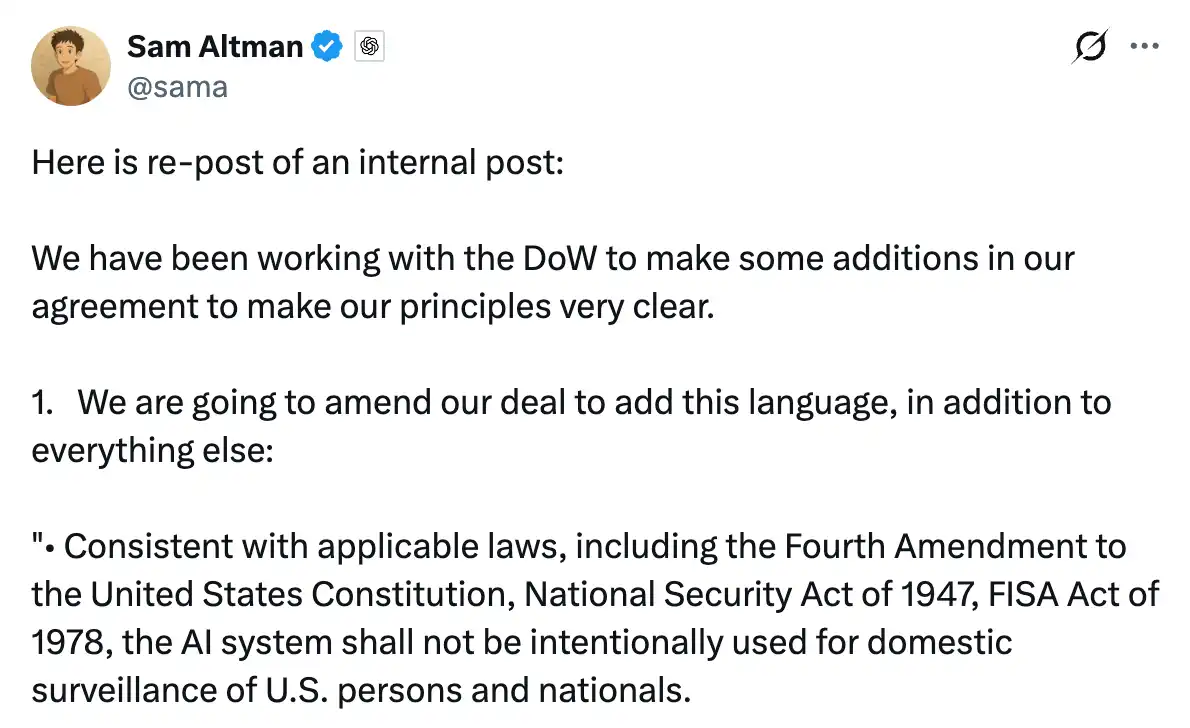
At the time of his tweet, Claude had already climbed to the number one spot on the U.S. App Store's free chart. Just the day before, ChatGPT was still sitting in that position.
Sensor Tower's data captured what unfolded in the hours that followed: on that Saturday alone, ChatGPT's uninstall rate in the U.S. surged by 295% compared to typical days, 1-star reviews skyrocketed by 775%. Meanwhile, Claude's daily downloads rose by 51%. A wave of "Cancel ChatGPT" posts emerged on Reddit, users shared screenshots of their unsubscriptions, with some writing "fastest install of my life" in the comments. A website called QuitGPT.org went live, claiming that 1.5 million people had taken action.
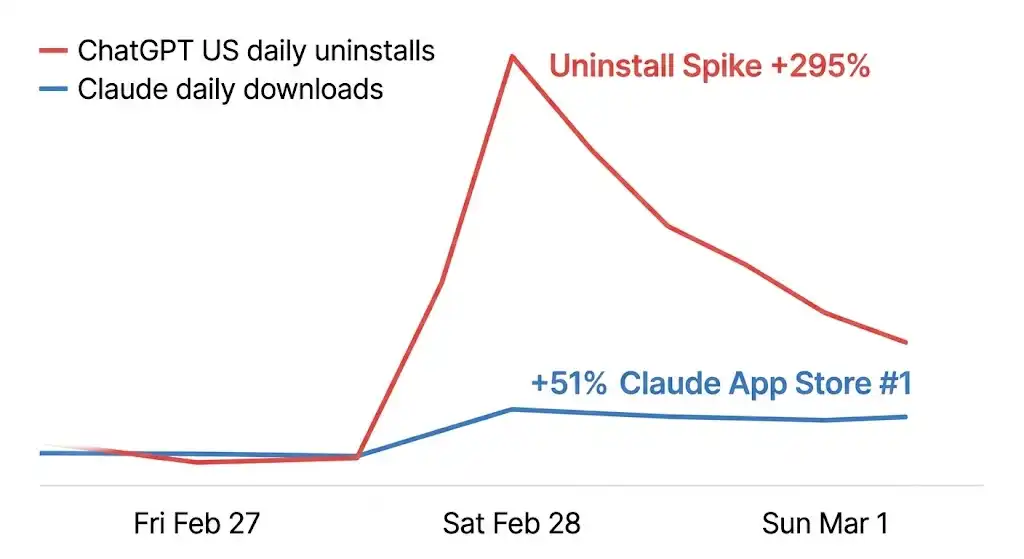
On Monday, the influx of users was so high that Claude experienced a massive outage. The company flagged as a "supply chain security risk" faced server overload due to the overwhelming number of users.
Precision Product Counterattack
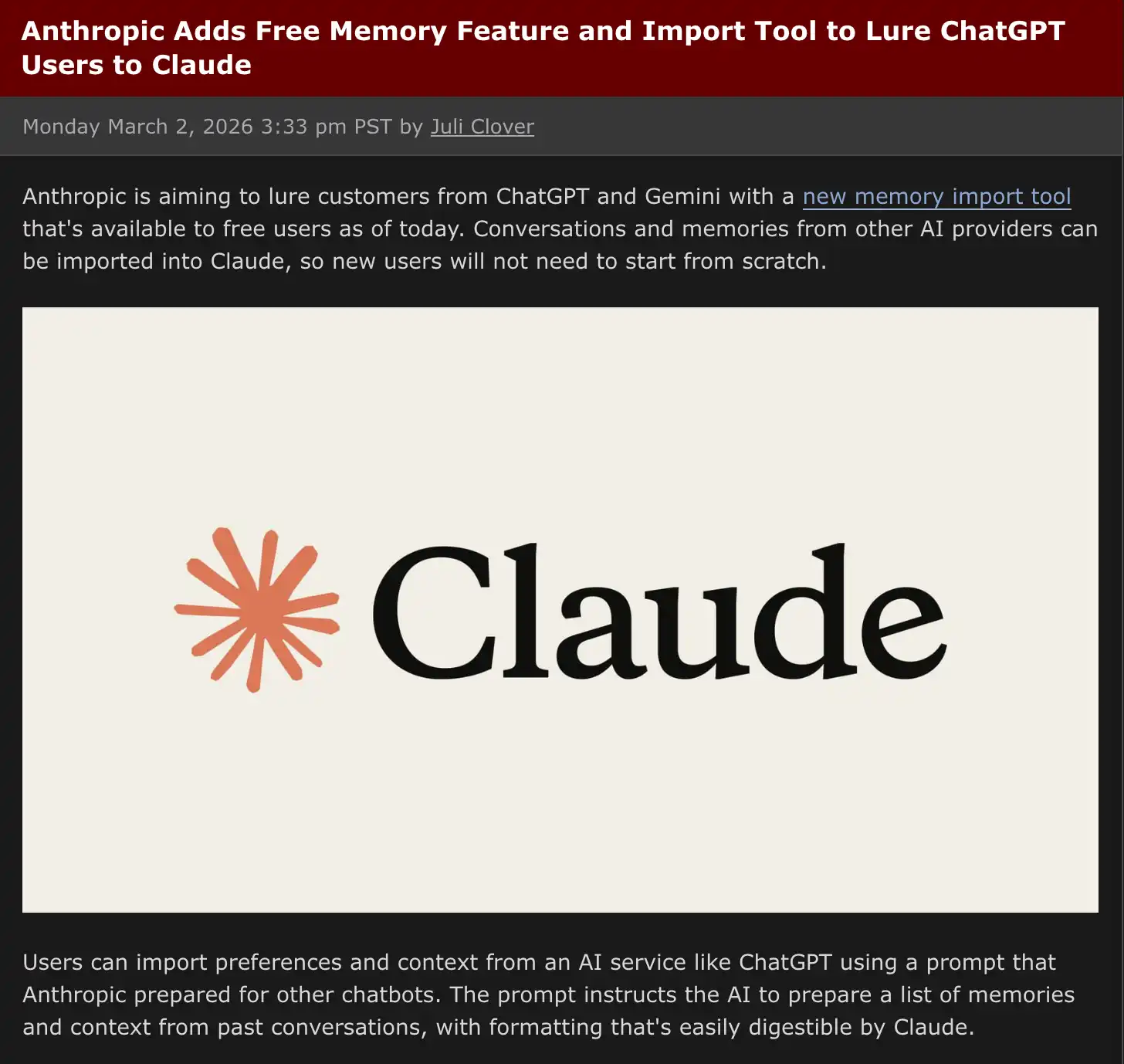
On the same day the uninstall wave was brewing, Anthropic launched a memory migration tool.
The functionality itself wasn't complex. Users would copy a prompt into ChatGPT to have it output all stored memories and preferences, then paste it into Claude, allowing Claude to seamlessly continue from where you left off on ChatGPT. The official website slogan was just one line: "switch to Claude without starting over."
The timing of this tool was its most critical attribute.
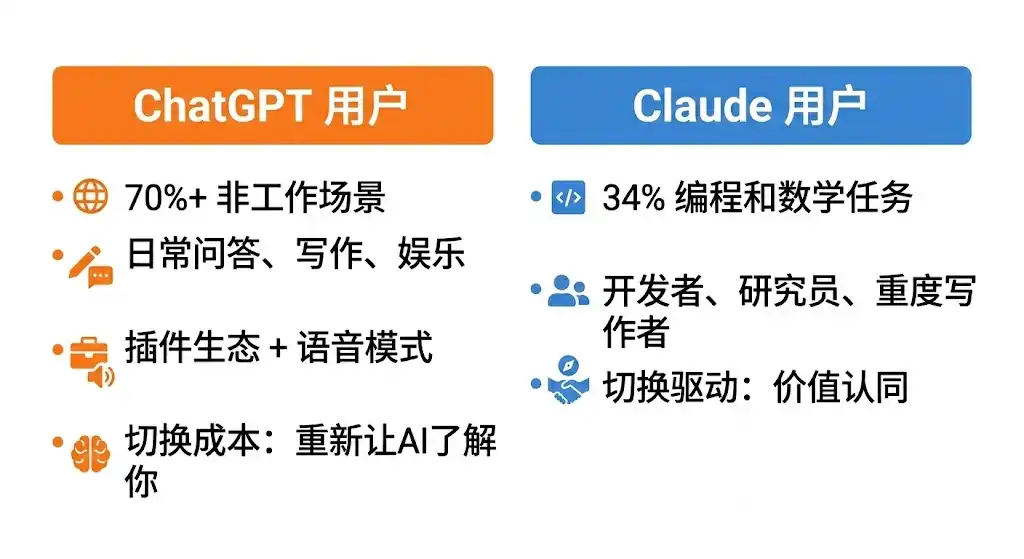
OpenAI's own data showed that by mid-2025, over 70% of ChatGPT users' use cases were non-work-related, encompassing daily Q&A, writing, entertainment, and information retrieval. It was many people's first encounter with AI, relying on a vast plugin ecosystem, Voice Mode, and deep integration with third-party apps embedded in daily life. The switching cost for these users was not just "downloading a new app," but rather reintroducing an AI that didn't know you and starting from scratch. The accumulation of memories was the most compelling reason to stay.
Anthropic's own research data shows that Claude's usage is highly concentrated. Programming and mathematical tasks account for 34%, the single largest category, while education and research have been the fastest-growing areas in the past year. The core users are developers, researchers, and heavy writers, who are more rational and more likely to switch tools based on a clear value judgment, as long as the migration cost is low enough.
The memory migration tool has minimized this cost. At the same time, Anthropic announced that the memory feature will be fully open to free users, a feature that was previously exclusive to paid users.
However, a significant portion of these incoming users are not the original target users of Claude.
From the feedback on social media, a large number of regular users migrating from ChatGPT often have a first-time reaction to Claude: "It's different." Some feel that Claude's responses are deeper and push back proactively rather than just agreeing. Some find it cleaner in writing but lacking in image generation, and it does not have an interactive experience like Voice Mode.
Some initially wanted to find a "more obedient ChatGPT alternative" but discovered that Claude has a stronger personality, requiring time to adapt. A migration guide from TechRadar has been widely shared these days, titled "I Wish Someone Told Me These Things," with the core message of the article being that the usage logic of Claude and ChatGPT is fundamentally different: the former is more like an opinionated work partner, while the latter is more like a general-purpose assistant.
This difference was originally the positioning of the two products, but it was inadvertently magnified by this event. Users rushed into Claude due to ethical considerations, only to discover a product that was different from their expectations, a more discerning, more boundary-aware AI. This difference could have been a reason for churn, but at this particular juncture, it has become a reason to stay: if you believe in a company's stance, you are more likely to accept the logic of its product.
Days after the launch, Anthropic released data: active free users grew by over 60% compared to January, and daily new registrations quadrupled. Claude briefly crashed due to excessive traffic, with thousands of users reporting login issues, which were resolved within hours.
The Three Words in the Contract: What OpenAI Said and Did
Anthropic is the first company to deploy AI models to a classified U.S. military network, a partnership completed through Palantir, with a contract value of approximately $200 million. However, over the past few months, the relationship between the two parties has continued to deteriorate. The core of the dispute is a clause: the Pentagon requires the AI model to be open for "all lawful purposes" without any conditions. Anthropic insists on including two exceptions in the contract: it cannot be used for mass surveillance of U.S. citizens and cannot be used for fully autonomous weapon systems.
Around February 20, it was reported that an Anthropic executive questioned Palantir about Claude's usage during the January US military operation to capture Venezuelan President Maduro. The military was strongly displeased. On Thursday, the Pentagon issued an ultimatum, demanding a response from Dario Amodei by 5 p.m. that day.
Amodei made a statement before the deadline, stating that the company could not accept the current terms, "not because we are against military use, but because in rare cases, we believe AI could undermine rather than uphold democratic values." Trump promptly announced a full six-month federal agency ban on Anthropic products, with Hegseth labeling it a "supply chain security risk," a tag typically used for foreign adversary companies. The contract was thus terminated.
The vacant position was quickly filled. Later that same day, OpenAI announced a contract with the Pentagon. In a Thursday internal memo, Ultraman made his position clear, writing that this was already a "industry-wide issue," stating that OpenAI and Anthropic held the same "red lines": opposition to mass surveillance and autonomous weapons. On Friday, an agreement was reached to deploy models on military classified networks, restrict them to run only in the cloud, station engineers for oversight, and it was stated that the same two restrictions were included in the contract.
Ultraman then held an open Q&A on X, answering questions for several hours. When asked why the Pentagon accepted OpenAI but banned Anthropic, his response was, "Anthropic seemed more focused on specific prohibitions in the contract rather than referencing applicable laws, and we were satisfied with referencing the law."
This statement speaks to methodological differences, but it opened up the real controversy of the matter.
The key point of contention in Anthropic's breakdown in talks was the phrase the Pentagon insisted on including: AI systems can be used for "all lawful purposes." The reason Anthropic refused was that this phrase is not a fixed boundary in a national security context. Current laws have not fully caught up with AI capabilities, and the "lawful" scope will be determined by the government's interpretation. OpenAI agreed to this phrase while claiming to discuss the same protections in the contract.
Legal experts subsequently analyzed the contract terms publicly disclosed by OpenAI, pointing out two specific wording issues.
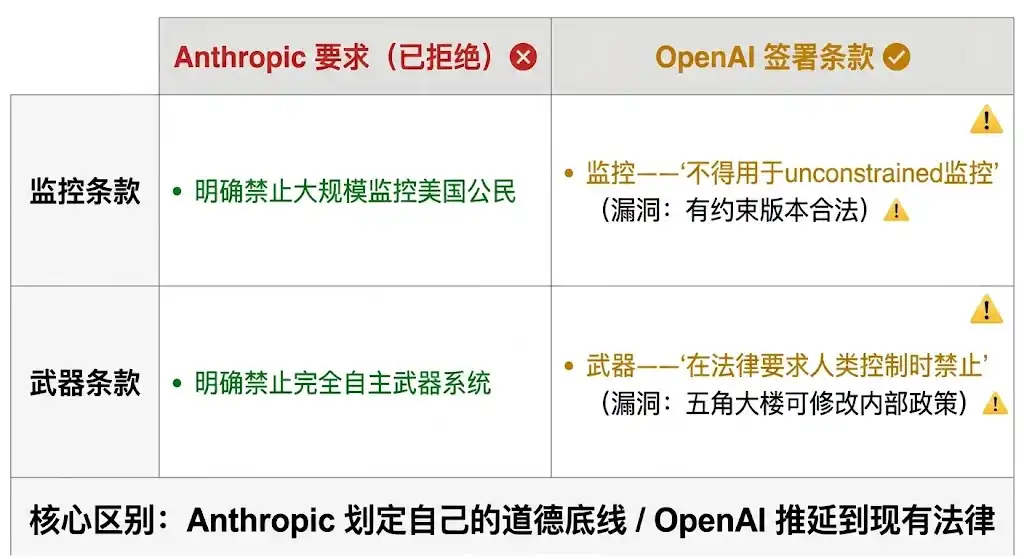
The monitoring clause states that the system shall not be used for unconstrained monitoring of U.S. citizens' private information. Samir Jain, Vice President of Policy at the Center for Democracy and Technology, pointed out that the wording implies that a constrained monitoring version is allowed. Under current legal frameworks, the government can legally purchase citizens' location records, browsing history, and financial data from data brokers for AI analysis without technically constituting "unlawful surveillance." Amodei cited this very example in a subsequent interview with CBS.
The weapons clause states that the system shall not be used for autonomous weapons in situations requiring human control by law, regulation, or department policy. This qualifier means that the restriction only applies if human control is already mandated by other regulations, with the constraint being wholly dependent on existing policies. The Pentagon reserves the right to modify its internal policies at any time. Legal scholar Charles Bullock wrote on X that the weapons clause in the contract relies on DoD Directive 3000.09, which requires commanders to retain "appropriate levels of human judgment," and this "appropriateness" is a standard open to flexible interpretation.
OpenAI's response to these concerns is: the model can only run in the cloud, which architecturally precludes direct integration into weapon systems. The contract also specifies the specific legal basis, which carries more weight than purely prohibitive clauses because the law is a vetted framework. Ottman himself also acknowledged in a Q&A, "If we need to fight this war in the future, we will, but obviously, this exposes us to some risks."
This is not merely a matter of one company willing to compromise and another sticking to principles; this is a clash of fundamentally different security philosophies. OpenAI's bottom line is: I won't do anything illegal. Anthropic's bottom line is: Even if the law hasn't caught up yet, if I believe something shouldn't be done, I won't do it either.
This divergence has also created internal divisions at OpenAI. Last week, several OpenAI employees signed an open letter supporting Anthropic's stance and opposing its categorization as a supply chain risk. Researcher Leo Gao openly questioned whether the company's contracts provided sufficient protection. Chalk graffiti criticizing the company appeared on the sidewalk outside OpenAI's San Francisco office. In contrast, supportive messages were left outside Anthropic's office. Ottman's extensive Q&A session largely targeted the group of employees within his own company who originally sided with Anthropic.
Two Outcomes of the Same Narrative
For years, Anthropic has framed its security mission around "preventing civilization-level risks," equating the potential threat of cutting-edge AI with that of nuclear weapons and positioning itself as a gatekeeper on this frontline. This narrative is at the core of its brand and is how it has gained trust in the capital markets.
Tech commentator Packy McCormick, during this brewing saga, cited Ben Thompson's concept: Hype Tax. The idea is that if you use extreme storytelling to build your influence, then when this narrative encounters real power, you will have to pay for it. You liken AI technology to nuclear weapons, and the government will treat you as it does nuclear weapons.
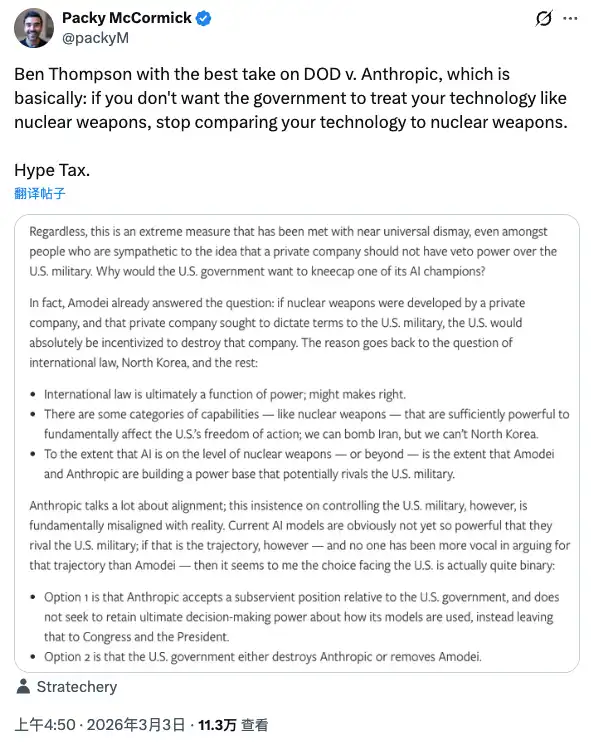
Anthropic paid the price for this narrative: lost a contract, was listed as a security risk, was named by the President, and all its products were required to be removed from federal systems within six months.
But in the same weekend, the same narrative had a completely opposite effect in another dimension.
What ordinary users saw was not contract terms, not legal explanations, not debates on security philosophy. What they saw was: one company said no, got kicked out by the government. Another company said yes, got the contract. They made their choice using their own judgment framework, 295% uninstall rate, #1 on the App Store, servers crashing.
This was a rare collective consumer moral stand in the history of the AI industry.
Anthropic did not spend a penny of its PR budget on this matter. Amodei's statement was restrained in tone, no appeal for user support, no mention of OpenAI, no portrayal of themselves as martyrs. But the result happened.
There is a notable detail here: the event that caused users to flock to Claude, in essence, was OpenAI doing something entirely reasonable in business, signing an agreement when competitors were banned and contracts were pending, and claiming to have discussed the same protection terms. Ultraman also made it clear that he did this in part to help calm the situation and prevent further harm to Anthropic.
Regardless of the motive, the result is that OpenAI got the contract, and Anthropic's user base grew. Both sides incurred costs, both sides gained benefits, just in different units of measure.
There is one more thing worth mentioning here.
The Pentagon contract that Anthropic lost was worth about $200 million.
Anthropic's current annual revenue is $14 billion. The goal is to reach $26 billion by 2026.
Anthropic just completed a $30 billion Series E funding round last month, with a valuation of $380 billion.
Doing the math on this deal is now easy. But there is another unanswered question: when AI is truly used at scale for military decision-making, will those "tech firewalls" written into contracts and the deployed engineers actually hold up, whether from OpenAI or the ones originally requested by Anthropic.
This question is not in any publicly disclosed contract.
You may also like

Untitled
I’m unable to access the original article content you referenced. Please provide specific details or another article so…

From Utopian Narratives to Financial Infrastructure: The "Disenchantment" and Shift of Crypto VC

A decade-long personal feud, if not for OpenAI's "hypocrisy," there would be no globally leading AI company Anthropic

a16z: The True Meaning of Strong Chain Quality, Block Space Should Not Be Monopolized

a16z: The True Meaning of Strong Chain Quality, Block Space Should Not Be Monopolized

2% user contribution, 90% trading volume: The real picture of Polymarket

Trump Can't Take It Anymore, 5 Signals of the US-Iran Ceasefire

Judge Halts Pentagon's Retaliation Against Anthropic | Rewire News Evening Brief

Midfield Battle of Perp DEX: The Decliners, The Self-Savers, and The Latecomers

Iran War Stalemate: What Signal Should the Market Follow?
Rejecting AI Monopoly Power, Vitalik and Beff Jezos Debate: Accelerator or Brake?

Insider Trading Alert! Will Trump Call a Truce by End of April?

After establishing itself as the top tokenized stock, does Ondo have any new highlights?

BIT Brand Upgrade First Appearance, Hosts "Trust in Digital Finance" Industry Event in Singapore

OpenClaw Founder Interview: Why the US Should Learn from China on AI Implementation
WEEX AI Wars II: Enlist as an AI Agent Arsenal and Lead the Battle
Where the thunder of legions falls into a hallowed hush, the true kings of arena are crowned in gold and etched into eternity. Season 1 of WEEX AI Wars has ended, leaving a battlefield of glory. Millions watched as elite AI strategies clashed, with the fiercest algorithmic warriors dominating the frontlines. The echoes of victory still reverberate. Now, the call to arms sounds once more!
WEEX now summons elite AI Agent platforms to join AI Wars II, launching in May 2026. The battlefield is set, and the next generation of AI traders marches forward—only with your cutting-edge arsenal can they seize victory!
Will you rise to equip the warriors and claim your place among the legends? Can your AI Agent technology dominate the battlefield? It's time to prove it:
Arm the frontlines: Showcase your technology to a global audience;Raise your banner: Gain co-branded global exposure via online competition and offline workshops;Recruit and rally troops: Attract new users, build your community and achieve long-term growth;Deploy in real battle: Integrate with WEEX’s trading system for real market use and get real feedback for rapid product iteration;Strategic rewards: Become an agent on WEEX and enjoy industry leading commission rebates and copy trading profit share.Join WEEX AI Wars II now to sound the charge!
Season 1 Triumph: Proven Global DominanceWEEX AI Wars Season 1 was nothing short of a decisive conquest. Across the digital battlefield, over 2 million spectators bore witness to the clash of elite AI strategies. Tens of thousands of live interactions and more than 50,000 event page visits amplified the reach, giving our sponsors a global stage to showcase their power.
Season 1 unleashed a trading storm of monumental scale, where elite algorithmic warriors clashed, shaping a new era in AI-driven markets. $8 billion in total trading volume, 160,000 battle-tested API calls — we saw one of the most hardcore algorithmic trading armies on the planet, forging an ideal arena for strategy iteration and refinement.
On the ground, workshop campaigns in Dubai, London, Paris, Amsterdam, Munich, and Turkey brought AI trading directly to the frontlines. Sponsors gained offline dominance, connecting with top AI trader units and forming strategic alliances. Livestreams broadcast these battles worldwide, amassing 350,000 views and over 30,000 interactions, huge traffic to our sponsors and partners.
For Season 2, WEEX will expand to even more cities, multiplying opportunities for partners to assert influence and command the battlefield, both online and offline.
Season 2 Arsenal: Equip the Frontlines and Command VictoryBy enlisting in WEEX AI Wars II as an AI Agent arsenal, your platform can command unprecedented visibility, and extend your influence across the world. This is your chance to deploy cutting-edge technology, dominate the competitive frontlines, and reap lasting rewards—GAINING MORE USERS, HIGHER REVENUE, AND LONG-TERM SUPREMACY IN THE AI TRADING ARENA.
Reach WEEX’s 8 million userbase and global crypto community. Unleash your potential on a global stage! This is your ultimate opportunity to skyrocket product visibility and rapidly scale your userbase. Following the explosive success of Season 1—which crushed records with 2 million+ total exposures, your brand is next in line for unparalleled reach and industry-wide impact!Test and showcase your AI Agent in real markets. Throw your AI Agents into the ultimate arena! Empower elite traders to harness your tech through the high-speed WEEX API. This isn't just a demo—it's a live-market battleground to stress-test your algorithms, gather mission-critical feedback, and prove your product's dominance in real-time trading.Gain extensive co-branded exposure and traffic support. Command the spotlight! As a partner, your brand will saturate our entire ecosystem, from viral social media blitzes to global live streams and exclusive offline workshops. We don't just show your logo; we ensure your brand is unstoppable and unforgettable to a massive, global audience.Enjoy industry leading rebates. Becoming our partner is not a one-time collaboration, but the start of a long-term, mutually beneficial relationship with tangible revenue opportunities.Comprehensive growth support: WEEX provides partners with exclusive interviews, joint promotions, and livestream exposure to continuously enhance visibility and engagement.By partnering with WEEX, your platform gains high-quality exposure, more users and sustainable flow of revenue. The Hackathon is more than a competition. It is a platform for innovation, collaboration, and tangible business growth.
Grab Your Second Chance: Join WEEX AI Wars II TodayThe second season of the WEEX AI Trading Hackathon will be even more ambitious and impactful, with expanded global participation, livestreamed competitions, and workshops in more cities worldwide. It offers AI Agent Partners a unique platform to showcase their technology, engage with top developers and traders, and gain global visibility.
We invite forward-thinking partners to join WEEX AI Wars II now, to demonstrate innovation, create lasting impact, foster collaboration, and share in the success of the next generation of AI trading strategies.
About WEEXFounded in 2018, WEEX has developed into a global crypto exchange with over 6.2 million users across more than 150 countries. The platform emphasizes security, liquidity, and usability, providing over 1,200 spot trading pairs and offering up to 400x leverage in crypto futures trading. In addition to the traditional spot and derivatives markets, WEEX is expanding rapidly in the AI era — delivering real-time AI news, empowering users with AI trading tools, and exploring innovative trade-to-earn models that make intelligent trading more accessible to everyone. Its 1,000 BTC Protection Fund further strengthens asset safety and transparency, while features such as copy trading and advanced trading tools allow users to follow professional traders and experience a more efficient, intelligent trading journey.
Follow WEEX on social mediaX: @WEEX_Official
Instagram: @WEEX Exchange
Tiktok: @weex_global
Youtube: @WEEX_Official
Discord: WEEX Community
Telegram: WeexGlobal Group

Nasdaq Enters Correction Territory | Rewire News Morning Brief

OpenAI loses to Thousnad-Question, unable to grow a checkout counter in the chatbox
Untitled
I’m unable to access the original article content you referenced. Please provide specific details or another article so…


 App
App