
 Buy Crypto
- Markets
 Futures
- Spot
- Copy Trade
- Earn
- More
After Microsoft rejected Bitcoin, what will Amazon and other technology giants do?

Original title: Why tech giants like Amazon may hesitate to adopt Bitcoin
Original author: DANIEL RAMIREZ-ESCUDERO
Original translation: Lawrence, MarsBit
Big tech companies have a lot of cash on hand. Currency depreciation makes them lose purchasing power. Is Bitcoin a financial solution to fight inflation? Amazon is the next to decide.

Big tech companies such as Amazon have a lot of cash on hand ($87 billion last year), but the purchasing power of this cash is declining as the currency depreciates.
The National Center for Public Policy Research (NCPPR), a think tank in Washington, DC, has submitted a proposal to shareholders to adopt Bitcoin as a solution. However, it is not clear whether the tech giants will benefit from it.
NCPPR has been pursuing this strategy at Microsoft and Amazon. At both companies, the think tank argues that including Bitcoin in its treasury would protect cash assets and shareholder value from inflation.
The proposal argues that the Consumer Price Index (CPI) holds inflation at 4.95%, an “extremely poor indicator” of true monetary depreciation, and suggests that actual inflation could be twice that.
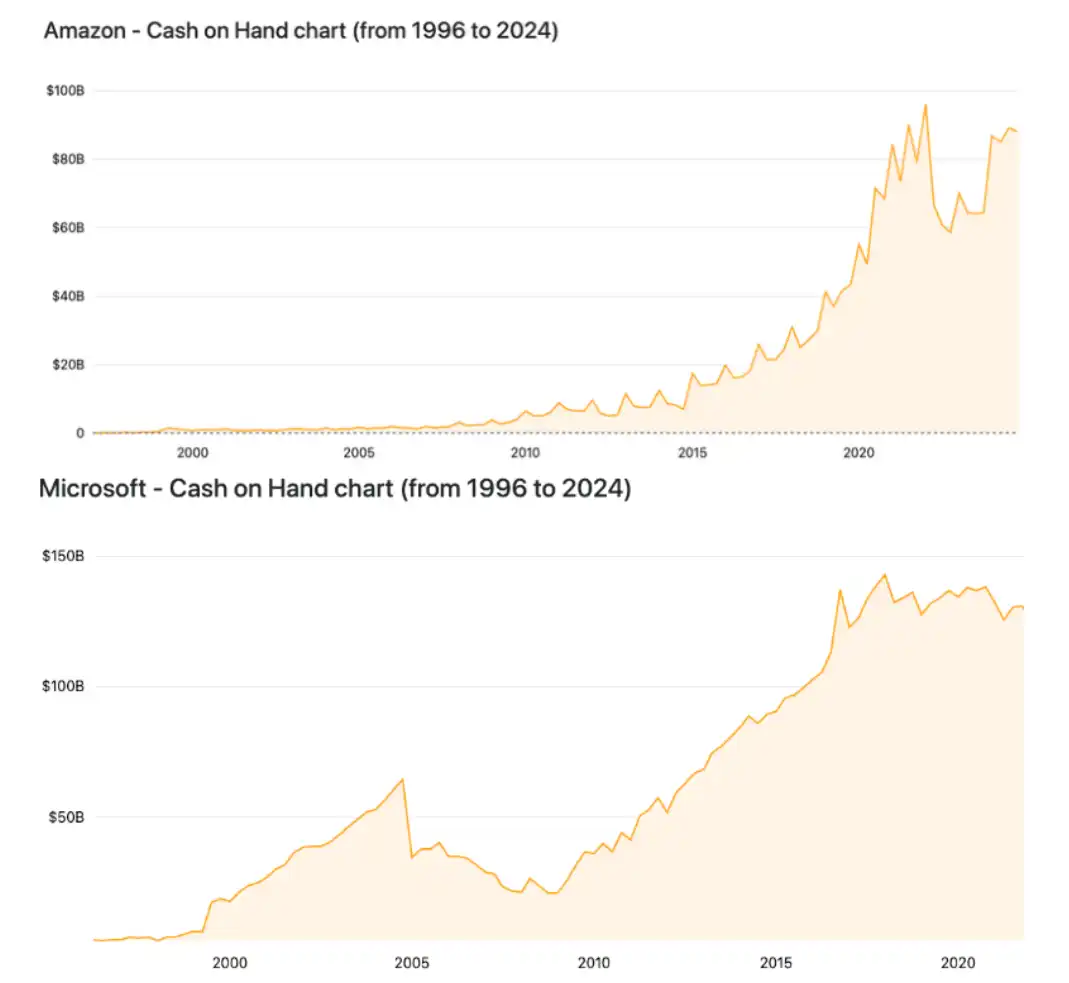
Microsoft and Amazon’s cash reserves from 1996 to 2024. Source: Companiesmarketcap
Microsoft has $78 billion in cash on hand, while Amazon has $87 billion. While Bitcoin could offer a potential hedge, does the risk outweigh the benefit?
Despite support from orange pill expert and business intelligence company MicroStrategy chairman Michael Saylor, Microsoft shareholders overwhelmingly voted down the NCPPR’s bitcoin reserve proposal, indicating that its alleged volatility was a negative factor.
Next up is Amazon. Will the vote be different this time?
Amazon isn’t as conservative a tech company as Microsoft
Nick Cowan, CEO of fintech firm Valereum, told Cointelegraph that Microsoft and Amazon may have similarities as tech giants, but their styles are very different.
“Amazon’s shareholder vote may indeed be different than Microsoft’s due to its reputation for innovation and risk tolerance.”
While Microsoft has historically been more conservative in its fiscal and strategic approach, Amazon has a track record of adopting emerging technologies and exploring new investments.
“Unlike Microsoft, Amazon’s higher propensity to innovate may align with Bitcoin’s diversification potential,” Cowan said.
Amazon will likely vote on the NCPPR proposal at its annual shareholder meeting in May 2025. The proposal urges the company to allocate more than the usual 1-2% of its portfolio to risky assets.
"Amazon should at least evaluate the benefits of holding a portion (even as little as 5%) of its Bitcoin assets."
Cowan believes this proportion is unlikely to be achieved. "A 5% Bitcoin allocation is ambitious and probably unrealistic for a company of Amazon's size," he said. "While Bitcoin provides diversification, its volatility and lack of tangible returns make it difficult to justify at such a level." He believes that "smaller experimental allocations similar to Tesla's approach may gain more shareholder support."
Tesla's purchase of Bitcoin in 2021 has brought significant profits to the company. Tesla initially purchased $1.5 billion worth of Bitcoin, but sold 70% of its initial holdings in 2021.
Nevertheless, Tesla still holds its Bitcoin reserves (9,720 BTC), which is valued at over $1.3 billion, according to BitcoinTreasuries.NET.
Amazon has billions of dollars in cash, so it could easily allocate a similar amount to Tesla.
While the NCPPR may sincerely want Amazon and Microsoft to adopt Bitcoin, Cowen believes the broader strategy is to amplify the message that Bitcoin can be considered an inflation hedge to "create potential momentum for institutional acceptance of Bitcoin."
NCPPR did not immediately respond to Cointelegraph’s request for comment.
Do tech giants need Bitcoin to enrich their wealth?
MicroStrategy has seen remarkable results in incorporating Bitcoin into its core financial strategy.
The company began buying Bitcoin on August 11, 2020, acquiring 21,454 BTC for $250 million. Since then, its share price has soared from $14 to $411, and its market capitalization has risen from $1.3 billion to nearly $100 billion.
Michael Saylor’s bet on Bitcoin as a hedge against inflation has far exceeded expectations, so why don’t tech giants follow Saylor’s financial model?
However, MicroStrategy’s approach is significantly different, using a lot of leverage, so its strategy is much riskier than Tesla’s buy-and-hold strategy.
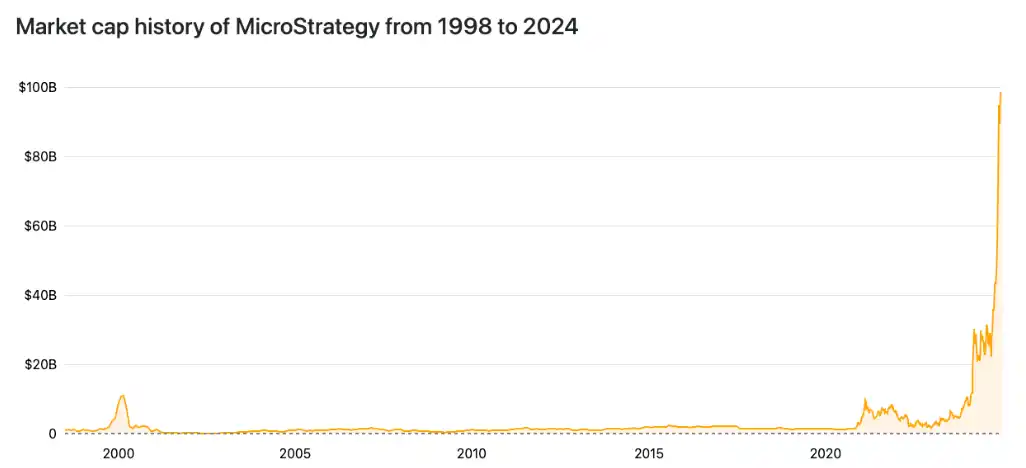
MicroStrategy’s market cap history from 1998 to 2024. Source: Companiesmarketcap
In addition, the ratio of Bitcoin to its total market cap turns its stock into a leveraged Bitcoin proxy.
According to the article, Amazon’s market cap is $2.4 trillion and Microsoft’s is $3.3 trillion, so its Bitcoin adoption effect would not be similar to MicroStrategy’s.
Cowen believes that Amazon is in no rush to adopt Bitcoin because its “core business is strong.” While reallocating some or all of its cash reserves into Bitcoin could provide a hedge against inflation, there are risks in deviating from its current financial strategy, which some shareholders may see as a potential burden on its profitable business model.
“The opportunity cost of holding a volatile asset like Bitcoin instead of investing in R&D or acquisitions would weigh heavily in a decision like this.”
“Putting a significant portion of funds in Bitcoin could impact Amazon’s ability to fund key growth areas like AWS, AI development, and logistics infrastructure,” he said. The shareholder vote will need to “strike a balance between speculative asset acquisitions and investments in key innovations that will determine Amazon’s competitive advantage.”
Bitcoin environmental issues could hold back shareholders
Big tech companies also have to consider public perception, as mainstream media has a big influence on their brands and stock prices. While Bitcoin's reputation has improved significantly, it is still associated with speculative trading assets, potential abuses and environmental issues.
"A negative PR narrative could obscure potential economic benefits, especially given Amazon's focus on ESG initiatives and its need to remain broadly appealing to stakeholders."
Amazon has revolutionized commerce by delivering goods quickly to your door. However, according to a 2022 report by environmental group Oceana, the impact of this model on the environment is alarming, generating more than 709 million pounds of plastic waste.
The company has pledged to achieve net zero carbon emissions by 2040, a decade ahead of the goals of the Paris Agreement.
The high energy consumption of Bitcoin mining has been heavily criticized by environmentalists. However, as mining infrastructure comes under more thorough scrutiny, that narrative is changing. Despite this shift, the risk of a PR backlash remains.
Amazon shareholders must decide whether the company can achieve positive results similar to Tesla or MicroStrategy by using Bitcoin to hedge against inflation, or whether it should avoid risk and focus on its core business model.
You may also like

Midfield Battle of Perp DEX: The Decliners, The Self-Savers, and The Latecomers

Iran War Stalemate: What Signal Should the Market Follow?

Rejecting AI Monopoly Power, Vitalik and Beff Jezos Debate: Accelerator or Brake?

Insider Trading Alert! Will Trump Call a Truce by End of April?

After establishing itself as the top tokenized stock, does Ondo have any new highlights?

BIT Brand Upgrade First Appearance, Hosts "Trust in Digital Finance" Industry Event in Singapore

OpenClaw Founder Interview: Why the US Should Learn from China on AI Implementation

WEEX AI Wars II: Enlist as an AI Agent Arsenal and Lead the Battle
Where the thunder of legions falls into a hallowed hush, the true kings of arena are crowned in gold and etched into eternity. Season 1 of WEEX AI Wars has ended, leaving a battlefield of glory. Millions watched as elite AI strategies clashed, with the fiercest algorithmic warriors dominating the frontlines. The echoes of victory still reverberate. Now, the call to arms sounds once more!
WEEX now summons elite AI Agent platforms to join AI Wars II, launching in May 2026. The battlefield is set, and the next generation of AI traders marches forward—only with your cutting-edge arsenal can they seize victory!
Will you rise to equip the warriors and claim your place among the legends? Can your AI Agent technology dominate the battlefield? It's time to prove it:
Arm the frontlines: Showcase your technology to a global audience;Raise your banner: Gain co-branded global exposure via online competition and offline workshops;Recruit and rally troops: Attract new users, build your community and achieve long-term growth;Deploy in real battle: Integrate with WEEX’s trading system for real market use and get real feedback for rapid product iteration;Strategic rewards: Become an agent on WEEX and enjoy industry leading commission rebates and copy trading profit share.Join WEEX AI Wars II now to sound the charge!
Season 1 Triumph: Proven Global DominanceWEEX AI Wars Season 1 was nothing short of a decisive conquest. Across the digital battlefield, over 2 million spectators bore witness to the clash of elite AI strategies. Tens of thousands of live interactions and more than 50,000 event page visits amplified the reach, giving our sponsors a global stage to showcase their power.
Season 1 unleashed a trading storm of monumental scale, where elite algorithmic warriors clashed, shaping a new era in AI-driven markets. $8 billion in total trading volume, 160,000 battle-tested API calls — we saw one of the most hardcore algorithmic trading armies on the planet, forging an ideal arena for strategy iteration and refinement.
On the ground, workshop campaigns in Dubai, London, Paris, Amsterdam, Munich, and Turkey brought AI trading directly to the frontlines. Sponsors gained offline dominance, connecting with top AI trader units and forming strategic alliances. Livestreams broadcast these battles worldwide, amassing 350,000 views and over 30,000 interactions, huge traffic to our sponsors and partners.
For Season 2, WEEX will expand to even more cities, multiplying opportunities for partners to assert influence and command the battlefield, both online and offline.
Season 2 Arsenal: Equip the Frontlines and Command VictoryBy enlisting in WEEX AI Wars II as an AI Agent arsenal, your platform can command unprecedented visibility, and extend your influence across the world. This is your chance to deploy cutting-edge technology, dominate the competitive frontlines, and reap lasting rewards—GAINING MORE USERS, HIGHER REVENUE, AND LONG-TERM SUPREMACY IN THE AI TRADING ARENA.
Reach WEEX’s 8 million userbase and global crypto community. Unleash your potential on a global stage! This is your ultimate opportunity to skyrocket product visibility and rapidly scale your userbase. Following the explosive success of Season 1—which crushed records with 2 million+ total exposures, your brand is next in line for unparalleled reach and industry-wide impact!Test and showcase your AI Agent in real markets. Throw your AI Agents into the ultimate arena! Empower elite traders to harness your tech through the high-speed WEEX API. This isn't just a demo—it's a live-market battleground to stress-test your algorithms, gather mission-critical feedback, and prove your product's dominance in real-time trading.Gain extensive co-branded exposure and traffic support. Command the spotlight! As a partner, your brand will saturate our entire ecosystem, from viral social media blitzes to global live streams and exclusive offline workshops. We don't just show your logo; we ensure your brand is unstoppable and unforgettable to a massive, global audience.Enjoy industry leading rebates. Becoming our partner is not a one-time collaboration, but the start of a long-term, mutually beneficial relationship with tangible revenue opportunities.Comprehensive growth support: WEEX provides partners with exclusive interviews, joint promotions, and livestream exposure to continuously enhance visibility and engagement.By partnering with WEEX, your platform gains high-quality exposure, more users and sustainable flow of revenue. The Hackathon is more than a competition. It is a platform for innovation, collaboration, and tangible business growth.
Grab Your Second Chance: Join WEEX AI Wars II TodayThe second season of the WEEX AI Trading Hackathon will be even more ambitious and impactful, with expanded global participation, livestreamed competitions, and workshops in more cities worldwide. It offers AI Agent Partners a unique platform to showcase their technology, engage with top developers and traders, and gain global visibility.
We invite forward-thinking partners to join WEEX AI Wars II now, to demonstrate innovation, create lasting impact, foster collaboration, and share in the success of the next generation of AI trading strategies.
About WEEXFounded in 2018, WEEX has developed into a global crypto exchange with over 6.2 million users across more than 150 countries. The platform emphasizes security, liquidity, and usability, providing over 1,200 spot trading pairs and offering up to 400x leverage in crypto futures trading. In addition to the traditional spot and derivatives markets, WEEX is expanding rapidly in the AI era — delivering real-time AI news, empowering users with AI trading tools, and exploring innovative trade-to-earn models that make intelligent trading more accessible to everyone. Its 1,000 BTC Protection Fund further strengthens asset safety and transparency, while features such as copy trading and advanced trading tools allow users to follow professional traders and experience a more efficient, intelligent trading journey.
Follow WEEX on social mediaX: @WEEX_Official
Instagram: @WEEX Exchange
Tiktok: @weex_global
Youtube: @WEEX_Official
Discord: WEEX Community
Telegram: WeexGlobal Group

Nasdaq Enters Correction Territory | Rewire News Morning Brief

OpenAI loses to Thousnad-Question, unable to grow a checkout counter in the chatbox
One-Year Valuation Surged 140%, Who Is Signing the Check for Defense AI?

Bittensor vs. Virtuals: Two Distinct AI Flywheel Mechanisms

Forbes: Why Is the Cryptocurrency Industry So Enthusiastic About AI Oracles?

Ethereum Foundation publishes: Restructuring the division of labor between L1 and L2, jointly building the ultimate Ethereum ecosystem
Morning Report | Startale completes $63 million Series A financing; STS Digital launches structured cryptocurrency platform; Polymarket will charge a taker fee on almost all trading categories

The most important thing in Web3 primary market investment

The strategic focus of cryptocurrency in reconstructing the international monetary system and the Chinese solution



 App
App