
 Buy Crypto
- Markets
 Futures
- Spot
- Copy Trade
- Earn
- More
After the rise in the stablecoin's status, long-time partners Circle and Stripe vie for dominance

Original Title: "As Stablecoin Status Rises, Long-time Partners Circle and Stripe Vie for Territory"
Original Author: Dang Dang, Odaily Planet Daily
In the stablecoin industry chain, Circle and Stripe were once a pair of partners with very clear division of labor.
Circle was responsible for mapping real-world US dollars to the blockchain, minting them into the stablecoin USDC; Stripe, through its globally interconnected payment network, enabled these digital dollars to flow in real-world business scenarios. One was responsible for minting money, and the other was responsible for enabling money flow. This allied pair has been almost naturally complementary in the past few years.
But two recent events, when viewed together, give rise to a subtle feeling: these two companies seem to be slowly moving toward the same destination.
On February 11, Stripe announced the launch of the x402 payment feature on Base. This feature allows developers to charge AI agents directly using USDC, transforming the stablecoin from just a pricing tool on trading platforms to a payment medium for transactions between machines in the AI Agent wave.
During the same week, Stripe's stablecoin infrastructure company Bridge received preliminary approval for a trust banking charter from the Office of the Comptroller of the Currency (OCC). This means that Bridge may, as a regulated financial institution, begin to advance stablecoin issuance, custody, and reserve management businesses.
On one side, Stripe is building new payment scenarios using USDC; on the other side, it is constructing its own stablecoin financial infrastructure.
The Old Era of the Stablecoin Industry Chain
If we break down the stablecoin world, the industry chain is not actually complex.
At the bottom is the issuance layer. Institutions like Circle are responsible for mapping real-world US dollar reserves to the blockchain, minting them into stablecoins, such as USDC. The next layer up is the settlement layer, with the blockchain network taking on the role of fund accounting and clearing. Moving up further is the payment layer. Internet payment infrastructure like Stripe embeds stablecoins into real-world commercial transactions, allowing blockchain funds to enter scenarios such as e-commerce, SaaS, or cross-border trade. At the very top is the application layer. From DeFi to AI Agent payments, various specific financial activities take place here.
When stablecoins were just a tool in the crypto market, participants in this chain of industry each had their own roles: the issuer was responsible for "minting," the payment platform was responsible for "receiving funds," the blockchain was responsible for settlement, and developers focused on use cases.
As early as 2014, Stripe was among the first mainstream payment processors to support Bitcoin payments. However, due to issues such as Bitcoin's price volatility, long transaction confirmation times, and unpredictable fees, this business attempt sadly contracted in 2018. Bitcoin seemed more like a speculative asset rather than a currency suitable for internet payments.
The emergence of stablecoins precisely filled this gap. The price stability, programmability, and on-chain settlement capability of USDC made it closer to Stripe's vision of an "internet-native currency." In 2022, Stripe re-entered the crypto field and chose to support USDC payments. This step not only reintegrated stablecoins into the mainstream payment system but also objectively drove rapid growth in USDC's circulation, with its market capitalization once surpassing $55 billion.
In such a cooperative relationship, Circle provides the US Dollar Coin, Stripe offers a global payment network, and both jointly propel USDC from a crypto transaction tool to a market approaching a scale of $70 billion.
On-chain data also confirms the economies of scale brought about by this collaboration. According to Artemis data, the on-chain transaction volume of USDC exceeded $8.4 trillion in January, while the total on-chain transaction volume of stablecoins in the market was $10 trillion. In terms of transaction volume, USDC held an 84% market share of the total market.
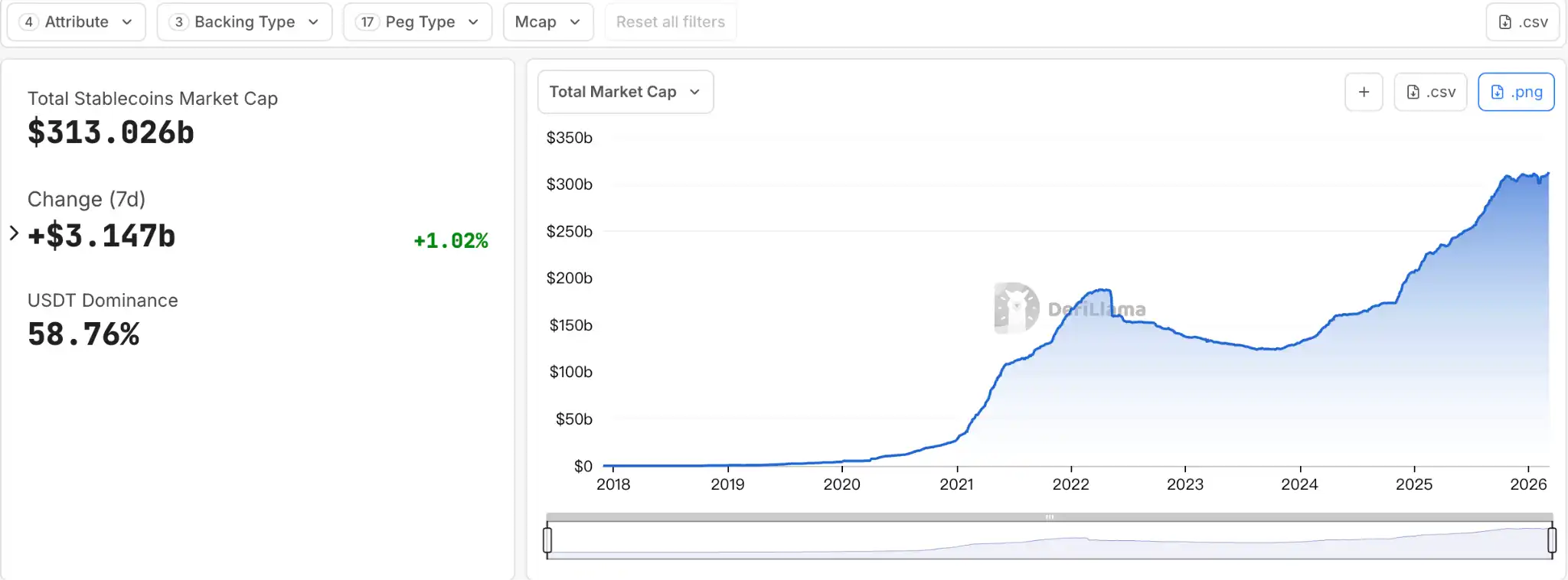
At the same time, significant changes have occurred in the external regulatory environment. With the formal implementation of the "GENIUS Act," stablecoins, once a financial experiment in the regulatory gray area, are gradually being integrated into the track of the legal financial system. Today, the stablecoin market has surpassed $300 billion. In the future, the scale supported by this market could be at the trillion-dollar level in the financial network.
Stablecoins are no longer just an internal tool of the crypto market but are beginning to be seen as part of the next-generation financial infrastructure. When a market evolves from a crypto tool to financial infrastructure, the industry logic often changes accordingly.
When Stablecoins Become Infrastructure
In any financial system, truly stable profits often do not come from a single link but from control of key nodes. Whoever can control the track of fund flows can define the rules.
If a stablecoin is only a underlying asset and all payment gateways, developer tools, and business use cases are controlled by other platforms, then the issuing party's ultimate potential revenue is actually very limited. On the contrary, if one controls a payment network or settlement system, then one can continuously capture value at every stage of capital flow.
Therefore, as a stablecoin begins to evolve from a cryptographic asset to financial infrastructure, an almost inevitable trend begins to emerge: the industry roles that were originally scattered across different levels start to try to extend upstream and downstream, incorporating more links into their own system.
In financial history, such a process is not unfamiliar. From the banking system to credit card networks, and then to internet payment platforms, mature financial systems often tend to go through similar stages—moving from role dispersion to eventual structural integration.
Today, this wave of industry integration is also starting to impact the stablecoin world.
If we view the stablecoin industry chain as a vertical structure, then in the past few years, Circle and Stripe have stood at opposite ends of this chain. And now, they are both moving towards the middle.
· Circle: Not Just Looking to Be a "Money Printer"
In the on-chain ecosystem, the circulation efficiency and usage frequency of USDC have long been undeniable. In the latest stablecoin flow report, the circulation speed of USDC is almost 5 times that of USDT.
However, merely relying on issuing a stablecoin is not a particularly imaginative business model in itself.
The main sources of revenue for a stablecoin issuer are roughly divided into two parts: one is the interest income generated by reserve assets, and the other is the related fees generated during issuance and redemption of the stablecoin. But as the scale of the stablecoin expands, this part of the revenue often needs to be shared with ecosystem partners. For example, as one of the most important distribution channels for USDC, Coinbase receives close to $1 billion in profit sharing from the USDC system each year. This means that even though the issuer plays the most central "minting" role in the stablecoin system, the actual disposable income space is still constrained by the ecosystem structure.
This also explains why in the past two years, Circle's strategy has clearly started to extend more towards the application layer: it is no longer satisfied with just issuing a stablecoin but is trying to build a complete stablecoin payment network.
From the current publicly available information, Circle's layout at the application layer can be roughly divided into three steps.
Step One, L1 blockchain Arc designed for enterprises. It acts as a "coordination layer" at the application level, helping developers build payment, settlement, and other applications. Arc launched its testnet in October 2025, attracting 100+ companies, processing over 166 million transactions, with the mainnet planned to go live by 2026.
Step Two, centered around USDC, addresses liquidity fragmentation through the Cross-Chain Transfer Protocol (CCTP) and gateway tools. At the application layer, it assists enterprises in unifying USDC across multiple chains to Arc and CPN, enabling seamless distribution and application development.
Step Three, also a core application layer product of Circle, is the Circle Payments Network (CPN). Launched in May 2025, it is an "open standard" payment coordination network designed for programmable, compliant, and auditable payments. To date, 55 financial institutions have registered, with an additional 74 undergoing qualification review.
This framework is enabling Circle to evolve from a simple stablecoin issuer to gradually building a complete set of application infrastructure capable of handling fund flows.
· Stripe: The "Checkout" Also Wants to Lead
Meanwhile, Stripe sits at the other end of the stablecoin ecosystem. As one of the world's most critical internet payment infrastructures, Stripe holds a significant merchant gateway. By 2025, the total payment volume on the Stripe platform reached $19 trillion, a 34% year-on-year increase, roughly equivalent to about 1.6% of the global GDP. From Shopify to Amazon, numerous internet merchant payment systems are built on Stripe's infrastructure. In a sense, Stripe does not produce currency, but it controls the gateway of currency flows.
However, if in the future stablecoin issuers and blockchain networks jointly control the settlement layer, payment platforms might be compressed into mere technology service providers.
This is why Stripe has systematically begun to expand its footprint upstream and downstream in the industry chain in recent years.
In February 2025, Stripe completed an $11 billion acquisition of the stablecoin infrastructure platform Bridge. Finally, on February 12 this year, Bridge received conditional approval from the OCC, a critical step in Stripe's infrastructure endeavors.
Meanwhile, Stripe has also co-incubated the L1 blockchain Tempo with Paradigm, aiming to build a settlement chain specifically for Internet finance. The public testnet went live in December 2025, with the mainnet scheduled to launch within 2026.
Furthermore, in 2025, Stripe acquired the wallet infrastructure company Privy, providing users with embedded wallets and identity systems to lower the barriers for users to access the on-chain financial system.
Putting all these moves together reveals a very clear trend: Stripe is extending downward from the payment gateway, attempting to control the underlying track of stablecoin operation.
The Convergence of Two Companies in the Middle of the Industry Chain
Circle is extending from the issuance layer to the application layer, while Stripe is descending from the payment layer to infrastructure. As both paths move toward the center of the industry chain simultaneously, the once clear boundaries inevitably begin to overlap.
Against the backdrop of the stablecoin industry structure being reshaped, it is more of a reminder: the competition in stablecoins is no longer just about "who issues more tokens." The real question that may matter in the future is — who controls the track of stablecoin circulation.
As issuance, settlement, payment, and applications are gradually reintegrated, the competition in the stablecoin world will also shift from "asset scale" to "financial network." In this new race track, Circle and Stripe, once highly complementary allies, have begun to meet in the middle of the industry chain.
The story of stablecoins is also evolving from a crypto industry experiment into a reconstruction of the financial network.
You may also like

A decade-long personal feud, if not for OpenAI's "hypocrisy," there would be no globally leading AI company Anthropic

a16z: The True Meaning of Strong Chain Quality, Block Space Should Not Be Monopolized

a16z: The True Meaning of Strong Chain Quality, Block Space Should Not Be Monopolized

2% user contribution, 90% trading volume: The real picture of Polymarket

Trump Can't Take It Anymore, 5 Signals of the US-Iran Ceasefire

Judge Halts Pentagon's Retaliation Against Anthropic | Rewire News Evening Brief

Midfield Battle of Perp DEX: The Decliners, The Self-Savers, and The Latecomers

Iran War Stalemate: What Signal Should the Market Follow?
Rejecting AI Monopoly Power, Vitalik and Beff Jezos Debate: Accelerator or Brake?

Insider Trading Alert! Will Trump Call a Truce by End of April?

After establishing itself as the top tokenized stock, does Ondo have any new highlights?

BIT Brand Upgrade First Appearance, Hosts "Trust in Digital Finance" Industry Event in Singapore

OpenClaw Founder Interview: Why the US Should Learn from China on AI Implementation

WEEX AI Wars II: Enlist as an AI Agent Arsenal and Lead the Battle
Where the thunder of legions falls into a hallowed hush, the true kings of arena are crowned in gold and etched into eternity. Season 1 of WEEX AI Wars has ended, leaving a battlefield of glory. Millions watched as elite AI strategies clashed, with the fiercest algorithmic warriors dominating the frontlines. The echoes of victory still reverberate. Now, the call to arms sounds once more!
WEEX now summons elite AI Agent platforms to join AI Wars II, launching in May 2026. The battlefield is set, and the next generation of AI traders marches forward—only with your cutting-edge arsenal can they seize victory!
Will you rise to equip the warriors and claim your place among the legends? Can your AI Agent technology dominate the battlefield? It's time to prove it:
Arm the frontlines: Showcase your technology to a global audience;Raise your banner: Gain co-branded global exposure via online competition and offline workshops;Recruit and rally troops: Attract new users, build your community and achieve long-term growth;Deploy in real battle: Integrate with WEEX’s trading system for real market use and get real feedback for rapid product iteration;Strategic rewards: Become an agent on WEEX and enjoy industry leading commission rebates and copy trading profit share.Join WEEX AI Wars II now to sound the charge!
Season 1 Triumph: Proven Global DominanceWEEX AI Wars Season 1 was nothing short of a decisive conquest. Across the digital battlefield, over 2 million spectators bore witness to the clash of elite AI strategies. Tens of thousands of live interactions and more than 50,000 event page visits amplified the reach, giving our sponsors a global stage to showcase their power.
Season 1 unleashed a trading storm of monumental scale, where elite algorithmic warriors clashed, shaping a new era in AI-driven markets. $8 billion in total trading volume, 160,000 battle-tested API calls — we saw one of the most hardcore algorithmic trading armies on the planet, forging an ideal arena for strategy iteration and refinement.
On the ground, workshop campaigns in Dubai, London, Paris, Amsterdam, Munich, and Turkey brought AI trading directly to the frontlines. Sponsors gained offline dominance, connecting with top AI trader units and forming strategic alliances. Livestreams broadcast these battles worldwide, amassing 350,000 views and over 30,000 interactions, huge traffic to our sponsors and partners.
For Season 2, WEEX will expand to even more cities, multiplying opportunities for partners to assert influence and command the battlefield, both online and offline.
Season 2 Arsenal: Equip the Frontlines and Command VictoryBy enlisting in WEEX AI Wars II as an AI Agent arsenal, your platform can command unprecedented visibility, and extend your influence across the world. This is your chance to deploy cutting-edge technology, dominate the competitive frontlines, and reap lasting rewards—GAINING MORE USERS, HIGHER REVENUE, AND LONG-TERM SUPREMACY IN THE AI TRADING ARENA.
Reach WEEX’s 8 million userbase and global crypto community. Unleash your potential on a global stage! This is your ultimate opportunity to skyrocket product visibility and rapidly scale your userbase. Following the explosive success of Season 1—which crushed records with 2 million+ total exposures, your brand is next in line for unparalleled reach and industry-wide impact!Test and showcase your AI Agent in real markets. Throw your AI Agents into the ultimate arena! Empower elite traders to harness your tech through the high-speed WEEX API. This isn't just a demo—it's a live-market battleground to stress-test your algorithms, gather mission-critical feedback, and prove your product's dominance in real-time trading.Gain extensive co-branded exposure and traffic support. Command the spotlight! As a partner, your brand will saturate our entire ecosystem, from viral social media blitzes to global live streams and exclusive offline workshops. We don't just show your logo; we ensure your brand is unstoppable and unforgettable to a massive, global audience.Enjoy industry leading rebates. Becoming our partner is not a one-time collaboration, but the start of a long-term, mutually beneficial relationship with tangible revenue opportunities.Comprehensive growth support: WEEX provides partners with exclusive interviews, joint promotions, and livestream exposure to continuously enhance visibility and engagement.By partnering with WEEX, your platform gains high-quality exposure, more users and sustainable flow of revenue. The Hackathon is more than a competition. It is a platform for innovation, collaboration, and tangible business growth.
Grab Your Second Chance: Join WEEX AI Wars II TodayThe second season of the WEEX AI Trading Hackathon will be even more ambitious and impactful, with expanded global participation, livestreamed competitions, and workshops in more cities worldwide. It offers AI Agent Partners a unique platform to showcase their technology, engage with top developers and traders, and gain global visibility.
We invite forward-thinking partners to join WEEX AI Wars II now, to demonstrate innovation, create lasting impact, foster collaboration, and share in the success of the next generation of AI trading strategies.
About WEEXFounded in 2018, WEEX has developed into a global crypto exchange with over 6.2 million users across more than 150 countries. The platform emphasizes security, liquidity, and usability, providing over 1,200 spot trading pairs and offering up to 400x leverage in crypto futures trading. In addition to the traditional spot and derivatives markets, WEEX is expanding rapidly in the AI era — delivering real-time AI news, empowering users with AI trading tools, and exploring innovative trade-to-earn models that make intelligent trading more accessible to everyone. Its 1,000 BTC Protection Fund further strengthens asset safety and transparency, while features such as copy trading and advanced trading tools allow users to follow professional traders and experience a more efficient, intelligent trading journey.
Follow WEEX on social mediaX: @WEEX_Official
Instagram: @WEEX Exchange
Tiktok: @weex_global
Youtube: @WEEX_Official
Discord: WEEX Community
Telegram: WeexGlobal Group

Nasdaq Enters Correction Territory | Rewire News Morning Brief

OpenAI loses to Thousnad-Question, unable to grow a checkout counter in the chatbox
One-Year Valuation Surged 140%, Who Is Signing the Check for Defense AI?



 App
App