
 Buy Crypto
- Markets
 Futures
- Spot
- Copy Trade
- Earn
- More
Bankless Founder: By 2026, Treat Tokens Like Equity

Original Title: A Fresh Start for Tokenomics in 2026
Original Author: David Hoffman, Bankless Founder
Translation: Deep Tide TechFlow
Abstract: Are most tokens garbage? Bankless co-founder David Hoffman points out that historically teams have not treated tokens as seriously as equity, and the market has responded with price accordingly.
But there is a turning point in 2026:
MegaETH locks 53% of its tokens in a KPI plan, only unlocking upon achieving growth targets;
The Cap Protocol replaces governance tokens with stablecoin airdrops, where true investors can only get CAP through token sales.
These innovative strategies are ending the era of "airdrop" token distribution and shifting towards precise, conditional allocation mechanisms.
Full Text:
The crypto industry has a "good coins problem."
Most tokens are garbage.
Most tokens have not been treated by teams on a legal and strategic level as seriously as equity. Because teams historically have not given tokens the same respect as equity in the past, the market has also reflected this through token prices.
Today, I want to share two sets of data that make me optimistic about the state of tokens in 2026 and beyond:
1. MegaETH's KPI Plan
2. Cap's Stablecoin Airdrop (stabledrop)
Making Token Supply Conditional
MegaETH locks 53% of the total supply of MEGA tokens in a "KPI plan." The logic is: if MegaETH does not achieve the KPIs (Key Performance Indicators), these tokens will not unlock.
Therefore, in a pessimistic scenario, even if the ecosystem does not grow, at least there will be no more tokens flooding the market to dilute holders. MEGA tokens will only enter the market when the MegaETH ecosystem truly achieves growth (as defined by the KPI).
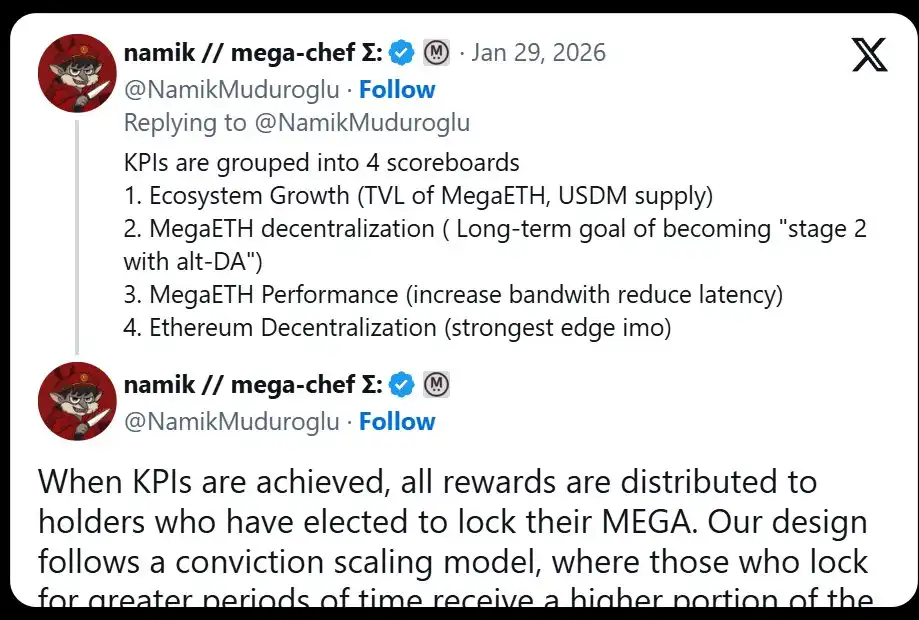
The plan's KPI is divided into 4 scoreboards:
1. Ecosystem Growth (TVL, USDM Supply)
2. MegaETH Decentralization (L2Beat Stage Progress)
3. MegaETH Performance (IBRL)
4. Ethereum Decentralization
Therefore, in theory, as MegaETH achieves KPI targets, the value of MegaETH should correspondingly increase, mitigating the negative impact of MEGA dilution on the market price.
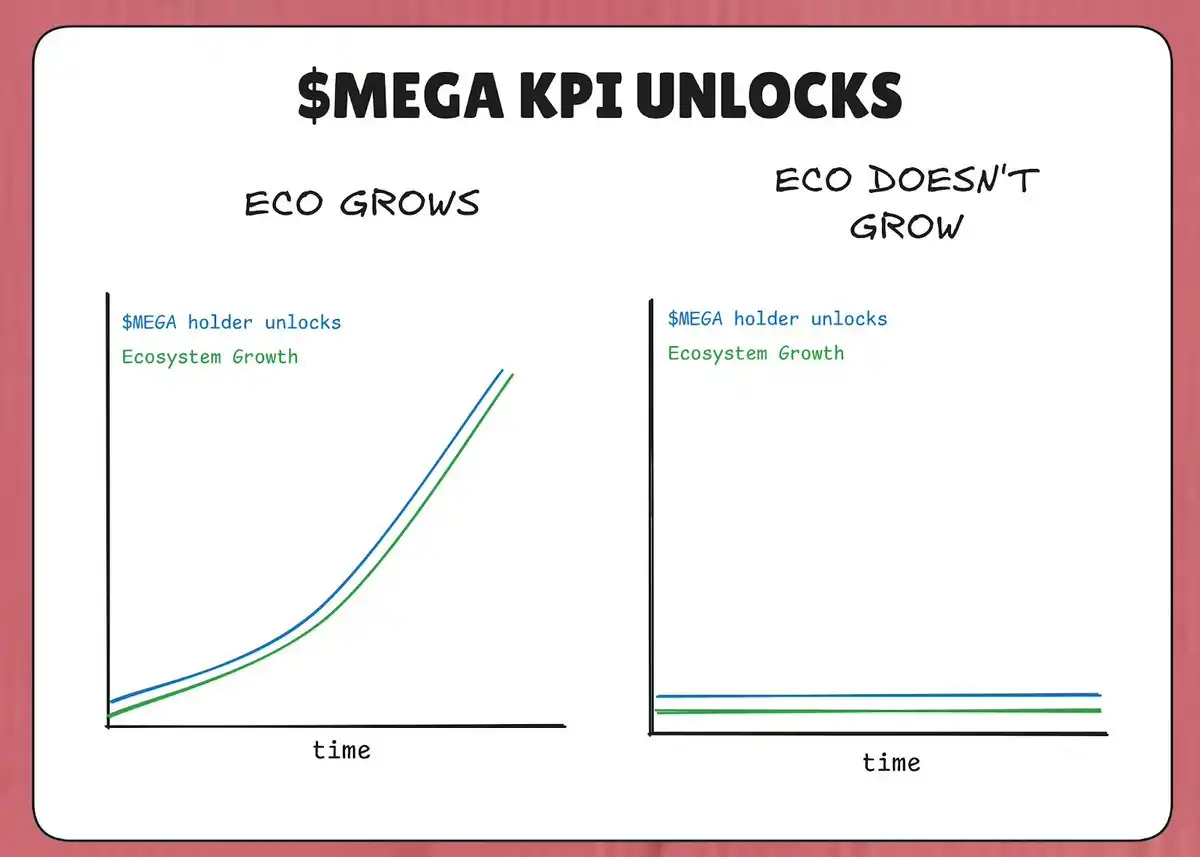
This strategy is reminiscent of Tesla's "deliver or you don't get paid" compensation philosophy to Elon Musk. In 2018, Tesla granted Musk a stock compensation plan that vested in tranches, only redeemable if Tesla met incremental market cap and revenue targets simultaneously. Elon Musk would only get compensated if Tesla's revenue and market cap increased.
MegaETH is attempting to port the same logic into its tokenomics. "More supply" is not a given—it is something the protocol must earn by achieving tangible points on a meaningful scoreboard.
Unlike Musk's Tesla benchmark, I did not see any mention of using MEGA market cap as a KPI target in Namik's KPI objectives—perhaps due to legal reasons. But as a public MEGA investor, this KPI is indeed interesting to me.
Who Gets Unlocked Is Important
Another interesting factor of this KPI plan is: who gets MEGA upon KPI achievement. According to Namik's tweet, those who get unlocked MEGA are the ones staking MEGA into the locking contract.
Those staking more MEGA for longer periods will receive 53% of the unlocked MEGA tokens entering the market.
The logic behind this is simple: allocate MEGA dilution to those who have already proven themselves as MEGA holders and are interested in holding more MEGA—the least likely to become MEGA sellers.
Alignment and Balancing
It is worth emphasizing that this also comes with risks. We have seen historical cases where similar structures have led to serious issues. Take a look at this excerpt from Cobie's article: "{content}"
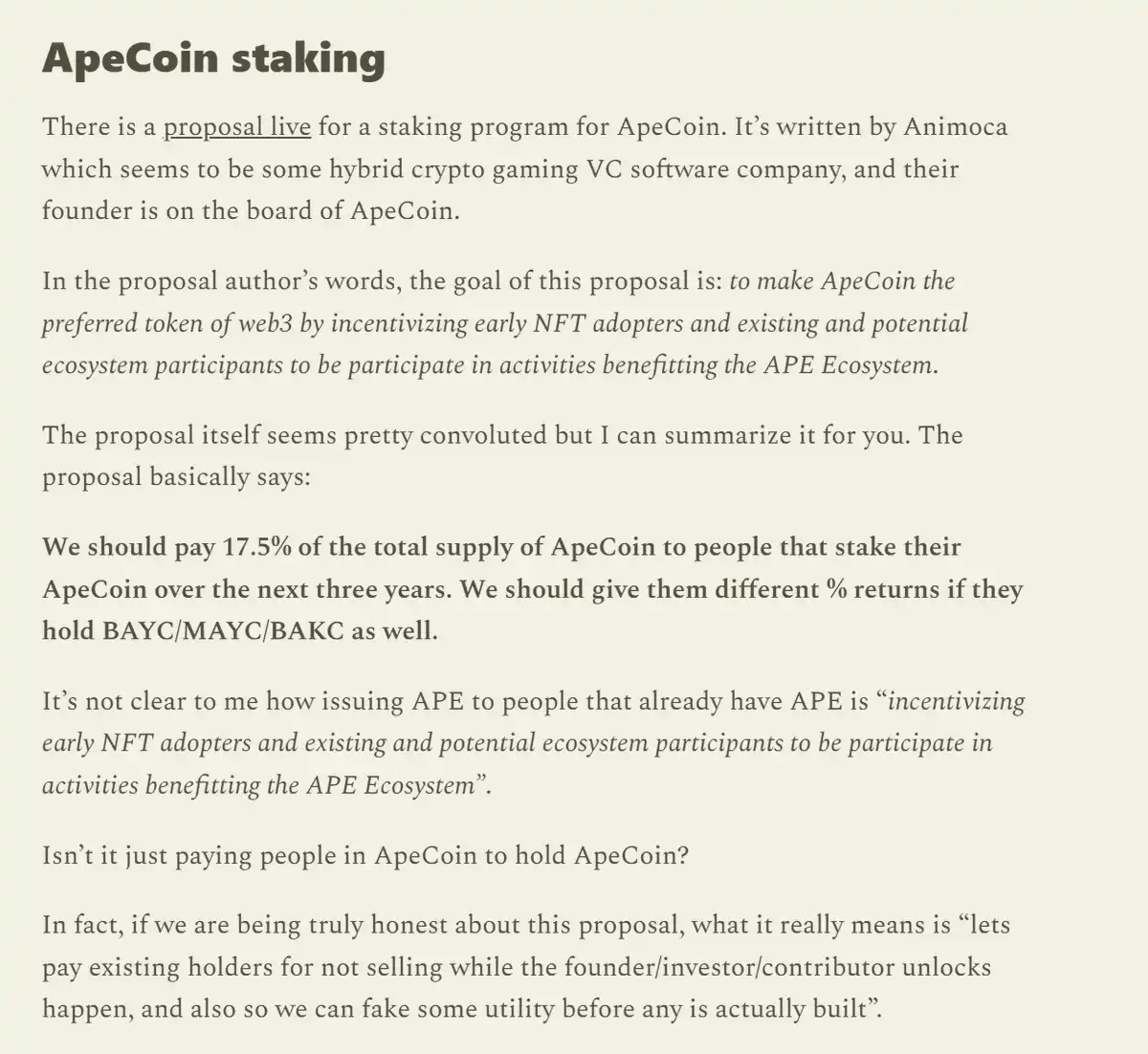
If you are a token pessimist, crypto nihilist, or just bearish, this alignment issue is what you are concerned about.
Or, looking from the same article: "The staking mechanism should be designed to support the ecosystem's goals."
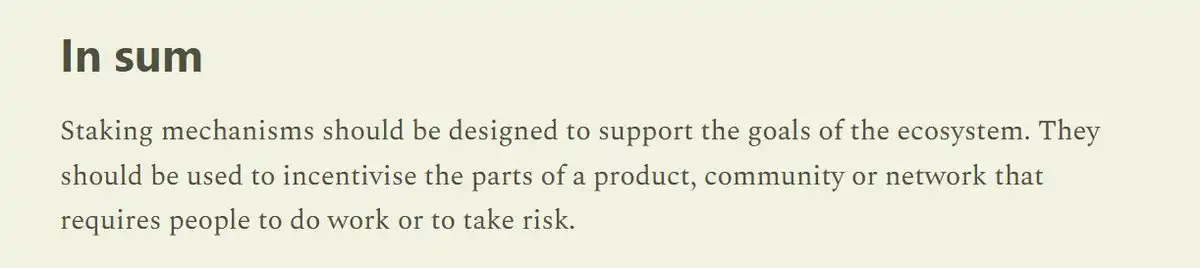
Locking token dilution behind KPIs that should actually reflect the MegaETH ecosystem's value growth is a mechanism far superior to any typical staking mechanism we saw during the 2020-2022 liquidity mining era. In that era, tokens were issued regardless of the team's fundamental progress or ecosystem growth.
Therefore, the net effect is MEGA dilution:
· Constrained by the corresponding MegaETH ecosystem growth
· Diluted into the hands least likely to sell MEGA
This does not guarantee an increase in MEGA value—the market will do what the market wants to do. But this is an effective and honest attempt aimed at addressing what seems to be a core underlying issue affecting the entire cryptocurrency token industry complex.
Viewing Tokens as Equity
Historically, teams have been "spray-and-praying" their tokens into the ecosystem. Airdrops, mining rewards, grants, etc.—if what they were distributing was truly valuable, teams wouldn't engage in these activities.
Because teams distributed tokens like distributing valueless governance tokens, the market priced them as valueless governance tokens.
Following Binance opening MEGA token futures on its platform (Binance historically attempted to extort teams with this), you can see the same philosophy in MegaETH's approach to listing on CEX:
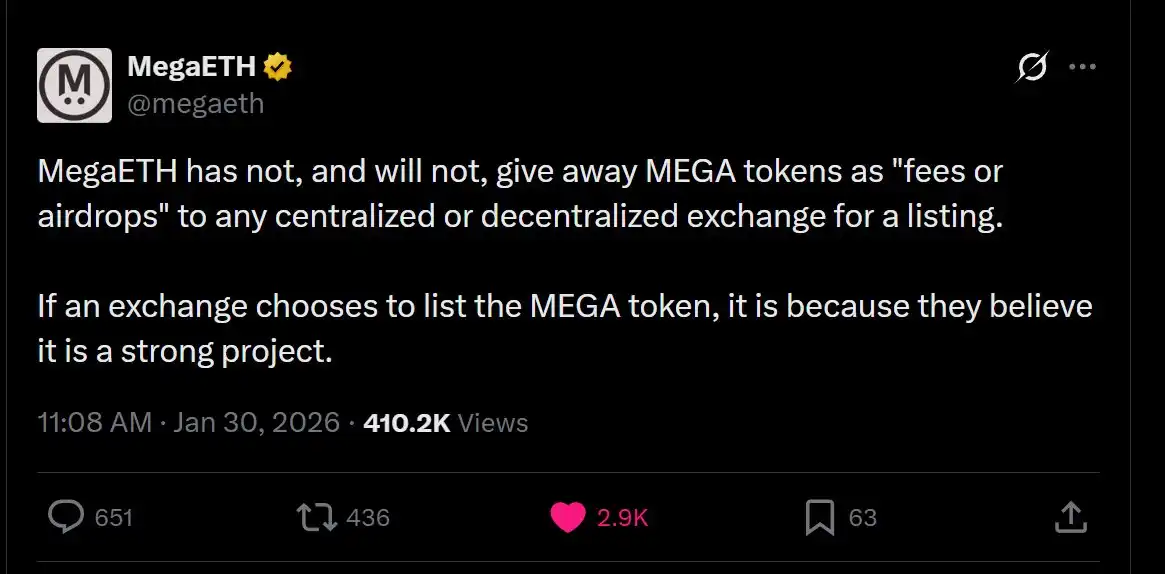
Hopefully, teams will start to be more selective in their token distribution. If teams start to treat their tokens as precious, perhaps the market will respond in kind.
Cap's Stable Airdrop
The stablecoin protocol Cap introduced a "stablecoin airdrop" (stabledrop) instead of a traditional airdrop. They did not airdrop the native governance token CAP but distributed the native stablecoin cUSD to users who received Cap points.
This approach incentivizes liquidity providers with real value rewards, fulfilling a social contract. Users depositing USDC into Cap's supply side accept smart contract risk and opportunity cost, with the stablecoin airdrop compensating them accordingly.
For those interested in acquiring CAP itself, Cap is conducting a token sale via Uniswap CCA. Anyone seeking CAP tokens must become a true investor and commit real capital.
Filtering for True Holders
The combination of stablecoin airdrops and token sale has filtered for strong holders. A traditional CAP airdrop would flow to speculative farmers who might sell immediately. By requiring capital investment through the token sale, Cap ensures that CAP flows to participants willing to accept all downside risk for the upside potential—those more likely to hold long term.
The theory is that this structure, by creating a concentrated holder base aligned with the protocol's long-term vision, provides CAP with a higher likelihood of success than a less precise airdrop mechanism that disperses tokens to those solely focused on short-term gains.
Watch this video: https://x.com/DeFiDave22/status/2013641379038081113
Token Design Maturing
The protocol has become more intelligent and precise in its token distribution mechanism. No longer a shotgun-spray of airdropped tokens hoping for the best—MegaETH and Cap are selective in who receives their tokens.
“Distribution optimization” is no longer a thing—it may be a toxic hangover from the Gensler era. Instead, these two teams are optimizing for concentration to provide a stronger foundational holder base.
I hope that as more applications come online by 2026, they can observe and learn from these strategies, even iterate on them, so the “quality token issue” is no longer a problem, and we are left with only “quality tokens.”
You may also like

Kalshi's eight-year entrepreneurial history: A boxer in a suit steps onto the stage

Once you're over 25, you're already too old to be playing with meme coins.

Four New Frontlines Post Ceasefire | Rewire News Daily Brief

Holmez accepts Bitcoin for toll payment, how much can Iran earn?

When No One on the Team Wants to Sell: The Valuation Game at Anthropic Enters the “Seller Disappearance” Stage

Anthropic's new product, powerful enough to make the AI Agent Infrastructure team unemployed?

Trump Admin's $950 Million Bet on Oil Price Plunge Before Ceasefire Turned Crude Market into Insider Trading Heaven

Why Did Trump Take the US into War with Iran?
From Threat to Ceasefire: How Did the U.S. Lose Its Dominance?

How long can the Ethereum ecosystem survive after the launch of Mythos?

Morning News | Yi Lihua establishes AI fund OpenX Labs; Pharos Network completes $44 million Series A financing; Iran demands that Hormuz tankers pay Bitcoin as tolls

Ray Dalio's new article: The world is entering a war cycle
IOSG: When Fintech Meets Crypto Native: The Next Decade of Digital Finance

They knew in advance that Trump would tweet about a ceasefire, entered with $20k, and exited with $400k.
The biggest bottleneck in DeFi development
CZ Memoir Released: Reveals a Large Amount of Industry Insider Information, Prompting Intense Rebuttal from Xu Mingxing

a16z: After securities are on the blockchain, why will intermediary institutions be replaced by code?

XRP Tokyo Is Here: What We Learn and What’s Next for XRP Price
Key Takeaways: Ripple’s 2025 XRP Tokyo event highlights a projected $33 trillion on-chain stablecoin volume by 2026. Significant…


 App
App