
 Buy Crypto
- Markets
 Futures
- Spot
- Copy Trade
- Earn
- More
Disaster to Gambling Site? Polymarket Stirs Controversy with "California Wildfire Prediction Market"

Original Article Title: Polymarket faces backlash over 'sick' California wildfire markets
Original Author: Protos Staff
Original Translation: Ashley, BlockBeats
Editor's Note: The article criticized the prediction market platform Polymarket for the controversy surrounding users speculating on the California wildfires. Against the backdrop of wildfires that have already caused multiple deaths and forced tens of thousands to evacuate, users apathetically bet on the development of the disaster, with some prediction pools reaching up to $100,000. This behavior of "gambling" on a public disaster has sparked intense moral questioning.
The following is the original content (slightly rephrased for better understanding):
Wildfire 'Gambling' Sparks Outrage
Polymarket is currently facing widespread criticism for its "disgusting" prediction markets, where the platform is allowing bets on the ongoing California wildfires.
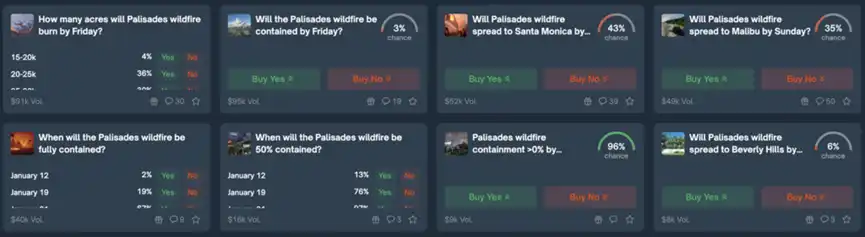
The wildfires broke out in the Hollywood Hills on Wednesday and quickly spread across various parts of Los Angeles. As of now, five deadly wildfires have led to over 137,000 evacuations and claimed the lives of 5 individuals.
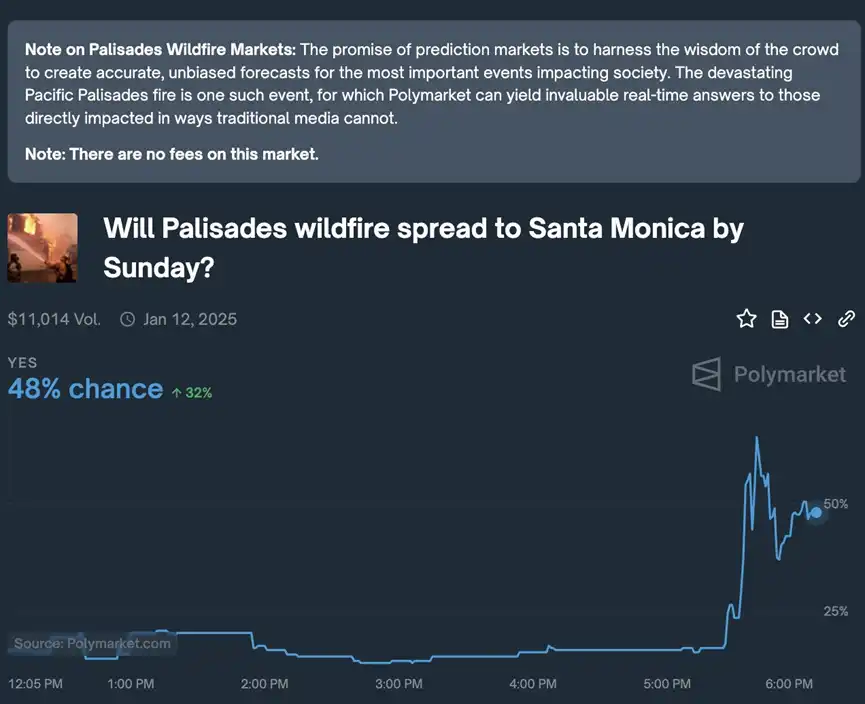
Many Polymarket users have taken advantage of this situation to create various prediction markets related to the spread of the fire, when the fire will be brought under control, and potential resignations of political figures, among others. The trading volume for some markets has approached $100,000.

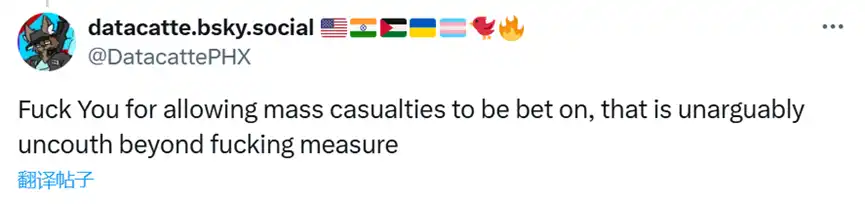
However, many netizens are not buying into these markets and Polymarket's promotion. One user on X platform bluntly stated, "Betting on a wildfire is truly sick." Another user expressed that betting on such a tragedy is "unacceptably shameless no matter what."

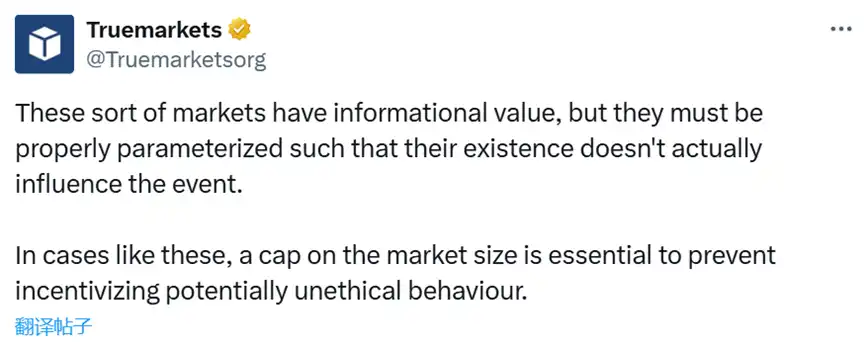
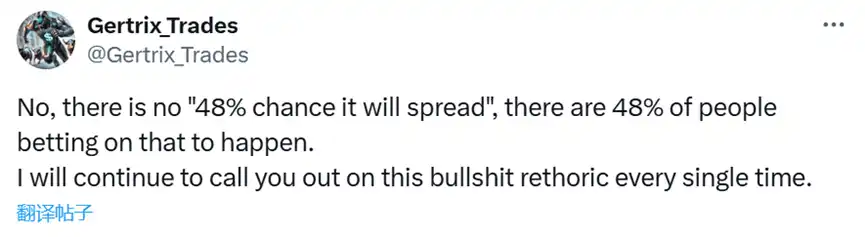
Some users are even concerned that wildfire prediction markets may encourage arsonists to increase their bet's success rate. One user pointed out that the odds of these markets are entirely based on gamblers' emotions and responded to Polymarket's post saying, "No, there is no '48% chance of spreading,' it's just that 48% of people are betting on it happening."
For Polymarket, such strong opposition is nothing new. Last year, in the Titan Submersible Disaster market, the platform faced similar criticism for allowing users to bet on whether the submersible would explode, leading to the death of 5 passengers.
To mitigate its liability across at least 10 different Wildfire markets, Polymarket added a brief disclaimer stating that it leverages "crowdsourced wisdom" to create "accurate and objective event predictions." The disclaimer states: "The devastating Pacific Palisades wildfire is one such event where Polymarket can provide valuable real-time answers to those directly affected in a way that traditional media cannot."
It is worth noting that if you are truly affected by a wildfire, relying on news organizations actively reporting on the event is more reliable than a crypto prediction platform.
Crypto Companies Near the Wildfires
In addition to threatening millions of California residents, the rapidly spreading wildfires also pose a significant threat to several crypto companies and prominent community members. Many have already lost homes and belongings, including valuable hardware wallets.
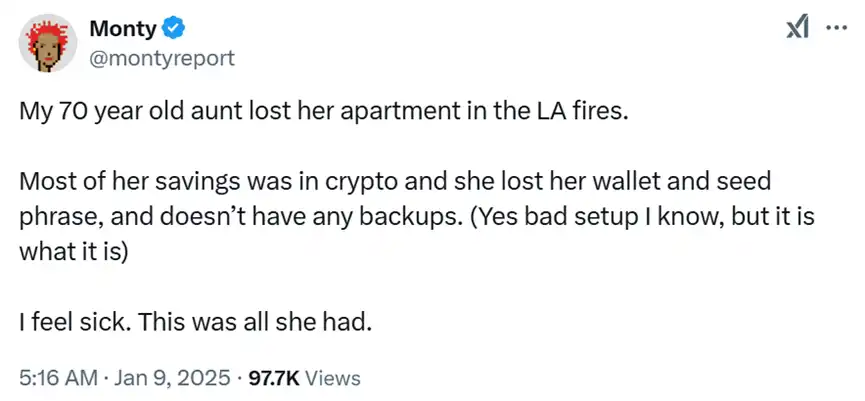
Employees of the Santa Monica Bitcoin Office are located just south of the Palisades and Getty fires. Several employees of Swan Bitcoin, which previously hosted the Pacific Bitcoin conference in Santa Monica, are also in the southern fire-affected region.
Blockchain service provider BlockDaemon is headquartered in Los Angeles, along with another crypto game developer, SuperVerse. Blockchain-based identity verification and tokenization company SpringLabs is headquartered in the nearby Marina del Rey.
Some companies have been relatively fortunate. As of now, the Crypto.com Arena in downtown Los Angeles has not been impacted by the fires. Crypto entertainment venues DaBank and Jungla in Hawthorne and North Hollywood have also temporarily been spared from the wildfires.
You may also like

Cyber Taoist Fortune Teller: Fake Taoist, AI Fortune Telling, and Northeastern Metaphysics History

Bloomberg: Stablecoin Payments Emerge as Crypto VC's Newest Favorite Thing
BeatSwap is evolving towards a full-stack Web3 infrastructure, covering the entire lifecycle of IP rights.
BeatSwap, a global Web3 Intellectual Property (IP) infrastructure project, is attempting to overcome the current fragmentation limitations of the Web3 ecosystem, building a full-stack system that covers the entire lifecycle of IP rights.
Currently, most Web3 projects are still in the stage of functional fragmentation, often focusing only on a single aspect, such as IP asset tokenization, transaction functionality, or a simple incentive model. This structural dispersion has become a key bottleneck hindering the industry's scale application.
BeatSwap's approach is more integrated, integrating multiple core modules into the same system, including:
· IP authentication and on-chain registration
· Authorization-based revenue sharing mechanism
· User-engagement-driven incentive system
· Transaction and liquidity infrastructure
Through the above integration, the platform builds an end-to-end closed-loop path, allowing IP rights to complete a full cycle of "creation, use, and monetization" within the same ecosystem.
BeatSwap is not limited to existing crypto users but is attempting to take the global music industry as a starting point, actively creating new market demand. Its core strategies include:
Exploring and incubating music creators (Artist discovery)
Building a fan community
Igniting IP-centric content consumption demand
The current global music industry is valued at around $260 billion, with over 2 billion digital music users. This means that the potential market corresponding to the tokenization and financialization of IP far exceeds the traditional crypto user base.
In this context, BeatSwap positions itself at the intersection of "real-world content demand" and "on-chain infrastructure," attempting to bridge the structural gap between content production and financial flow.
BeatSwap's upcoming core product "Space" is scheduled to launch in the second quarter of 2026. This product is defined as the SocialFi layer in the ecosystem, aiming to directly connect creators with users and achieve deep integration with other platform modules.
Key designs include:
A fan-centric interactive mechanism
Exposure and distribution logic based on $BTX staking
User paths connected to DeFi and liquidity structures
Thus, a complete user behavior loop is formed within the platform: Discovery → Participation → Consumption → Rewards → Trading
$BTX is designed to be a core utility asset within the ecosystem, rather than just a simple incentive token, with its value directly tied to platform activity and IP use cases.
Main features include:
· Yield distribution based on on-chain authorized actions
· Value reflection based on IP usage and user engagement dynamics
· Support for staking and DeFi participation mechanisms
· Value growth driven by ecosystem expansion
With the increased frequency of IP use, the utility and value support of $BTX will enhance simultaneously, helping alleviate the "disconnect between value and utility" issue present in traditional Web3 token models to some extent.
Currently, $BTX has been listed on several mainstream exchanges, including:
Binance Alpha
Gate
MEXC
OKX Boost
As the launch of "Space" approaches, BeatSwap is actively pursuing more exchange listings to further enhance liquidity and global accessibility, laying a foundation for future market expansion.
BeatSwap's goal is no longer limited to the traditional Web3 narrative but aims to target over 2 billion digital music users and a trillion KRW-scale content market.
By integrating content creators, users, capital, and liquidity into a blockchain framework centered around IP rights, BeatSwap is striving to build a next-generation infrastructure focused on "IP tokenization."
BeatSwap integrates IP authentication, authorization distribution, incentive mechanism, transaction system, and market construction to establish a unified structure that bridges the full lifecycle path of IP rights.
With the launch of the Q2 2026 "Space," the project is expected to become a key infrastructure connecting content and finance in the IP-RWA (Real World Assets) track.

Mag 7 Evaporates $2 Trillion | Rewire News Morning Edition

Losing $19K per Coin Mined, Bitcoin Mining Firms Collective AI Defection

Morning Report | Tom Lee predicts that the cryptocurrency winter will end in April; xStocks introduces a new on-chain private equity fund; Sui mainnet upgraded to V1.68.1

Polymarket rules have changed, how should airdrop participants respond?

Crypto ETF Weekly | Last week, the net outflow of Bitcoin spot ETFs in the U.S. was $296 million; the net outflow of Ethereum spot ETFs in the U.S. was $206 million

This Week's Key News Preview | The U.S. Releases March Non-Farm Payroll Data; Polymarket Expands Fee Structure

Slow Down, That's the Answer to the Age of the Agent

From Cash to Cryptocurrency: Moving Towards a Unified Regulatory Path for Illegal Payments
Who will own the most Bitcoin in 2026

A private feud lasting 10 years, if not for OpenAI's "hypocrisy," would not have led to the world's strongest AI company, Anthropic

"Crypto Tsar" steps down: 130 days of political performance come to an end, how much of Trump's crypto promise remains?

From Utopian Narratives to Financial Infrastructure: The "Disenchantment" and Shift of Crypto VC
A decade-long personal feud, if not for OpenAI's "hypocrisy," there would be no globally leading AI company Anthropic

a16z: The True Meaning of Strong Chain Quality, Block Space Should Not Be Monopolized
a16z: The True Meaning of Strong Chain Quality, Block Space Should Not Be Monopolized
Cyber Taoist Fortune Teller: Fake Taoist, AI Fortune Telling, and Northeastern Metaphysics History
Bloomberg: Stablecoin Payments Emerge as Crypto VC's Newest Favorite Thing
BeatSwap is evolving towards a full-stack Web3 infrastructure, covering the entire lifecycle of IP rights.
BeatSwap, a global Web3 Intellectual Property (IP) infrastructure project, is attempting to overcome the current fragmentation limitations of the Web3 ecosystem, building a full-stack system that covers the entire lifecycle of IP rights.
Currently, most Web3 projects are still in the stage of functional fragmentation, often focusing only on a single aspect, such as IP asset tokenization, transaction functionality, or a simple incentive model. This structural dispersion has become a key bottleneck hindering the industry's scale application.
BeatSwap's approach is more integrated, integrating multiple core modules into the same system, including:
· IP authentication and on-chain registration
· Authorization-based revenue sharing mechanism
· User-engagement-driven incentive system
· Transaction and liquidity infrastructure
Through the above integration, the platform builds an end-to-end closed-loop path, allowing IP rights to complete a full cycle of "creation, use, and monetization" within the same ecosystem.
BeatSwap is not limited to existing crypto users but is attempting to take the global music industry as a starting point, actively creating new market demand. Its core strategies include:
Exploring and incubating music creators (Artist discovery)
Building a fan community
Igniting IP-centric content consumption demand
The current global music industry is valued at around $260 billion, with over 2 billion digital music users. This means that the potential market corresponding to the tokenization and financialization of IP far exceeds the traditional crypto user base.
In this context, BeatSwap positions itself at the intersection of "real-world content demand" and "on-chain infrastructure," attempting to bridge the structural gap between content production and financial flow.
BeatSwap's upcoming core product "Space" is scheduled to launch in the second quarter of 2026. This product is defined as the SocialFi layer in the ecosystem, aiming to directly connect creators with users and achieve deep integration with other platform modules.
Key designs include:
A fan-centric interactive mechanism
Exposure and distribution logic based on $BTX staking
User paths connected to DeFi and liquidity structures
Thus, a complete user behavior loop is formed within the platform: Discovery → Participation → Consumption → Rewards → Trading
$BTX is designed to be a core utility asset within the ecosystem, rather than just a simple incentive token, with its value directly tied to platform activity and IP use cases.
Main features include:
· Yield distribution based on on-chain authorized actions
· Value reflection based on IP usage and user engagement dynamics
· Support for staking and DeFi participation mechanisms
· Value growth driven by ecosystem expansion
With the increased frequency of IP use, the utility and value support of $BTX will enhance simultaneously, helping alleviate the "disconnect between value and utility" issue present in traditional Web3 token models to some extent.
Currently, $BTX has been listed on several mainstream exchanges, including:
Binance Alpha
Gate
MEXC
OKX Boost
As the launch of "Space" approaches, BeatSwap is actively pursuing more exchange listings to further enhance liquidity and global accessibility, laying a foundation for future market expansion.
BeatSwap's goal is no longer limited to the traditional Web3 narrative but aims to target over 2 billion digital music users and a trillion KRW-scale content market.
By integrating content creators, users, capital, and liquidity into a blockchain framework centered around IP rights, BeatSwap is striving to build a next-generation infrastructure focused on "IP tokenization."
BeatSwap integrates IP authentication, authorization distribution, incentive mechanism, transaction system, and market construction to establish a unified structure that bridges the full lifecycle path of IP rights.
With the launch of the Q2 2026 "Space," the project is expected to become a key infrastructure connecting content and finance in the IP-RWA (Real World Assets) track.


 App
App