
Etherscan's Surcharge Scandal Exposes Ethereum Ecosystem's Data Dependency Dilemma

Original Article Title: "Etherscan Cancels Several Free APIs, Revealing Unforeseen Issues"
Original Article Author: Eric, Foresight News
On November 23, Lefteris Karapetsas, the founder of the open-source portfolio tracker Rotki, took to Twitter to complain about Etherscan. He mentioned that during Devcon, Etherscan suddenly announced that they would no longer provide free APIs for the Avalanche C-Chain, Base, BNB Chain, and OP Mainnet block explorers.
While he understood the pressure of providing free services, he questioned why there was no advance notice or why such a decision was made during a major event when everyone was away, leading to a "sudden attack" without any time to react.
According to Etherscan's announcement, as the chain's performance gradually improved, the data volume also increased significantly, leading to a substantial rise in costs. In this situation, they could no longer afford to provide all APIs for free and had to reluctantly convert some previously free APIs into paid versions.
It is evident that the decision to no longer offer free APIs for specific chains was likely due to insufficient funding or resource support.
Finally, the founder expressed some confusion, questioning why, apart from Avalanche, Base, OP Mainnet, and BNB Chain did not have enough money to support such critical services.
However, opposing voices quickly emerged, with the founder of Routescan and operator of the Avalanche block explorer Snowtrace, Jack, at the forefront. Jack provided some industry-insider data:
· Etherscan charges supported chains approximately between $1.5 million to $2 million annually, with some as low as around $300,000, but providing only basic data;
· For chains that are already paying, Etherscan only provides a free API with 5 RPS (Requests Per Second), and for additional requests, the monthly subscription fee can go up to $899.
· Last month, the independent visitor numbers of various chain explorers on Etherscan were as follows: OP Mainnet, 102k; BNB Chain, 2.5M; Base, 1M; HyperEVM, 30k; Avalanche, 16k. Etherscan itself had 4M visitors.
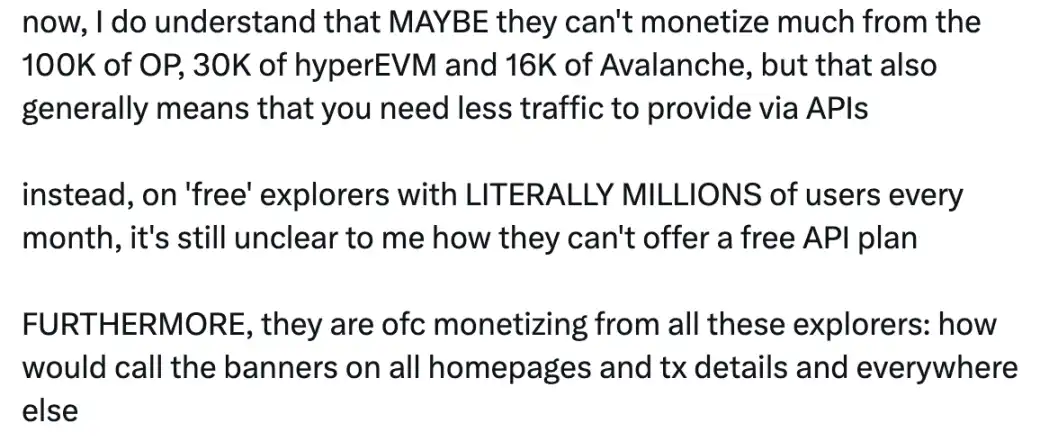
The CEO's implicit meaning is: Charging for a small number of APIs is indeed due to financial constraints, not because we find the income insignificant. For some chains that don't pay us, we have offered free service for a while and have done our utmost. Let's stop arguing about this and move on.
There isn't much to say about the discussion on this issue; it's simply a matter of some people thinking Etherscan is too greedy, while others view it as justifiable business behavior. However, some discussions arising from this event are quite interesting.
First of all, it was through this incident that the author learned about an ecosystem alliance called VERA, which promotes convenient, standardized, and open access to EVM smart contract source code, as well as the Open Labels Initiative, which drives the standardization framework and data model for EVM address labels. The fundamental goal of both organizations is to support the accessibility of blockchain data, especially validation.
The Open Labels Initiative retweeted Lefteris Karapetsas's complaint tweet, stating that over the past year, they have been working to prevent incidents like this caused by overreliance on centralized on-chain data providers. They believe that such critical infrastructure should not be monopolized but rather co-developed.
Entities such as sourcefify.eth for verifying Ethereum contract code, the Ethereum data visualization platform growthepie, the open-source block explorer Blockscout, and the previously mentioned Routescan are all contributing to the readability and accessibility of Ethereum data.
According to Akshat Mittal, a DeFi engineer at Reserve Protocol, Etherscan has not been involved in these initiatives. Is it for commercial gain? No one knows, but even if it is, it's understandable. The Ethereum ecosystem will always have individuals who adhere to open-source culture and reject excessive commercialization, which is not a matter of right or wrong but rather showcases the diversity of the ecosystem. Profit-driven institutions can ensure service quality, while open-source products will still have their place.
Furthermore, there has been recent effusive praise by IC's zCloak Network founder 0xFrancis, once again comparing IC to Ethereum.
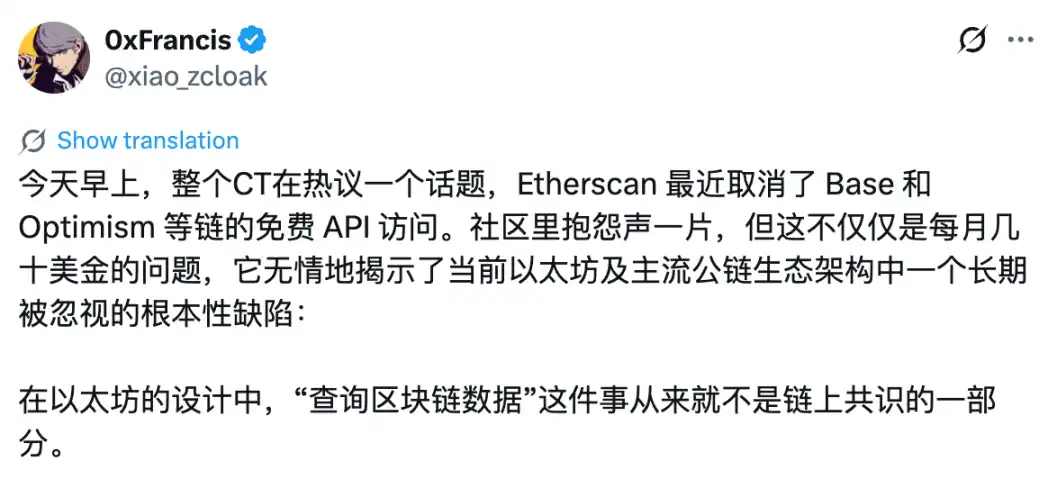
0xFrancis argues that Ethereum does not include "querying block data" as part of its consensus, so DApp development must rely on third-party RPC services. If RPC nodes collectively go offline, the chain will still run but become "unreadable."
Going deeper, if centralized RPC nodes or websites like Etherscan provide false data, they can easily deceive users. The Internet Computer (IC) incorporates querying as part of its protocol. When someone initiates a query, the request is executed through the ICP node network and returns cryptographically authenticated data to ensure its accuracy.
0xFrancis's point is not unfounded. This can be seen as a case of IC being too forward-thinking, with the Etherscan fee controversy being a typical debate about centralization versus decentralization. However, could it be that Ethereum's imperfections and the need for commercialized components have actually contributed to the ecosystem's prosperity?
You may also like

The payment moment of AI agents: Who will become the Stripe of the machine economy?

Rented Tracks: What is this wave of stablecoin FX hot money really paying for?

Strategy should have said that selling coins is not ruled out

How MegaETH Achieved a TVL of 700m Within a Week of TGE? Analyzing the Packaging Strategy

Futures Trading Hours: Trade Cryptocurrency 24/7 and Earn Back Up to 45% in Trading Fees
Learn futures trading hours and the best time to trade crypto futures. Discover 24/7 market insights, peak trading sessions, and how to earn back up to 45% in fees.

Why is a16z Crypto raising another $2.2 billion to heavily invest in Web3?
Polymarket Underlying Algorithm Explained

What do projects born in the crypto bear market do?

a16z founder's Stanford lecture: Whenever Wall Street and Silicon Valley have different ideas, it's Wall Street that ends up being wrong

Michael Saylor: After three consecutive quarters of losses, Strategy will sell Bitcoin to pay dividends
The toll station at Hormuz and the RMB that cannot be bought

Interview with Coinbase Institutional's Strategic Head: The Institutionalization of Crypto Reaches a Critical Point

Dialogue with Agora CEO Nick: The battle for stablecoin licenses has just begun

Morning Report | a16z Crypto completes $2.2 billion fundraising for its fifth fund; Bullish invests $4.2 billion to acquire share transfer agency Equiniti; PayPal's Q1 performance exceeds expectations

a16z Crypto: What We See Behind the $2.2 Billion New Fund
Web3 is dead, Web2+3 should rise
Stablecoins and Latin American Remittances: The Misunderstood $174 Billion Market

The arrival of the Web 3.0 era: A review of Hong Kong court rulings on digital assets
The payment moment of AI agents: Who will become the Stripe of the machine economy?
Rented Tracks: What is this wave of stablecoin FX hot money really paying for?
Strategy should have said that selling coins is not ruled out
How MegaETH Achieved a TVL of 700m Within a Week of TGE? Analyzing the Packaging Strategy
Futures Trading Hours: Trade Cryptocurrency 24/7 and Earn Back Up to 45% in Trading Fees
Learn futures trading hours and the best time to trade crypto futures. Discover 24/7 market insights, peak trading sessions, and how to earn back up to 45% in fees.
Why is a16z Crypto raising another $2.2 billion to heavily invest in Web3?


