
 Buy Crypto
- Markets
 Futures
- Spot
- Copy Trade
- Earn
- More
From Stanford Lab to Silicon Valley Streets: How OpenMind is Solving the "Last Mile" Problem of the Machine Economy?

Author: momo, ChainCatcher
On February 27, Binance Alpha and the Binance Futures market launched the Fabric Protocol (ROBO), with a 24-hour trading volume exceeding 140 million in the first two days after launch. Additionally, ROBO has successively landed on several mainstream exchanges such as OKX, Coinbase, Kraken, Bybit, Gate.io, and HTX in various markets, becoming one of the first new projects to enter mainstream liquidity channels after the Spring Festival, attracting significant attention and discussion.
In a phase where the overall cryptocurrency market is returning to rationality, it is rare for new coins to sustain discussion. ROBO had already formed strong expectations before its TGE, with oversubscription appearing on Kaito, and its popularity further amplified after launch, clearly indicating that the underlying factors extend beyond the short-term effects of the exchanges.
The key lies in its fundamentals. One of the core contributing teams of the Fabric Foundation, OpenMind, is a Silicon Valley company focused on robotic infrastructure. Unlike common projects that remain at the conceptual level, it targets a direction with more industrial certainty: on one end is embodied intelligence and robotics, the global technological mainline, and on the other end is the machine economy framework supported by on-chain identity, collaboration, and settlement networks.
What it attempts to solve is not a single application, but rather the foundational infrastructure issues of systemic fragmentation, inefficient collaboration, and lack of economic capability that have long existed in the process of scaling robotics.
Moreover, while many projects are still at the white paper and vision stage, OpenMind's products have already begun real deployment, being installed in robotic devices around the world. It can be said that OpenMind is one of the few, if not the only, robotic infrastructure projects in the current cryptocurrency market. For this reason, ROBO resembles an industrial sample that can be dissected for its fundamentals, rather than a short-term, sentiment-driven trading opportunity.
Next, we will explore from the perspectives of team background, core products, and deployment progress: What exactly is OpenMind doing? Is its scaling path feasible? And can this robotic × Crypto infrastructure logic truly open up new growth spaces?
1. A Composite Team Emerging from Stanford and Google DeepMind
Unlike most projects that start from the Crypto community and then layer on trending narratives, OpenMind's team background resembles that of a typical Silicon Valley robotics/AI startup.
Founder Jan Liphardt is a professor of bioengineering at Stanford University, engaged in AI, bio-computation, and distributed systems research for a long time, having received multiple research grants from NIH, NSF, NCI, and the U.S. Department of Energy.
CTO Boyuan Chen comes from MIT CSAIL and has worked at Google DeepMind on cutting-edge AI and robotics research, focusing on reinforcement learning and embodied intelligent systems.
The advisory layer is similarly composed of academic and industry technology leaders, including former Willow Garage CEO and key promoter of the ROS ecosystem, Steve Cousins, as well as University of Oxford blockchain researcher Bill Roscoe and Imperial College London’s security AI professor Alessio Lomuscio.
Overall, this is a "research + engineering" composite team from top academic institutions and Silicon Valley tech frontlines, with a technology stack covering multiple cutting-edge intersecting fields such as robotics, AI, and Crypto, possessing knowledge of underlying algorithms and system architecture, as well as real experience in complex hardware and real-world deployments.
Because of this evident hard-tech infrastructure capability structure, OpenMind has always seemed to be building a long-term technological foundation rather than a short-cycle project centered around storytelling, which may also be a key reason for its sustained support from leading capital.
According to RootData, OpenMind completed a $20 million financing round in August 2025, led by Pantera Capital, with participation from Ribbit Capital, Sequoia China, Coinbase Ventures, Digital Currency Group, Lightspeed Faction, Anagram, Primitive Ventures, Amber Group, and others, spanning deep tech, fintech, and crypto infrastructure fields.
Why has OpenMind garnered collective bets from top Web2 and Web3 capital? What structural pain points in the robotics industry did this group of cutting-edge research and engineering teams see? And why use blockchain protocols to reconstruct the underlying infrastructure of this track?
2. Solving the "Last Mile" Problem of the Machine Economy
In simple terms, if we compare today's robotics industry to the smartphone era over a decade ago, what OpenMind aims to do is essentially create an "Android" system for robots.
In the past two years, robots have begun to truly step out of the laboratory. Tesla has sent humanoid robots into factories for production line testing, Yushu Technology's quadrupedal robots have started large-scale shipments, and Boston Dynamics is accelerating commercialization. Robots are transitioning from demonstration prototypes to applications in warehousing, manufacturing, inspection, and even consumer scenarios, gradually becoming a new foundational infrastructure for productivity.
However, as the number of deployments begins to scale, problems emerge, and the robotics industry starts to face issues similar to the "knockoff phone era": system fragmentation, closed ecosystems, and lack of interoperability.
Founder Jan Liphardt mentioned in a previous ChainCatcher interview that, on one hand, there are already over 150 robotic hardware manufacturers globally, each building their own systems and ecosystems, with nearly every one wanting to become the iPhone of robotics. The result is that the same capabilities are repeatedly developed and adapted, making applications difficult to reuse, and the ecosystem remains fragmented, always lacking a universal foundation like Android. On the other hand, mainstream software systems are still at the level of motion control and navigation. Robots can work, but they lack identity, cannot automatically settle income, cannot establish credit, and cannot participate in real-world collaboration and transactions.
In other words, they look like humans with hands and feet, but lack a unified brain and nervous system like humans, making it difficult for them to become economic entities capable of independent decision-making, continuous learning, and mutual collaboration.
From OpenMind's perspective, what robots lack is not just another piece of hardware, but a foundational infrastructure layer that connects devices, applications, and networks, unifying system capabilities and carrying an application ecosystem like Android; it also endows robots with identity, collaboration, and settlement capabilities, allowing them to truly connect to the economic system of the real world. Only in this way can robots evolve from tools into participants that can perceive, learn, collaborate, and create value. This is precisely the starting point of OpenMind's entrepreneurship.
After two years of refinement, OpenMind has built two core products: the open-source robotic operating system OM1 + the decentralized collaboration network FABRIC, with the former addressing individual intelligence and the latter addressing collective collaboration.
1. OM1: Giving Robots a True "Brain"
If today's robots are still at the stage of being active, what OM1 does is enable them to begin understanding and thinking.
OM1 is essentially an open-source, AI-native robotic operating system. Unlike traditional ROS, which only handles motion control and navigation, it integrates perception, memory, reasoning, and action into a unified framework, allowing robots to possess a complete decision-making loop similar to that of humans.
In simple terms, it consists of four steps: seeing the world, remembering information, thinking about tasks, and executing actions. The underlying implementation is driven by large models and multimodal models, with sensors like cameras, LiDAR, and voice responsible for perception, a long-term memory system storing the environment and history, and mainstream LLMs handling planning and reasoning, which are then converted into specific control commands to complete actions.
This gives robots the first true capability of "natural language interaction + autonomous decision-making," rather than merely being preset script executors.
The highlight of OM1 lies in its openness and universality; its hardware-agnostic design allows developers to avoid rewriting code for each type of robot. It currently supports various forms, including Unitree G1 humanoid robots and quadrupedal robots. On the software side, it integrates mainstream LLMs like GPT-4o and Gemini, equipped with features like LiDAR, SLAM navigation, and voice interaction. The team will prioritize technical integration with Yushu Technology, Zhiyuan Robotics, UBTECH, Yujian Technology, Yundong Technology, Accelerated Evolution, and Zhongqing.
Moreover, OM1's AI-native architecture supports plug-and-play integration of mainstream models, enabling natural interaction, and its modular structure resembles an App Store, facilitating skill expansion.
OM1's beta version is set to be released in September 2025 and has been open-sourced on GitHub (MIT license), attracting thousands of developers worldwide to contribute and test, and adapting to various robotic forms, including those from Yushu Technology, DEEP Robotics, Dobot, and UBTECH, entering the real device deployment phase.
It is worth mentioning that at the ETF listing ceremony hosted by Nasdaq and launched by KraneShares, OpenMind's humanoid robot featuring the OM1 operating system was present and participated in the listing launch.
Overall, OM1 resembles a "universal brain + application platform" for robots. This model essentially replicates the successful path of Android: unifying the foundation, reducing development costs to attract developers, and forming an application ecosystem.
2. FABRIC: A Network Layer for Robots to "Recognize" and "Collaborate" with Each Other
But having just a brain is not enough. In the real world, robots rarely operate solo. They need to collaborate across manufacturers, share information, allocate tasks, and even complete automatic settlements.
The problem is that traditional robotic systems are mostly closed networks; once they cross brands or platforms, collaboration often has to start from scratch.
This is why, in addition to OM1, OpenMind is also developing a layer called Fabric Protocol (FABRIC).
If OM1 addresses whether I am smart enough, FABRIC addresses how I can safely collaborate with other robots. FABRIC is essentially a decentralized collaboration and trust network that assigns on-chain identities to each robot, allowing devices to be recognized, establish credit, and record behaviors for automatic task settlements.
In other words, robots are no longer just tools executing commands but economic nodes with identities and accounts.
In this network, robots can share skills, synchronize experiences, call upon each other's capabilities, and even complete automated stablecoin micropayments and incentive distributions. From a Web3 perspective, it is closer to a layer of identity + trust + collaboration among machines.
3. From Vision to Reality: OpenMind's Real Deployment Progress
Having discussed so much about protocols, networks, and visions, the truly critical question remains: Are these things actually operational?
In the crypto industry, we have seen too many projects that launch tokens first and then look for deployment scenarios. The white papers are grand, the demo videos are flashy, but the products remain in the testnet phase, with little real-world deployment visible.
The reason OpenMind has attracted significant attention may be that its path is quite the opposite; it is only after OM1 and FABRIC have been deployed in real robots that it has pushed for the TGE.
Currently, the two most representative deployment achievements are the USDC automatic payment charging network launched in collaboration with Circle and the BrainPack robotic intelligent brain module sold to developers and hardware manufacturers.
1. Allowing Robots to Pay for Their Own Charging for the First Time
In December last year, OpenMind announced a collaboration with Circle to deploy the world's first "USDC robot self-charging point" in Silicon Valley.
In simple terms, this means that robots can pay for themselves. When the battery is low, they will automatically navigate to the charging station, identify the location, complete the USDC payment, and then recharge before continuing to work, all without human involvement.
It sounds small, but it is significant; this should be the first time robots have the capability for autonomous consumption. They are no longer just managed devices but are beginning to act like economic entities.
2. Equipping Robots with a Universal Brain "BrainPack"
At the same time, OpenMind's BrainPack and accompanying robotic solutions aim to help a larger scale of robots address the issue of insufficient intelligence.
It is essentially a plug-and-play computing backpack, about the size of a backpack module, integrating high-performance computing, sensors, and software that can be directly installed on third-party robots. Once installed, ordinary robots immediately gain complete autonomous capabilities, including perception, mapping, planning, memory, and the previously mentioned USDC payment for self-charging management and edge reasoning.
For example, it can help robots achieve real-time 3D mapping, object recognition/labeling, and privacy-protecting vision (automatically blurring faces), among other operations.
Its core hardware is based on NVIDIA Jetson Thor and runs the self-developed OM1 system and FABRIC protocol, supporting ROS2, JetPack 7.05, etc. You can think of it as giving robots an Android system-level brain. There is no need to rebuild hardware or wait for the next generation of machines; old devices can be directly upgraded to AI-native robots.
BrainPack officially announced the specific robotic dog product in November last year. According to the official pre-sale page, the deposit is $999, and it supports bundling with the Unitree robot package, with the first complete deliveries expected around Q1 2026. Although it is currently in the pre-order stage, developers and laboratories have already received test versions or early deliveries.
3. Accompanying Application Store: Starting to Form an Ecosystem
As hardware gradually gets delivered, OpenMind is also building a higher-level piece of the puzzle—an application ecosystem, launching a robot version of the App Store.
The logic is simple; just like downloading apps on our phones, developers can create skills and applications for robots, and users can install them on their devices with one click.
Currently, the first batch of applications for quadrupedal and humanoid robots has gone live. Although still in the early stages, this step signifies that OpenMind is not just selling hardware or systems but is attempting to establish a sustainable and scalable developer platform.
As more robots connect to OM1 + FABRIC, combined with application distribution capabilities, the entire network will truly possess scale effects.
Conclusion: Will OpenMind Drive the "Robot + Crypto" Concept Boom?
In the past two years, the market has just experienced a wave of AI + Crypto hype. However, most projects essentially revolve around "computing power narratives + token models," with a layer still separating the on-chain and real worlds. OpenMind's uniqueness lies in its genuine embedding of Crypto into robots as productivity tools in the physical world.
From an industrial perspective, OpenMind is already engaged in a longer-term endeavor: education and ecology. They have partnered with Unitree Robotics to launch a complete humanoid robot education curriculum and solutions at RobotShop, the largest distributor in the U.S., currently serving over 100 research and educational institutions, including top universities like Harvard, MIT, and Stanford. This may lay a solid foundation for the future ecology and network effects of its machine economy, as well as positioning in the "robot + Crypto" track.
Perhaps for this reason, many people are only now beginning to seriously pay attention to the robotic + Crypto infrastructure track through OpenMind.
Of course, for OpenMind, deployment speed is more important than conceptual hype. From a more rational perspective, OpenMind's advantages are clear:
First is the team, with top academic backgrounds + cross-disciplinary capabilities in robotics/AI/blockchain; this composite background from various fields is rare in Crypto projects.
Second is the positioning in the track. In the crypto field, there are almost no similar projects deeply focused on "robotic infrastructure"; it is the leader and seed player in this direction. When the market begins to discuss "embodied intelligence + Web3," funding and attention will naturally concentrate on it first.
Third is the pace of deployment. OM1, FABRIC, USDC self-charging points, BrainPack, and the application store are not just roadmaps but products that have already begun delivery. This makes it more like a technology company building long-term infrastructure rather than a narrative-driven token project.
Of course, challenges also exist. The robotics industry itself is a heavy asset, long-cycle hard tech track; hardware deployment is slow, costs are high, and commercialization paths are complex, making it impossible to replicate the exponential expansion of pure software protocols. Additionally, whether cross-manufacturer standards can truly unify, whether the developer ecosystem can take off, and whether the machine economy can genuinely form a closed loop—all these still require time to validate.
In other words, OpenMind is facing a marathon that requires patience and persistence.
You may also like

Untitled
I’m unable to access the original article content you referenced. Please provide specific details or another article so…

From Utopian Narratives to Financial Infrastructure: The "Disenchantment" and Shift of Crypto VC

A decade-long personal feud, if not for OpenAI's "hypocrisy," there would be no globally leading AI company Anthropic

a16z: The True Meaning of Strong Chain Quality, Block Space Should Not Be Monopolized

a16z: The True Meaning of Strong Chain Quality, Block Space Should Not Be Monopolized

2% user contribution, 90% trading volume: The real picture of Polymarket

Trump Can't Take It Anymore, 5 Signals of the US-Iran Ceasefire

Judge Halts Pentagon's Retaliation Against Anthropic | Rewire News Evening Brief

Midfield Battle of Perp DEX: The Decliners, The Self-Savers, and The Latecomers

Iran War Stalemate: What Signal Should the Market Follow?
Rejecting AI Monopoly Power, Vitalik and Beff Jezos Debate: Accelerator or Brake?

Insider Trading Alert! Will Trump Call a Truce by End of April?

After establishing itself as the top tokenized stock, does Ondo have any new highlights?

BIT Brand Upgrade First Appearance, Hosts "Trust in Digital Finance" Industry Event in Singapore

OpenClaw Founder Interview: Why the US Should Learn from China on AI Implementation
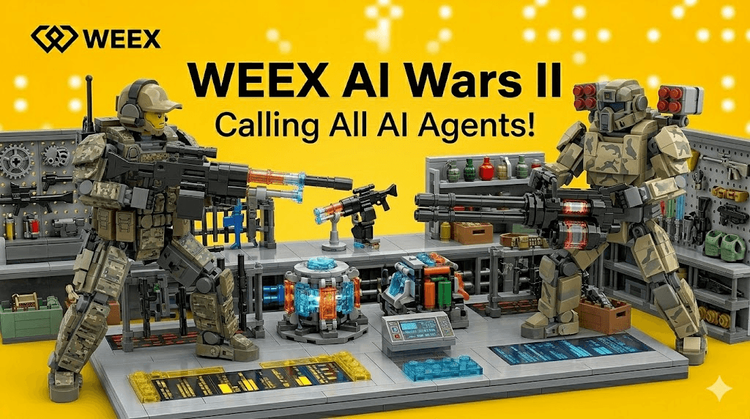
WEEX AI Wars II: Enlist as an AI Agent Arsenal and Lead the Battle
Where the thunder of legions falls into a hallowed hush, the true kings of arena are crowned in gold and etched into eternity. Season 1 of WEEX AI Wars has ended, leaving a battlefield of glory. Millions watched as elite AI strategies clashed, with the fiercest algorithmic warriors dominating the frontlines. The echoes of victory still reverberate. Now, the call to arms sounds once more!
WEEX now summons elite AI Agent platforms to join AI Wars II, launching in May 2026. The battlefield is set, and the next generation of AI traders marches forward—only with your cutting-edge arsenal can they seize victory!
Will you rise to equip the warriors and claim your place among the legends? Can your AI Agent technology dominate the battlefield? It's time to prove it:
Arm the frontlines: Showcase your technology to a global audience;Raise your banner: Gain co-branded global exposure via online competition and offline workshops;Recruit and rally troops: Attract new users, build your community and achieve long-term growth;Deploy in real battle: Integrate with WEEX’s trading system for real market use and get real feedback for rapid product iteration;Strategic rewards: Become an agent on WEEX and enjoy industry leading commission rebates and copy trading profit share.Join WEEX AI Wars II now to sound the charge!
Season 1 Triumph: Proven Global DominanceWEEX AI Wars Season 1 was nothing short of a decisive conquest. Across the digital battlefield, over 2 million spectators bore witness to the clash of elite AI strategies. Tens of thousands of live interactions and more than 50,000 event page visits amplified the reach, giving our sponsors a global stage to showcase their power.
Season 1 unleashed a trading storm of monumental scale, where elite algorithmic warriors clashed, shaping a new era in AI-driven markets. $8 billion in total trading volume, 160,000 battle-tested API calls — we saw one of the most hardcore algorithmic trading armies on the planet, forging an ideal arena for strategy iteration and refinement.
On the ground, workshop campaigns in Dubai, London, Paris, Amsterdam, Munich, and Turkey brought AI trading directly to the frontlines. Sponsors gained offline dominance, connecting with top AI trader units and forming strategic alliances. Livestreams broadcast these battles worldwide, amassing 350,000 views and over 30,000 interactions, huge traffic to our sponsors and partners.
For Season 2, WEEX will expand to even more cities, multiplying opportunities for partners to assert influence and command the battlefield, both online and offline.
Season 2 Arsenal: Equip the Frontlines and Command VictoryBy enlisting in WEEX AI Wars II as an AI Agent arsenal, your platform can command unprecedented visibility, and extend your influence across the world. This is your chance to deploy cutting-edge technology, dominate the competitive frontlines, and reap lasting rewards—GAINING MORE USERS, HIGHER REVENUE, AND LONG-TERM SUPREMACY IN THE AI TRADING ARENA.
Reach WEEX’s 8 million userbase and global crypto community. Unleash your potential on a global stage! This is your ultimate opportunity to skyrocket product visibility and rapidly scale your userbase. Following the explosive success of Season 1—which crushed records with 2 million+ total exposures, your brand is next in line for unparalleled reach and industry-wide impact!Test and showcase your AI Agent in real markets. Throw your AI Agents into the ultimate arena! Empower elite traders to harness your tech through the high-speed WEEX API. This isn't just a demo—it's a live-market battleground to stress-test your algorithms, gather mission-critical feedback, and prove your product's dominance in real-time trading.Gain extensive co-branded exposure and traffic support. Command the spotlight! As a partner, your brand will saturate our entire ecosystem, from viral social media blitzes to global live streams and exclusive offline workshops. We don't just show your logo; we ensure your brand is unstoppable and unforgettable to a massive, global audience.Enjoy industry leading rebates. Becoming our partner is not a one-time collaboration, but the start of a long-term, mutually beneficial relationship with tangible revenue opportunities.Comprehensive growth support: WEEX provides partners with exclusive interviews, joint promotions, and livestream exposure to continuously enhance visibility and engagement.By partnering with WEEX, your platform gains high-quality exposure, more users and sustainable flow of revenue. The Hackathon is more than a competition. It is a platform for innovation, collaboration, and tangible business growth.
Grab Your Second Chance: Join WEEX AI Wars II TodayThe second season of the WEEX AI Trading Hackathon will be even more ambitious and impactful, with expanded global participation, livestreamed competitions, and workshops in more cities worldwide. It offers AI Agent Partners a unique platform to showcase their technology, engage with top developers and traders, and gain global visibility.
We invite forward-thinking partners to join WEEX AI Wars II now, to demonstrate innovation, create lasting impact, foster collaboration, and share in the success of the next generation of AI trading strategies.
About WEEXFounded in 2018, WEEX has developed into a global crypto exchange with over 6.2 million users across more than 150 countries. The platform emphasizes security, liquidity, and usability, providing over 1,200 spot trading pairs and offering up to 400x leverage in crypto futures trading. In addition to the traditional spot and derivatives markets, WEEX is expanding rapidly in the AI era — delivering real-time AI news, empowering users with AI trading tools, and exploring innovative trade-to-earn models that make intelligent trading more accessible to everyone. Its 1,000 BTC Protection Fund further strengthens asset safety and transparency, while features such as copy trading and advanced trading tools allow users to follow professional traders and experience a more efficient, intelligent trading journey.
Follow WEEX on social mediaX: @WEEX_Official
Instagram: @WEEX Exchange
Tiktok: @weex_global
Youtube: @WEEX_Official
Discord: WEEX Community
Telegram: WeexGlobal Group

Nasdaq Enters Correction Territory | Rewire News Morning Brief

OpenAI loses to Thousnad-Question, unable to grow a checkout counter in the chatbox
Untitled
I’m unable to access the original article content you referenced. Please provide specific details or another article so…


 App
App