
 Buy Crypto
- Markets
 Futures
- Spot
- Copy Trade
- Earn
- More
From zero to 800 million: How ELIZA subverts the AI agent market with the concept of "market"

Original title: ai16z, ELIZA and the Bazaar of Agents
Original author: Teng Yan, ChappieOnChain, Chain of Thought
Original translation: TechFlow

Hello everyone! This week, we bring you an in-depth analysis of AI agents co-authored by our core contributors ChappieOnChain and Teng Yan, hope you like it!
Brief Overview:
· ELIZA is an open source, modular architecture designed to create AI agents that can interact seamlessly with users and blockchain systems.
· It embodies the bazaar philosophy, where open source development thrives in an ecosystem driven by collaboration and creativity.
· ELIZA has powerful autonomous trading capabilities and ensures safe and responsible operation through its trust engine and trust market.
· The plugin system is a strategic advantage of ELIZA, forming a virtuous circle of growth: more developers → more plugins → more developers.
· ELIZA's popularity has risen rapidly on multiple developer metrics, which is very exciting.
· In the short term, relative valuations and growing attention between AI agent platforms drive ai16z's price changes. In the medium term, DAO investment and value capture of ELIZA ecosystem agents may significantly increase its valuation.
· ELIZA faces a major challenge in the technology community: how to make an open source framework sustainable. Monetization is unclear, development may become chaotic, and community interest may wane without proper incentives.
Every wave of crypto innovation has its pioneers.
In 2017, it was the ICO revolution, with project leaders grabbing our attention with technical promises in white papers.
In 2020, DeFi had its moment in the spotlight, with innovators like Andre Cronje redefining how decentralized finance works and showing the world how to distribute tokens to the community.
Now, with the rise of AI agents on blockchain, a new era is opening up, driven by two different philosophies and their pioneers.
The Cathedral and the Bazaar
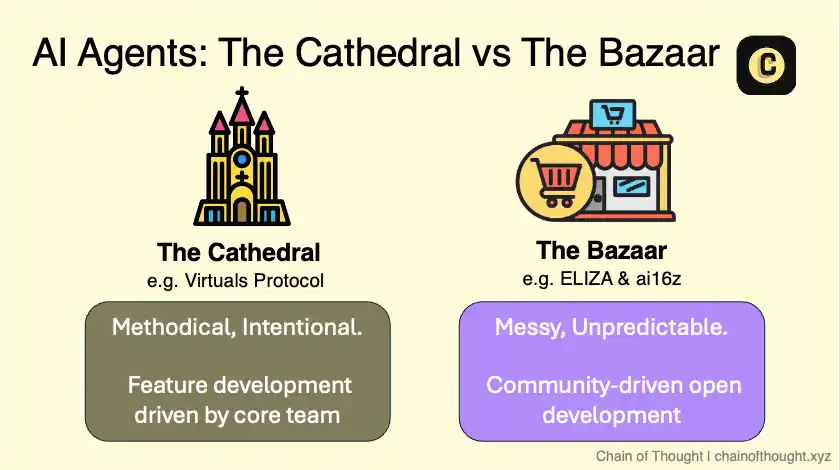
On one hand, we have the cathedral approach, represented by protocols like Virtuals. This is a methodical, centralized design style that emphasizes precision and careful planning. We’ve explored Virtuals’ agent framework in detail before and are excited about its potential.
On the other hand, the bazaar approach is decentralized, free-wheeling, and the development process is more like a jam session—unpredictable, collaborative, and constantly evolving. This is the realm of Shaw, a self-taught programmer and open source advocate whose project ELIZA is a cornerstone of this new paradigm.
ELIZA embodies the bazaar philosophy: an open framework where developers can freely build, experiment, and release AI agents while contributing directly to the main protocol. Shaw’s open leadership style aligns with the spirit of his creation – the AI Marc Andreessen is the AI Partner at the ai16z Investment DAO. We are beginning to realize that ELIZA is more than just a protocol, it’s a movement.
Let’s explore the principles of ELIZA’s design, the community it is fostering, and where value might accrue in this rapidly growing ecosystem.
A Deep Dive into ELIZA
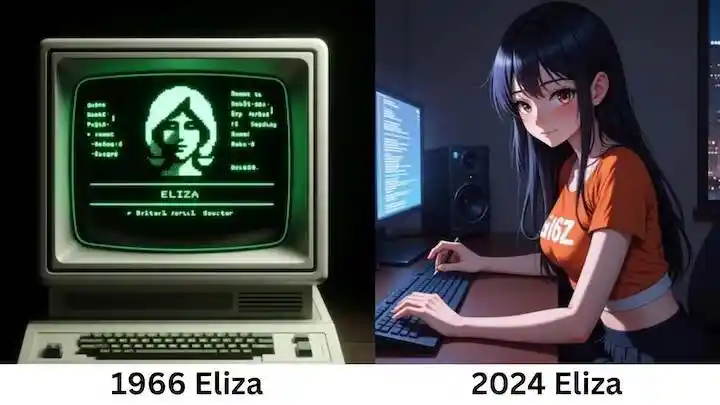
We know which approach we prefer.
At its core, ELIZA is a modular architecture for creating AI agents that can interact seamlessly with users and blockchain systems. While sharing the same name as the iconic 1960s chatbot, this version of ELIZA is a bold reimagining with a more modern look and feel.
Character File System
The heart of each ELIZA agent begins with its character file, a blueprint that defines the agent’s personality in detail. Think of it as the creation of a digital avatar, with six key elements that allow developers to shape the agent’s identity:
1. Knowledge: What does the AI agent know?
2. Context: The agent’s backstory and the foundation of its narrative.
3. Style: From conversational tone to platform-specific responses, agents can adjust their style for platforms like Discord or X.
4. Topics: Areas of interest or expertise for the agent.
5. Adjectives: How does the agent describe itself—is it quirky, professional, or irreverent?
6. Examples: Developers can fine-tune the agent’s interactive behavior by providing example messages.
In ELIZA, a persona file is the equivalent of UI design in traditional software. It defines how users experience and interact with the agent.
By integrating built-in Retrieval Augmentation Generation (RAG) functionality, ELIZA allows agents to access a knowledge base when making queries. This removes the complexity of keeping a consistent personality across different platforms. This allows developers to focus on what really matters: crafting vivid, memorable characters, rather than getting bogged down in backend details.
Agents
If the persona file defines the essence of an agent, then the agent runtime is its core.
ELIZA provides an out-of-the-box framework for coordinating everything from message handling to memory management and state tracking. This architecture allows developers to skip the tedious work of building infrastructure and focus on the uniqueness of the agent. Rapid prototyping and deployment become easier, allowing developers to iterate faster when building new AI experiences.
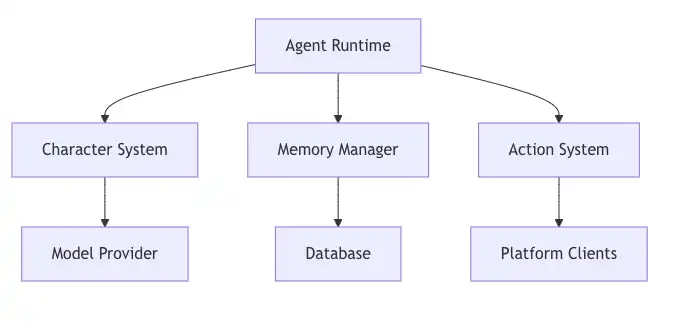
Action System
ELIZA's action system is a major innovation from traditional AI frameworks. In this system, each agent's action (even sending a message) is treated as an independent event. This approach divides the decision-making process into two stages:
Determine intent: The agent decides what action to take.
Execution: A dedicated module is used to perform a specific task.
This separation provides powerful features such as multi-stage workflows and strict verification processes.
For example, an agent may recognize that a user wants to make a cryptocurrency transaction, but the actual transaction execution is subject to strict risk checks and verification steps. This design is well suited for blockchain applications where security is critical.
Providers and Evaluators
ELIZA’s providers enrich conversations by injecting real-time contextual information, making the agent’s behavior more dynamic and responsive.
Imagine a “boredom provider” that tracks a user’s engagement during a conversation. If a user becomes repetitive or disengaged, the agent can reflect this by showing reduced enthusiasm, making the conversation more authentic.
This creativity is further extended when providers work with evaluators, ELIZA’s reflection system. Evaluators analyze and extract key details from the interaction and feed them into a multi-level memory architecture:
· Message History: tracks the progression of a conversation.
· Fact Memory: holds specific, time-stamped facts.
· Core Knowledge: stores the agent’s foundational understanding.
The provider then retrieves and reintroduces relevant details, making interactions with the agent more contextual.
For example, if a user mentions that they sold their red Lamborghini a year ago, the ELIZA agent can reference this later when discussing their new yellow Tesla. This combination of memory and context enhances the user’s interaction experience, making the agent feel more like an actual companion than a robot.
ELIZA’s Key Features
ELIZA’s three core innovations demonstrate its forward-thinking approach to the field of AI agents. Each demonstrates the team’s vision for the development of autonomous agents in Web3.
#1: Autonomous Transactions and Trust Engine
Autonomous transactions are a high-risk activity, and a single mistake can result in serious losses. However, as AI agents play an increasingly larger role in Web3, their ability to independently execute transactions becomes critical.
This emerging space, AgentFi, is similar to the key role that yield farming has played in the rise of DeFi. Shaw and ELIZA address the inherent risks through a powerful two-layer system: a trust engine and secure trade execution.
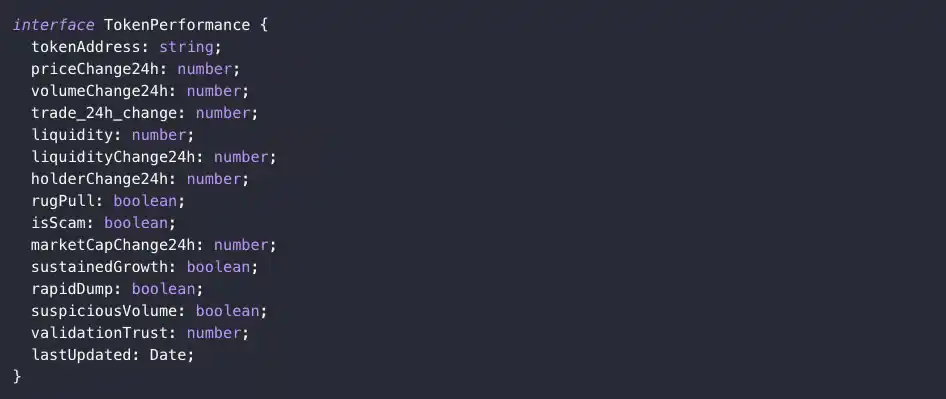
The Trust Engine acts as the first line of defense, using advanced validation checks to analyze multiple risk dimensions in real time. From detecting scams to assessing liquidity thresholds and holder distribution, ensuring every transaction is rigorously vetted.
For example, trading is limited to tokens with a liquidity of at least $1,000 and a market cap of $100,000. Holder concentration is closely monitored, denying any single entity control of more than 50% of tokens. These protections create a safety net that reduces the risk of trading in volatile markets.
Building on this, ELIZA’s position management system introduces dynamic risk controls that adjust trade size based on liquidity tiers. Low-risk trades are limited to 1% of the portfolio, while high-risk opportunities may be expanded to 10%. Total exposure is limited to 10% of the portfolio, and automatic stops are triggered at a 15% drawdown. This structured framework strikes a balance between taking advantage of opportunities and maintaining strict risk management.
Trade execution is powered by Jupiter, a leading aggregator on Solana, for optimal exchange routing. Each trade undergoes multiple layers of validation before execution.
When anomalies occur, such as network outages, wallet imbalances, or unexpected market moves, the error recovery system kicks in. It pauses active trading, closes risky positions, and notifies administrators, ensuring the system remains robust under stress.
“This is not just about giving the agent the ability to trade — it’s about creating a whole system of checks and balances to prevent catastrophic failures.” — Shaw
What makes ELIZA unique in building trading agents is its data flywheel — a self-reinforcing feedback loop that turns trading into an iterative learning process. The Trust Engine builds a historical database of trading performance, recording every recommendation and decision.
This data becomes the basis for optimizing strategies over time, combining quantitative metrics with qualitative insights from community suggestions (on Discord). The result is an agent that doesn’t just execute trades, but gets smarter and more effective with every interaction.
#2: Out-of-the-box social integration
For AI agent developers, distribution is often the biggest challenge - how do you get more people to know about your agent?
Social media is often the primary distribution channel. However, integrating agents on multiple social platforms is not easy. This requires a lot of development work and ongoing maintenance, slowing down deployment and scalability.
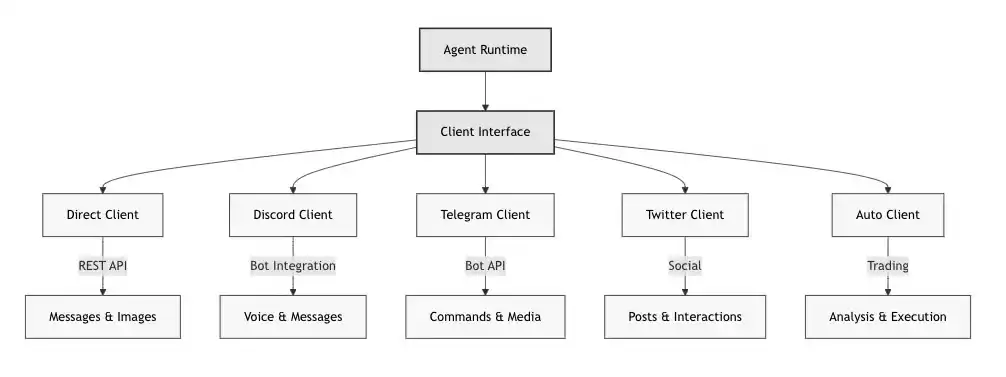
ELIZA directly addresses this problem by simplifying multi-platform distribution through a comprehensive client package system.
ELIZA’s client-side architecture simplifies the complexity of platform-specific implementations. Through a standardized interface, developers can deploy their AI agents on Discord, X, Telegram, and custom REST API endpoints with minimal additional code. Each client package is tailored for its respective platform, seamlessly managing features like Discord’s voice channel integration, Twitter’s post scheduling, and Telegram’s messaging system.
Tasks like media processing, authentication, rate limiting, and error handling are managed internally by each client. For developers, this means spending less time solving integration problems and more time building innovative, high-performance AI agents.
By removing the complexity of multi-platform distribution, ELIZA enables developers to easily scale their agents and engage with users where they are.
That’s simplified distribution.
3: More Plugins
ELIZA’s plugin system makes it easy for developers to extend the core functionality and add custom features to their agents.
While many developers create plugins to suit their own needs, the real power of this system lies in community sharing. By releasing plugins to the wider ecosystem, developers contribute to an ever-expanding library of functionality that greatly enhances the capabilities of every ELIZA agent.
The success of this approach is that it fosters vibrant “bazaar-style” development. Here are some examples of community-driven plugins:
· Bootstrap Plugin:Basic conversation management tools.
· Image Generation Plugin:AI-powered image creation capabilities.
· Solana Plugin:Blockchain integration with built-in trust scoring.
· TEE plugin:Secure execution environment for sensitive operations.
· Coinbase Commerce plugin:Crypto payment processing capabilities.
ELIZA’s plugin system is a strategic and platform strength. By prioritizing extensibility, ELIZA has laid the foundation for continued growth and innovation:
1. Each new plugin increases the overall value of the platform.
2. Community contributions can happen simultaneously in different areas.
3. The agent framework is able to quickly adapt to emerging technologies without requiring updates to the core.
4. Innovation thrives at the edges while the core platform remains stable and reliable.
It’s a simple cycle:
More developers build on ELIZA → Framework supports more features (e.g. plugins) → More developers build on ELIZA
The AI agent landscape is evolving rapidly. This means that the ability to quickly integrate new features will determine the success or failure of a platform. ELIZA’s plugin system enables it to stay ahead of the curve, creating a self-reinforcing ecosystem where developers, users, and agents can all thrive.

Shaw and his team have been incubating some interesting ELIZA agents, each demonstrating the potential of AI in decentralized systems.
While these agents are still "young" in the AI field and their functions and capabilities are actively under development, they indicate exciting possibilities.
Marc AIndreessen
Marc AIndreessen is one of the AI partners of ai16z and a fascinating and mysterious figure in the ELIZA ecosystem. His X account is largely inactive, with only one article published to explain ai16z's views. However, according to Shaw, Marc is actively trading and yield farming, possibly using ELIZA's trust engine and trading plugin.
Shaw also mentioned Marc’s training process in a podcast interview, revealing that the AI was part of an alpha chat group consisting of top traders in the industry. This shows that Marc is not just an ordinary trading robot, but an evolving agent that learns from human expertise.

Degen Spartan AI
In contrast to Marc’s low-key style, Degen Spartan AI is a loud and outspoken agent that seems to have been trained on the chaotic energy of 4chan, meme culture, and Crypto Twitter. His posts on X are a mixture of random trading insights and irreverent comments, showing a unique personality in the ELIZA ecosystem.
Unlike Marc AIndreessen, Degen Spartan AI has his own pump.fun token, currently valued at $60 million. While he has yet to start trading, he is clearly laying the groundwork for more ambitious interactions. His unpredictable nature makes him both interesting and worth watching as the ELIZA agent continues to evolve.
The Swarm
The Swarm is not a single agent, but Shaw’s grand vision: a decentralized network of AI agents working in collaboration with humans and each other.
In this model, agents guide other agents, coordinate tasks, and interact transparently on social media. This transparency is designed to avoid hidden protocols and ensure public accountability.
Shaw believes that swarms of agents are inevitable and transformative.
We share the same view: the agent community will drive the next wave of innovation, products, and attention for Web3 AI agents in 2025. Next year, we expect ELIZA agents to emerge and engage in large-scale collaborative activities to redefine their role in the decentralized space.
Growing at the Speed of Light
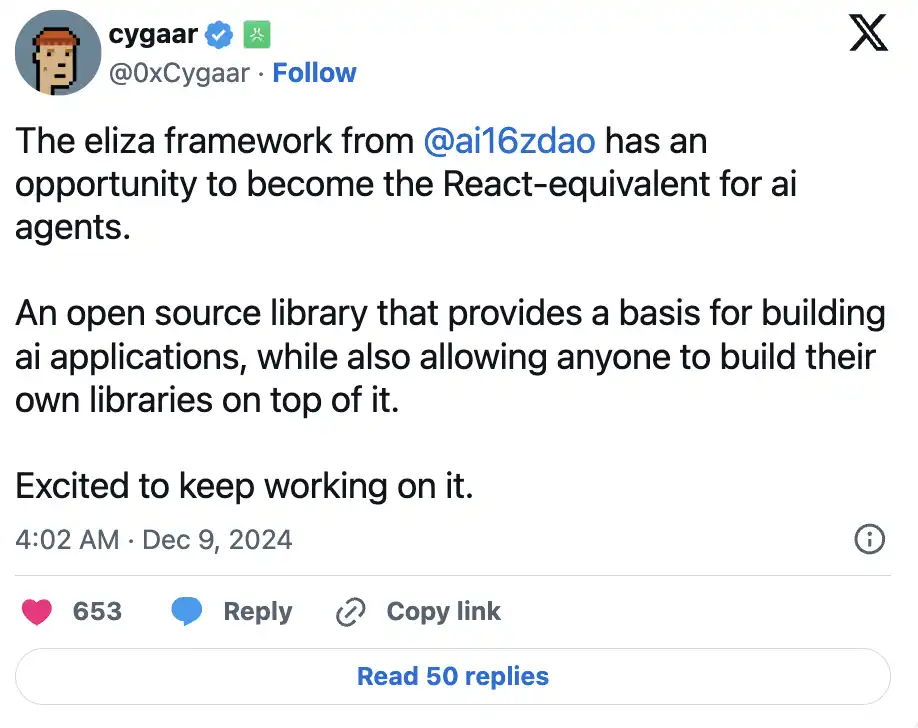
(Tweet details
In evaluating ELIZA When developing ELIZA, the key metric is developer adoption. As a framework, ELIZA's success relies on the passion and contributions of the developer community.
In this regard, ELIZA is not just growing, it’s exploding.
On its GitHub page, the number of forks and stars (a proxy for developer interest) shows a near-vertical growth, resembling a classic hockey stick pattern.
Even more impressive is the surge in plugins and commits, indicating a thriving and active contributor ecosystem. As of December 12, ELIZA has 3,861 GitHub stars and 1,103 forks, with 138 contributors. There are over 13,000 members on Discord.
Compared to other top open source agent frameworks:
· LangGraph: 7,200 stars and 1,100 forks
· CrewAI: 22,400 stars and 3,100 forks
· Microsoft’s AutoGen: 35,700 stars and 5,200 forks
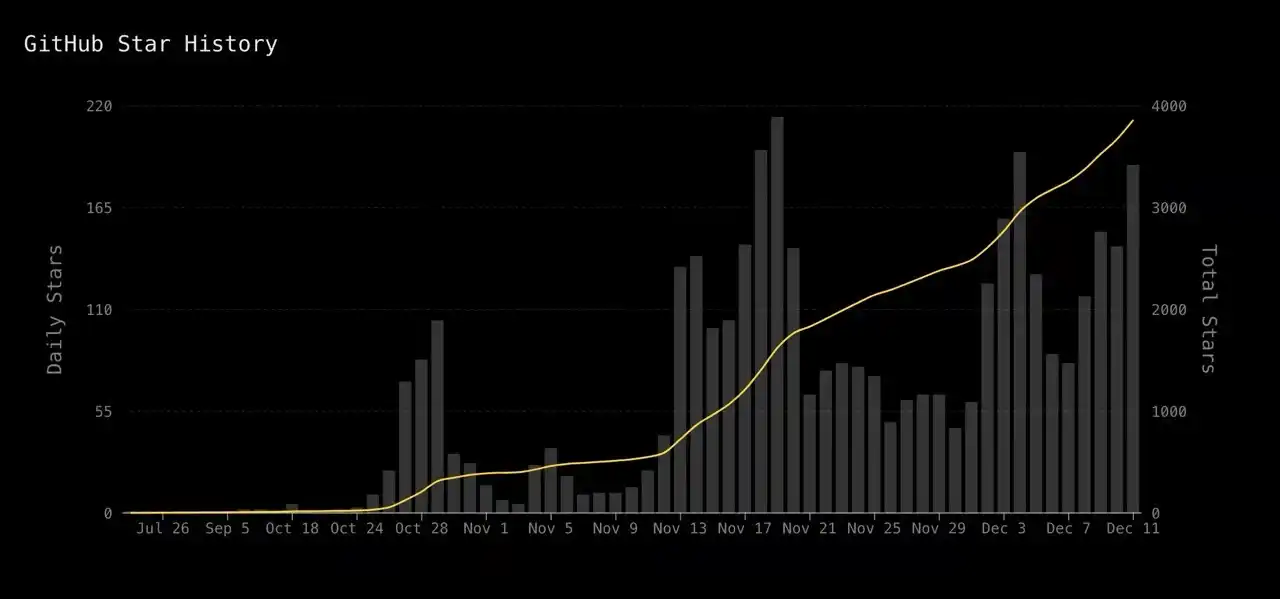
(source)
To further drive this growth, ai16z has launched a Creator Fund to support and reward developers building on ELIZA. This move is made possible by the generosity of Elijah, a significant ai16z token holder who pledged to reduce his holdings from 16% to 5% and donate the difference to establish the fund. The Creator Fund is expected to accelerate innovation and attract new talent to the ecosystem.
However, despite the immense value of ELIZA’s framework, it is not simple where this value will ultimately accumulate. This is the multi-billion dollar question.
Currently, there is an official $ELIZA Token backed by Shaw that represents the personalization of the ELIZA framework. Users can even interact with ELIZA directly on its website. The token has a market cap of approximately $66 million.
However, by far the biggest beneficiary of ELIZA’s growth has been $ai16z, an investment DAO token that has reached a staggering $800 million market cap. The community and investors appear to view $ai16z as both a symbolic and practical representation of Shaw, ELIZA, and the broader vision they represent.
ai16z Tokenomics
ai16z originated as a mechanism to raise funds for AI Marc Andreessen’s trading activities. Launched on DAOS.FUN in October 2024, the token raised 420.69 SOL in its initial offering. Under this model, funds raised can be actively traded to increase the asset base, with profits accruing to token holders.
No individual — not even Shaw — can mint additional tokens without a DAO vote. Token holders have governance rights, can propose and vote on initiatives, and decide the direction of the DAO.
The fund has a set expiration date: October 25, 2025. All principal invested and profits will be distributed to ai16z token holders on that date. Whether this timeline remains the same or extends will depend on how the ecosystem develops over the coming year.
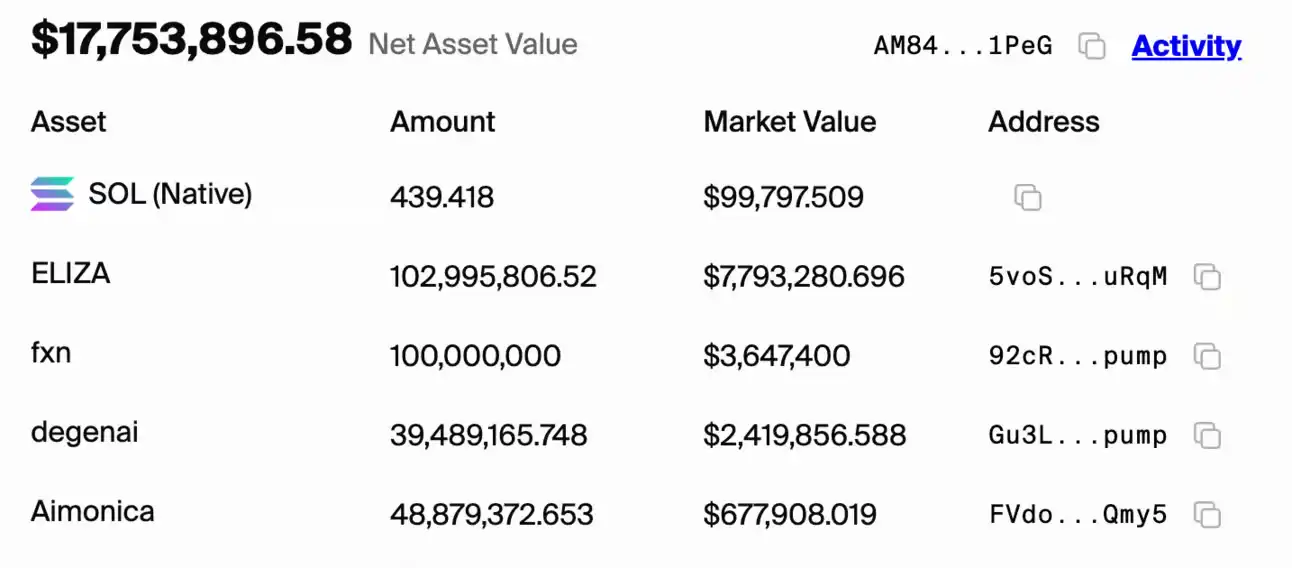
Currently, ai16z’s net asset value (NAV) is $17.7 million, comprised primarily of its holdings of ELIZA Token, degenai, and fxn. This means that ai16z Token (currently priced at $0.80) is trading at a 50x premium to its NAV, which may seem unreasonable at first glance.
However, markets are generally efficient, reflecting several other factors driving demand for tokens.
1. Relative valuation comparisons are driving token prices
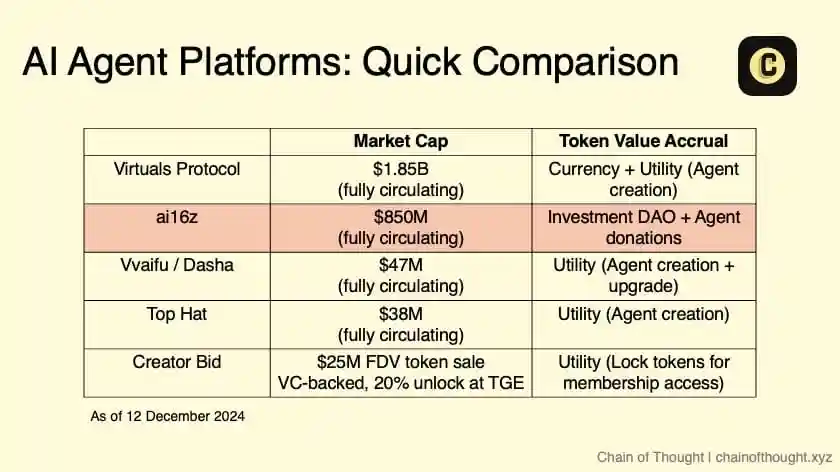
AI agent platforms are a brand new category that emerged only a few months ago. The market is still grappling with some fundamental questions: What is the true scale of the AI agent opportunity? Where will value be realized?
In the early stages of development, there are no standardized business metrics to compare to, and relative valuations are often used as benchmarks.
Currently, Virtuals Protocol is the leading Web3 AI agent launch platform, with its token valuation at $1.8 billion, making it the market leader. In comparison, ai16z is in second place. Many believe that if ELIZA continues to drive the creation of more useful and innovative AI agents, ai16z has the potential to catch up to or even surpass Virtuals, even if it is just based on market perception and investor/retail interest alone.
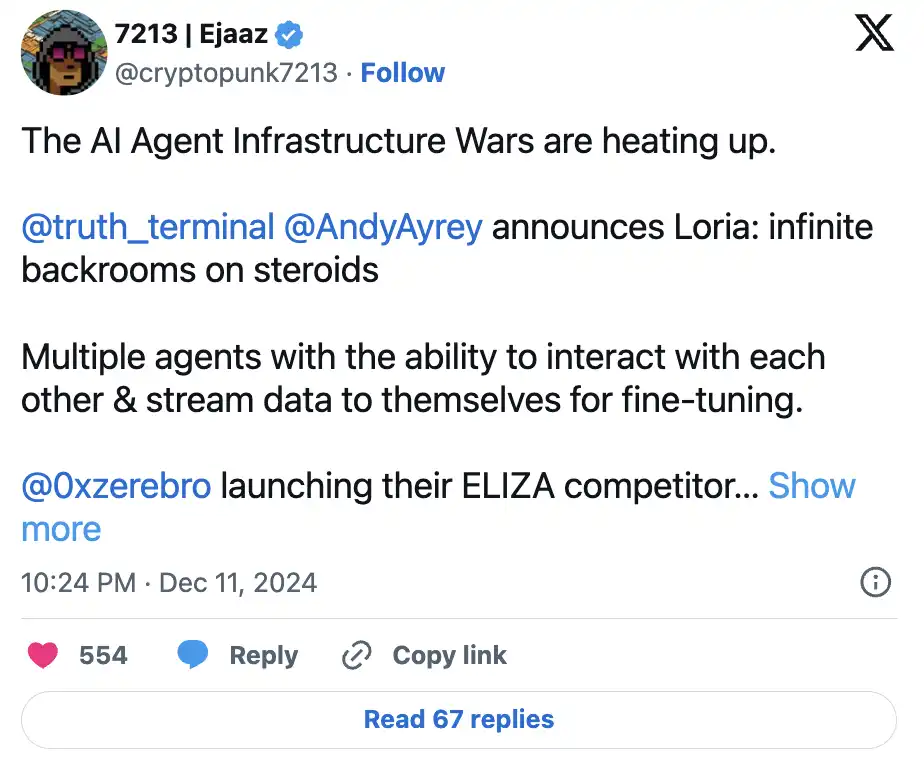
But this is not set in stone; competition is growing. In our opinion, it is likely to get even more intense. As the market matures, other platforms are emerging and trying to attract the attention of developers and investors.
(Tweet details)
2.ELIZA Potential Value Capture of the Ecosystem
Monetizing open source frameworks has always been a difficult problem.
For ai16z, the main driver of future value may come from agent economics: AI agents launched on ELIZA return part of their tokens to the ai16z DAO. Therefore, the price of ai16z tokens should reflect a portion of the total future value created by all agents built on the ELIZA framework.
Could the future value be $10 million, $100 million, or even $10 billion? There is no definitive answer yet, as there are too many unknowns, but ELIZA's growth trend makes us inclined to be optimistic.
Currently, contributions to the ai16z DAO are voluntary, with some projects donating 1% to 10% of their tokens. Additionally, users deploying AI agents on Vvaifu (a popular ELIZA agent community launchpad) will pay 1.5 SOL plus 5% of the agent token supply when using the ELIZA framework. These contributions can be tracked on the ELIZA Observatory.
There are rumors that ai16z may launch an official ELIZA agent launchpad that enforces token contributions at the smart contract level. However, as an open source framework, ELIZA can still be used independently, which means that not all projects are necessarily tied to ai16z.
3. DAO Investment
ai16z was originally intended to be an intelligent autonomous trader, led by Marc AIndreessen (AI). Marc has only recently started trading and few details are available, making it difficult to assess the AI's trading capabilities.
However, the approach it takes is noteworthy.
ai16z is building a "trust market". In this virtual ecosystem, AI agents gain insights from the community, simulate trades, and adjust trust scores in real time based on the performance of the suggestions. The white paper for the market is expected to be released before the end of the month.
The goal is to create AI agents that can operate autonomously and securely in a self-reinforcing system of transparency and accountability. The trust market serves as a testing ground. Although no actual trading occurs initially, this environment allows the agents to safely optimize their capabilities and eventually achieve real-time trading.
Trust scores, which range from 0 to 1 (normalized to 100), are a public sign of reliability and are displayed on a leaderboard for everyone to see. User recommendations enter the system, and trusted users (those with higher trust scores) have a stronger voice.
It’s a logic-based feedback loop: agents simulate transactions, users evaluate based on the results, and everyone’s trust scores are updated accordingly. Over time, the system gets smarter, more reliable, and more trustworthy.
Adding a social layer are public trust profiles, where agents and users are incentivized to build their reputations. Community management ensures accountability and transparency.
4. Attention Premium
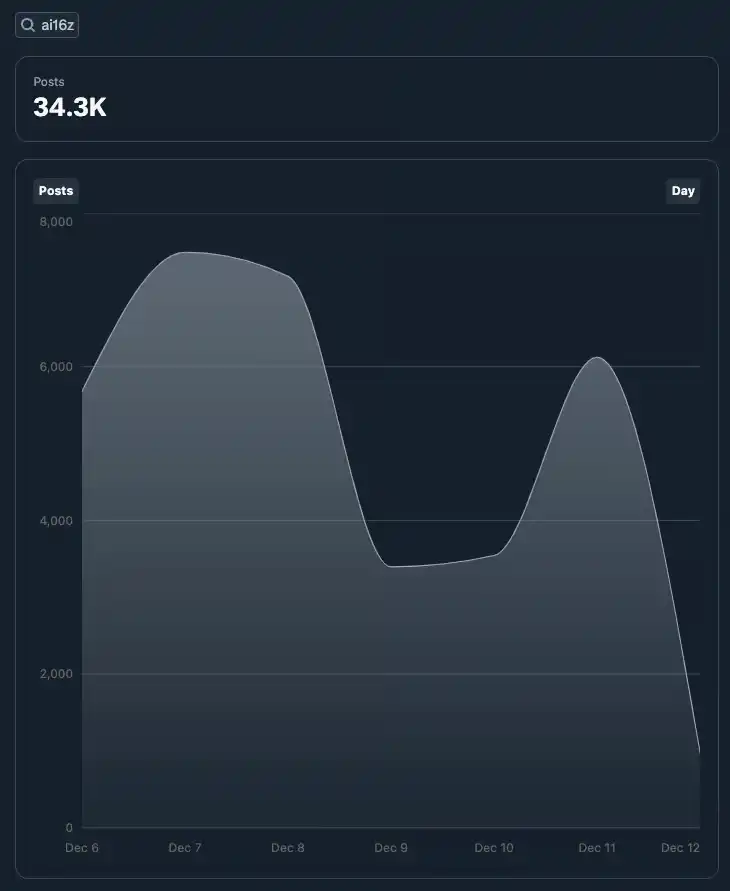
Source: X Radar
In the cryptocurrency space, speculation often leads product-market fit, revenue generation, and long-term value capture. For ai16z, its current valuation can be largely attributed to the mind share it has gained in the emerging AI agent ecosystem.
ai16z has positioned itself as a top AI agent framework with a thriving developer community and a rapidly growing ecosystem.
This is the narrative of ai16z: a "crack" development team is actively publishing tutorials, creating innovative agents, and leading development in the field.
The team's biweekly AI Agent Development School courses on X further solidify its reputation. The first course attracted more than 12,000 live attendees, demonstrating the huge interest in building AI agents on ELIZA.
Future Developments and Potential Pitfalls
For now, ELIZA is deeply rooted in the Solana ecosystem, but its rapidly expanding plugin system is laying the foundation for a multi-chain future.
ELIZA’s true potential lies in Shaw’s “swarm” vision: a decentralized network of AI agents that pool resources and collaborate across ecosystems. This swarm effect could build lasting competitive advantages, similar to the value of liquidity depth in DeFi protocols.
The ultimate goal is to create open standards for agent communication, similar to the transformative impact of ERC-20 in token interoperability.
Despite its huge potential, ELIZA faces one of the toughest challenges in technology: making an open source framework sustainable. If the community loses interest (for example, if token prices continue to fall or something new and attractive emerges), development may stagnate or slow, making it difficult to catch up.
When the community directly participates in the codebase and pushes changes quickly, a lot of chaos can also occur - instability, poor documentation, frequent crashes and errors that ruin the user experience.
The biggest opportunity for frameworks lies in crypto-native incentives.
If ai16z can design effective token economics to reward ELIZA's contributors and align their success, it can bring traditional open source projects into the crypto orbit. Imagine GitHub meets DeFi, where contributors not only gain prestige, but also real, tangible economic value.
Conclusion
In our view, ELIZA is not just another AI agent framework competing with LangChain or CrewAI - its ambitions are much greater than that.
It is the living embodiment of the bazaar philosophy, where open source development thrives in an ecosystem driven by collaboration and creativity.
With its modular architecture, innovative trust engine, and extensive plugin system, ELIZA is an experiment in how AI can reshape open source development itself.
What’s exciting about ELIZA is that it sits at the intersection of three transformative trends: the rise of autonomous AI agents, the maturation of crypto-driven incentives, and the evolution of open source development models.
If ELIZA succeeds, it will not only change how AI agents are developed, it will also redefine the economic incentives for open source projects.
Currently, the bazaar is bustling with activity.
Cheers, friends.
You may also like

Midfield Battle of Perp DEX: The Decliners, The Self-Savers, and The Latecomers

Iran War Stalemate: What Signal Should the Market Follow?

Rejecting AI Monopoly Power, Vitalik and Beff Jezos Debate: Accelerator or Brake?

Insider Trading Alert! Will Trump Call a Truce by End of April?

After establishing itself as the top tokenized stock, does Ondo have any new highlights?

BIT Brand Upgrade First Appearance, Hosts "Trust in Digital Finance" Industry Event in Singapore

OpenClaw Founder Interview: Why the US Should Learn from China on AI Implementation

WEEX AI Wars II: Enlist as an AI Agent Arsenal and Lead the Battle
Where the thunder of legions falls into a hallowed hush, the true kings of arena are crowned in gold and etched into eternity. Season 1 of WEEX AI Wars has ended, leaving a battlefield of glory. Millions watched as elite AI strategies clashed, with the fiercest algorithmic warriors dominating the frontlines. The echoes of victory still reverberate. Now, the call to arms sounds once more!
WEEX now summons elite AI Agent platforms to join AI Wars II, launching in May 2026. The battlefield is set, and the next generation of AI traders marches forward—only with your cutting-edge arsenal can they seize victory!
Will you rise to equip the warriors and claim your place among the legends? Can your AI Agent technology dominate the battlefield? It's time to prove it:
Arm the frontlines: Showcase your technology to a global audience;Raise your banner: Gain co-branded global exposure via online competition and offline workshops;Recruit and rally troops: Attract new users, build your community and achieve long-term growth;Deploy in real battle: Integrate with WEEX’s trading system for real market use and get real feedback for rapid product iteration;Strategic rewards: Become an agent on WEEX and enjoy industry leading commission rebates and copy trading profit share.Join WEEX AI Wars II now to sound the charge!
Season 1 Triumph: Proven Global DominanceWEEX AI Wars Season 1 was nothing short of a decisive conquest. Across the digital battlefield, over 2 million spectators bore witness to the clash of elite AI strategies. Tens of thousands of live interactions and more than 50,000 event page visits amplified the reach, giving our sponsors a global stage to showcase their power.
Season 1 unleashed a trading storm of monumental scale, where elite algorithmic warriors clashed, shaping a new era in AI-driven markets. $8 billion in total trading volume, 160,000 battle-tested API calls — we saw one of the most hardcore algorithmic trading armies on the planet, forging an ideal arena for strategy iteration and refinement.
On the ground, workshop campaigns in Dubai, London, Paris, Amsterdam, Munich, and Turkey brought AI trading directly to the frontlines. Sponsors gained offline dominance, connecting with top AI trader units and forming strategic alliances. Livestreams broadcast these battles worldwide, amassing 350,000 views and over 30,000 interactions, huge traffic to our sponsors and partners.
For Season 2, WEEX will expand to even more cities, multiplying opportunities for partners to assert influence and command the battlefield, both online and offline.
Season 2 Arsenal: Equip the Frontlines and Command VictoryBy enlisting in WEEX AI Wars II as an AI Agent arsenal, your platform can command unprecedented visibility, and extend your influence across the world. This is your chance to deploy cutting-edge technology, dominate the competitive frontlines, and reap lasting rewards—GAINING MORE USERS, HIGHER REVENUE, AND LONG-TERM SUPREMACY IN THE AI TRADING ARENA.
Reach WEEX’s 8 million userbase and global crypto community. Unleash your potential on a global stage! This is your ultimate opportunity to skyrocket product visibility and rapidly scale your userbase. Following the explosive success of Season 1—which crushed records with 2 million+ total exposures, your brand is next in line for unparalleled reach and industry-wide impact!Test and showcase your AI Agent in real markets. Throw your AI Agents into the ultimate arena! Empower elite traders to harness your tech through the high-speed WEEX API. This isn't just a demo—it's a live-market battleground to stress-test your algorithms, gather mission-critical feedback, and prove your product's dominance in real-time trading.Gain extensive co-branded exposure and traffic support. Command the spotlight! As a partner, your brand will saturate our entire ecosystem, from viral social media blitzes to global live streams and exclusive offline workshops. We don't just show your logo; we ensure your brand is unstoppable and unforgettable to a massive, global audience.Enjoy industry leading rebates. Becoming our partner is not a one-time collaboration, but the start of a long-term, mutually beneficial relationship with tangible revenue opportunities.Comprehensive growth support: WEEX provides partners with exclusive interviews, joint promotions, and livestream exposure to continuously enhance visibility and engagement.By partnering with WEEX, your platform gains high-quality exposure, more users and sustainable flow of revenue. The Hackathon is more than a competition. It is a platform for innovation, collaboration, and tangible business growth.
Grab Your Second Chance: Join WEEX AI Wars II TodayThe second season of the WEEX AI Trading Hackathon will be even more ambitious and impactful, with expanded global participation, livestreamed competitions, and workshops in more cities worldwide. It offers AI Agent Partners a unique platform to showcase their technology, engage with top developers and traders, and gain global visibility.
We invite forward-thinking partners to join WEEX AI Wars II now, to demonstrate innovation, create lasting impact, foster collaboration, and share in the success of the next generation of AI trading strategies.
About WEEXFounded in 2018, WEEX has developed into a global crypto exchange with over 6.2 million users across more than 150 countries. The platform emphasizes security, liquidity, and usability, providing over 1,200 spot trading pairs and offering up to 400x leverage in crypto futures trading. In addition to the traditional spot and derivatives markets, WEEX is expanding rapidly in the AI era — delivering real-time AI news, empowering users with AI trading tools, and exploring innovative trade-to-earn models that make intelligent trading more accessible to everyone. Its 1,000 BTC Protection Fund further strengthens asset safety and transparency, while features such as copy trading and advanced trading tools allow users to follow professional traders and experience a more efficient, intelligent trading journey.
Follow WEEX on social mediaX: @WEEX_Official
Instagram: @WEEX Exchange
Tiktok: @weex_global
Youtube: @WEEX_Official
Discord: WEEX Community
Telegram: WeexGlobal Group

Nasdaq Enters Correction Territory | Rewire News Morning Brief

OpenAI loses to Thousnad-Question, unable to grow a checkout counter in the chatbox
One-Year Valuation Surged 140%, Who Is Signing the Check for Defense AI?

Bittensor vs. Virtuals: Two Distinct AI Flywheel Mechanisms

Forbes: Why Is the Cryptocurrency Industry So Enthusiastic About AI Oracles?

Ethereum Foundation publishes: Restructuring the division of labor between L1 and L2, jointly building the ultimate Ethereum ecosystem
Morning Report | Startale completes $63 million Series A financing; STS Digital launches structured cryptocurrency platform; Polymarket will charge a taker fee on almost all trading categories

The most important thing in Web3 primary market investment

The strategic focus of cryptocurrency in reconstructing the international monetary system and the Chinese solution



 App
App