
 Buy Crypto
- Markets
 Futures
- Spot
- Copy Trade
- Earn
- More
Global Stablecoin Regulation Update Overview

Original Article Title: "WOO X Research: Stablecoins: An Overview of New Regulatory Dynamics"
Original Source: WOO
In recent years, the rapid development of stablecoins has attracted the attention of regulatory agencies worldwide. As a type of cryptocurrency pegged to fiat currency or other assets, stablecoins possess the characteristic of price stability and have been widely used in areas such as cross-border payments and DeFi. Particularly in this cycle, Real World Assets (RWAs) have performed well, with both traditional financial institutions (such as BlackRock) and web3-native institutions/organizations (such as Sky, formerly MakerDAO) entering the space. More and more investors are also paying attention to this sector, leading to a trend of ranging growth.
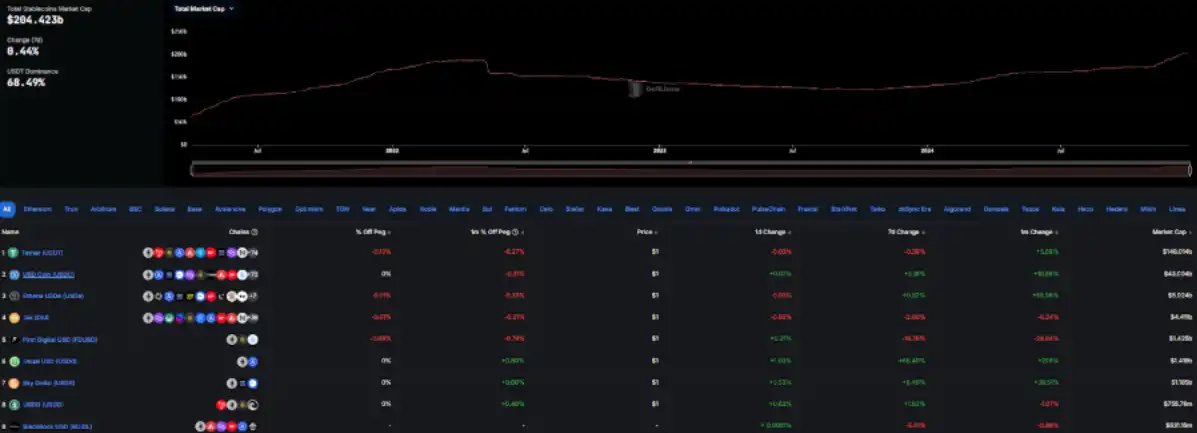
(Image Source: https://defillama.com/stablecoins)
"Regulations are necessary for orderly development," and consequently, governments and international organizations have begun to introduce policies to regulate stablecoins. This article provides a brief summary of the current regulatory landscape.
United States (North America)
The United States is one of the primary markets for stablecoin development, and its regulatory policies are relatively complex. The U.S. stablecoin regulatory framework is mainly implemented by multiple agencies, including the Treasury Department, the Securities and Exchange Commission (SEC), and the Commodity Futures Trading Commission (CFTC).
For certain stablecoins, the SEC may deem them to have securities attributes, requiring compliance with the relevant securities laws. The Office of the Comptroller of the Currency (OCC) under the Treasury Department has proposed allowing national banks and federal savings associations to provide services to stablecoin issuers, subject to anti-money laundering and compliance requirements. Recently, the U.S. Congress has been discussing legislative proposals such as the "Stablecoin Transparency Act" in an attempt to establish a unified regulatory framework for stablecoins. With the election of Donald Trump, often referred to as the "Crypto President," although the policies have not yet been implemented, cryptocurrency regulation seems to be generally trending positively.
European Union (Europe)
Stablecoin regulation in the European Union primarily relies on the Markets in Crypto-Assets Regulation (MiCA).
MiCA categorizes stablecoins into Asset-Referenced Tokens (ARTs) and Electronic Money Tokens (EMTs). Electronic Money Tokens (EMTs) refer to tokens pegged to a single fiat currency, such as stablecoins pegged to the Euro or the Dollar. Meanwhile, Asset-Referenced Tokens (ARTs) refer to tokens pegged to certain assets (such as fiat currency, commodities, or cryptocurrencies). MiCA sets out corresponding regulatory requirements for each category. Entities issuing stablecoins must obtain a license from an EU member state and meet requirements such as capital reserve and transparency disclosure.
Hong Kong (Asia)
On July 17, 2024, the Hong Kong Monetary Authority and the Financial Services and the Treasury Bureau jointly issued a consultation summary outlining the key features of the upcoming stablecoin regulatory regime. Under this regime, companies looking to issue or promote fiat-backed stablecoins to the Hong Kong public will need to obtain a license from the HKMA. The regulatory requirements include asset reserves management, corporate governance, risk controls, disclosure, and measures to combat money laundering and terrorist financing.
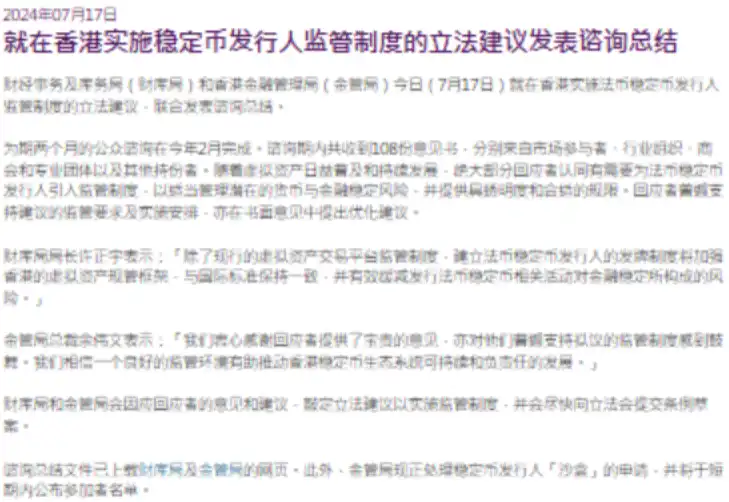
(Image Source Link: https://www.hkma.gov.hk/eng/news-and-media/press-releases/2024/07/20240717-3/?utm_source=chatgpt.com)
In addition, the HKMA has introduced a stablecoin issuer sandbox scheme to engage with the industry on the proposed regulatory requirements. The first list of participants was announced on July 18, 2024, including JD Coinchain Technology (Hong Kong) Limited, Roundcoin Innovation Technology Limited, and a consortium composed of Standard Chartered Bank (Hong Kong) Limited, Animoca Brands Limited, and Hong Kong Telecom Limited.
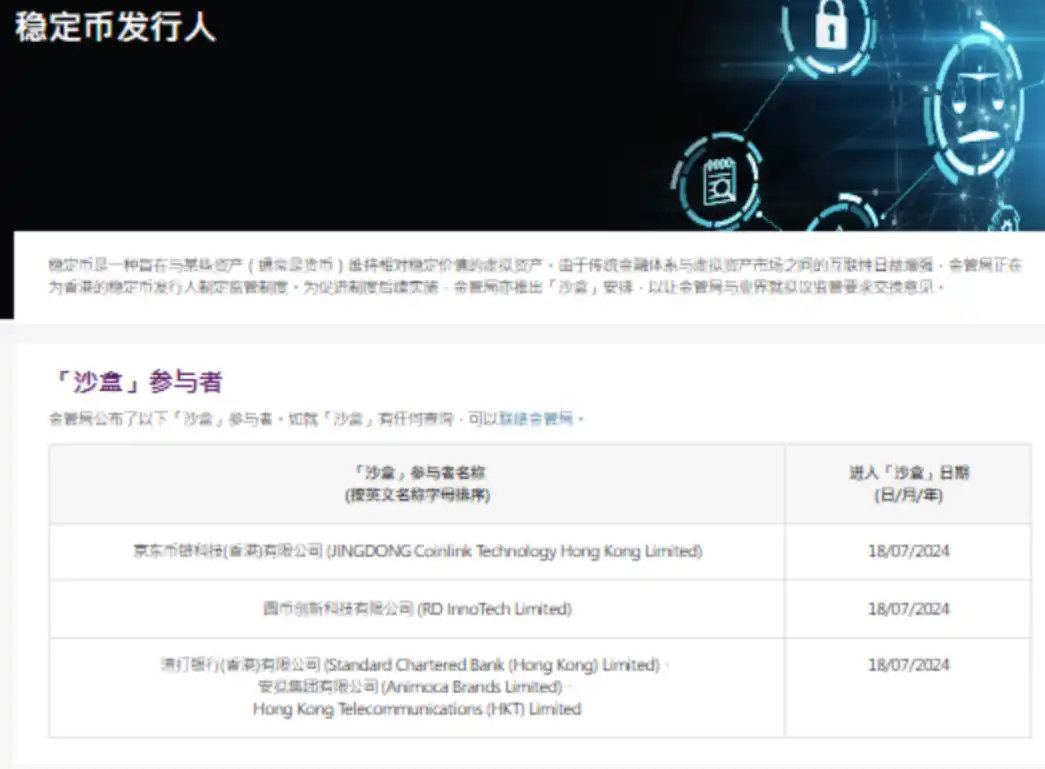
(Image Source Link: https://www.hkma.gov.hk/eng/key-functions/international-financial-centre/stablecoin-issuers/?utm_source=chatgpt.com)
Recently, on December 6, 2024, the government published the "Stablecoin Bill" in the Gazette, aiming to introduce a regulatory regime for fiat-backed stablecoin issuers in Hong Kong to enhance the oversight framework for virtual asset activities.
Singapore (Asia)
Under Singapore's Payment Services Act, stablecoins are considered digital payment tokens, and their issuance and circulation require approval from the Monetary Authority of Singapore (MAS). MAS provides a regulatory sandbox for startups to test business models related to stablecoins.
Japan (Asia)
In June 2022, Japan revised the Payment Services Act (PSA), establishing a regulatory framework for the issuance and trading of stablecoins. Under the amended PSA, stablecoins fully backed by fiat currency are defined as "Electronic Payment Instruments" (EPI) that can be used to pay for goods and services. There are specific requirements for the issuing entities: only three types of institutions can issue stablecoins: banks, funds transfer service providers, and trust companies. Institutions wishing to engage in stablecoin-related activities must first register as Electronic Payment Instrument Service Providers (EPISP) to obtain the necessary licenses to provide services.
Brazil (South America)
In October 2024, BCB President Roberto Campos Neto announced plans to regulate stablecoins and asset tokenization in 2025. In November 2024, BCB proposed a regulatory measure suggesting a ban on users withdrawing stablecoins from centralized exchanges to self-custody wallets. Additionally, in December, BCB's Deputy Director of the Financial System stated that the central bank might lift the ban if key issues such as transaction transparency are addressed.
Conclusion
Furthermore, Russia, a BRICS country, is also considering using cryptocurrency as a settlement method for cross-border financing. Overall, whether it's creating regulatory sandboxes for crypto companies or defining categories based on stablecoins' different characteristics, more and more stablecoin regulatory policies will be introduced in the future. Cross-border payments seem to be one of the most widely applicable scenarios for stablecoins.
This article is a contributed piece and does not represent the views of BlockBeats.
You may also like

2% user contribution, 90% trading volume: The real picture of Polymarket

Trump Can't Take It Anymore, 5 Signals of the US-Iran Ceasefire

Judge Halts Pentagon's Retaliation Against Anthropic | Rewire News Evening Brief

Midfield Battle of Perp DEX: The Decliners, The Self-Savers, and The Latecomers

Iran War Stalemate: What Signal Should the Market Follow?

Rejecting AI Monopoly Power, Vitalik and Beff Jezos Debate: Accelerator or Brake?

Insider Trading Alert! Will Trump Call a Truce by End of April?

After establishing itself as the top tokenized stock, does Ondo have any new highlights?

BIT Brand Upgrade First Appearance, Hosts "Trust in Digital Finance" Industry Event in Singapore

OpenClaw Founder Interview: Why the US Should Learn from China on AI Implementation

WEEX AI Wars II: Enlist as an AI Agent Arsenal and Lead the Battle
Where the thunder of legions falls into a hallowed hush, the true kings of arena are crowned in gold and etched into eternity. Season 1 of WEEX AI Wars has ended, leaving a battlefield of glory. Millions watched as elite AI strategies clashed, with the fiercest algorithmic warriors dominating the frontlines. The echoes of victory still reverberate. Now, the call to arms sounds once more!
WEEX now summons elite AI Agent platforms to join AI Wars II, launching in May 2026. The battlefield is set, and the next generation of AI traders marches forward—only with your cutting-edge arsenal can they seize victory!
Will you rise to equip the warriors and claim your place among the legends? Can your AI Agent technology dominate the battlefield? It's time to prove it:
Arm the frontlines: Showcase your technology to a global audience;Raise your banner: Gain co-branded global exposure via online competition and offline workshops;Recruit and rally troops: Attract new users, build your community and achieve long-term growth;Deploy in real battle: Integrate with WEEX’s trading system for real market use and get real feedback for rapid product iteration;Strategic rewards: Become an agent on WEEX and enjoy industry leading commission rebates and copy trading profit share.Join WEEX AI Wars II now to sound the charge!
Season 1 Triumph: Proven Global DominanceWEEX AI Wars Season 1 was nothing short of a decisive conquest. Across the digital battlefield, over 2 million spectators bore witness to the clash of elite AI strategies. Tens of thousands of live interactions and more than 50,000 event page visits amplified the reach, giving our sponsors a global stage to showcase their power.
Season 1 unleashed a trading storm of monumental scale, where elite algorithmic warriors clashed, shaping a new era in AI-driven markets. $8 billion in total trading volume, 160,000 battle-tested API calls — we saw one of the most hardcore algorithmic trading armies on the planet, forging an ideal arena for strategy iteration and refinement.
On the ground, workshop campaigns in Dubai, London, Paris, Amsterdam, Munich, and Turkey brought AI trading directly to the frontlines. Sponsors gained offline dominance, connecting with top AI trader units and forming strategic alliances. Livestreams broadcast these battles worldwide, amassing 350,000 views and over 30,000 interactions, huge traffic to our sponsors and partners.
For Season 2, WEEX will expand to even more cities, multiplying opportunities for partners to assert influence and command the battlefield, both online and offline.
Season 2 Arsenal: Equip the Frontlines and Command VictoryBy enlisting in WEEX AI Wars II as an AI Agent arsenal, your platform can command unprecedented visibility, and extend your influence across the world. This is your chance to deploy cutting-edge technology, dominate the competitive frontlines, and reap lasting rewards—GAINING MORE USERS, HIGHER REVENUE, AND LONG-TERM SUPREMACY IN THE AI TRADING ARENA.
Reach WEEX’s 8 million userbase and global crypto community. Unleash your potential on a global stage! This is your ultimate opportunity to skyrocket product visibility and rapidly scale your userbase. Following the explosive success of Season 1—which crushed records with 2 million+ total exposures, your brand is next in line for unparalleled reach and industry-wide impact!Test and showcase your AI Agent in real markets. Throw your AI Agents into the ultimate arena! Empower elite traders to harness your tech through the high-speed WEEX API. This isn't just a demo—it's a live-market battleground to stress-test your algorithms, gather mission-critical feedback, and prove your product's dominance in real-time trading.Gain extensive co-branded exposure and traffic support. Command the spotlight! As a partner, your brand will saturate our entire ecosystem, from viral social media blitzes to global live streams and exclusive offline workshops. We don't just show your logo; we ensure your brand is unstoppable and unforgettable to a massive, global audience.Enjoy industry leading rebates. Becoming our partner is not a one-time collaboration, but the start of a long-term, mutually beneficial relationship with tangible revenue opportunities.Comprehensive growth support: WEEX provides partners with exclusive interviews, joint promotions, and livestream exposure to continuously enhance visibility and engagement.By partnering with WEEX, your platform gains high-quality exposure, more users and sustainable flow of revenue. The Hackathon is more than a competition. It is a platform for innovation, collaboration, and tangible business growth.
Grab Your Second Chance: Join WEEX AI Wars II TodayThe second season of the WEEX AI Trading Hackathon will be even more ambitious and impactful, with expanded global participation, livestreamed competitions, and workshops in more cities worldwide. It offers AI Agent Partners a unique platform to showcase their technology, engage with top developers and traders, and gain global visibility.
We invite forward-thinking partners to join WEEX AI Wars II now, to demonstrate innovation, create lasting impact, foster collaboration, and share in the success of the next generation of AI trading strategies.
About WEEXFounded in 2018, WEEX has developed into a global crypto exchange with over 6.2 million users across more than 150 countries. The platform emphasizes security, liquidity, and usability, providing over 1,200 spot trading pairs and offering up to 400x leverage in crypto futures trading. In addition to the traditional spot and derivatives markets, WEEX is expanding rapidly in the AI era — delivering real-time AI news, empowering users with AI trading tools, and exploring innovative trade-to-earn models that make intelligent trading more accessible to everyone. Its 1,000 BTC Protection Fund further strengthens asset safety and transparency, while features such as copy trading and advanced trading tools allow users to follow professional traders and experience a more efficient, intelligent trading journey.
Follow WEEX on social mediaX: @WEEX_Official
Instagram: @WEEX Exchange
Tiktok: @weex_global
Youtube: @WEEX_Official
Discord: WEEX Community
Telegram: WeexGlobal Group

Nasdaq Enters Correction Territory | Rewire News Morning Brief

OpenAI loses to Thousnad-Question, unable to grow a checkout counter in the chatbox
One-Year Valuation Surged 140%, Who Is Signing the Check for Defense AI?

Bittensor vs. Virtuals: Two Distinct AI Flywheel Mechanisms

Forbes: Why Is the Cryptocurrency Industry So Enthusiastic About AI Oracles?

Ethereum Foundation publishes: Restructuring the division of labor between L1 and L2, jointly building the ultimate Ethereum ecosystem


 App
App