
Horizontal Comparison of the Four Major AI Frameworks: A Comprehensive Analysis of Adoption Status, Strengths and Weaknesses, and Growth Potential


Original Article Title: A Deep Dive into Frameworks: A Sector we think Could Grow to $20b+
Original Source: Deep Value Memetics
Original Article Translation: Azuma, Odaily Planet Daily
Key Points Overview
In this report, we discuss the development landscape of several mainstream frameworks in the Crypto & AI field. We will examine the current four mainstream frameworks—Eliza (AI16Z), G.A.M.E (GAME), Rig (ARC), ZerePy (ZEREBRO), analyzing their technical differences and development potential.
Over the past week, we have analyzed and tested the above four major frameworks, and the key conclusions are summarized below.
· We believe Eliza (with a market share of about 60%, valued at approximately $900 million when the original article was written, and valued at around $1.4 billion at the time of publication) will continue to dominate the market share. Eliza's value lies in its first-mover advantage and accelerated developer adoption, with 193 contributors on GitHub, 1800 forks, and over 6000 stars proving this, making it one of the most popular repositories on GitHub.
· G.A.M.E (with a market share of about 20%, valued at approximately $300 million when the original article was written, and valued at around $257 million at the time of publication) has experienced a very smooth development up to now, and is also undergoing rapid adoption, as previously announced by the Virtuals Protocol, with over 200 projects built on G.A.M.E, daily request counts exceeding 150,000, and a weekly growth rate of over 200%. G.A.M.E will continue to benefit from the VIRTUAL's breakout and has the potential to become one of the biggest winners in the ecosystem.
· Rig (with a market share of about 15%, valued at approximately $160 million when the original article was written, and valued at around $279 million at the time of publication) has a very eye-catching and easy-to-use modular design, and is poised to dominate in the Solana ecosystem (RUST).
· Zerepy (with a market share of about 5%, valued at approximately $300 million when the original article was written, and valued at around $424 million at the time of publication) is a more niche application, specific to a fervent ZEREBRO community, and its recent collaboration with the ai16z community may result in some synergies.
In the above statistics, "Market Share" calculates a comprehensive way considering market capitalization, development track record, and the breadth of the underlying operating system's terminal market.
We believe AI frameworks will be the fastest-growing sector in this cycle, with the current market cap of approximately $17 billion likely easily growing to $200 billion. Compared to the peak valuations of Layer 1 in 2021, this number may still be relatively conservative—many individual project valuations exceeded $200 billion at that time. Although the above frameworks serve different terminal markets (chains/ecosystems), considering our view that this sector will grow overall, adopting a market cap-weighted approach may be relatively more prudent.
Four Major Frameworks
At the intersection of AI and Crypto, several frameworks have emerged to accelerate AI development, including Eliza (AI16Z), G.A.M.E (GAME), Rig (ARC), and ZerePy (ZEREBRO). From open-source community projects to performance-focused enterprise solutions, each framework caters to different needs and philosophies of agent development.
In the table below, we list the key technologies, components, and advantages of each framework.
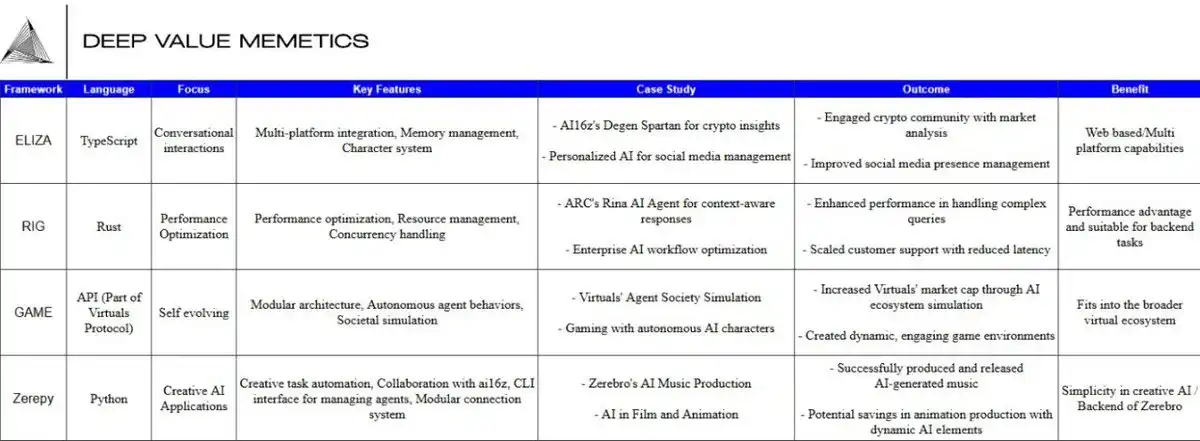
This report will first focus on what these frameworks are, the programming languages they use, technical architecture, algorithms, and unique features with potential use cases. Then, we will compare each framework based on usability, scalability, adaptability, and performance, while discussing their strengths and limitations.
Eliza
Eliza is an open-source multi-agent simulation framework developed by AI16Z, aimed at creating, deploying, and managing autonomous AI agents. It is developed in TypeScript as the programming language, providing a flexible, scalable platform for building intelligent agents that can interact with humans across multiple platforms while maintaining consistent personalities and knowledge.
The core features of this framework include: supporting the simultaneous deployment and management of multiple unique AI personality multi-agent architectures; creating a diverse agent role system using a role file framework; providing long-term memory and context-aware memory management through an advanced retrieval-augmented generation (RAG) system. Additionally, the Eliza framework also offers seamless platform integrations for reliable connections with Discord, X, and other social media platforms.
Eliza excels in AI agent communication and media capabilities. In terms of communication, the framework supports integration with Discord's voice channel feature, X feature, Telegram, and direct API access for custom use cases. On the other hand, the framework's media handling capabilities have expanded to PDF document reading and analysis, link content extraction and summarization, audio transcription, video content processing, image analysis, and conversation summarization, effectively handling various media inputs and outputs.
Eliza offers flexible AI model support, enabling on-device inference using open-source models, cloud-based inference using default configurations such as OpenAI and Nous Hermes Llama 3.1 B, and integration with Claude for handling complex queries. Eliza features a modular architecture with extensive action systems, custom client support, and a comprehensive API, ensuring cross-application scalability and adaptability.
Eliza's use cases span across various domains, such as AI assistants for customer support, community management, and personal tasks; social media roles like automatic content creators and brand representatives; knowledge workers playing roles like research assistants, content analysts, and document processors; as well as interactive roles in the form of role-playing bots, educational tutors, and entertainment agents.
Eliza's architecture is built around an agent runtime that seamlessly integrates with role systems (supported by model providers), a memory manager (linked to a database), and action systems (interfacing with platform clients). Unique features of this framework include a plugin system allowing modular feature extensions, support for multi-modal interactions such as voice, text, and media, and compatibility with leading AI models like Llama, GPT-4, and Claude. With its versatility and robust design, Eliza has become a powerful tool for developing cross-domain AI applications.
G.A.M.E
G.A.M.E, developed by the Virtuals official team, stands for "The Generative Autonomous Multimodal Entities Framework." This framework aims to provide developers with an application programming interface (API) and software development kit (SDK) to experiment with AI agents. The framework offers a structured approach to managing AI agent behaviors, decisions, and learning processes.
· The key components of G.A.M.E include, firstly, the "Agent Prompting Interface," which is the developer's entry point to integrating G.A.M.E into an agent to elicit agent behaviors.
· The "Perception Subsystem" initiates a session by specifying parameters such as session ID, agent ID, user, and other relevant details. It synthesizes incoming messages into a format suitable for the "Strategic Planning Engine," serving as the sensory input mechanism for the AI agent, whether in the form of dialogue or reaction. At the core is the "Dialogue Processing Module," responsible for handling messages and responses from the agent and collaborating with the "Perception Subsystem" to effectively interpret and react to input.
· The "Strategic Planning Engine" works in conjunction with the "Dialogue Processing Module" and the "On-chain Wallet Operator" to generate responses and plans. This engine operates on two levels: as a high-level planner creating broad strategies based on context or goals; and as a low-level strategist that transforms these strategies into executable policies, further segmented into an action planner (for task specification) and a plan executor (for task execution).
· A separate but key component is the "World Context," which references the environment, world information, and game state to provide necessary context for the agent's decision-making. Additionally, the "Agent Repository" is used to store long-term attributes such as goals, reflections, experiences, and personality, collectively shaping the agent's behavior and decision-making process. The framework utilizes "Short-Term Working Memory" and a "Long-Term Memory Processor" — the short-term memory retains pertinent information about previous actions, outcomes, and current plans; in contrast, the long-term memory processor extracts key information based on criteria such as importance, recency, and relevance. This memory stores knowledge about the agent's experiences, reflections, dynamic personality, world context, and working memory to enhance decision-making and provide a foundation for learning.
· To enhance adaptability, the "Learning Module" obtains data from the "Perception Subsystem" to generate general knowledge, which is fed back into the system to optimize future interactions. Developers can provide feedback on actions, game states, and sensory data through the interface to enhance the AI agent's learning and improve its planning and decision-making capabilities.
The workflow begins with developers interacting through the agent prompt interface; the "Perception Subsystem" processes the input and forwards it to the "Dialogue Processing Module," which manages the interaction logic; then, the "Strategic Planning Engine" formulates and executes plans based on this information, utilizing high-level strategies and detailed action planning.
Data from the "World Context" and "Agent Repository" informs these processes, while the working memory tracks real-time tasks. Simultaneously, the "Long-Term Memory Processor" stores and retrieves knowledge over time. The "Learning Module" analyzes outcomes and integrates new knowledge into the system, continuously improving the agent's behavior and interactions.
Rig
Rig is an open-source framework based on Rust, designed to streamline the development of Large Language Model (LLM) applications. It offers a unified interface for interacting with multiple LLM providers (such as OpenAI and Anthropic) and supports various vector storages, including MongoDB and Neo4j. The framework's modular architecture features core components like the "Provider Abstraction Layer," "Vector Storage Integration," and "Agent System," facilitating seamless interactions with LLMs.
Rig's primary audience includes developers building AI/ML applications in Rust, while the secondary audience comprises organizations seeking to integrate multiple LLM providers and vector storages into their Rust applications. The repository is organized based on a workspace structure, containing multiple crates that achieve scalability and efficient project management. Key features of Rig include the "Provider Abstraction Layer," which standardizes APIs for LLM providers through consistent error handling; the "Vector Storage Integration" component provides an abstract interface for multiple backends and supports vector similarity search; the "Agent System" simplifies LLM interactions, supporting Retrieve-and-Generate (RAG) and tool integrations. Additionally, the embedded framework offers batch processing capabilities and type-safe embedding operations.
Rig leverages multiple technological advantages to ensure reliability and performance. Asynchronous operations utilize Rust's asynchronous runtime to efficiently handle a large number of concurrent requests; the framework's inherent error handling mechanism enhances resilience to failures from AI providers or database operations; type safety prevents errors at compile time, thus improving code maintainability; efficient serialization and deserialization processes assist in handling data in formats such as JSON, which is crucial for communication and storage in AI services; detailed logging and instrumentation further aid in debugging and monitoring applications.
The workflow in Rig begins with a client initiating a request, which flows through the "provider abstraction layer" interacting with the respective LLM model; then, the data is processed by the core layer, where agents can utilize tools or access vector storage for context; responses are generated and enhanced through complex workflows like RAG, which involve document retrieval and context understanding, before being returned to the client. The system integrates multiple LLM providers and vector storage, adapting to model availability or performance changes.
Rig's use cases are diverse, including retrieving relevant documents to provide accurate answers in question-answering systems, document search and retrieval for efficient content discovery, and chatbots or virtual assistants providing context-aware interactions for customer service or education. It also supports content generation, capable of creating text and other materials based on learned patterns, serving as a versatile tool for developers and organizations.
ZerePy
ZerePy is an open-source framework written in Python designed to deploy agents on X utilizing OpenAI or Anthropic LLM. ZerePy originates from a modular version of the Zerebro backend, allowing developers to kickstart agents with functionalities similar to the Zerebro core. While the framework provides the foundation for agent deployment, fine-tuning of models is necessary to generate creative outputs. ZerePy simplifies the development and deployment of personalized AI agents, particularly suited for content creation on social platforms, fostering an AI creative ecosystem aimed at art and decentralized applications.
Built using the Python language, the framework emphasizes agent autonomy, focusing on creative output generation, aligning with Eliza's architecture + partnerships. Its modular design supports memory system integration, facilitating agent deployment on social platforms. Key features include a command-line interface for agent management, integration with X, support for OpenAI and Anthropic LLM, and a modular connection system for enhanced functionalities.
ZerePy's use cases cover social media automation, where users can deploy AI agents for posting, replying, liking, and retweeting to increase platform engagement. Additionally, it is suitable for content creation in areas such as music, memetics, and NFTs, serving as a key tool for digital art and blockchain-based content platforms.
Horizontal Comparison
In our view, each of the above frameworks has offered a unique approach to AI development, catering to specific needs and environments. This has shifted the debate away from whether these frameworks are direct competitors to focusing on whether each framework can provide unique utility and value.
· Eliza stands out for its user-friendly interface, particularly suitable for developers familiar with JavaScript and Node.js environments. Its comprehensive documentation aids in setting up AI agents across various platforms. Despite its rich feature set, which may present a moderate learning curve, Eliza is well-suited for building agents embedded in networks, especially considering most frontend web infrastructure is TypeScript-based. The framework is renowned for its multi-agent architecture, allowing diverse AI personality agents to be deployed across platforms like Discord, X, and Telegram. Its advanced RAG system for memory management makes it particularly suitable for building AI assistants for customer support or social media applications. While it offers flexibility, strong community support, and consistent cross-platform performance, it is still in its early stages, potentially posing a learning curve for developers.
· G.A.M.E is designed specifically for game developers, offering a low-code or no-code interface through APIs, making it accessible to users with lower technical expertise in the gaming field. However, it focuses on game development and blockchain integration, with a steeper learning curve for those without relevant experience. It excels in procedural content generation and NPC behavior but is constrained by its niche focus and additional complexity when integrating with blockchain.
· Rig, utilizing the Rust language, may present a challenge to users due to the complexity of the language, posing a significant learning curve. However, for those proficient in systems programming, it can provide an intuitive interaction. Compared to TypeScript, Rust is renowned for its performance and memory safety. It features strict compile-time checks and zero-cost abstractions, essential for running complex AI algorithms. The language's efficiency and low-level control make it an ideal choice for resource-intensive AI applications. The framework adopts a modular and scalable design, offering high-performance solutions, making it well-suited for enterprise applications. Nevertheless, for developers unfamiliar with the Rust language, using Rust can introduce a steep learning curve.
· ZerePy uses the Python language, providing higher usability for creative AI tasks. For Python developers, especially those with an AI/ML background, the learning curve is lower, and due to Zerebro's popularity, strong community support is available. ZerePy excels in creative AI applications such as NFTs and positions itself as a powerful tool in the digital media and art fields. While it shines in creativity, its scope is relatively narrow compared to other frameworks.
Here is a comparison of the four frameworks in terms of scalability.
· Eliza made significant progress after the V2 version update, introducing a unified messaging pipeline and an extensible core framework, achieving efficient cross-platform management. However, without optimization, managing such cross-platform interactions may pose scalability challenges.
· G.A.M.E excels in real-time processing required for gaming, and its scalability can be managed through efficient algorithms and the potential of a blockchain distributed system. However, it may be constrained by specific game engines or blockchain network limitations.
· The Rig framework leverages Rust's performance benefits for better scalability, inherently designed for high-throughput applications, which may be particularly effective for enterprise deployments. However, achieving true scalability may require complex configurations.
· ZerePy's scalability is geared towards creative output and has support from the community. However, the framework's focus may limit its application in a broader artificial intelligence environment, and its scalability may be tested by the diversity of creative tasks rather than user volume.
In terms of applicability, Eliza leads by a large margin with its plugin system and cross-platform compatibility, followed by G.A.M.E in the gaming environment and Rig for handling complex AI tasks. ZerePy shows high adaptability in the creative field but is less suitable for broader AI applications.
In terms of performance, here are the test results for the four frameworks.
· Eliza is optimized for quick interaction on social media, but its performance may vary when handling more complex computational tasks.
· G.A.M.E focuses on high-performance real-time interaction in gaming scenarios, leveraging efficient decision-making processes and potential blockchain for decentralized AI operations.
· Rig, based on Rust, offers outstanding performance for high-performance computing tasks, suitable for enterprise applications where computational efficiency is critical.
· ZerePy's performance is geared towards creative content creation, with metrics centered around the efficiency and quality of content generation, which may not be as applicable outside the creative domain.
Combining the above strengths and weaknesses in a comprehensive analysis, Eliza provides greater flexibility and scalability. Its plugin system and role configuration make it highly adaptable and beneficial for cross-platform social AI interaction. G.A.M.E offers unique real-time interaction capabilities in gaming scenarios and provides novel AI participation through blockchain integration. Rig excels in performance and scalability, catering to enterprise-level AI tasks, with a focus on clean and modular code to ensure long-term project health. ZerePy excels in fostering creativity, leading in AI applications for digital art and supported by a vibrant community-driven development model.
In conclusion, each framework has its limitations. Eliza is still in its early stages, with potential stability issues and a steep learning curve for new developers. G.A.M.E's niche focus may limit its broader application, and blockchain integration adds complexity. Rig's learning curve is steeper due to the complexity of the Rust language, which may deter some developers. Zerepy's narrow focus on creative output may limit its application in other AI fields.
Core Comparison Items Overview
Rig (ARC)
· Language: Rust, focusing on security and performance.
· Use Case: Prioritizes efficiency and scalability, making it an ideal choice for enterprise-level AI applications.
· Community: Less community-driven, more focused on technical developers.
Eliza (AI16Z)
· Language: TypeScript, emphasizing the flexibility of Web3 and community involvement.
· Use Case: Specifically designed for social interaction, DAOs, and transactions, with a particular emphasis on multi-agent systems.
· Community: Highly community-driven, with extensive ties to GitHub.
ZerePy (ZEREBRO):
· Language: Python, which is more easily embraced by a broader AI developer community.
· Use Case: Suitable for social media automation and simpler AI agent tasks.
· Community: Relatively new, but poised for growth due to Python's popularity and support from ai16z contributors.
G.A.M.E (VIRTUAL, GMAE):
· Focus: Autonomous, adaptive AI agents that can evolve based on interactions in a virtual environment.
· Use Case: Most suitable for scenarios where agents need to learn and adapt, such as in gaming or virtual worlds.
· Community: Innovative but still establishing its position amidst competition.
Github Stars Growth Data
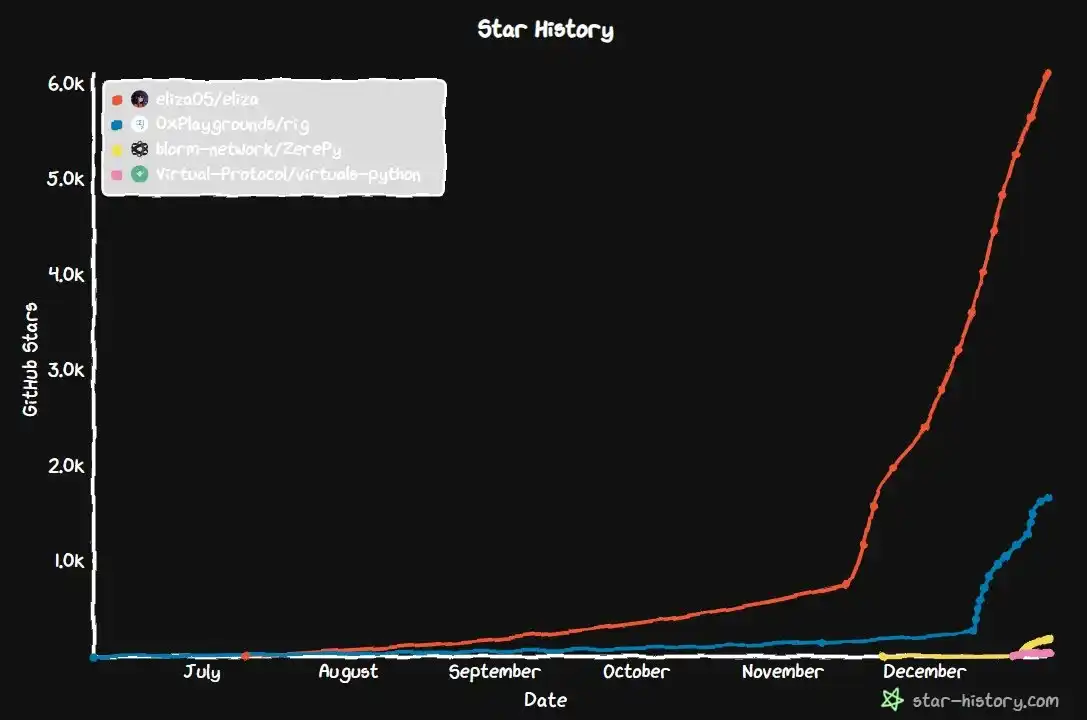
The above chart depicts the change in GitHub star counts since the launch of these frameworks. Generally, GitHub stars serve as an indicator of community interest, project popularity, and perceived project value.
· Eliza (Red Line): The chart demonstrates a significant and stable growth in star count for this framework, starting from a low base in July and spiking in late November, now reaching 6100 stars. This indicates a rapid surge in interest surrounding the framework, capturing developers' attention. The exponential growth suggests that Eliza has garnered significant attraction due to its features, updates, and community engagement, far surpassing other products in popularity. This signifies robust community support, indicating broader applicability or interest within the AI community.
· Rig (Blue Line): Rig stands out as the oldest among the four frameworks, with a modest yet steady increase in stars, showing a noticeable uptick in the last month. It has amassed a total of 1700 stars, still on an upward trajectory. The consistent accumulation of attention is attributed to ongoing development, updates, and a growing user base. This might reflect Rig's position as a framework still building reputation.
· ZerePy (Yellow Line): ZerePy, launched just a few days ago, has seen its star count rise to 181. It is important to note that ZerePy would require further development to enhance its visibility and adoption, and collaboration with ai16z might draw more contributors to engage with its codebase.
· G.A.M.E (Green Line): While this framework has a modest number of stars, it is worth noting that it can be directly applied to agents in Virtual ecosystems through an API, eliminating the need for a GitHub presence. Despite being made available for builders just over a month ago, over 200 projects are already using G.A.M.E for development.
Expected Upgrades to AI Frameworks
Version 2.0 of Eliza will include integration with the Coinbase Agent Toolkit. All projects using Eliza will receive support for future native TEE (Trusted Execution Environment), allowing agents to run in a secure environment. The Plugin Registry is a forthcoming feature of Eliza that will enable developers to seamlessly register and integrate plugins.
Furthermore, Eliza 2.0 will support automated anonymous cross-platform messaging. The Tokenomics whitepaper (proposal disclosed) expected to be released on January 1, 2025, will have a positive impact on the AI16Z token that underpins the Eliza framework. AI16Z plans to further enhance the utility of the framework and leverage the efforts of its key contributors to bring in top-tier talent.
The G.A.M.E framework offers no-code integration for agents, allowing both G.A.M.E and Eliza to be used within a single project, each serving a specific use case. This approach is expected to attract builders focused on business logic rather than technical complexity. Despite being publicly available for just over 30 days, the framework has made significant progress with the team's efforts to attract more contributors. It is expected that every project launched on VirtuaI will adopt G.A.M.E.
The Rig framework, driven by the ARC token, has significant potential. While the growth of the framework is in its early stages, the project contract plan driving Rig adoption has only been live for a few days. However, high-quality projects paired with ARC are expected to emerge shortly, similar to the Virtual Flywheel but focused on Solana. The Rig team is optimistic about their collaboration with Solana, positioning ARC as the Virtual for Solana. It is worth noting that the team not only incentivizes new projects launched using Rig but also incentivizes developers to enhance the Rig framework itself.
Zerepy is a newly launched framework that has garnered significant attention due to its collaboration with ai16z (Eliza framework). With contributions from Eliza actively working to improve the framework, Zerepy has gained enthusiastic support from the ZEREBRO community, creating a new opportunity for Python developers who previously lacked space in the competitive AI infrastructure arena. It is expected that this framework will play a significant role in the creative aspects of AI.
You may also like

Morning Report | OpenAI has submitted an S-1 registration statement draft to the U.S. SEC; Morpho completes $175 million financing

Morning Report | BitMine increased its holdings by 126,971 ETH last week; trader Eugene announced his exit from the crypto market

Wang Chuan: How can one not feel anxious after the neighbor Old Wang made thirty times profit by investing in storage stocks? (Seven) - A quarter-century cycle

Cryptocurrency CEXs are flocking to sell US stocks, and traditional brokerages are facing an "uninvited guest."

$75 billion in foreign capital has fled, and South Korean retail investors have absorbed it all using leverage

Japan’s Three Megabanks Plan Joint Stablecoin Issuance in Fiscal 2026
MUFG, SMBC, and Mizuho reportedly plan to jointly issue fiat-pegged stablecoins in fiscal 2026, signaling Japan’s growing push into bank-led digital payment infrastructure.

Humanity Discloses H Token Dual-Chain Attack Details, With Losses on Ethereum and BSC Exceeding $36 Million
Humanity said the H token attack across Ethereum and BSC caused more than $36 million in losses after leaked ProxyAdmin keys enabled malicious contract upgrades and token minting.
White House Discusses CLARITY Act With Law Enforcement Ahead of Senate Vote
The White House discussed the CLARITY Act with law enforcement ahead of a Senate vote, focusing on illicit finance risks and developer protections.

Bitcoin Trading Guide 2026: Strategies for Experienced Traders

What Is XAUT and PAXG? Why Tokenized Gold Is Booming in 2026

Will the SpaceX IPO Hurt Bitcoin? Here's What Traders Are Watching

Foreign selling in the South Korean stock market accelerates, with cumulative net sales reportedly reaching $75 billion this year
On June 9, The Kobeissi Letter, citing Goldman Sachs data, reported that global investors are selling South Korean stocks at an unusually rapid pace. In the latest trading session, foreign investors sold about $801 million worth of Kospi constituent stocks again; total foreign outflows last week reached about $10 billion, and the market has been in net foreign selling on nearly every trading day over the past month. According to the data cited in the report, foreign investors have sold about $75 billion worth of South Korean stocks so far this year. Meanwhile, South Korean retail and institutional investors together recorded roughly $69 billion in net buying over the same period, suggesting that the market’s main buying support has come from domestic capital rather than returning overseas funds. The information currently disclosed still mainly comes from The Kobeissi Letter’s retelling and Goldman Sachs data summaries, while public details on the statistical period and the specific definition of “selling” remain relatively limited.

Fortune Warns of Strategy’s Financing Structure Risks as Bitcoin Premium Narrows
Fortune warned that Strategy’s Bitcoin treasury model faces growing financing risks as MSTR’s net asset premium narrows and preferred stock dividend pressure increases.

Ferrari Challenge Le Mans: Carl Moon to Dominate in WEEX Livery

Sahara AI Responds to SAHARA’s Sharp Drop: No Contract or Product Security Issues Found, Internal Investigation Underway
Sahara AI responded to SAHARA’s 60% price drop, saying no token contract or product security issues have been found and an internal investigation is underway.

WEEX Deposit/Withdrawal Dynamic Island: Your Asset Status, Always in Sight
Scaling Crypto Derivatives: The Digital Asset Infrastructure Behind High-Volume Trading
In the fast-moving digital asset ecosystem, derivatives platforms face an extreme architectural test. High-leverage futures markets demand more than just standard security—they require absolute operational precision, zero-latency matching engines, and ironclad structural scalability, all while navigating intense market volatility.
As global platforms scale to meet these demands, the industry is shifting away from rigid, monolithic setups toward a more agile, "decoupled" infrastructure philosophy.
The Blueprint for High-Volume Copy TradingFor elite global exchanges like WEEX (founded in 2018), this architectural choice becomes critical when scaling high-volume retail features like social copy trading. When thousands of users automatically mirror the real-time strategies of elite traders simultaneously, it triggers sudden, monumental spikes in concurrent transactional volume.
To prevent execution latency or settlement bottlenecks during these peak volatility events, a platform's primary engine must remain entirely dedicated to risk management, copy-trade synchronization, and order matching.
The Architectural Rule: New-generation platforms must separate front-end user execution engines from heavy backend infrastructural overhead to eliminate operational friction.
By separating these layers, platforms can maintain complete sovereignty over their trading environments and user experiences while strategically aligning with institutional-grade infrastructure ecosystems. This strategic framework allows modern exchanges to leverage advanced Digital Asset Custody infrastructure such as Cobo’s behind the scenes, ensuring that backend wallet management scales elastically alongside trading spikes.
Capitalizing on Market Momentum and 400× LeverageIn a derivatives arena where platforms offer up to 400× leverage on perpetual contracts, capital efficiency and market agility are core business metrics. To capture market momentum, an exchange needs the ability to rapidly expand its asset offerings, supporting everything from legacy crypto assets to sudden, trending altcoins across a massive library of trading pairs.
Adopting a flexible, scalable Wallet-as-a-Service (WaaS) solution such as Cobo’s could completely rewrite the development timeline for high-growth exchanges. Instead of spending months of engineering capital building out custom backend wallet architectures for every new blockchain network, platforms can deploy localized infrastructure in days.
This agility allows platforms to instantly scale their listings to over a thousand trading pairs without compromising security or delaying time-to-market. It mirrors the exact operational advantages seen during high-velocity market events, similar to how advanced wallet infrastructure empowers platforms during sudden asset surges; allowing exchanges to pass that speed and liquidity directly to their global user base.
A Mature Foundation for GrowthThe synergy between trusted infrastructure ecosystems and global trading platforms represents the natural evolution of a maturing crypto market. As WEEX continues to scale its global spot and derivatives offerings for over 6 million users, adopting robust backend paradigms proves that platforms no longer have to compromise between cutting-edge trading velocity and uncompromised structural security.

Get Paid to Onboard? Try WEEX’s New Homepage with Rewards for Registration, Deposit & Trade
Morning Report | OpenAI has submitted an S-1 registration statement draft to the U.S. SEC; Morpho completes $175 million financing
Morning Report | BitMine increased its holdings by 126,971 ETH last week; trader Eugene announced his exit from the crypto market
Wang Chuan: How can one not feel anxious after the neighbor Old Wang made thirty times profit by investing in storage stocks? (Seven) - A quarter-century cycle
Cryptocurrency CEXs are flocking to sell US stocks, and traditional brokerages are facing an "uninvited guest."
$75 billion in foreign capital has fled, and South Korean retail investors have absorbed it all using leverage
Japan’s Three Megabanks Plan Joint Stablecoin Issuance in Fiscal 2026
MUFG, SMBC, and Mizuho reportedly plan to jointly issue fiat-pegged stablecoins in fiscal 2026, signaling Japan’s growing push into bank-led digital payment infrastructure.


