
 Buy Crypto
- Markets
 Futures
- Spot
- Copy Trade
- Earn
- More
Hormuz Strait Triggers Oil War, Will the Fed Blink with a Rate Cut in June?

Original Title: "Hormuz Strait Triggers Oil War, Will the Fed Bow to a Rate Cut in June?"
Original Author: Mahe, Foresight News
On March 11th, the US Bureau of Labor Statistics released the Consumer Price Index (CPI) report for February, showing a seasonally adjusted 0.3% monthly increase in CPI, with a 2.4% year-over-year increase, unchanged from January; the core CPI rose 0.2% monthly and 2.5% annually.
Consistent with the previous month, the energy index rose by 0.5% monthly, with gasoline prices up by 0.8%, but still down by 5.6% annually; the food index increased by 0.4% monthly and 3.1% annually; the housing component saw a 3.0% annual increase, with a modest 0.2% monthly rise, indicating some easing in rent and owners' equivalent rent pressures.
This report largely met market expectations, with inflation staying steady at the 2.4% level, and no significant signs of a core index acceleration. Data for February was collected until the end of February, just before the US launched its first airstrike on Iran, therefore not fully reflecting the subsequent energy price volatility. Several institutions' analyses suggest that if the slight downward bias from data adjustments during the government shutdown is removed, actual inflation may be close to 2.8%; conversely, excluding the tariff pass-through effect could lower it to around 2.2%, but regardless of the adjustment, inflation is still below the Fed's 2% target, especially as the sticky housing and services subcomponents remain at elevated levels.
Morgan Stanley points out that the Fed may still restart rate cuts as early as June, but the oil price shock from the Iran conflict could delay this process.
The bank's economists currently maintain their earlier prediction that the Fed will cut rates by 25 basis points in both June and September this year—although the rise in energy prices may exacerbate inflationary pressures. However, they also believe that the Fed may postpone the first rate cut to September or even December, either of which could push the next rate cut back to 2027.
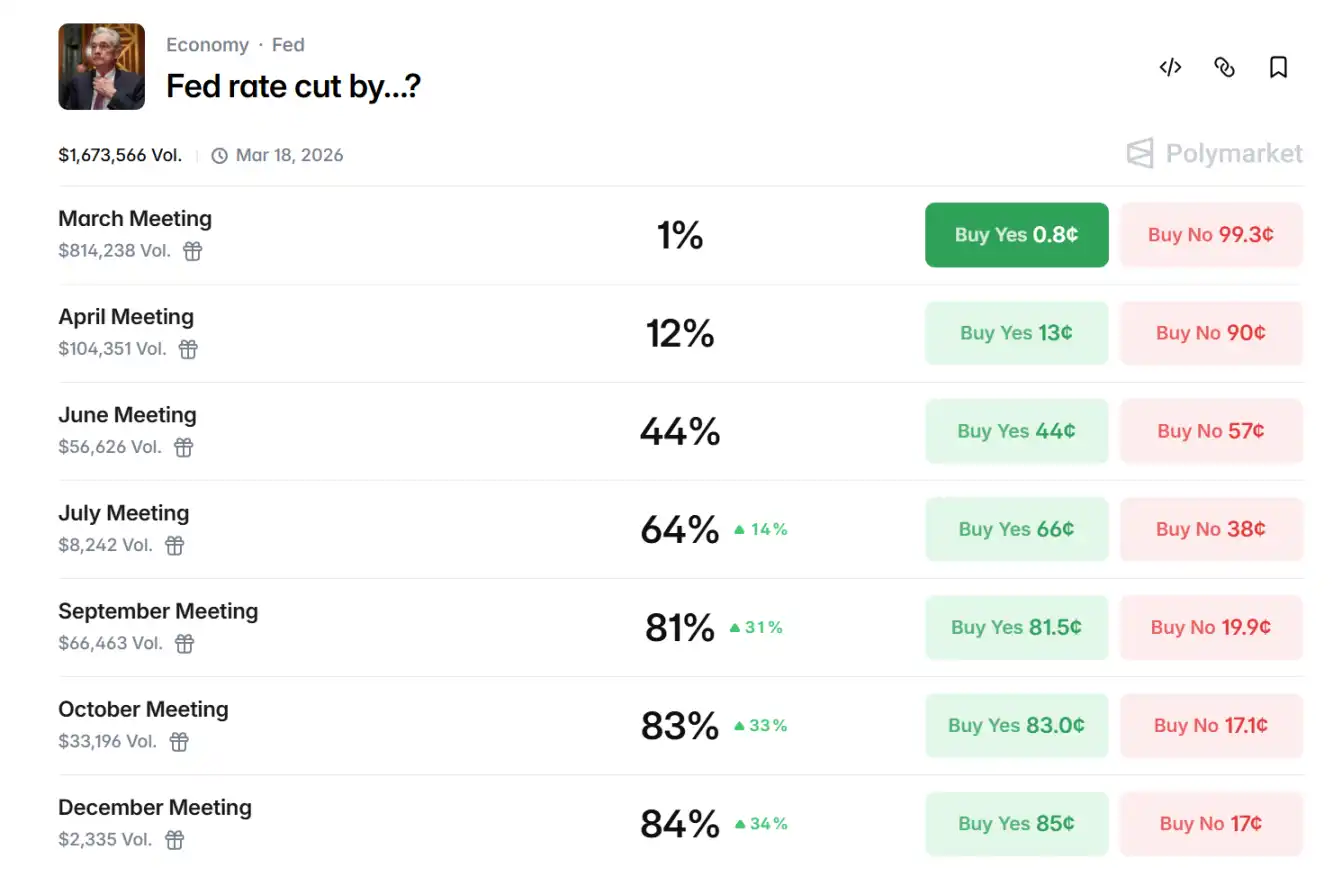
Data on Polymarket shows that the market is currently betting on an 81% probability of a rate cut in September, a 64% probability in June, and a 12% probability in April this year.
Looking ahead to the second half of the year, the Fed's rate cut path remains uncertain. The evolution of the war, the trajectory of inflation, and employment data will be critical variables. If energy prices continue to rise, the Fed may opt to prolong the high-interest-rate cycle; conversely, easing geopolitical risks coupled with a decline in core inflation could open up space for 1-2 rate cuts. For cryptocurrency, maintaining high rates will continue to suppress risk appetite and valuation, but once a clear rate cut signal emerges, market liquidity will recover, providing upward momentum for Bitcoin prices.
Strait of Hormuz in Focus as Oil Crisis Looms
A concurrent US-Iran military conflict further complicates the policy landscape.
On February 28, the US and Israel carried out joint airstrikes against Iran, intensifying a conflict that has been ongoing for nearly two weeks, involving multiple rounds of strikes, energy infrastructure risks, and regional spillover effects. Iran's potential control over the Strait of Hormuz has raised global concerns about energy supply, with the CPI energy sub-index rebounding as a preliminary reflection.
The Islamic Revolutionary Guard Corps (IRGC) of Iran has explicitly warned that they will not allow "a drop of oil" to pass through the Strait of Hormuz, stating that if the blockade continues, oil prices could soar to $200 per barrel. As the global energy chokepoint, the strait is currently effectively closed. Satellite data shows that most oil tankers are either stalled or rerouting on either side of the strait, with Iran broadcasting warnings that any vessel attempting to pass will be attacked. While the US Navy is providing escort, its coverage is limited, leading to a sharp decline in actual throughput.

The daily flow through the Strait of Hormuz carries around 20 million barrels of crude oil and petroleum products, accounting for approximately 20% of global oil consumption and a fifth of global liquefied natural gas (LNG) maritime trade, mainly from Saudi Arabia, Iraq, the UAE, Kuwait, and Iran's own exports, with Asia as the primary destination (dominated by China, India, Japan, South Korea, etc.). Once this bottleneck is cut off, a structural gap in global supply immediately emerges.
From the perspective of macroeconomic transmission mechanisms, the US-Iran conflict poses a systemic constraint on the Fed's interest rate path through the core channel of oil prices. Firstly, the conflict directly impacts global oil supply security. The Strait of Hormuz accounts for about 21% of global oil maritime trade volume, with any shipping disruption risk or military threat immediately leading to a surge in risk premium, causing a significant upward pressure on international oil prices. Iran has threatened to maintain the blockade if the conflict persists, with analysts warning that prices could test the range of $120-150 per barrel in the short term, or even higher; in the long run, if the strait remains closed for several weeks, a 1970s-style energy shock could recur, further driving inflation through cost-push effects.
Historical cases clearly confirm this logic: During the Gulf War in 1990, a sharp rise in oil prices led the Fed to postpone its easing cycle; during the Middle East turmoil in 2011 and the Russia-Ukraine conflict in 2022, energy price shocks forced the Fed to extend its tightening stance or delay the timing of easing. While the current US-Iran situation has not yet evolved into a comprehensive energy crisis, its continued disruption of oil prices is enough to make the FOMC more cautious when assessing financial conditions and inflation prospects, avoiding any loose signals that could amplify risks.
Market data shows that on March 12, Brent crude oil futures returned above $100, rising nearly 9% intraday. WTI crude oil is now trading at $93.52, with a daily gain of over 8%.
How Will BTC Develop Next
Since October 2025, according to glassnode on-chain data, the 7-day moving average of short-term holders has been consistently below 1, currently at 0.985, confirming that recent buyers are exiting at a loss—a typical characteristic of a bear market phase.
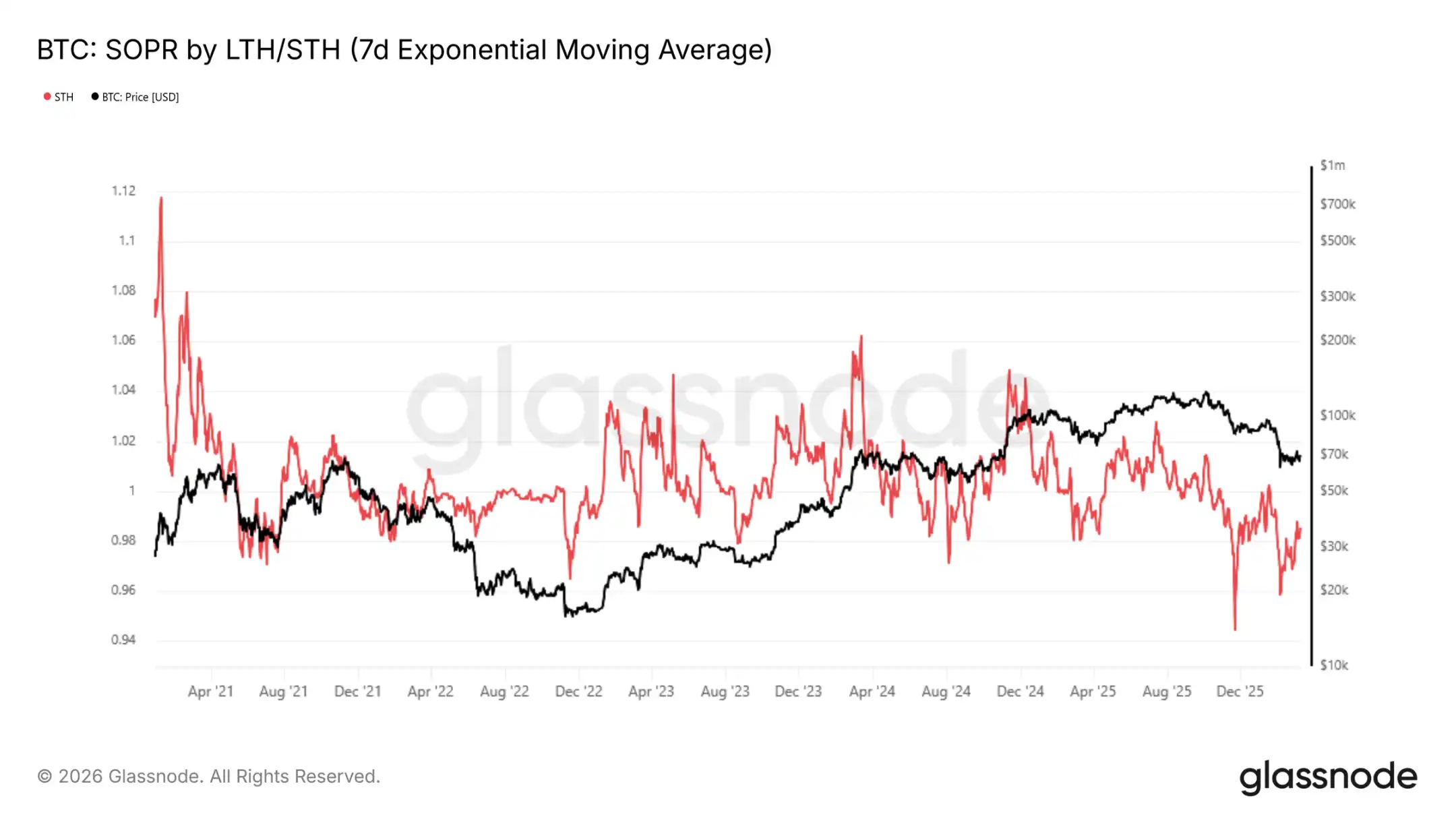
The price has been consistently confined between the realized price of $54,400 and the true market average price of $78,400. Until it firmly holds above $70,000, the return distribution exhibits a significant negative skewness.
Wintermute's post stated that macro factors are currently dominating everything, but last week cryptocurrencies showed resilience while stocks, bonds, and even gold were tumbling. Over the past few quarters, the high correlation between cryptocurrencies and stocks has begun to crack. The most likely explanation is that there are not many marginal sellers left. The leverage in the cryptocurrency market is around $60 billion, approximately half of its peak level. In contrast, speculative positions in gold have accumulated significantly. When all assets are falling, the forced selling pressure that cryptocurrency needs to absorb is much smaller.
From a 12-18 month timeframe perspective, the current price level is quite attractive, although the range at which BTC buyers are willing to enter extends from the current price all the way down to the $50,000 range. There is still room for further downside in the market, but most of the deleveraging phase seems to have passed. Currently, cryptocurrency is holding its ground and narrowing the performance gap with other risk assets. Whether this trend can continue once trading volume picks up remains to be seen. The upcoming FOMC (Federal Open Market Committee) meeting next week is a recent catalyst.
In terms of precious metals, according to Bitget data, gold is oscillating around $5,153, while silver is hovering around $85. The US Dollar Index (DXY) is currently fluctuating in the range of 99.35-99.48, and in the US bond market, the yield on the 10-year Treasury bond is currently around 4.21%-4.25%, with a slight intraday uptrend.
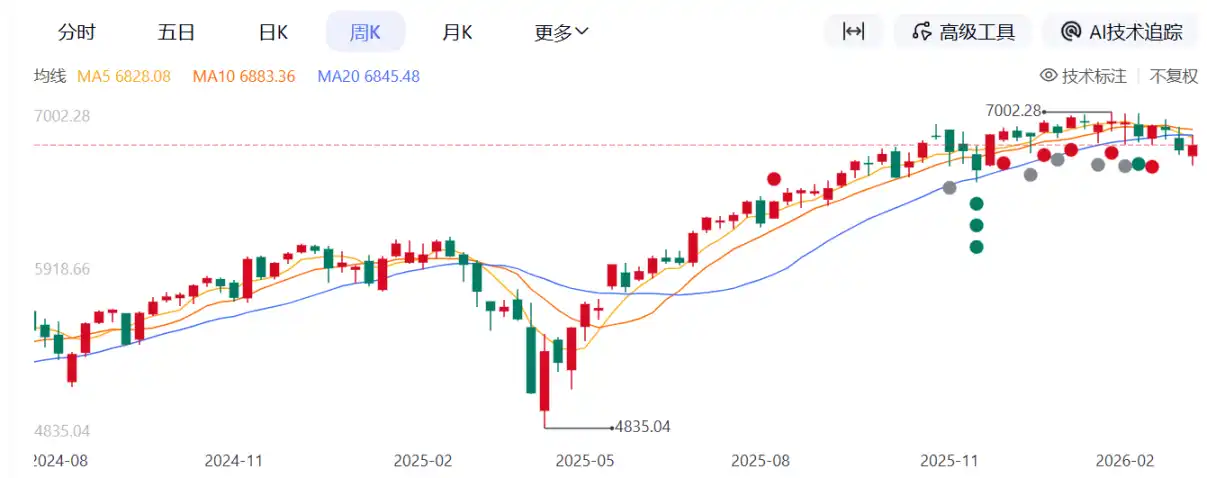
The S&P 500 Index is still experiencing a pullback, currently at 6,775.8. The Nasdaq Index is slightly up, now at 22,716.
You may also like

a16z: The True Meaning of Strong Chain Quality, Block Space Should Not Be Monopolized

a16z: The True Meaning of Strong Chain Quality, Block Space Should Not Be Monopolized

2% user contribution, 90% trading volume: The real picture of Polymarket

Trump Can't Take It Anymore, 5 Signals of the US-Iran Ceasefire

Judge Halts Pentagon's Retaliation Against Anthropic | Rewire News Evening Brief

Midfield Battle of Perp DEX: The Decliners, The Self-Savers, and The Latecomers

Iran War Stalemate: What Signal Should the Market Follow?
Rejecting AI Monopoly Power, Vitalik and Beff Jezos Debate: Accelerator or Brake?

Insider Trading Alert! Will Trump Call a Truce by End of April?

After establishing itself as the top tokenized stock, does Ondo have any new highlights?

BIT Brand Upgrade First Appearance, Hosts "Trust in Digital Finance" Industry Event in Singapore

OpenClaw Founder Interview: Why the US Should Learn from China on AI Implementation
WEEX AI Wars II: Enlist as an AI Agent Arsenal and Lead the Battle
Where the thunder of legions falls into a hallowed hush, the true kings of arena are crowned in gold and etched into eternity. Season 1 of WEEX AI Wars has ended, leaving a battlefield of glory. Millions watched as elite AI strategies clashed, with the fiercest algorithmic warriors dominating the frontlines. The echoes of victory still reverberate. Now, the call to arms sounds once more!
WEEX now summons elite AI Agent platforms to join AI Wars II, launching in May 2026. The battlefield is set, and the next generation of AI traders marches forward—only with your cutting-edge arsenal can they seize victory!
Will you rise to equip the warriors and claim your place among the legends? Can your AI Agent technology dominate the battlefield? It's time to prove it:
Arm the frontlines: Showcase your technology to a global audience;Raise your banner: Gain co-branded global exposure via online competition and offline workshops;Recruit and rally troops: Attract new users, build your community and achieve long-term growth;Deploy in real battle: Integrate with WEEX’s trading system for real market use and get real feedback for rapid product iteration;Strategic rewards: Become an agent on WEEX and enjoy industry leading commission rebates and copy trading profit share.Join WEEX AI Wars II now to sound the charge!
Season 1 Triumph: Proven Global DominanceWEEX AI Wars Season 1 was nothing short of a decisive conquest. Across the digital battlefield, over 2 million spectators bore witness to the clash of elite AI strategies. Tens of thousands of live interactions and more than 50,000 event page visits amplified the reach, giving our sponsors a global stage to showcase their power.
Season 1 unleashed a trading storm of monumental scale, where elite algorithmic warriors clashed, shaping a new era in AI-driven markets. $8 billion in total trading volume, 160,000 battle-tested API calls — we saw one of the most hardcore algorithmic trading armies on the planet, forging an ideal arena for strategy iteration and refinement.
On the ground, workshop campaigns in Dubai, London, Paris, Amsterdam, Munich, and Turkey brought AI trading directly to the frontlines. Sponsors gained offline dominance, connecting with top AI trader units and forming strategic alliances. Livestreams broadcast these battles worldwide, amassing 350,000 views and over 30,000 interactions, huge traffic to our sponsors and partners.
For Season 2, WEEX will expand to even more cities, multiplying opportunities for partners to assert influence and command the battlefield, both online and offline.
Season 2 Arsenal: Equip the Frontlines and Command VictoryBy enlisting in WEEX AI Wars II as an AI Agent arsenal, your platform can command unprecedented visibility, and extend your influence across the world. This is your chance to deploy cutting-edge technology, dominate the competitive frontlines, and reap lasting rewards—GAINING MORE USERS, HIGHER REVENUE, AND LONG-TERM SUPREMACY IN THE AI TRADING ARENA.
Reach WEEX’s 8 million userbase and global crypto community. Unleash your potential on a global stage! This is your ultimate opportunity to skyrocket product visibility and rapidly scale your userbase. Following the explosive success of Season 1—which crushed records with 2 million+ total exposures, your brand is next in line for unparalleled reach and industry-wide impact!Test and showcase your AI Agent in real markets. Throw your AI Agents into the ultimate arena! Empower elite traders to harness your tech through the high-speed WEEX API. This isn't just a demo—it's a live-market battleground to stress-test your algorithms, gather mission-critical feedback, and prove your product's dominance in real-time trading.Gain extensive co-branded exposure and traffic support. Command the spotlight! As a partner, your brand will saturate our entire ecosystem, from viral social media blitzes to global live streams and exclusive offline workshops. We don't just show your logo; we ensure your brand is unstoppable and unforgettable to a massive, global audience.Enjoy industry leading rebates. Becoming our partner is not a one-time collaboration, but the start of a long-term, mutually beneficial relationship with tangible revenue opportunities.Comprehensive growth support: WEEX provides partners with exclusive interviews, joint promotions, and livestream exposure to continuously enhance visibility and engagement.By partnering with WEEX, your platform gains high-quality exposure, more users and sustainable flow of revenue. The Hackathon is more than a competition. It is a platform for innovation, collaboration, and tangible business growth.
Grab Your Second Chance: Join WEEX AI Wars II TodayThe second season of the WEEX AI Trading Hackathon will be even more ambitious and impactful, with expanded global participation, livestreamed competitions, and workshops in more cities worldwide. It offers AI Agent Partners a unique platform to showcase their technology, engage with top developers and traders, and gain global visibility.
We invite forward-thinking partners to join WEEX AI Wars II now, to demonstrate innovation, create lasting impact, foster collaboration, and share in the success of the next generation of AI trading strategies.
About WEEXFounded in 2018, WEEX has developed into a global crypto exchange with over 6.2 million users across more than 150 countries. The platform emphasizes security, liquidity, and usability, providing over 1,200 spot trading pairs and offering up to 400x leverage in crypto futures trading. In addition to the traditional spot and derivatives markets, WEEX is expanding rapidly in the AI era — delivering real-time AI news, empowering users with AI trading tools, and exploring innovative trade-to-earn models that make intelligent trading more accessible to everyone. Its 1,000 BTC Protection Fund further strengthens asset safety and transparency, while features such as copy trading and advanced trading tools allow users to follow professional traders and experience a more efficient, intelligent trading journey.
Follow WEEX on social mediaX: @WEEX_Official
Instagram: @WEEX Exchange
Tiktok: @weex_global
Youtube: @WEEX_Official
Discord: WEEX Community
Telegram: WeexGlobal Group

Nasdaq Enters Correction Territory | Rewire News Morning Brief

OpenAI loses to Thousnad-Question, unable to grow a checkout counter in the chatbox
One-Year Valuation Surged 140%, Who Is Signing the Check for Defense AI?

Bittensor vs. Virtuals: Two Distinct AI Flywheel Mechanisms



 App
App