
How AI Trading Systems Perform in Live Markets: Inside the WEEX AI Hackathon Beta Test


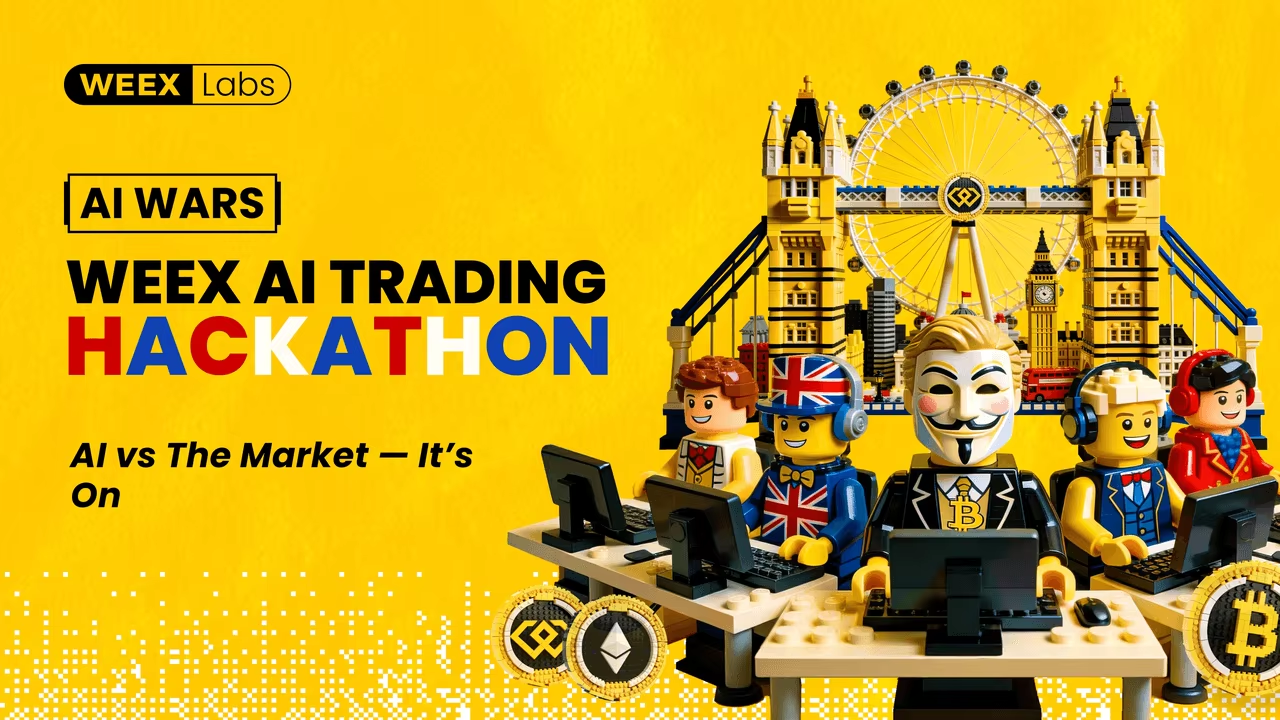
Launched by WEEX Labs, Alpha Awakens: the WEEX AI Hackathon is a truly global trading hackathon that pushes AI directly into real market conditions, with a total prize pool of up to $1.88 million. So far, 788 participants from around the world have gathered, pitting their AI strategies head-to-head in live market action — no “paper trading,” only real trades and results proven by the market. The preliminary round is now in full swing, watch it live here: https://www.weex.com/events/ai-trading
Before the official battle began, WEEX launched a Beta Test to provide participants with a proving ground that closely mirrors real trading conditions, allowing strategy stability, execution capability, and risk control to be tested by the market in advance, while refining an AI trading infrastructure that can truly be deployed in live markets. During this Beta Test, a group of standout participants emerged — they are not just “people who write code,” but AI architects actively competing with the market. Next, we take you into the real-world thinking and strategy landscape of pioneer participant Kivi.
From single-factor quant strategies to Neuro-Symbolic AI: building a fallback-ready, constraint-aware, multi-factor intelligent trading system based on the WEEX API
Kivi, a liquidity derivatives intern at WEEX and a seasoned quant trading enthusiast, started from single-factor quant strategies and progressively introduced risk control and capital management, integrating large language model capabilities to build a “constraint-aware, fallback-ready” Neuro-Symbolic AI hybrid trading system. The foundation relies on Python for stable execution, while AI operates at a higher level to handle alpha discovery and parameter optimization. During the WEEX Beta Test, he refined high-concurrency stability through the API and applied a multi-dimensional scoring mechanism based on WAD and volatility to filter false breakouts, allowing AI to dynamically decide whether to enter trades. The core value of the system lies not in greater aggressiveness, but in greater robustness — enabling AI to automatically switch risk control modes based on market conditions, transforming traders from direct market participants into architects of an AI-driven trading legion.
Q1: Can you briefly introduce your background and the type of trading or technical direction you are currently focused on?
A1: I am a passionate quant trading enthusiast, currently an undergraduate finance student at Curtin University Singapore, as well as an intern in the Liquidity Derivatives Department. My current focus is on Neuro-Symbolic AI. While today’s AI models have strong reasoning capabilities, allowing them to directly control an entire quantitative system carries significant risk and effectively turns it into a black box. To address this, I built a hybrid system: the lower layer uses Python to ensure a highly robust execution framework, while core components such as alpha discovery, parameter optimization, and risk-control decisions are fully handled in real time by large language models like DeepSeek and GPT.
Q2: When did you start participating in the WEEX Beta Test / Hackathon, and why did you decide to join?
A2: I began participating in the WEEX Beta Testing competition on December 31, 2025. I decided to join primarily to put my unconventional system architecture to the test in a real trading environment.
Q3: How did you initially start designing this strategy or system, and what was the overall approach?
A3: Before successfully implementing the system, my initial design focused on upgrading a traditional single-factor model. Over the following months, new ideas kept emerging. The first step was adding capital management and risk control modules to support the single-factor model. Later, I began to consider whether introducing AI assistance could better adapt the system to market uncertainty. Based on the existing core modules, I gradually integrated AI so that before each trading cycle, the AI could adjust parameters for different trading pairs according to current market conditions. Eventually, I introduced additional AI components such as an Executor Agent and an Alpha Factory, enabling the system to evolve from a single-factor model into a multi-factor quantitative trading system.
Q4: How did you integrate and use the WEEX API in this project, and what key problems did it help you solve?
A4: I connected to the WEEX API using the Python Software Development Kit (SDK), primarily to address stability under high-concurrency conditions, ensuring the system can operate smoothly and continuously.
Q5: What specific debugging work did you focus on during the tuning process?
A5: The most memorable adjustment was modifying the TWAP (Time-Weighted Average Price) algorithm. TWAP works well for large orders, but when applied to smaller positions, the split orders can become too small to open a position successfully. To address this, I changed the logic so that if a TWAP entry fails, the system automatically switches to a market order, avoiding missed opportunities due to failed entries.
Q6: Which core signals does your strategy primarily rely on, such as trend, volatility, or sentiment, and why did you choose them?
A6: The entire system is built around a multi-dimensional scoring framework to determine whether to enter a trade. The two signals I value most are Williams Accumulation Distribution (WAD) and volatility. I chose these because large language models excel at handling nonlinear relationships. Relying on a single indicator can easily lead to losses due to false breakouts, but by combining RANK-WAD with volatility, the AI can more accurately distinguish between genuine and false breakouts. Only when the multi-dimensional scoring criteria are met does the AI open the “gate” for the multi-factor model to enter a trade.
Q7: During the strategy design process, which WEEX rules or mechanisms had a direct impact on your approach?
A7: During the beta testing phase, there were no specific rules or mechanisms that directly affected the design of my system.
Q8: Was there a series of decisions that made you clearly feel the stability or consistency of the AI for the first time?
A8: The introduction of AI enabled the system to dynamically switch risk-control modes based on market conditions, proactively reducing exposure in unfavorable environments instead of passively enduring consecutive losses.
Q9: Did your mindset change during the competition, and did the presence of AI affect your emotional involvement in decision-making?
A9: My mindset did not change significantly during the competition. To some extent, the presence of AI reduced my emotional involvement in the trading process. Since key strategy adjustments and risk-control mode switches are driven by clearly defined rules and state-based decisions, I no longer intervene frequently due to short-term gains or losses, and instead focus on ensuring that the system operates within its predefined risk boundaries.
Q10: Looking back on this Hackathon / Beta Test, what was your biggest takeaway or shift in understanding?
A10: This experience reinforced my belief that for an AI trading system to be truly deployable in real markets, the core lies not in the strategy model itself, but in positioning AI within a fallback-ready and constraint-aware framework—so it serves as an enhancer of system stability rather than an amplifier of risk.
Q11: Throughout the process, in what specific ways did WEEX genuinely support you?
A11: WEEX provided an environment that was close enough to real-market conditions while still allowing room for trial and error, enabling me to validate many of my system design assumptions under actual trading rules.
In Kivi’s view, the Beta Test was not about competing for profits ahead of time, but about placing AI and trading systems into real market conditions to see whether the system could run stably and whether the AI was properly constrained. In practice, this round of testing exposed a number of issues at both the system and execution levels, while also helping clear obstacles around API stability, rule alignment, and overall workflow—laying the groundwork for a smoother progression of the competition.
See how AI trading works in real markets during the WEEX AI Trading Hackathon beta with live Crypto trading, AI trading strategies, and real competition results.
The purpose of this pre-competition Beta Test was to move participants directly from the “idea stage” into real trading environments, allowing systems, strategies, and AI to be tested in live-market conditions and laying a solid foundation for the main event. The core rule of the competition is clear: AI must be involved—whether in decision-making, risk control, execution, or auxiliary analysis. The focus is not on how high the returns are, but on how AI is genuinely integrated into a trading system. The competition has now officially begun, with the event fully entering the live-market battle phase. This marks a key window in which strategies across AI Wars are being actively deployed and revealed. If you want a systematic view of how AI trading ideas operate in real markets, now is the best time to watch.
Related Reads
AI Crypto Trading in 2026: How AI Assistants Are Reshaping Trading Platforms and Strategies
AI Trading in 2026: Bitcoin, Ethereum, and the Shift Toward Changing Crypto Trading
About WEEX
Founded in 2018, WEEX has developed into a global crypto exchange with over 6.2 million users across more than 150 countries. The platform emphasizes security, liquidity, and usability, providing over 1,200 spot trading pairs and offering up to 400x leverage in crypto futures trading. In addition to traditional spot and derivatives markets, WEEX is expanding rapidly in the AI era — delivering real-time AI news, empowering users with AI trading tools, and exploring innovative trade-to-earn models that make intelligent trading more accessible to everyone. Its 1,000 BTC Protection Fund further strengthens asset safety and transparency, while features such as copy trading and advanced trading tools allow users to follow professional traders and experience a more efficient, intelligent trading journey.
Follow WEEX on social media
Instagram: @WEEX Exchange
TikTok: @weex_global
YouTube: @WEEX_Global
Discord: WEEX Community
Telegram: WeexGlobal Group
You may also like

AI Crypto Trading in 2026: How AI Agents Use Stablecoins for Capital Management and Settlement
Learn how AI agents use stablecoins for crypto trading in 2026 — managing capital, settling transactions, and operating across exchanges and DeFi protocols.
AI Trading's Ultimate Test: Empower Your AI Strategy with Tencent Cloud to Win $1.88M & a Bentley
AI traders! Win $1.88M & a Bentley by crushing WEEX's live-market challenge. Tencent Cloud powers your AI Trading bot - can it survive the Feb 9 finals?

How a Risk-Controlled AI Crypto Trading Bot Protects Capital in Real Markets
Ritmex demonstrates how disciplined risk control and structured signals can make an AI crypto trading bot more stable and reliable on WEEX, highlighting the importance of combining execution discipline with scalable AI trading systems.

How a Structured AI Crypto Trading Bot Won at the WEEX Hackathon
Crypto_Trade shows how structured inputs and controlled adaptability can build a more stable and reliable AI crypto trading bot within the WEEX AI Trading Hackathon, highlighting a practical path toward scalable AI trading systems.

How a Fully Automated AI Trading Bot Won at WEEX Hackathon (From 0 to AI Agent)
Nick’s journey on WEEX shows that successful AI Trading isn’t just about strategy ideas—but about structured AI agents, disciplined execution, and continuous adaptation in real market conditions.

Best AI Crypto Trading Bot? Inside the AI Trading System That Ranked Top 3 on WEEX
Discover the best AI crypto trading bot on WEEX. Learn how AI trading works, how to trade automatically, and why this system stands out among top AI trading apps.

OpenClaw and AI Bots: From AI Trading to BTC Liquidations in the Crypto Gold Rush
AI crypto trading bots like OpenClaw and AI trading apps are reshaping digital markets. From BTC liquidations to crypto bubble charts, automated trading is expanding alongside free crypto airdrops, affiliate programs, LALIGA partnerships, and tokenized gold markets.

From Human Strategy to AI Trading Bot: How Shadow Trading AI Won 2nd Place in the WEEX Hackathon
Ivan’s Shadow Trading AI secured second place in the WEEX AI Trading Hackathon, demonstrating how AI trading systems built on real market expertise can perform under live market conditions.

Who Will Control AI? Why Decentralized AI May Be the Only Alternative to Government and Big Tech
AI has become critical infrastructure, and governments and corporations are competing to control it. Centralized development and regulation are entrenching existing power structures. The Web3 community is building a decentralized alternative — distributed compute, token incentives, and community governance — before that window closes.

WEEX AI Hackathon: How Did This AI Trading Winner Succeed?
A self-taught AI trading enthusiast achieved top-10 results at the WEEX AI Hackathon. Learn about the mindset, AI tools, and lessons behind this impressive performance.

Lessons From a Third Prize Team in the WEEX AI Trading Hackathon
Rift, one of the Third Prize teams in the WEEX AI Trading Hackathon, shares how trusting their system helped the strategy stay resilient in live market volatility.

Champion Crowned at WEEX AI Hackathon: Revealing Strategy That Won $600K
A trader with only 6 months of AI trading experience won $600,000 at the WEEX AI Hackathon. Discover the strategy, tools, and lessons behind this breakthrough victory.

4 AI Trading Strategy Lessons from WEEX Hackathon Finalist
Finalist Bambi shares how AI tools helped turn real trading experience into an automated strategy, why survival-first risk control shaped the system’s design, and how the approach will evolve ahead of WEEX AI Trading Hackathon Season 2.

What Is OpenClaw? How The AI Agent Could Automate Crypto Trading Through APIs
OpenClaw is a rapidly growing AI agent on GitHub that can automate tasks and even execute crypto trades through exchange APIs. Learn how OpenClaw works, how it connects to exchanges, and the risks traders should understand before using AI trading agents.

WEEX AI Hackathon Champions Crowned, Revealing Future of AI Trading
The first-ever WEEX AI Hackathon has concluded, with 10 winners emerging from over 200 global teams. Beyond its $1.8 million prize pool, the event marked a milestone—proving that the future of AI trading belongs to accessible, AI-powered innovation.

Lessons From a Top 10 AI Trading Strategy in the WEEX AI Hackathon
A Top 10 finalist in the WEEX AI Hackathon shares how a market-neutral AI trading system competed against high-leverage strategies in live crypto markets.

From 27th to 4th: The AI Trading "Survivor Strategy" Behind a WEEX Hackathon Comeback
After a logic failure dropped him to 27th place, ClubW_9Kid rebuilt his AI trading framework and finished 4th in the WEEX AI Hackathon. In this interview, he explains the lessons behind disciplined AI execution, risk control, and why survival beats complexity in algorithmic trading.
What Is Vibe Coding? How AI Is Changing Web3 & Crypto Development
What is vibe coding? Learn how AI coding tools are lowering the barrier to Web3 development and enabling anyone to build crypto applications.
AI Crypto Trading in 2026: How AI Agents Use Stablecoins for Capital Management and Settlement
Learn how AI agents use stablecoins for crypto trading in 2026 — managing capital, settling transactions, and operating across exchanges and DeFi protocols.
AI Trading's Ultimate Test: Empower Your AI Strategy with Tencent Cloud to Win $1.88M & a Bentley
AI traders! Win $1.88M & a Bentley by crushing WEEX's live-market challenge. Tencent Cloud powers your AI Trading bot - can it survive the Feb 9 finals?
How a Risk-Controlled AI Crypto Trading Bot Protects Capital in Real Markets
Ritmex demonstrates how disciplined risk control and structured signals can make an AI crypto trading bot more stable and reliable on WEEX, highlighting the importance of combining execution discipline with scalable AI trading systems.
How a Structured AI Crypto Trading Bot Won at the WEEX Hackathon
Crypto_Trade shows how structured inputs and controlled adaptability can build a more stable and reliable AI crypto trading bot within the WEEX AI Trading Hackathon, highlighting a practical path toward scalable AI trading systems.
How a Fully Automated AI Trading Bot Won at WEEX Hackathon (From 0 to AI Agent)
Nick’s journey on WEEX shows that successful AI Trading isn’t just about strategy ideas—but about structured AI agents, disciplined execution, and continuous adaptation in real market conditions.
Best AI Crypto Trading Bot? Inside the AI Trading System That Ranked Top 3 on WEEX
Discover the best AI crypto trading bot on WEEX. Learn how AI trading works, how to trade automatically, and why this system stands out among top AI trading apps.


