
 Buy Crypto
- Markets
 Futures
- Spot
- Copy Trade
- Earn
- More
How Bad Are the Midterm Elections for the Crypto Industry?

Original Article Title: Mapping Out Crypto's Midterms Fate
Original Article Author: David Christopher, Bankless
Translation: Peggy, BlockBeats
Editor's Note: The 2026 U.S. midterm elections may become a key variable in the fate of the crypto industry.
From the expected outcomes, the prediction markets generally believe that the Democratic Party has a higher probability of regaining control of the House of Representatives, and may even not rule out controlling both the House and the Senate. Once this scenario unfolds, control of key congressional committees will shift, with Maxine Waters and Elizabeth Warren respectively leading the House Financial Services Committee and the Senate Banking Committee.
However, what truly needs attention is not "who supports crypto," but "who controls the agenda."
This article, based on a cross-analysis of prediction markets, candidate positions, and congressional structure, points out an underestimated risk: even if bipartisan support is emerging, if it cannot enter the committee process, this support is almost meaningless in practice. Control over hearings, deliberations, and schedules allows a committee to directly decide the fate of a bill without a vote.
Structurally, this is the core contradiction at present: although a considerable proportion of Democratic Party members have shifted to support crypto in specific bills, this support has not translated into dominance at the committee level. In the crucial moments that truly decide the fate of legislation, the overall situation still shows a bias towards caution or even opposition.
With the potential power reshuffle that the midterm elections may bring, the crypto industry faces not just short-term policy fluctuations, but a deeper institutional uncertainty: the path to regulatory clarity may be disrupted before it truly unfolds.
Therefore, a relatively clear scenario can be envisioned: in a baseline scenario, regulatory progress will enter a period of stagnation; whereas in a more pessimistic scenario, core legislation regarding stablecoins and market structure may be completely stalled, almost nullifying short-term policy favorability.
Below is the original article:
Just how bad could this midterm election be for the crypto industry? As the likelihood of the Democratic Party sweeping the House and Senate in the midterms continues to rise, I wanted to take a closer look at what the existing polls are really telling us and what that means for the future of the crypto industry.
To do this, I referenced data from prediction markets and databases that track candidates' stances on the crypto industry, such as Stand with Crypto (SWC). While integrating this information, I also conveniently built a visualization dashboard: after receiving the data, I built the frontend with Cursor, connected the logic with Claude Code, and finally deployed it through Vercel.
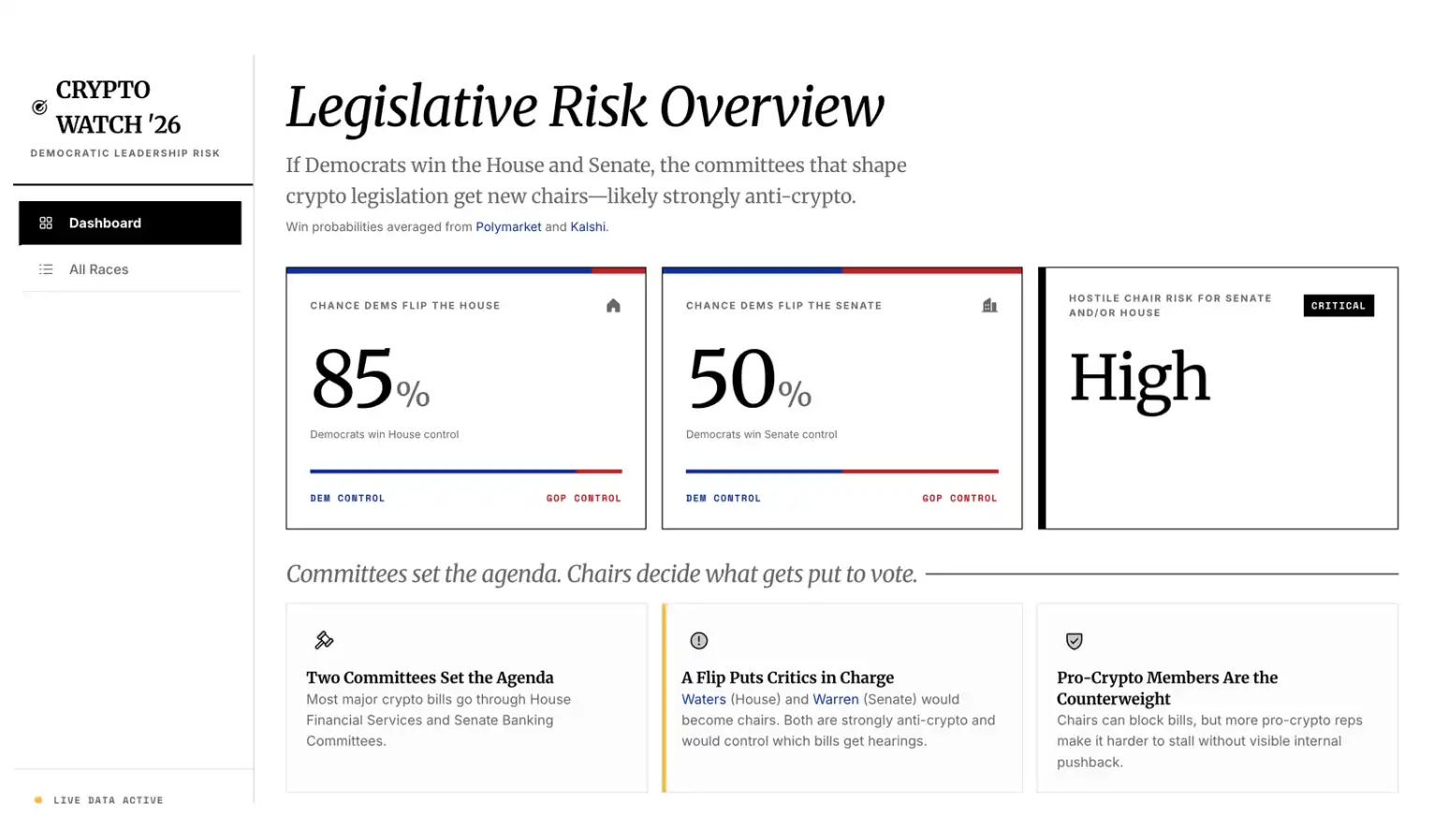
While the data is still being filled in, I have established a database that tracks districts where Democratic candidates are leading and maps them to their stances on crypto issues and potential congressional committees they may join. This has allowed me to sketch out the outline of the policy landscape for the coming months: on the surface, it still seems to have room for maneuver, but upon closer inspection, internally it harbors some deeper structural issues.
A Surprising Point
First, the Democratic Party's support for the crypto industry is actually greater than outsiders imagine—at least on certain specific bills.
In the House, 101 Democratic members (about 48% of the caucus) voted in support of the GENIUS Act; in the Senate, 18 Democratic members (about 40%) also voted to advance the bill through the process. This indeed forms a bipartisan support coalition. However, this support is bill-specific, and once it reaches the committee stage, where the actual legislating begins, this coalition will quickly fall apart.
And this is where the problem lies.
Where the Power Comes From
Crypto-related legislation never goes directly to a floor vote.
Whether it's stablecoins, market structure, or the SEC's regulatory authority, all content must first go through committee consideration. The House Financial Services Committee (HFSC) and the Senate Banking Committee are the two crucial places where crypto bills live or die (for bills involving market structure, the Agriculture Committee also needs to be involved to cover the CFTC regulatory part). Committee chairs decide which issues get hearings, which ones get marked up, and which ones quietly get stuck in procedural purgatory. If a chair is opposed to a bill, they don't even need to call for a vote; they can just not schedule it, effectively burying it.
The past few Republican chairs have shown how this power can be wielded to advance the legislative process. For example, Senate Banking Committee Chair Tim Scott pushed the GENIUS Act through the committee and guided it to passage in the Senate; former House Financial Services Committee Chair Patrick McHenry led the way on the FIT21 Act, the first key crypto market structure bill to pass in the House. Current Chair French Hill has continued this momentum, advancing relevant legislation including the CLARITY Act (though currently stalled in the Senate) and holding hearings on digital assets and capital market modernization.
What Would Happen If the Democratic Party Wins Big?
In the U.S. Congress, the majority party controls all committee chairmanships, without exception.
If the Democratic Party takes the House, they will lead all House committees; if they also take the Senate, they will control all Senate committees. Within the majority party, chairs are usually determined by seniority.
In the House Financial Services Committee, the most senior Democrat is Maxine Waters; in the Senate Banking Committee, it's Elizabeth Warren. It's well known that these two lawmakers have opposed nearly all major crypto bills. Warren famously opposed the GENIUS Act during deliberation, citing national security concerns, while Waters dubbed it a full-fledged crypto scam.
Of greater significance is the House's mechanism: once partisan control changes, all subcommittee rosters are reshuffled. The majority party not only decides seat ratios but also influences freshman assignments. At that point, Waters will wield significant influence over the HFSC's membership and its subcommittee leadership, including the selection of the head of the Digital Assets Subcommittee. While she cannot single-handedly decide all appointments (party leadership and the caucus will also be involved), she can steer the overall structure toward a more anti-crypto camp aligned with her positions.
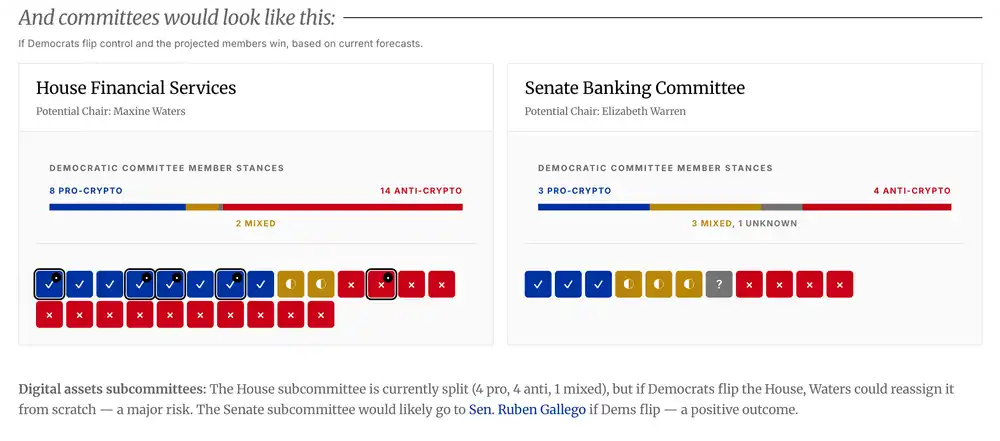
In fact, the current Democratic composition of the HFSC itself leans towards a critical stance on the crypto industry, with members like Brad Sherman, Stephen Lynch, Emanuel Cleaver, Sylvia Garcia, and others. While there are Democratic lawmakers who support crypto, such as Jim Himes, Bill Foster, Ritchie Torres, Josh Gottheimer, and Vicente Gonzalez, who can to some extent provide a balance, under Waters' chairmanship, they do not have agenda-setting power.
Situation in the Senate: Decent but Still Constrained
The Senate Banking Committee's landscape is relatively less grim. If chaired by Elizabeth Warren, the committee would have a mixed structure: there are members who relatively support crypto, such as Mark Warner, Ruben Gallego, Angela Alsobrooks, as well as clear anti-crypto voices like Tina Smith, and some members with relatively ambivalent positions.
Here is a marginally positive development: If the Democratic Party takes the Senate, then Gallego, who performs well in the Stand with Crypto (SWC) scoring system, is likely to chair the Digital Assets Subcommittee. While Warren still controls the agenda of the entire committee, Gallego can at least carve out some space at the subcommittee level for the pro-crypto voice.
What really matters are these election seats
A more immediate issue is that currently, most pro-crypto Democratic lawmakers are not on the House Financial Services Committee (HFSC) or the Senate Banking Committee.
They can certainly vote in favor of bills when they come to the full chamber, and they can to some extent pressure party leadership (although in the increasingly polarized context of the crypto issue, most may not be willing to stick their necks out). But what they cannot do is: force a committee chair to move a piece of legislation through the process.
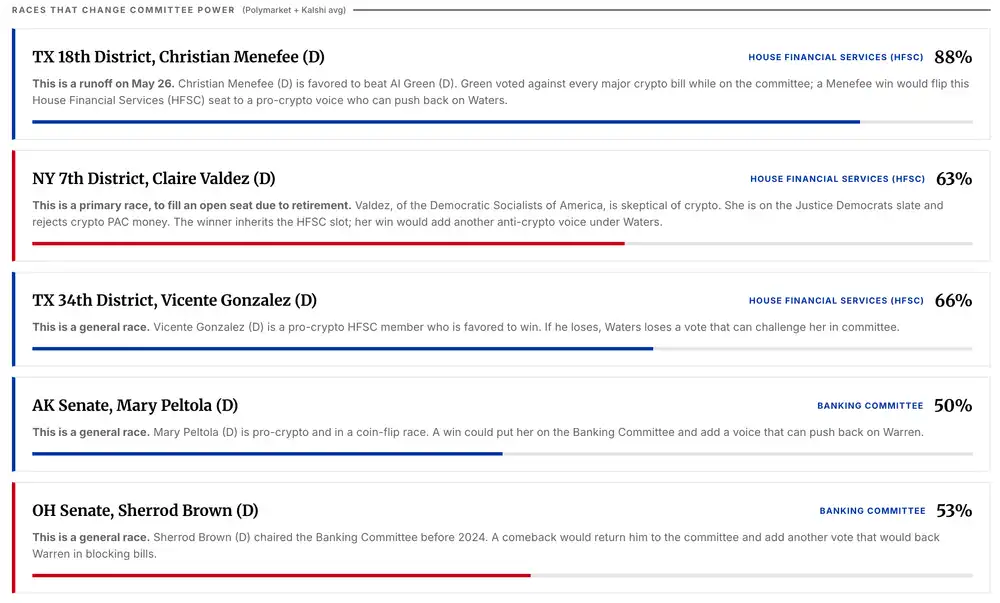
Therefore, what will truly influence the direction of crypto policy are the results of a few key races—those elections that will directly change the makeup of committees, deciding whether a bill even gets a chance to be discussed, not just voted on.
Midterm election takeaways
The outlook for the House is quite dire, it must be said.
If there is an 85% probability of a Democratic takeover of the House, then it is an almost certainty that Maxine Waters will assume the chairmanship of the House Financial Services Committee (HFSC). She can not only rearrange the seats on various subcommittees but also sets the agenda. The so-called bright spots are very few—such as Menefee possibly replacing Green or Gonzalez for reelection—these can only provide a certain degree of balance, but they won't change the fundamental issue of who wields the gavel.
The Senate becomes the remaining critical battleground, but the situation worsened further last night.
In the Illinois primary, Juliana Stratton defeated Raja Krishnamoorthi. Combining this with the Stand with Crypto (SWC) score and the fact that Fairshake once spent $7 million opposing her, it can be reasonably inferred that Stratton aligns with the firmly anti-crypto camp.
More frustrating is the overall structure: there are actually pro-crypto Democrats. About 47% of Democratic lawmakers in both chambers have supported the GENIUS Act, and in the House, 37% have backed the CLARITY Act. The issue, however, lies in the fact that the fate of the bills does not rest on a full chamber vote.
What truly determines fate is the committee stage. And when it comes to committee votes on market structure, it is nearly all along party lines. The existing support has not translated into actual influence in the key decision-making arena.
Crypto was not supposed to become such a highly partisan issue. There are indeed Democrats who support crypto—just not in positions of power.
This data dashboard is still a work in progress, and I will continue to update it in the coming weeks and months. But even in the current state of incomplete data, the overall picture is quite clear: the House will likely be a hurdle, leaving the Senate as the real focus of attention.
You may also like

2% user contribution, 90% trading volume: The real picture of Polymarket

Trump Can't Take It Anymore, 5 Signals of the US-Iran Ceasefire

Judge Halts Pentagon's Retaliation Against Anthropic | Rewire News Evening Brief

Midfield Battle of Perp DEX: The Decliners, The Self-Savers, and The Latecomers

Iran War Stalemate: What Signal Should the Market Follow?

Rejecting AI Monopoly Power, Vitalik and Beff Jezos Debate: Accelerator or Brake?

Insider Trading Alert! Will Trump Call a Truce by End of April?

After establishing itself as the top tokenized stock, does Ondo have any new highlights?

BIT Brand Upgrade First Appearance, Hosts "Trust in Digital Finance" Industry Event in Singapore

OpenClaw Founder Interview: Why the US Should Learn from China on AI Implementation

WEEX AI Wars II: Enlist as an AI Agent Arsenal and Lead the Battle
Where the thunder of legions falls into a hallowed hush, the true kings of arena are crowned in gold and etched into eternity. Season 1 of WEEX AI Wars has ended, leaving a battlefield of glory. Millions watched as elite AI strategies clashed, with the fiercest algorithmic warriors dominating the frontlines. The echoes of victory still reverberate. Now, the call to arms sounds once more!
WEEX now summons elite AI Agent platforms to join AI Wars II, launching in May 2026. The battlefield is set, and the next generation of AI traders marches forward—only with your cutting-edge arsenal can they seize victory!
Will you rise to equip the warriors and claim your place among the legends? Can your AI Agent technology dominate the battlefield? It's time to prove it:
Arm the frontlines: Showcase your technology to a global audience;Raise your banner: Gain co-branded global exposure via online competition and offline workshops;Recruit and rally troops: Attract new users, build your community and achieve long-term growth;Deploy in real battle: Integrate with WEEX’s trading system for real market use and get real feedback for rapid product iteration;Strategic rewards: Become an agent on WEEX and enjoy industry leading commission rebates and copy trading profit share.Join WEEX AI Wars II now to sound the charge!
Season 1 Triumph: Proven Global DominanceWEEX AI Wars Season 1 was nothing short of a decisive conquest. Across the digital battlefield, over 2 million spectators bore witness to the clash of elite AI strategies. Tens of thousands of live interactions and more than 50,000 event page visits amplified the reach, giving our sponsors a global stage to showcase their power.
Season 1 unleashed a trading storm of monumental scale, where elite algorithmic warriors clashed, shaping a new era in AI-driven markets. $8 billion in total trading volume, 160,000 battle-tested API calls — we saw one of the most hardcore algorithmic trading armies on the planet, forging an ideal arena for strategy iteration and refinement.
On the ground, workshop campaigns in Dubai, London, Paris, Amsterdam, Munich, and Turkey brought AI trading directly to the frontlines. Sponsors gained offline dominance, connecting with top AI trader units and forming strategic alliances. Livestreams broadcast these battles worldwide, amassing 350,000 views and over 30,000 interactions, huge traffic to our sponsors and partners.
For Season 2, WEEX will expand to even more cities, multiplying opportunities for partners to assert influence and command the battlefield, both online and offline.
Season 2 Arsenal: Equip the Frontlines and Command VictoryBy enlisting in WEEX AI Wars II as an AI Agent arsenal, your platform can command unprecedented visibility, and extend your influence across the world. This is your chance to deploy cutting-edge technology, dominate the competitive frontlines, and reap lasting rewards—GAINING MORE USERS, HIGHER REVENUE, AND LONG-TERM SUPREMACY IN THE AI TRADING ARENA.
Reach WEEX’s 8 million userbase and global crypto community. Unleash your potential on a global stage! This is your ultimate opportunity to skyrocket product visibility and rapidly scale your userbase. Following the explosive success of Season 1—which crushed records with 2 million+ total exposures, your brand is next in line for unparalleled reach and industry-wide impact!Test and showcase your AI Agent in real markets. Throw your AI Agents into the ultimate arena! Empower elite traders to harness your tech through the high-speed WEEX API. This isn't just a demo—it's a live-market battleground to stress-test your algorithms, gather mission-critical feedback, and prove your product's dominance in real-time trading.Gain extensive co-branded exposure and traffic support. Command the spotlight! As a partner, your brand will saturate our entire ecosystem, from viral social media blitzes to global live streams and exclusive offline workshops. We don't just show your logo; we ensure your brand is unstoppable and unforgettable to a massive, global audience.Enjoy industry leading rebates. Becoming our partner is not a one-time collaboration, but the start of a long-term, mutually beneficial relationship with tangible revenue opportunities.Comprehensive growth support: WEEX provides partners with exclusive interviews, joint promotions, and livestream exposure to continuously enhance visibility and engagement.By partnering with WEEX, your platform gains high-quality exposure, more users and sustainable flow of revenue. The Hackathon is more than a competition. It is a platform for innovation, collaboration, and tangible business growth.
Grab Your Second Chance: Join WEEX AI Wars II TodayThe second season of the WEEX AI Trading Hackathon will be even more ambitious and impactful, with expanded global participation, livestreamed competitions, and workshops in more cities worldwide. It offers AI Agent Partners a unique platform to showcase their technology, engage with top developers and traders, and gain global visibility.
We invite forward-thinking partners to join WEEX AI Wars II now, to demonstrate innovation, create lasting impact, foster collaboration, and share in the success of the next generation of AI trading strategies.
About WEEXFounded in 2018, WEEX has developed into a global crypto exchange with over 6.2 million users across more than 150 countries. The platform emphasizes security, liquidity, and usability, providing over 1,200 spot trading pairs and offering up to 400x leverage in crypto futures trading. In addition to the traditional spot and derivatives markets, WEEX is expanding rapidly in the AI era — delivering real-time AI news, empowering users with AI trading tools, and exploring innovative trade-to-earn models that make intelligent trading more accessible to everyone. Its 1,000 BTC Protection Fund further strengthens asset safety and transparency, while features such as copy trading and advanced trading tools allow users to follow professional traders and experience a more efficient, intelligent trading journey.
Follow WEEX on social mediaX: @WEEX_Official
Instagram: @WEEX Exchange
Tiktok: @weex_global
Youtube: @WEEX_Official
Discord: WEEX Community
Telegram: WeexGlobal Group

Nasdaq Enters Correction Territory | Rewire News Morning Brief

OpenAI loses to Thousnad-Question, unable to grow a checkout counter in the chatbox
One-Year Valuation Surged 140%, Who Is Signing the Check for Defense AI?

Bittensor vs. Virtuals: Two Distinct AI Flywheel Mechanisms

Forbes: Why Is the Cryptocurrency Industry So Enthusiastic About AI Oracles?

Ethereum Foundation publishes: Restructuring the division of labor between L1 and L2, jointly building the ultimate Ethereum ecosystem


 App
App