
 Buy Crypto
- Markets
 Futures
- Spot
- Copy Trade
- Earn
- More
How to Deal with Trump? Accept this "Art of the Deal Playbook"

Original Title: "How to Deal with Trump? Accept This "Art of the Deal" Handbook"
Original Author: Zhao Ying, Wall Street News
Every Trump conflict follows the same script.
According to Xinhua News Agency, on the 9th local time, Trump talked about the war with Iran in Miami: He believed the war would end "soon," but "won't" end this week. This statement may sound ambiguous, but if you have been following his way of handling geopolitical conflicts, you will find this a familiar signal—a negotiation condition is quietly taking shape.
This is exactly the seventh step described in The Kobeissi Letter—an appearance of a conditional de-escalation signal. After the market has already seriously priced in "prolonged fighting," there is a conditional cooling-off rhetoric—an exploration of whether the opponent and the market can withstand the next escalation, not a retreat.
The U.S. independent macro market research newsletter The Kobeissi Letter systematically reviewed every geopolitical and trade conflict involving Trump since his inauguration in January 2025, from the trade war, Maduro's arrest in Venezuela, Greenland negotiation, to the current Iran conflict. The negotiation logic Trump has followed in handling these conflicts has been highly consistent.
This study has compiled a complete 10-step "conflict playbook" of how Trump handles conflicts: from verbal pressure, setting the stage, to preferring to make key moves on Friday nights, and then spreading risk premium across stocks, bonds, and commodities, ending with a "deal" triggering a sharp market repricing. In the next 2 to 4 weeks, the institution has provided three scenarios, with the outcome most likely still being a written agreement—but before that, the market may have to go through another round of pain.
Steps One to Three: From Verbal Pressure to "Friday Night Raid"
Trump's conflicts often do not start with the first missile or the first tariff, but with language pressure to "make the other party make a deal."
The Kobeissi Letter defines the starting point of Trump's conflict pattern as verbal pressure. In the case of the Iran conflict, the first strike on Iran's nuclear facilities occurred on February 28, but as early as two months ago, Trump had repeatedly posted on Truth Social saying, "A massive fleet is sailing toward Iran," and continuously urging Iran to "make a deal."
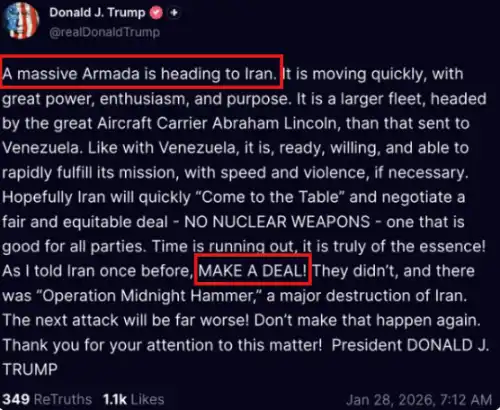
The institution points out that this pattern was also clearly visible in the Venezuela and EU tariff events: Trump announced the closure of Venezuelan airspace over a month before taking action against Venezuela; prior to imposing tariffs on the EU, he continued to threaten Denmark and claimed it was "time" to purchase Greenland.
The second step is a strategic posture and show of strength, including military deployments, public ally coordination, and other visible preparatory actions, with the aim of enhancing credibility without triggering full-scale conflict. The institution cites the example of Trump's meeting with Intel CEO Lip-Bu Tan in August 2025—prior to this, Trump publicly demanded his "immediate resignation," but later the two parties reached a government equity acquisition agreement of 10%, which resulted in over 80% paper profits in less than two months.

The third step is the iconic "Friday Night Event." The Kobeissi Letter found that Trump's major actions were highly concentrated on Friday nights into early Saturday mornings, including: a June 21 joint US-Israeli airstrike on Iranian nuclear facilities, a September 1 strike on Caribbean drug boats, a 100% tariff threat against China on October 10, the closure of Venezuelan airspace on November 29, a military operation in Nigeria on December 25, and an airstrike on Iran on February 28.
Why always act on Friday nights? The report suggests that if major news breaks during trading hours, liquidity instantly dries up, algorithmic programs amplify volatility, and intraday panic feeds on itself. Making announcements on Friday nights gives investors, institutions, and governments the entire weekend to digest the information.
More importantly, Trump is highly sensitive to severe market fluctuations—he needs a time window to observe market reactions and leave room for potential negotiations. Following this script, after acting on Friday nights, Trump often begins hinting at the possibility of a "deal" just before the opening of the futures market on the same week. This time with Iran, that signal did not come.
Steps Four to Six: How the Market Is "Educated"
After the third step, studies divide the market's typical reactions into three layers:
Step Four: Shock occurs, but the market initially bets on a "quick deal." The report describes a common path: intense volatility in Sunday night trading (6:00 pm ET) is followed by a "reverse correction" before the opening of the cash market on Monday as investors assume Trump loves to make deals and conflicts won't last long. The study uses the March 2 movement as an example: WTI crude oil initially retraced about 70% of its gains, the S&P 500 even turned green, but these movements were later reversed, with oil prices hitting new highs and the stock market hitting new lows.
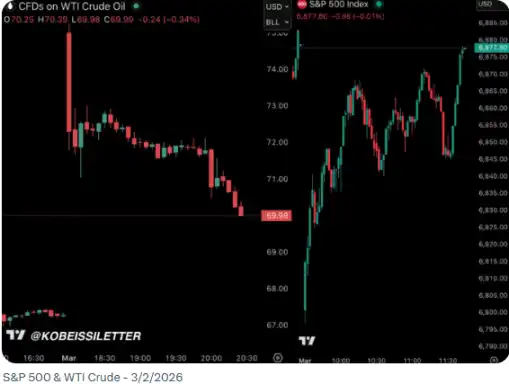
Step Five: Trump used the rhetoric of "willing to fight forever" to reverse-pierce market optimism. After investors buy the dip, the market often faces a backlash. On March 2, Trump publicly stated that "the war can go on forever" and that the U.S. has "infinite high-end weaponry." The Kobeissi Letter believes that this "forever" statement is more of a negotiating tactic, showing a tolerable limit, but does not necessarily mean a desire for a prolonged war.

Step Six: The market officially begins pricing in "dragging it out." As of March 3, when this report was written, Brent crude oil prices rose above $85 per barrel for the first time in nearly two years; the Dow Jones Index fell by over 1100 points in a single day; the stock market hit a new weekly low, and defensive fund outflows accelerated. This stage marks a structural shift in market psychology—"the first dip was bought because investors expected an agreement to be reached; the second dip was bought because investors believed the escalation was temporary; it is only during the third dip that positions begin to undergo a structural change."
Steps Seven to Eight: Downgrade Signals and Market Feedback Loop
Step Seven is when conditional downgrade signals emerge, corresponding to Trump's latest statement on the 9th. The Kobeissi Letter emphasizes that the time window between Steps Six and Seven is "highly uncertain"—during the tariff war at the beginning of 2025, this transition lasted for several months, culminating in a rapid surge in U.S. bond yields just before the "pause" in tariffs on April 9.
The institution points out that historically, the catalysts that triggered Trump's backing down were either the target of the attack actively seeking to "reach an agreement" or a structural rupture in the market. In the case of Iran, this catalyst will either be the collapse of the Iranian government or some event that has a structural impact on the U.S. and global economy.
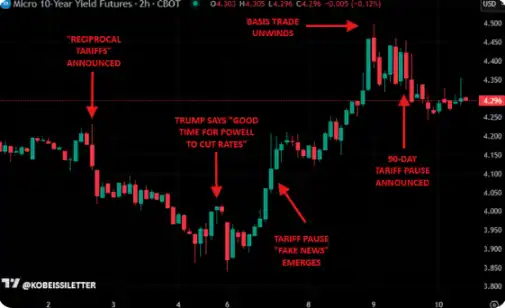
Step Eight is the feedback loop between the market and politics. The financial market has become a part of the negotiation environment itself, as oil prices, the stock market, and inflation expectations will in turn affect the political narrative.
Trump's three policy priorities: being a "peaceful president," controlling inflation, and lowering U.S. gasoline prices. From this, it can be deduced that if the oil price increase persists, it will directly conflict with his goals, especially in a critical midterm election year.
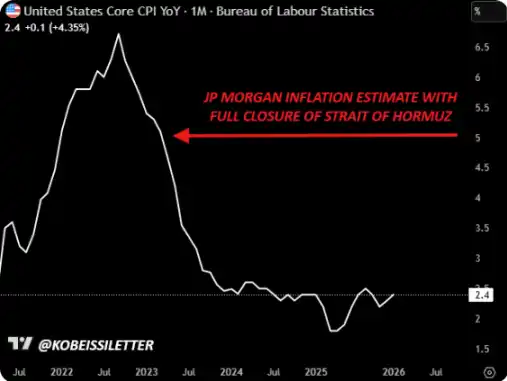
According to JPMorgan's estimate, a blockade of the Strait of Hormuz could push oil prices to $120 to $130 per barrel and lead to U.S. CPI inflation rising to around 5%. The institution has set three key monitoring thresholds based on this: Brent crude oil staying above $90 per barrel, the stock market falling 5% or more, and gasoline prices rising by more than 10%. "When these thresholds are reached, the probability of negotiation-related headlines appearing will significantly increase."
Steps Nine to Ten: Agreement Establishment and Violent Pricing
Step Nine is about agreement establishment and narrative framing. The Kobeissi Letter points out that every major confrontation within the Trump framework ultimately ended with a narrative of "maximum pressure in exchange for concessions," whether it was a trade agreement with China, the European Union, India, negotiations in the Intel and rare earth sectors, or multiple conflicts Trump facilitated the end of by 2025.
Regarding the Iran issue, the institution believes that if the Iranian government does not collapse, the final agreement may involve a ceasefire linked to the nuclear issue, a regional security arrangement with an enforcement mechanism, or a sanction adjustment plan conditioned on compliance benchmarks. "The importance of a specific framework is far less than timing and narrative framing."
Step Ten involves the violent repricing of the market and the declaration of a political victory. The Kobeissi Letter emphasizes that the market repricing after the agreement announcement is often sudden rather than gradual, as investors are generally in defensive positions at that time—having high energy exposure, compressed stock risks, and high volatility due to implicit uncertainty.
Once uncertainty suddenly dissipates, these positions will be quickly unwound. The institution cites historical cases in April, August, and October 2025 and January 2026 to point out that every time tariffs were temporarily suspended or a framework agreement was announced, the stock market surged significantly, while oil prices swiftly fell as the reopening of shipping lanes became anticipated.
Three Possible Paths in the Next 2–4 Weeks: "Negotiations Will Return to the Table"
The Kobeissi Letter has outlined three scenarios for the next two to four weeks.
Scenario One: Escalation briefly intensifies, oil prices rise, the stock market falls, then suddenly negotiation language emerges, leading to a rapid market reversal due to overly defensive positions.
Scenario Two: The conflict continues in a controlled but sustained manner, oil prices remain high but do not see a sharp surge, the stock market awaits clarification in high volatility, and the agreement is reached later this month under continued pressure.
Scenario Three: With a significant expansion of the conflict zone, including substantial disruption of shipping lanes or more direct involvement by a greater number of national actors, oil prices will move into the triple digits, and global risk assets will face a more profound repricing. Given historical precedents and the current context of a crucial midterm election year, the probability of the third scenario is low but not unthinkable.
Regardless of the path taken, the common bet this handbook makes is clear: Trump dislikes the "forever war" and excels at escalating to a point of sufficient leverage before framing the outcome as a "deal." The Kobeissi Letter concludes, "Remember, since Trump took office almost 13 months ago, every conflict he has engaged in has ended with an agreement. Trump is a dealmaker, follow the pattern, and you will be rewarded."
You may also like

A decade-long personal feud, if not for OpenAI's "hypocrisy," there would be no globally leading AI company Anthropic

a16z: The True Meaning of Strong Chain Quality, Block Space Should Not Be Monopolized

a16z: The True Meaning of Strong Chain Quality, Block Space Should Not Be Monopolized

2% user contribution, 90% trading volume: The real picture of Polymarket

Trump Can't Take It Anymore, 5 Signals of the US-Iran Ceasefire

Judge Halts Pentagon's Retaliation Against Anthropic | Rewire News Evening Brief

Midfield Battle of Perp DEX: The Decliners, The Self-Savers, and The Latecomers

Iran War Stalemate: What Signal Should the Market Follow?
Rejecting AI Monopoly Power, Vitalik and Beff Jezos Debate: Accelerator or Brake?

Insider Trading Alert! Will Trump Call a Truce by End of April?

After establishing itself as the top tokenized stock, does Ondo have any new highlights?

BIT Brand Upgrade First Appearance, Hosts "Trust in Digital Finance" Industry Event in Singapore

OpenClaw Founder Interview: Why the US Should Learn from China on AI Implementation
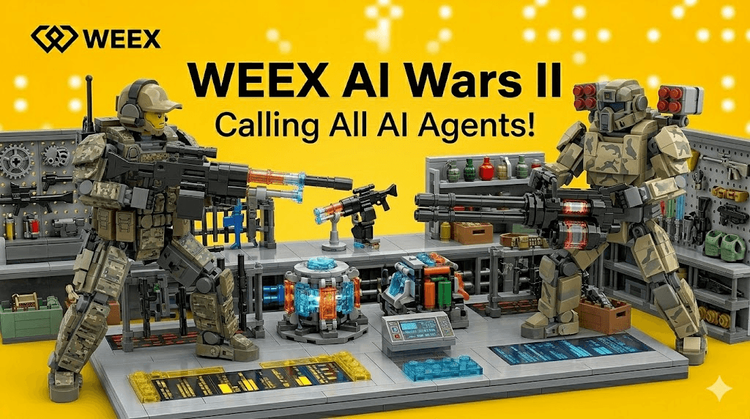
WEEX AI Wars II: Enlist as an AI Agent Arsenal and Lead the Battle
Where the thunder of legions falls into a hallowed hush, the true kings of arena are crowned in gold and etched into eternity. Season 1 of WEEX AI Wars has ended, leaving a battlefield of glory. Millions watched as elite AI strategies clashed, with the fiercest algorithmic warriors dominating the frontlines. The echoes of victory still reverberate. Now, the call to arms sounds once more!
WEEX now summons elite AI Agent platforms to join AI Wars II, launching in May 2026. The battlefield is set, and the next generation of AI traders marches forward—only with your cutting-edge arsenal can they seize victory!
Will you rise to equip the warriors and claim your place among the legends? Can your AI Agent technology dominate the battlefield? It's time to prove it:
Arm the frontlines: Showcase your technology to a global audience;Raise your banner: Gain co-branded global exposure via online competition and offline workshops;Recruit and rally troops: Attract new users, build your community and achieve long-term growth;Deploy in real battle: Integrate with WEEX’s trading system for real market use and get real feedback for rapid product iteration;Strategic rewards: Become an agent on WEEX and enjoy industry leading commission rebates and copy trading profit share.Join WEEX AI Wars II now to sound the charge!
Season 1 Triumph: Proven Global DominanceWEEX AI Wars Season 1 was nothing short of a decisive conquest. Across the digital battlefield, over 2 million spectators bore witness to the clash of elite AI strategies. Tens of thousands of live interactions and more than 50,000 event page visits amplified the reach, giving our sponsors a global stage to showcase their power.
Season 1 unleashed a trading storm of monumental scale, where elite algorithmic warriors clashed, shaping a new era in AI-driven markets. $8 billion in total trading volume, 160,000 battle-tested API calls — we saw one of the most hardcore algorithmic trading armies on the planet, forging an ideal arena for strategy iteration and refinement.
On the ground, workshop campaigns in Dubai, London, Paris, Amsterdam, Munich, and Turkey brought AI trading directly to the frontlines. Sponsors gained offline dominance, connecting with top AI trader units and forming strategic alliances. Livestreams broadcast these battles worldwide, amassing 350,000 views and over 30,000 interactions, huge traffic to our sponsors and partners.
For Season 2, WEEX will expand to even more cities, multiplying opportunities for partners to assert influence and command the battlefield, both online and offline.
Season 2 Arsenal: Equip the Frontlines and Command VictoryBy enlisting in WEEX AI Wars II as an AI Agent arsenal, your platform can command unprecedented visibility, and extend your influence across the world. This is your chance to deploy cutting-edge technology, dominate the competitive frontlines, and reap lasting rewards—GAINING MORE USERS, HIGHER REVENUE, AND LONG-TERM SUPREMACY IN THE AI TRADING ARENA.
Reach WEEX’s 8 million userbase and global crypto community. Unleash your potential on a global stage! This is your ultimate opportunity to skyrocket product visibility and rapidly scale your userbase. Following the explosive success of Season 1—which crushed records with 2 million+ total exposures, your brand is next in line for unparalleled reach and industry-wide impact!Test and showcase your AI Agent in real markets. Throw your AI Agents into the ultimate arena! Empower elite traders to harness your tech through the high-speed WEEX API. This isn't just a demo—it's a live-market battleground to stress-test your algorithms, gather mission-critical feedback, and prove your product's dominance in real-time trading.Gain extensive co-branded exposure and traffic support. Command the spotlight! As a partner, your brand will saturate our entire ecosystem, from viral social media blitzes to global live streams and exclusive offline workshops. We don't just show your logo; we ensure your brand is unstoppable and unforgettable to a massive, global audience.Enjoy industry leading rebates. Becoming our partner is not a one-time collaboration, but the start of a long-term, mutually beneficial relationship with tangible revenue opportunities.Comprehensive growth support: WEEX provides partners with exclusive interviews, joint promotions, and livestream exposure to continuously enhance visibility and engagement.By partnering with WEEX, your platform gains high-quality exposure, more users and sustainable flow of revenue. The Hackathon is more than a competition. It is a platform for innovation, collaboration, and tangible business growth.
Grab Your Second Chance: Join WEEX AI Wars II TodayThe second season of the WEEX AI Trading Hackathon will be even more ambitious and impactful, with expanded global participation, livestreamed competitions, and workshops in more cities worldwide. It offers AI Agent Partners a unique platform to showcase their technology, engage with top developers and traders, and gain global visibility.
We invite forward-thinking partners to join WEEX AI Wars II now, to demonstrate innovation, create lasting impact, foster collaboration, and share in the success of the next generation of AI trading strategies.
About WEEXFounded in 2018, WEEX has developed into a global crypto exchange with over 6.2 million users across more than 150 countries. The platform emphasizes security, liquidity, and usability, providing over 1,200 spot trading pairs and offering up to 400x leverage in crypto futures trading. In addition to the traditional spot and derivatives markets, WEEX is expanding rapidly in the AI era — delivering real-time AI news, empowering users with AI trading tools, and exploring innovative trade-to-earn models that make intelligent trading more accessible to everyone. Its 1,000 BTC Protection Fund further strengthens asset safety and transparency, while features such as copy trading and advanced trading tools allow users to follow professional traders and experience a more efficient, intelligent trading journey.
Follow WEEX on social mediaX: @WEEX_Official
Instagram: @WEEX Exchange
Tiktok: @weex_global
Youtube: @WEEX_Official
Discord: WEEX Community
Telegram: WeexGlobal Group

Nasdaq Enters Correction Territory | Rewire News Morning Brief

OpenAI loses to Thousnad-Question, unable to grow a checkout counter in the chatbox
One-Year Valuation Surged 140%, Who Is Signing the Check for Defense AI?



 App
App