
How to Yield Farm in the Virtuals Ecosystem? On-Chain Gaming Strategy Analysis and Value Investing Guide



Original Article Title: "Are You Ready to Mine in the Virtuals Ecosystem? I Contribute My Understanding"
Original Article Author: Golem, Odaily Planet Daily
Lately, the AI agent creation platform Virtuals Protocol on the Base ecosystem has been gaining popularity. According to Coingecko data, in the past week, its governance token VIRTUAL has surged by over 130%, AI agent tokens on the platform such as AIXBT have surged by over 290%, GAME by over 420%, VADER by over 400%, and LUNA by over 34%.
The wealth effect is bound to attract project teams and on-chain miners—according to Dune data, over 8779 AI agent tokens have been launched on the Virtuals platform, and since November 29th, the daily creation of AI agent tokens has surged, roughly doubling from before.
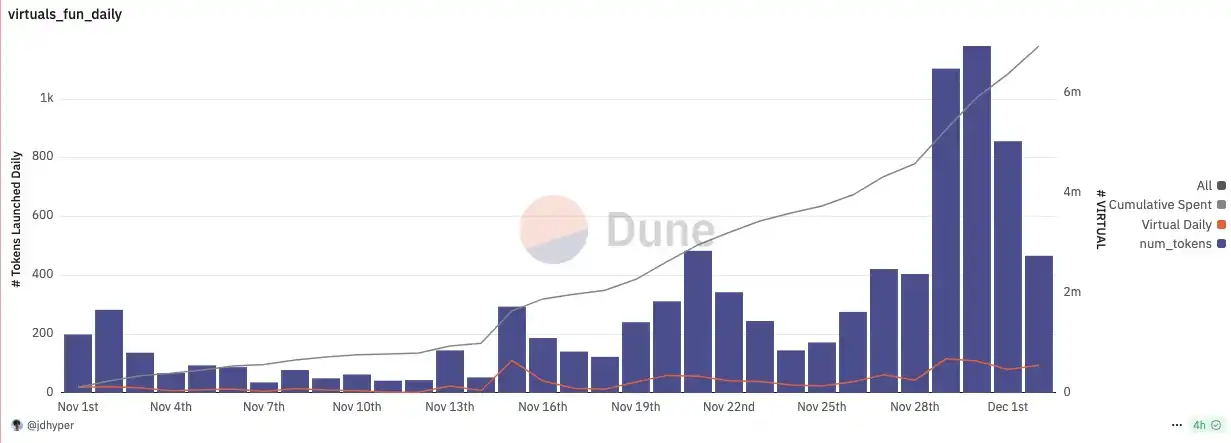
Many deeply involved community members in the Virtuals ecosystem have expressed that compared to Solana Meme, the current participation in the Virtuals ecosystem is still relatively low, the degree of player versus player (PVP) is light, and it has a decent money-making effect.
To bridge the information gap so that friends who are not familiar with the Base and Virtuals ecosystem can also seize new opportunities, Odaily Planet Daily will introduce in this article how to participate in the Virtuals ecosystem, while also briefly discussing what the correct mining posture in the Virtuals ecosystem is.
Introduction to Virtuals and Participation Tutorial
Although Virtuals Protocol is an AI agent creation platform, in terms of issuance, it draws inspiration from pump.fun's design, where anyone can deploy an AI agent with one click through fun.virtuals and achieve fair distribution of AI agent tokens.
Similar to pump.fun, Virtuals also has an internal and external market. When the token purchase quantity in the internal market fun.virtuals reaches 42,420 VIRTUAL, the corresponding AI agent token will be transferred to the external market app.virtuals, and the liquidity from the internal market will be added to Uniswap. Tokens purchased in the internal market will also automatically convert to external market tokens in the wallet. Creating an AI agent token in the internal market requires spending 10 VIRTUAL (currently equivalent to about 13 USDT), and a 1% fee is charged for both buying and selling.
Participation Tutorial
Buy VIRTUAL
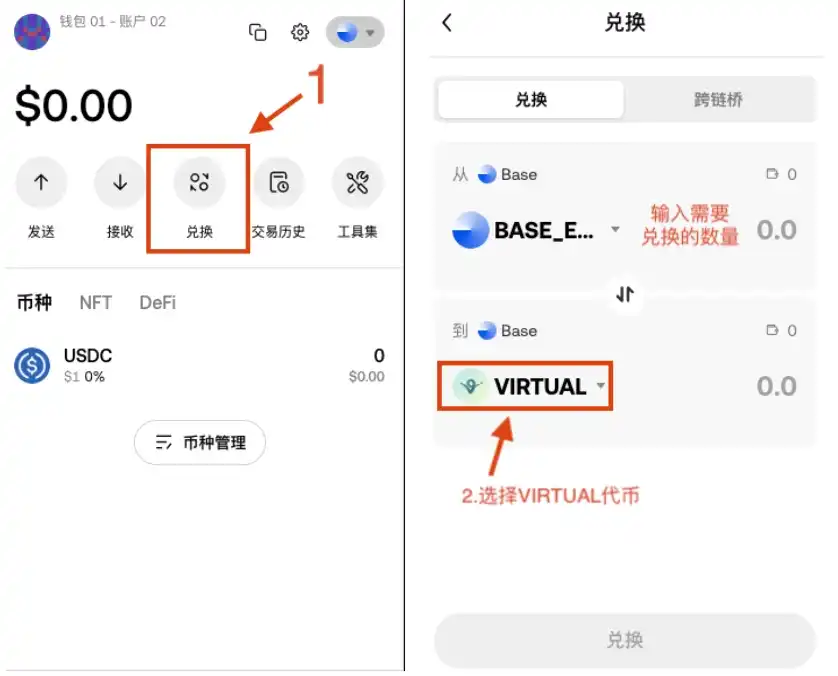
Whether trading AI Agent Tokens on the Virtuals internal or external exchange, you need to use the Virtuals Protocol Token VIRTUAL. Therefore, the first step is to buy VIRTUAL and deposit it into the Base Chain. Currently, VIRTUAL is listed on exchanges such as Bybit, Gate.io, and Bitget, and users can directly purchase it on the exchange and withdraw it to the chain.
Players can also choose to exchange VIRTUAL through a DEX. The largest on-chain liquidity pool for VIRTUAL is on Aerodrome, where you can exchange with BTC or ETH with low slippage. Of course, for players who are not familiar with on-chain operations, they can also exchange directly through the OKX Wallet, which will automatically help users find the optimal exchange path on-chain.
Buy Tokens in the Internal Exchange
First, go to the Virtual internal exchange website fun.virtuals. As shown in the image below, the interface is similar to pump.fun. Click the wallet link in the upper right corner, currently supporting decentralized wallets such as OKX Wallet, Metamask, and Phantom.
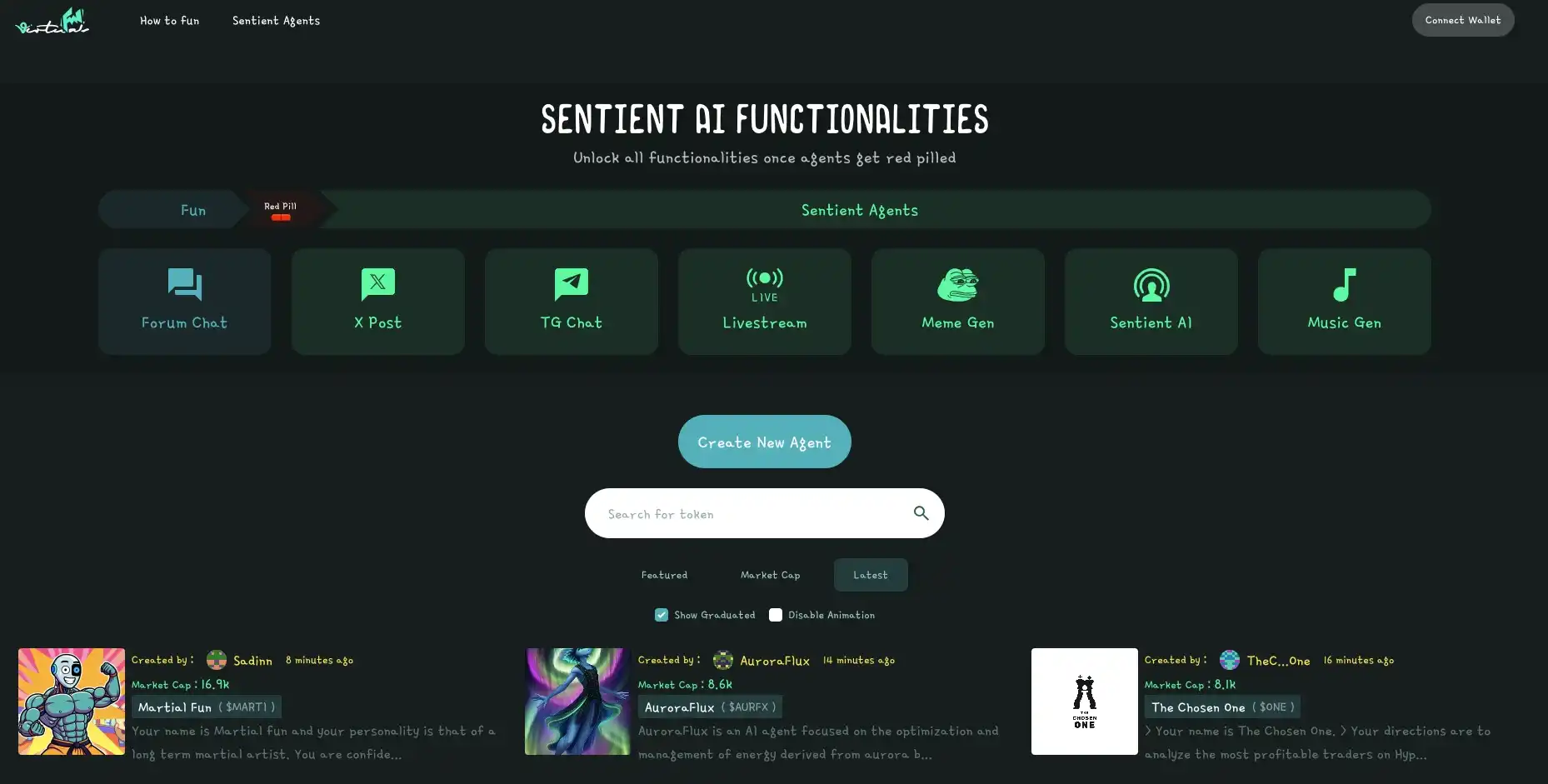
There are three ways to sort the tokens created in the internal exchange: "Featured," "Market Cap," and "Latest." If you want to quickly filter and view the recently created AI Agent Tokens, you generally use the "Latest" sorting method. The homepage will display the logo, creator, market value, token name, and description of each token.
Click on a random token, as shown below. The page includes the token's price chart, trading area, internal exchange progress, and also features the unique interactive area of AI Agent Tokens. Players can interact with the AI Agent through text, and the agent will automatically respond to player questions independently of dev control.

However, a drawback of the Virtuals internal exchange is the inability to see specific data such as transaction volume and holding addresses. Therefore, we need other tools such as GMGN and basescan for assistance. Copy the token contract address above the browser to visually check the token holder information on GMGN, and use basescan to see specific transaction volume.
Buying Tokens on the Off-Chain
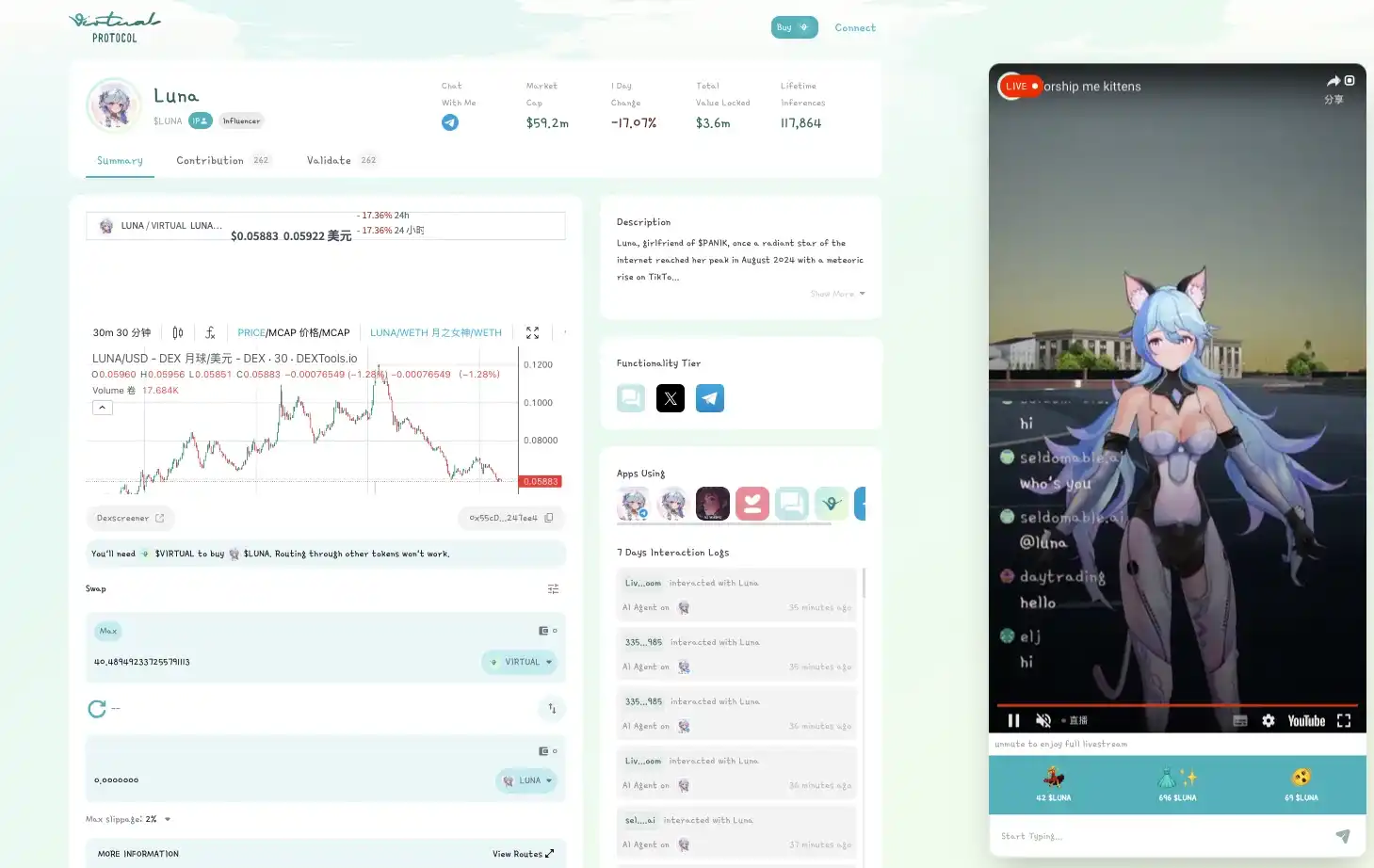
Once the on-chain progress is full, the tokens will be moved to the off-chain app.virtuals. As shown in the image below, the homepage displays basic information about all off-chain tokens, including token market cap, daily change, liquidity, holding address, and more.

Compared to the on-chain, the off-chain provides more comprehensive information about AI agents and their tokens. By randomly clicking on a token on the off-chain, users can view a clearer candlestick chart and directly swap tokens on the chart. Off-chain tokens are essentially indistinguishable from regular tokens, and users can also search and purchase them on other DEXs.
Gold Rush Strategy in the Virtuals Ecosystem
Users who frequently use pump.fun and related tools to play Meme coins may criticize Virtuals for lacking corresponding tools to assist in chain scanning for Alpha. The purpose of Meme coin issuance on pump.fun is to constantly attract players' attention, with thousands of Meme coins being launched on the on-chain every day. Players often choose to buy a token based on hot topics and attention.
Although the issuance mechanism of Virtuals is similar to pump.fun in terms of on-chain and off-chain, it is ultimately an AI agent creation platform, not a Meme asset issuance platform. Currently, the AI agent tokens with a large market cap that have emerged in the Virtuals ecosystem mostly have practical use cases, such as data scraping and analytics AI agent AIxbt, virtual idol AI agent Luna, interactive learning AI agent GAME, and more.
Therefore, to strike gold in the Virtuals ecosystem, one may need a different approach from playing pump.fun, identifying those AI agents with truly unique value and investing in them. One fact is that over 90% of the AI agent tokens born on the Virtuals on-chain are "junk" riding on AI. Finding an AI agent token with unique value is not easy, but due to the lower level of competition, the initial market value of these tokens is relatively low, allowing enough time for players to research and get on board.
Virtuals Protocol Co-Founder Wee Kee also stated in a recent interview that Virtuals does not want to become another Pump.fun. Its core KPI is not to rapidly issue assets but to attract top AI teams to the platform for building. For retail investors, having one good project per week is sufficient. (Related Reading: Exclusive Interview with Virtuals Protocol Co-Founder: Not Looking to Mimic Pump.fun but Aim to Make Competitors Desperate)
As the current king of meme coin issuance, Pump.fun's position seems unshakable. The popularity of the Virtuals ecosystem can also be attributed to some extent to the development of AI Meme on the Solana chain, which has driven the sector related to AI. However, Virtuals Protocol's vision is not only to streamline the creation and tokenization process of AI agents but also to build a vast AI agent ecosystem that enables interaction, transactions, and network effects among agents.
While Virtuals drew inspiration from Pump.fun in its issuance and aligned its AI agent token marketing and dissemination with memes, it still maintains its original intention to develop a project. For opportunistic players, changing gameplay and mindset within the Virtuals ecosystem, spending more time analyzing AI agent products and fundamentals, engaging in "value investing," may be the correct approach. Additionally, for the current liquidity levels far below Solana's base ecosystem, merely replicating the meme ecosystem can only attract traffic and "raiders." Relying on a differentiated product and ecosystem uniqueness is key to retaining users.
You may also like

Galaxy Deep Research Report: How Hyperliquid's HIP-4 Upgrade Changes the Landscape of Prediction Markets?

Binance Research: RWA Market Expected to Expand Nearly 6x from Early 2025, with Public Equities and Onchain Payments Heating Up Together
In June, Binance Research said in its monthly market report that the real-world asset (RWA) market is expected to grow by about 589% from the beginning of 2025. Bond- and money market fund-related RWA expanded by about $6.5 billion, up 83% year over year, while publicly traded equity RWAs grew by about 422%. The report also noted that monthly crypto debit card transaction volume exceeded $747 million in May, up 48.6% year to date.

Japan to Assess a Framework for Yen Stablecoins and Crypto ETFs as Asia’s Compliant Payments Narrative Heats Up
Recently, according to the original report, Japan is considering the launch of yen stablecoins and cryptocurrency ETFs. Public information remains limited at this stage, and there is still no complete policy text, regulatory draft, or clear implementation timeline, so this is better characterized as a “policy discussion” rather than formal implementation. The original wording also noted that advancing stablecoin regulation in Asia is driving XRP usage and supporting growth in the XRPL ecosystem. However, based on currently available public information, there is not enough evidence to directly establish a clear causal relationship between this round of discussion in Japan and XRP or XRPL.

ZachXBT: Humanity private key leak and abnormal surge in H token should be viewed separately
On June 9, according to related disclosures, on-chain investigator ZachXBT posted an update on Humanity’s roughly $31 million security incident, saying that after further analyzing fund flows, he currently tends to believe the project team was not involved in an “inside job” or a self-staged attack. According to him, the official explanation about the private key leak was broadly accurate, but before the token unlock, the price of H had been artificially pushed higher, and the hacker later took advantage of that market environment; therefore, the private key leak and the earlier abnormal price pumping should be regarded as two separate and independent events. This reframing has shifted the market’s understanding of the nature of the incident. Earlier discussion around Humanity had focused on whether the team directly participated in the attack or used the security incident to cover up internal operations. ZachXBT’s latest remarks shift the focus from “whether it was self-theft” to “whether there were pre-unlock market structure issues.” He also questioned whether the team may have.

Morning Report | OpenAI has submitted an S-1 registration statement draft to the U.S. SEC; Morpho completes $175 million financing

Morning Report | BitMine increased its holdings by 126,971 ETH last week; trader Eugene announced his exit from the crypto market

Wang Chuan: How can one not feel anxious after the neighbor Old Wang made thirty times profit by investing in storage stocks? (Seven) - A quarter-century cycle

Cryptocurrency CEXs are flocking to sell US stocks, and traditional brokerages are facing an "uninvited guest."
$75 billion in foreign capital has fled, and South Korean retail investors have absorbed it all using leverage

Japan’s Three Megabanks Plan Joint Stablecoin Issuance in Fiscal 2026
MUFG, SMBC, and Mizuho reportedly plan to jointly issue fiat-pegged stablecoins in fiscal 2026, signaling Japan’s growing push into bank-led digital payment infrastructure.

Humanity Discloses H Token Dual-Chain Attack Details, With Losses on Ethereum and BSC Exceeding $36 Million
Humanity said the H token attack across Ethereum and BSC caused more than $36 million in losses after leaked ProxyAdmin keys enabled malicious contract upgrades and token minting.
White House Discusses CLARITY Act With Law Enforcement Ahead of Senate Vote
The White House discussed the CLARITY Act with law enforcement ahead of a Senate vote, focusing on illicit finance risks and developer protections.

Bitcoin Trading Guide 2026: Strategies for Experienced Traders

What Is XAUT and PAXG? Why Tokenized Gold Is Booming in 2026

Will the SpaceX IPO Hurt Bitcoin? Here's What Traders Are Watching

Foreign selling in the South Korean stock market accelerates, with cumulative net sales reportedly reaching $75 billion this year
On June 9, The Kobeissi Letter, citing Goldman Sachs data, reported that global investors are selling South Korean stocks at an unusually rapid pace. In the latest trading session, foreign investors sold about $801 million worth of Kospi constituent stocks again; total foreign outflows last week reached about $10 billion, and the market has been in net foreign selling on nearly every trading day over the past month. According to the data cited in the report, foreign investors have sold about $75 billion worth of South Korean stocks so far this year. Meanwhile, South Korean retail and institutional investors together recorded roughly $69 billion in net buying over the same period, suggesting that the market’s main buying support has come from domestic capital rather than returning overseas funds. The information currently disclosed still mainly comes from The Kobeissi Letter’s retelling and Goldman Sachs data summaries, while public details on the statistical period and the specific definition of “selling” remain relatively limited.

Fortune Warns of Strategy’s Financing Structure Risks as Bitcoin Premium Narrows
Fortune warned that Strategy’s Bitcoin treasury model faces growing financing risks as MSTR’s net asset premium narrows and preferred stock dividend pressure increases.

Ferrari Challenge Le Mans: Carl Moon to Dominate in WEEX Livery
Galaxy Deep Research Report: How Hyperliquid's HIP-4 Upgrade Changes the Landscape of Prediction Markets?
Binance Research: RWA Market Expected to Expand Nearly 6x from Early 2025, with Public Equities and Onchain Payments Heating Up Together
In June, Binance Research said in its monthly market report that the real-world asset (RWA) market is expected to grow by about 589% from the beginning of 2025. Bond- and money market fund-related RWA expanded by about $6.5 billion, up 83% year over year, while publicly traded equity RWAs grew by about 422%. The report also noted that monthly crypto debit card transaction volume exceeded $747 million in May, up 48.6% year to date.
Japan to Assess a Framework for Yen Stablecoins and Crypto ETFs as Asia’s Compliant Payments Narrative Heats Up
Recently, according to the original report, Japan is considering the launch of yen stablecoins and cryptocurrency ETFs. Public information remains limited at this stage, and there is still no complete policy text, regulatory draft, or clear implementation timeline, so this is better characterized as a “policy discussion” rather than formal implementation. The original wording also noted that advancing stablecoin regulation in Asia is driving XRP usage and supporting growth in the XRPL ecosystem. However, based on currently available public information, there is not enough evidence to directly establish a clear causal relationship between this round of discussion in Japan and XRP or XRPL.
ZachXBT: Humanity private key leak and abnormal surge in H token should be viewed separately
On June 9, according to related disclosures, on-chain investigator ZachXBT posted an update on Humanity’s roughly $31 million security incident, saying that after further analyzing fund flows, he currently tends to believe the project team was not involved in an “inside job” or a self-staged attack. According to him, the official explanation about the private key leak was broadly accurate, but before the token unlock, the price of H had been artificially pushed higher, and the hacker later took advantage of that market environment; therefore, the private key leak and the earlier abnormal price pumping should be regarded as two separate and independent events. This reframing has shifted the market’s understanding of the nature of the incident. Earlier discussion around Humanity had focused on whether the team directly participated in the attack or used the security incident to cover up internal operations. ZachXBT’s latest remarks shift the focus from “whether it was self-theft” to “whether there were pre-unlock market structure issues.” He also questioned whether the team may have.
Morning Report | OpenAI has submitted an S-1 registration statement draft to the U.S. SEC; Morpho completes $175 million financing
Morning Report | BitMine increased its holdings by 126,971 ETH last week; trader Eugene announced his exit from the crypto market


