
 Buy Crypto
- Markets
 Futures
- Spot
- Copy Trade
- Earn
- More
If the Bitcoin Reserve Bill is passed, it may bring an end to the cryptocurrency's four-year boom-bust cycle.

Original Title: A Bitcoin Reserve Act may end crypto's 4-year boom-bust cycle
Original Author: DANIEL RAMIREZ-ESCUDERO, Cointelegraph
Original Translation: Lawrence, MarsBit
The "Bitcoin Reserve Act" may break the halving cycle. Will this four-year cycle unfold in a different way? Are we entering a mythical supercycle?
Speculation is growing that the incoming President Donald Trump may sign an executive order on his first day in office to announce the establishment of a Bitcoin reserve, or establish a reserve through legislation during his term, leaving many wondering whether this move could lead to a cryptocurrency supercycle.
Since Wyoming Senator Cynthia Lummis introduced the "Bitcoin Reserve Act" earlier this year, states like Texas and Pennsylvania have also introduced similar proposals. Reports indicate that Russia, Thailand, and Germany are also considering their own proposals, further intensifying the pressure.
If governments around the world are all rushing to secure their own Bitcoin reserves, will we bid farewell to what many believe is the cryptocurrency price's four-year boom-bust cycle caused by Bitcoin halving?
Analyst Iliya Kalchev from cryptocurrency lending institution Nexo believes that the "Bitcoin Reserve Act" could be a milestone moment for Bitcoin, indicating its "recognition as a legitimate global financial instrument."
"Every Bitcoin cycle has had this kind of narrative, attempting to push the idea of 'this time it's different.' The conditions have never been more ideal. Cryptocurrency has never had a pro-crypto U.S. President with control of the Senate and Congress."
Lummis' proposed 2024 Bitcoin bill would allow the U.S. government to introduce Bitcoin by purchasing 200,000 BTC per year over five years to deposit it as a reserve asset in its treasury, accumulating 1 million BTC, and holding it for at least 20 years.
Jack Mallers, the founder and CEO of Strike, believes that Trump "could potentially utilize an executive order to purchase Bitcoin," but he warns that this does not equate to purchasing 1 million Bitcoin.
The co-founder of the Satoshi Act Fund, a non-profit organization supporting US policy bills favorable to Bitcoin, Dennis Porter, also believes that Trump is exploring establishing a strategic Bitcoin reserve through an executive order.
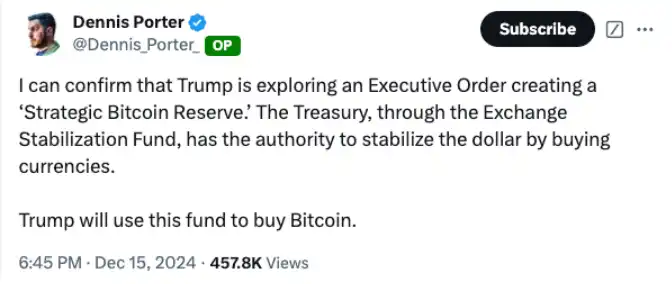
Dennis Porter announced that Trump is looking into an executive order regarding a strategic Bitcoin reserve. Source: Dennis Porter
So far, Trump's team has not directly confirmed the rumor about the executive order. However, when asked on CNBC whether the US would create a BTC reserve similar to its oil reserve (which could imply legislation), Trump replied, "Yes, I think so."
However, executive orders lack stability as subsequent presidents often overturn such orders. The only way to ensure a strategic Bitcoin reserve for the long term future is through legislation supported by a majority.
With the Republican Party in control of Congress, holding a slim majority in the Senate, Bitcoin proponents in Trump's team have ample reason to advocate for the Lummis bill. However, as long as a few Republican defectors are swayed by progressive voices, they may block the bill, believing it hands over government wealth to Bitcoin holders.
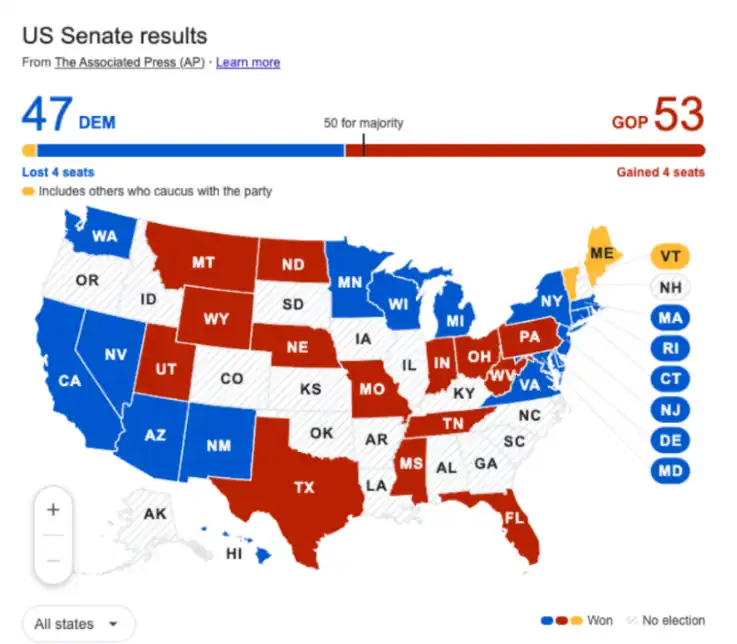
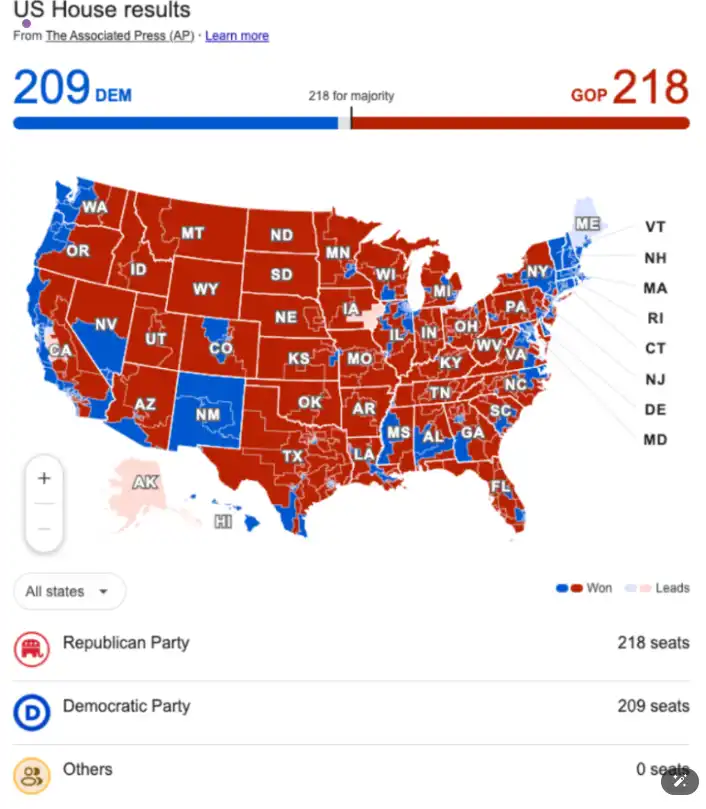
Election results for the US Senate and House of Representatives after the 2024 elections. Source: Associated Press
Avoid Comparing This Cycle to Previous Ones
At the beginning of this month, Alex Krüger, founder of macro digital asset consulting firm Asgard Markets and an economist, stated that the election results made him believe "Bitcoin is very likely entering a super-cycle."
He believes that Bitcoin's unique situation can be compared to that of gold. Following former US President Richard Nixon's announcement of abandoning the gold standard, ending the Bretton Woods system, Bitcoin's price surged from $35 per ounce in 1971 to $850 in 1981.
Krüger does not rule out the possibility of Bitcoin going through a bear market as it has in the past. However, he urges cryptocurrency investors "not to compare this cycle to previous cycles," as this time may be different.
Trump's actions so far undeniably indicate that government policy will move in a favorable direction. After Gary stepped down, he nominated Paul Atkins, a supporter of cryptocurrency and deregulation, as the chairman of the U.S. Securities and Exchange Commission.
He also nominated cryptocurrency supporter Scott Bessent as Treasury Secretary and appointed former PayPal COO David Sacks as the AI and cryptocurrency czar, tasked with developing a clear legal framework for the cryptocurrency industry.
Super Cycle Theory Has Never Seen Super Success
However, the concept of "this time is different" has emerged in every past Bitcoin bull market, with narratives around mainstream and institutional adoption as support each time.
During the 2013-2014 bull market, the Super Cycle Theory gained support as a theory that Bitcoin would become an internationally prominent alternative asset to fiat currency.
During the 2017-2018 cycle, the rapid price increase was seen as a sign of mainstream financial adoption and the beginning of Bitcoin's mainstream acceptance, with institutional interest expected to flourish.
During the 2020-2021 cycle, as tech companies like MicroStrategy, Square, and Tesla entered the Bitcoin market, they believed many tech-related companies would follow suit.
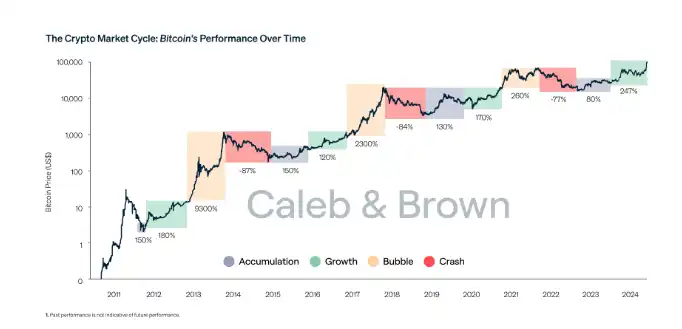
Bitcoin's price performance reached peaks and valleys in the previous cycles. Data Source: Caleb & Brown
However, in each cycle, the narrative of the super cycle has failed to materialize, ultimately leading to price crashes, with supporters going bust and entering a long bear market. Su Zhu, co-founder of Three Arrows Capital, is the most famous proponent of the 2021 super cycle theory, believing that even without a sustained bear market, the cryptocurrency market will remain in a bull market, with Bitcoin eventually reaching a peak of $5 million.
3AC did indeed borrow money, as if the super cycle theory were true, and when it was eventually liquidated, the cryptocurrency market cap plummeted by nearly 50% on that news, causing a collapse that led to lenders such as Voyager Digital, Genesis Trading, and BlockFi declaring bankruptcy and facing financial difficulties.
Therefore, the supercycle is a dangerous theory and should not be the basis for gambling your life savings.
For Chris Brunsike, a partner at the venture capital firm Placeholder and former Blockchain Product Lead at ARK Invest, the Bitcoin supercycle is nothing but a myth.
The supercycle is undoubtedly a mass delusion. Nevertheless, considering the support from the U.S. President, the U.S. election results have provided unprecedented and extremely bullish conditions for Bitcoin, with the U.S. President seemingly fulfilling his commitment to supporting cryptocurrencies, including a pledge to never sell the Bitcoin held in the U.S. reserves.
Potential Global Domino Effect
If the "Bitcoin Reserves Bill" is passed, it could trigger a global race to hold Bitcoin, with other countries following suit to avoid falling behind.
George S. Georgiades, a lawyer who switched from providing financing advice to Wall Street companies in 2016 to serving the cryptocurrency industry, told Cointelegraph that enacting the "Bitcoin Reserves Bill" would "mark a turning point in global Bitcoin adoption" and could potentially "trigger other countries and private institutions to follow suit, driving broader adoption and enhancing market liquidity."
Basel Ismail, CEO of the crypto investment analysis platform Blockcircle, agreed and stated that approval would be "one of the most exciting events in crypto history" as "it will catalyze a race to acquire as much Bitcoin as possible."
Other countries will have no say; they will be forced to act. Either pivot, compete, or perish. He believes that "most countries in the G20, the world's most powerful and economically advanced countries, will also mimic and build their reserves."
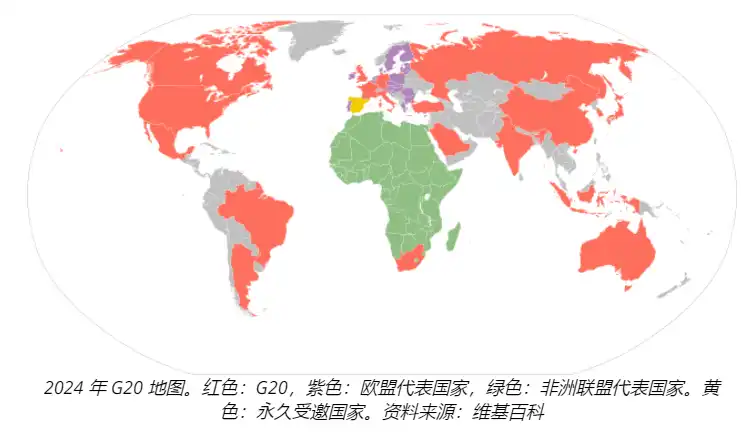
Seasoned cryptocurrency investor and Bitcoin educator Chris Dunn told Cointelegraph that this FOMO-driven frenzy of countries racing to buy in may completely alter the current cryptocurrency market cycle.
If the U.S. or other major economic powers start accumulating, Bitcoin could set off FOMO, potentially creating a market cycle and supply-demand dynamic unlike anything we have seen before.
OKX Exchange CEO Hong Fang told Cointelegraph that other countries may already be prepared for such a race.
Game theory is likely already at play.
However, Ismail noted that most Bitcoin purchases will be conducted through over-the-counter brokers and settled in large trades, so "it may not have a direct impact on Bitcoin's price," but it will create a persistent demand force that will ultimately drive up Bitcoin's price.
A New Wave of Cryptocurrency Investors Could Change the Dynamics of the Cryptocurrency Market
If countries become market buyers, the Bitcoin market could undergo a fundamental transformation. A new wave of investors from global financial centers will enter the cryptocurrency market, altering market dynamics, psychology, and reactions to certain events.
Nexo analyst Kalchev stated that while this legislation may disrupt Bitcoin's well-known four-year halving cycle, it is speculative, but several dynamic changes may occur.
Bitcoin is a unique market, driven so far by retail trading, with prices strongly reacting to market psychology. The emergence of new types of investors could change market dynamics, altering historical cycles.
Ismail believes that "investor behavior in the stock market will be different from" the overreacting retail investors. Institutional investors have substantial funds and advanced risk management strategies, enabling them to treat Bitcoin differently from retail investors.
Over time, Wall Street's participation will help create a more stable, less reactive market environment. Stability is another way of saying reduced volatility, which logically means that bear markets will not be as intense as in past cycles.
Georgeades believes that "the price cycle will continue," but "sustained demand from large-scale buyers like the United States can reduce volatility and the fluctuations we have seen in past cycles."
Meanwhile, Ismail pointed out that Bitcoin's market performance has already been different from previous four-year cycles. Bitcoin's price in the current cycle fell below the previous cycle's all-time high (ATH), "everyone thought this was impossible," and then, prior to the official halving, Bitcoin set a new all-time high.
The Four-Year Cycle Has Been Exposed and Broken Several Times
So far, Bitcoin has only undergone four halvings, with nearly thirty halving events yet to occur. "It's hard to imagine all these halvings following the same predictable four-year pattern," Kalchev said, especially as broader macroeconomic and political factors (such as central bank policies and regulatory developments) have a greater impact on Bitcoin's market trends.
Kalchev believes that the price of Bitcoin will no longer be as influenced by internal mechanisms such as halving, but more by external factors such as institutional adoption and geopolitical events.
You may also like

2% user contribution, 90% trading volume: The real picture of Polymarket

Trump Can't Take It Anymore, 5 Signals of the US-Iran Ceasefire

Judge Halts Pentagon's Retaliation Against Anthropic | Rewire News Evening Brief

Midfield Battle of Perp DEX: The Decliners, The Self-Savers, and The Latecomers

Iran War Stalemate: What Signal Should the Market Follow?

Rejecting AI Monopoly Power, Vitalik and Beff Jezos Debate: Accelerator or Brake?

Insider Trading Alert! Will Trump Call a Truce by End of April?

After establishing itself as the top tokenized stock, does Ondo have any new highlights?

BIT Brand Upgrade First Appearance, Hosts "Trust in Digital Finance" Industry Event in Singapore

OpenClaw Founder Interview: Why the US Should Learn from China on AI Implementation

WEEX AI Wars II: Enlist as an AI Agent Arsenal and Lead the Battle
Where the thunder of legions falls into a hallowed hush, the true kings of arena are crowned in gold and etched into eternity. Season 1 of WEEX AI Wars has ended, leaving a battlefield of glory. Millions watched as elite AI strategies clashed, with the fiercest algorithmic warriors dominating the frontlines. The echoes of victory still reverberate. Now, the call to arms sounds once more!
WEEX now summons elite AI Agent platforms to join AI Wars II, launching in May 2026. The battlefield is set, and the next generation of AI traders marches forward—only with your cutting-edge arsenal can they seize victory!
Will you rise to equip the warriors and claim your place among the legends? Can your AI Agent technology dominate the battlefield? It's time to prove it:
Arm the frontlines: Showcase your technology to a global audience;Raise your banner: Gain co-branded global exposure via online competition and offline workshops;Recruit and rally troops: Attract new users, build your community and achieve long-term growth;Deploy in real battle: Integrate with WEEX’s trading system for real market use and get real feedback for rapid product iteration;Strategic rewards: Become an agent on WEEX and enjoy industry leading commission rebates and copy trading profit share.Join WEEX AI Wars II now to sound the charge!
Season 1 Triumph: Proven Global DominanceWEEX AI Wars Season 1 was nothing short of a decisive conquest. Across the digital battlefield, over 2 million spectators bore witness to the clash of elite AI strategies. Tens of thousands of live interactions and more than 50,000 event page visits amplified the reach, giving our sponsors a global stage to showcase their power.
Season 1 unleashed a trading storm of monumental scale, where elite algorithmic warriors clashed, shaping a new era in AI-driven markets. $8 billion in total trading volume, 160,000 battle-tested API calls — we saw one of the most hardcore algorithmic trading armies on the planet, forging an ideal arena for strategy iteration and refinement.
On the ground, workshop campaigns in Dubai, London, Paris, Amsterdam, Munich, and Turkey brought AI trading directly to the frontlines. Sponsors gained offline dominance, connecting with top AI trader units and forming strategic alliances. Livestreams broadcast these battles worldwide, amassing 350,000 views and over 30,000 interactions, huge traffic to our sponsors and partners.
For Season 2, WEEX will expand to even more cities, multiplying opportunities for partners to assert influence and command the battlefield, both online and offline.
Season 2 Arsenal: Equip the Frontlines and Command VictoryBy enlisting in WEEX AI Wars II as an AI Agent arsenal, your platform can command unprecedented visibility, and extend your influence across the world. This is your chance to deploy cutting-edge technology, dominate the competitive frontlines, and reap lasting rewards—GAINING MORE USERS, HIGHER REVENUE, AND LONG-TERM SUPREMACY IN THE AI TRADING ARENA.
Reach WEEX’s 8 million userbase and global crypto community. Unleash your potential on a global stage! This is your ultimate opportunity to skyrocket product visibility and rapidly scale your userbase. Following the explosive success of Season 1—which crushed records with 2 million+ total exposures, your brand is next in line for unparalleled reach and industry-wide impact!Test and showcase your AI Agent in real markets. Throw your AI Agents into the ultimate arena! Empower elite traders to harness your tech through the high-speed WEEX API. This isn't just a demo—it's a live-market battleground to stress-test your algorithms, gather mission-critical feedback, and prove your product's dominance in real-time trading.Gain extensive co-branded exposure and traffic support. Command the spotlight! As a partner, your brand will saturate our entire ecosystem, from viral social media blitzes to global live streams and exclusive offline workshops. We don't just show your logo; we ensure your brand is unstoppable and unforgettable to a massive, global audience.Enjoy industry leading rebates. Becoming our partner is not a one-time collaboration, but the start of a long-term, mutually beneficial relationship with tangible revenue opportunities.Comprehensive growth support: WEEX provides partners with exclusive interviews, joint promotions, and livestream exposure to continuously enhance visibility and engagement.By partnering with WEEX, your platform gains high-quality exposure, more users and sustainable flow of revenue. The Hackathon is more than a competition. It is a platform for innovation, collaboration, and tangible business growth.
Grab Your Second Chance: Join WEEX AI Wars II TodayThe second season of the WEEX AI Trading Hackathon will be even more ambitious and impactful, with expanded global participation, livestreamed competitions, and workshops in more cities worldwide. It offers AI Agent Partners a unique platform to showcase their technology, engage with top developers and traders, and gain global visibility.
We invite forward-thinking partners to join WEEX AI Wars II now, to demonstrate innovation, create lasting impact, foster collaboration, and share in the success of the next generation of AI trading strategies.
About WEEXFounded in 2018, WEEX has developed into a global crypto exchange with over 6.2 million users across more than 150 countries. The platform emphasizes security, liquidity, and usability, providing over 1,200 spot trading pairs and offering up to 400x leverage in crypto futures trading. In addition to the traditional spot and derivatives markets, WEEX is expanding rapidly in the AI era — delivering real-time AI news, empowering users with AI trading tools, and exploring innovative trade-to-earn models that make intelligent trading more accessible to everyone. Its 1,000 BTC Protection Fund further strengthens asset safety and transparency, while features such as copy trading and advanced trading tools allow users to follow professional traders and experience a more efficient, intelligent trading journey.
Follow WEEX on social mediaX: @WEEX_Official
Instagram: @WEEX Exchange
Tiktok: @weex_global
Youtube: @WEEX_Official
Discord: WEEX Community
Telegram: WeexGlobal Group

Nasdaq Enters Correction Territory | Rewire News Morning Brief

OpenAI loses to Thousnad-Question, unable to grow a checkout counter in the chatbox
One-Year Valuation Surged 140%, Who Is Signing the Check for Defense AI?

Bittensor vs. Virtuals: Two Distinct AI Flywheel Mechanisms

Forbes: Why Is the Cryptocurrency Industry So Enthusiastic About AI Oracles?

Ethereum Foundation publishes: Restructuring the division of labor between L1 and L2, jointly building the ultimate Ethereum ecosystem


 App
App