
 Buy Crypto
- Markets
 Futures
- Spot
- Copy Trade
- Earn
- More
If you only follow the news, you may have misconstrued this Iran conflict

A prominent non-profit think tank in Washington, D.C. highlighted in a 2024 discussion on the challenges of the AI era:
“The current environment forces journalists to prioritize speed over accuracy in breaking news scenarios.”
The recent Iran conflict is a typical example: a school bombing, an assassination of a successor leader, a neighboring country’s sudden strike… Western media often provide highly impactful headlines in real-time to attract attention and quickly shape public opinion.
But there is a place that often demonstrates “true judgment” earlier than the media – the prediction markets.
Here, the probabilities of events such as “Will Hezbollah strike Israel” or “Will a country take military action against Iran” are not driven by emotions or institutional narratives but by outcomes formed by individual traders with real money.
Put simply, if a trader is convinced something will happen, they will bet “yes,” and this action itself increases the probability of the event occurring. This mechanism of expression constrained by funds makes prediction markets a different source of information from traditional media.
Two events in the Middle East over the past week perfectly illustrate this point.
Drone Attack on British Bases in Cyprus
On the evening of March 1st local time, UK Prime Minister Kiel Stammer announced through a pre-recorded video statement that the UK had agreed to allow the U.S. to use its bases to strike Iranian missile facilities. Hours later, the British Royal Air Force base in Akrotiri, Cyprus, was hit by a suspected drone attack.
Following the event, several mainstream media outlets such as the BBC, The Independent, and Reuters released reports promptly, using expressions like “Iran missiles” and “Iranian drone” in their headlines or body text, directly linking the attack to Iran.
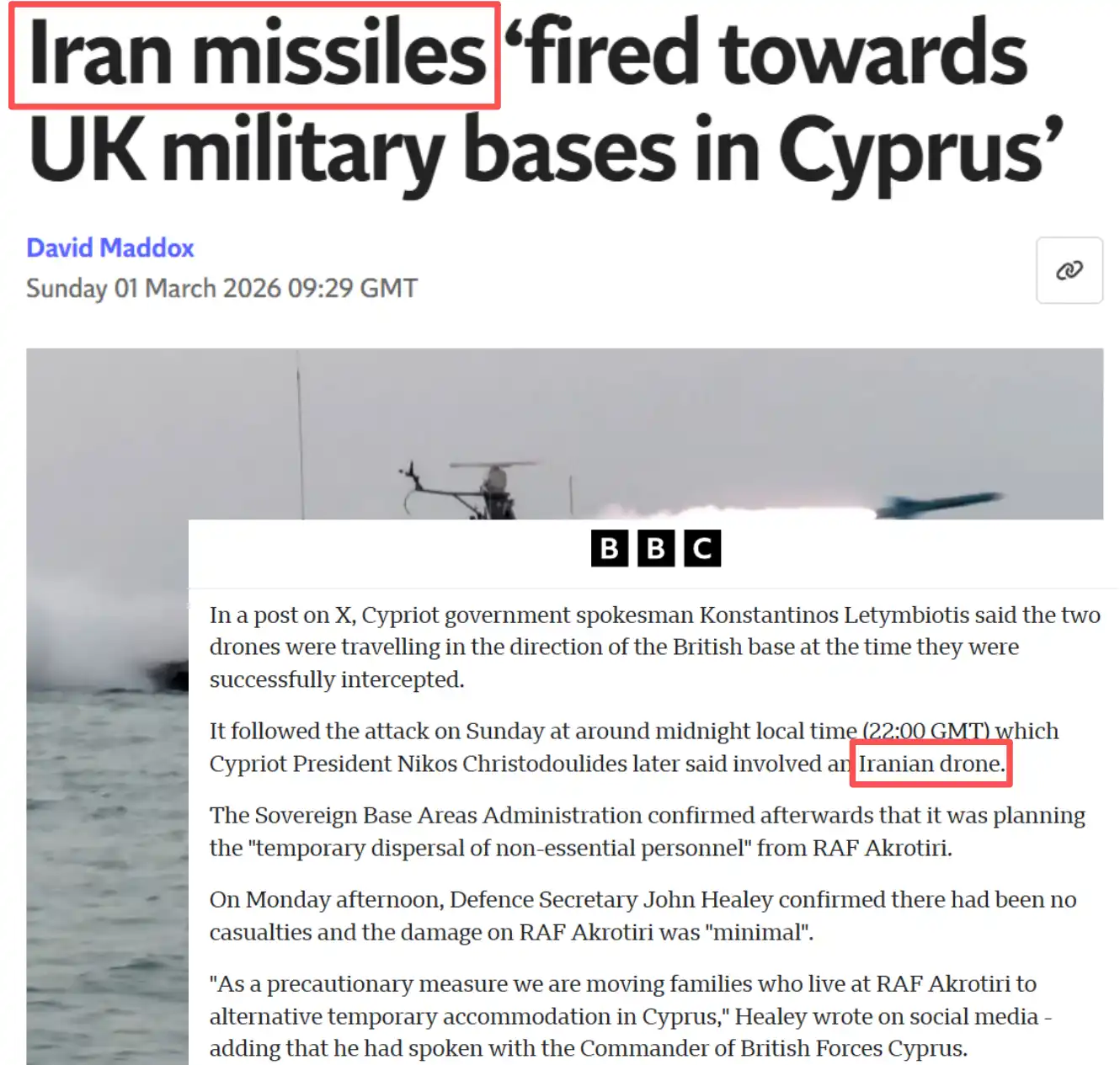
These reports quickly made headlines, leaving readers with a clear impression: Iran was directly attacking a NATO ally base.
However, in the immediate aftermath of the event, the related market on the prediction market platform Polymarket – “Will Iran strike Cyprus by March 31” – had a different response: following the release of media reports, the market did experience some typical “buy the news” trades, causing a brief increase in probability. But unlike the public opinion atmosphere shaped by the media, the market probability rapidly fell back to a level close to before the attack about 30 minutes later.
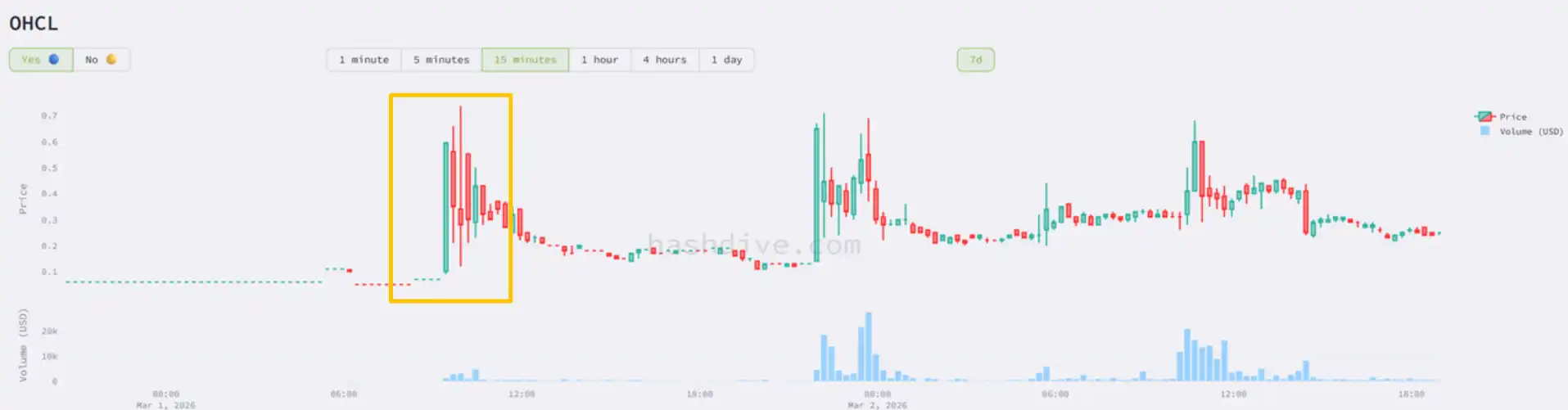
Clearly, the most information-sensitive group of people did not fully buy into the media narrative.
Hours later, the UK Ministry of Defense issued a statement saying, "There is currently no evidence to suggest that this attack came directly from Iran." The media outlets then followed up by revising their reports to state that this attack was more likely from Iran's proxy armed group, Hezbollah in Lebanon, and pointed out that the previously mentioned "Iranian drone" actually referred to an "Iranian-designed Shahed drone," not the so-called "attack directly initiated by Iran."
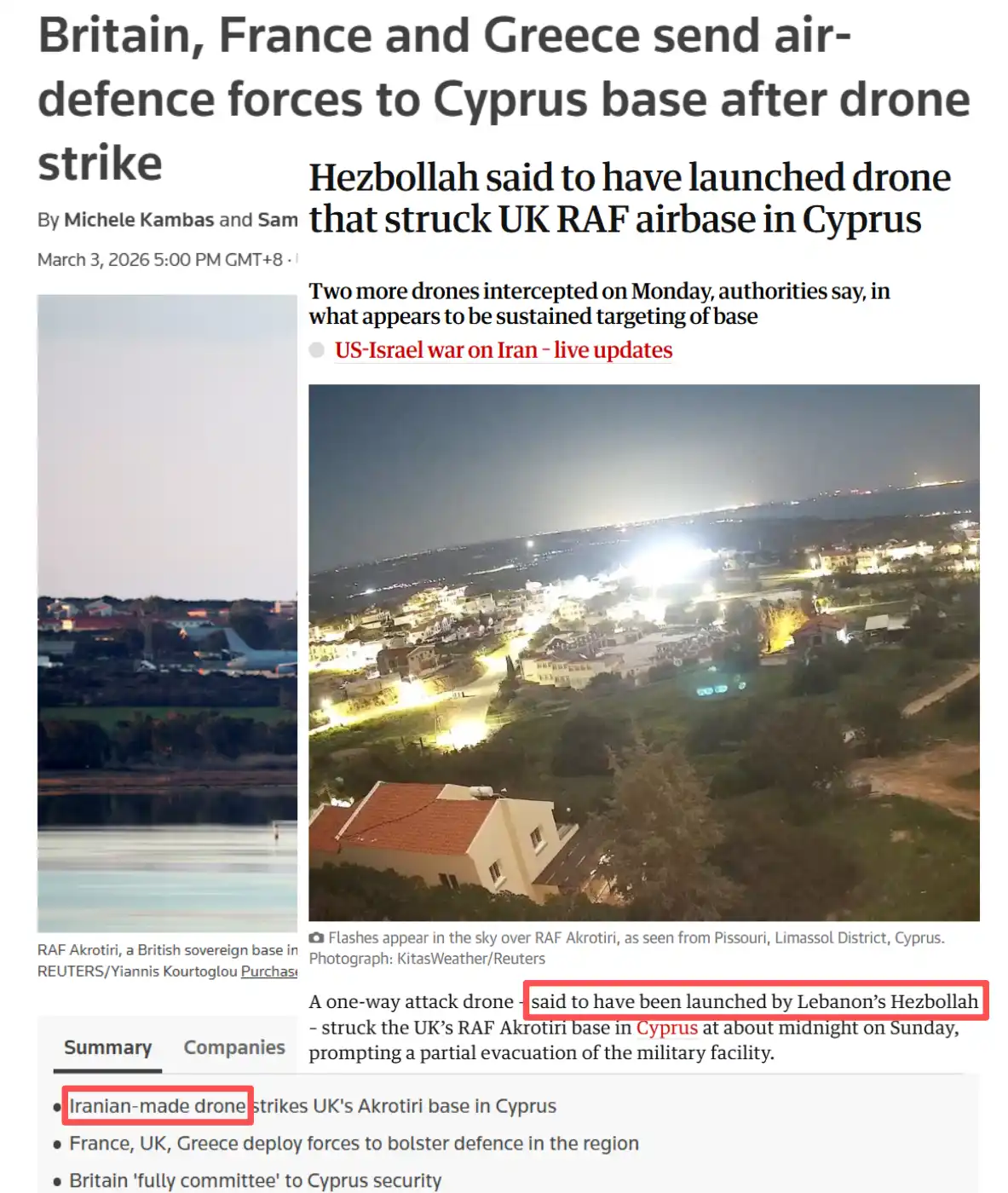
In other words, the media initially amplified Iran's direct responsibility through a narrative framework, while the prediction markets maintained a more cautious assessment from the outset.
Israeli Media Hypes UAE Strike on Iran
A similar situation occurred again this week. On March 8, several Israeli media outlets claimed that the UAE launched its first strike on Iranian soil. The reports described this action as a "symbolic retaliation" against Iran's previous attacks on Gulf states.
This narrative quickly created an impression that Gulf states were joining military action against Iran.
Similar to the Cyprus incident, the probability market on Polymarket for "Will the UAE strike Iran by March 31" saw a brief uptick after the reports were published, but rapidly fell back within about an hour.
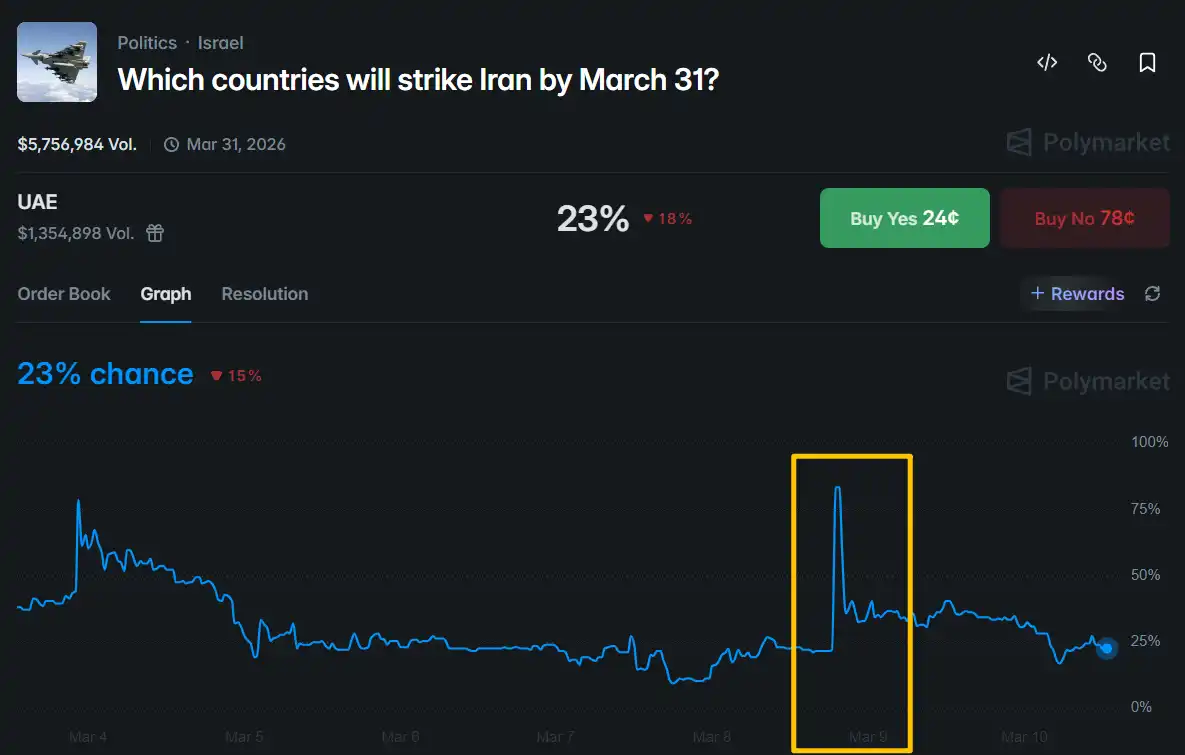
Shortly after, Ali Rashid Al Nuaimi, Chair of the UAE Federal National Council's Defense, Interior, and Foreign Affairs Committee, directly referred to it as "fake news" on X, and candidly stated, "If we did something, we have the courage to announce it openly."
From an information dissemination perspective, the extensive coverage by the Israeli media likely aimed to create a narrative atmosphere of regional united action against Iran, thereby increasing psychological pressure on Iran and pushing regional allies to more openly support US-Israeli actions.
By filtering out this media noise and focusing solely on the changes in prediction market probabilities, one could arguably have earlier realized that such reports might not be reliable.
Why Are Prediction Markets More Reliable?
As the global political environment gradually transitions from the post-Cold War era of openness to a more pronounced alignment and geopolitical competition, information dissemination is increasingly becoming a strategic tool.
In such an environment, the importance of traditional media is further amplified. Media is not only a news channel but has also become a crucial platform for influencing public opinion and policy discussions.
The differences in stance between different institutions in the U.S. media ecosystem are quite evident: CNN, long criticized by Trump, attracted many audiences supporting enhanced gun control due to its extensive coverage of school shootings. Interestingly, gun manufacturers are significant political donors to the Republican Party.
When news reporting is not just "information" but gradually becomes a tool to shape public attitudes, the reliability of traditional media as a pure information source is inevitably challenged.
In this environment, prediction markets offer a completely different information mechanism: because behind the probability of each event lies traders' decision-making on the event's outcome, profit-seeking traders must stake an amount corresponding to their judgment.
In this round of the Iran conflict, these participants may be open-source intelligence analysts, military enthusiasts, speculative traders, or even insiders involved in frontline or backstage warfare. Regardless of their backgrounds, their only way of expressing their views is through betting, with each bet representing the participant's genuine judgment based on their own understanding.
The accuracy of these genuine thoughts has been repeatedly proven in the past few years in a series of predictions such as elections, interest rates, and non-farm payroll, surpassing traditional polls and expert forecasts.
Anticipating Results in Advance Based on Prediction Market Data
As mentioned earlier, when we consider prediction market probabilities as a source of information, we are essentially observing a group of traders staking their funds on their future judgments.
However, pure market probabilities still face an issue: the skill levels of participating traders vary, with some just following the crowd. Therefore, some analytical tools further filter the data, with one common indicator being Market Strength.
In other words, participants who have been more accurate in the past predictions and earned higher trading profits will have a greater impact on the final probability. Compared to ordinary market probabilities, this indicator is closer to the so-called "smart money judgment."
You can understand this with a simple analogy: if you only look at market probabilities, it's like asking 10 anonymous individuals from different industries for investment advice; whereas, if you consider weighted market probabilities, it's like knowing the professional backgrounds and investment returns of these 10 people and naturally paying more attention to those with a higher long-term return.
With this in mind, let's take a look at a current global issue that the world is focusing on: whether other countries will join the United States and Israel in jointly combating Iran. Based on the current prediction market probabilities, the likelihood of other countries joining the strike this month is 51%; however, when looking at the weighted market probability, the likelihood of a strike occurring is only about 25%.
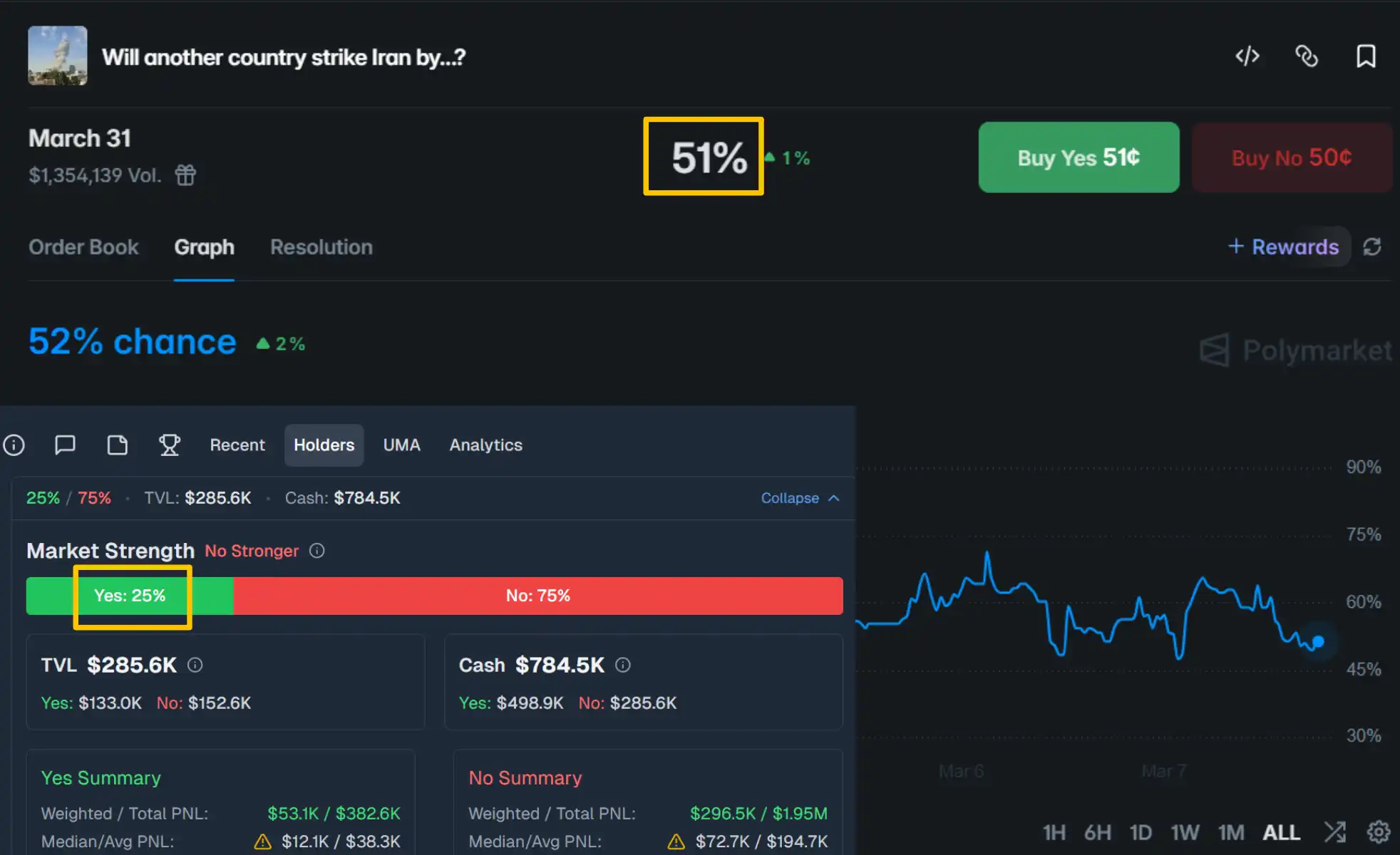
This result contrasts sharply with recent media narratives. On the surface, news reports are filled with Gulf states condemning Iran, European warships heading to the Middle East, and signals of escalating regional tensions, as if a larger conflict is imminent; but in the prediction markets, many long-time active traders familiar with geopolitics generally believe that the likelihood of other countries directly striking Iran this month is not high.
In this highly fragmented information age, the prediction market may not replace the news, but it is becoming a new information calibration mechanism. While media narratives keep amplifying emotions and positions, market prices provide a collectively judged assessment constrained by capital.
For those seeking to understand the real world, the difference between these two signals is itself important information.
You may also like

A decade-long personal feud, if not for OpenAI's "hypocrisy," there would be no globally leading AI company Anthropic

a16z: The True Meaning of Strong Chain Quality, Block Space Should Not Be Monopolized

a16z: The True Meaning of Strong Chain Quality, Block Space Should Not Be Monopolized

2% user contribution, 90% trading volume: The real picture of Polymarket

Trump Can't Take It Anymore, 5 Signals of the US-Iran Ceasefire

Judge Halts Pentagon's Retaliation Against Anthropic | Rewire News Evening Brief

Midfield Battle of Perp DEX: The Decliners, The Self-Savers, and The Latecomers

Iran War Stalemate: What Signal Should the Market Follow?
Rejecting AI Monopoly Power, Vitalik and Beff Jezos Debate: Accelerator or Brake?

Insider Trading Alert! Will Trump Call a Truce by End of April?

After establishing itself as the top tokenized stock, does Ondo have any new highlights?

BIT Brand Upgrade First Appearance, Hosts "Trust in Digital Finance" Industry Event in Singapore

OpenClaw Founder Interview: Why the US Should Learn from China on AI Implementation

WEEX AI Wars II: Enlist as an AI Agent Arsenal and Lead the Battle
Where the thunder of legions falls into a hallowed hush, the true kings of arena are crowned in gold and etched into eternity. Season 1 of WEEX AI Wars has ended, leaving a battlefield of glory. Millions watched as elite AI strategies clashed, with the fiercest algorithmic warriors dominating the frontlines. The echoes of victory still reverberate. Now, the call to arms sounds once more!
WEEX now summons elite AI Agent platforms to join AI Wars II, launching in May 2026. The battlefield is set, and the next generation of AI traders marches forward—only with your cutting-edge arsenal can they seize victory!
Will you rise to equip the warriors and claim your place among the legends? Can your AI Agent technology dominate the battlefield? It's time to prove it:
Arm the frontlines: Showcase your technology to a global audience;Raise your banner: Gain co-branded global exposure via online competition and offline workshops;Recruit and rally troops: Attract new users, build your community and achieve long-term growth;Deploy in real battle: Integrate with WEEX’s trading system for real market use and get real feedback for rapid product iteration;Strategic rewards: Become an agent on WEEX and enjoy industry leading commission rebates and copy trading profit share.Join WEEX AI Wars II now to sound the charge!
Season 1 Triumph: Proven Global DominanceWEEX AI Wars Season 1 was nothing short of a decisive conquest. Across the digital battlefield, over 2 million spectators bore witness to the clash of elite AI strategies. Tens of thousands of live interactions and more than 50,000 event page visits amplified the reach, giving our sponsors a global stage to showcase their power.
Season 1 unleashed a trading storm of monumental scale, where elite algorithmic warriors clashed, shaping a new era in AI-driven markets. $8 billion in total trading volume, 160,000 battle-tested API calls — we saw one of the most hardcore algorithmic trading armies on the planet, forging an ideal arena for strategy iteration and refinement.
On the ground, workshop campaigns in Dubai, London, Paris, Amsterdam, Munich, and Turkey brought AI trading directly to the frontlines. Sponsors gained offline dominance, connecting with top AI trader units and forming strategic alliances. Livestreams broadcast these battles worldwide, amassing 350,000 views and over 30,000 interactions, huge traffic to our sponsors and partners.
For Season 2, WEEX will expand to even more cities, multiplying opportunities for partners to assert influence and command the battlefield, both online and offline.
Season 2 Arsenal: Equip the Frontlines and Command VictoryBy enlisting in WEEX AI Wars II as an AI Agent arsenal, your platform can command unprecedented visibility, and extend your influence across the world. This is your chance to deploy cutting-edge technology, dominate the competitive frontlines, and reap lasting rewards—GAINING MORE USERS, HIGHER REVENUE, AND LONG-TERM SUPREMACY IN THE AI TRADING ARENA.
Reach WEEX’s 8 million userbase and global crypto community. Unleash your potential on a global stage! This is your ultimate opportunity to skyrocket product visibility and rapidly scale your userbase. Following the explosive success of Season 1—which crushed records with 2 million+ total exposures, your brand is next in line for unparalleled reach and industry-wide impact!Test and showcase your AI Agent in real markets. Throw your AI Agents into the ultimate arena! Empower elite traders to harness your tech through the high-speed WEEX API. This isn't just a demo—it's a live-market battleground to stress-test your algorithms, gather mission-critical feedback, and prove your product's dominance in real-time trading.Gain extensive co-branded exposure and traffic support. Command the spotlight! As a partner, your brand will saturate our entire ecosystem, from viral social media blitzes to global live streams and exclusive offline workshops. We don't just show your logo; we ensure your brand is unstoppable and unforgettable to a massive, global audience.Enjoy industry leading rebates. Becoming our partner is not a one-time collaboration, but the start of a long-term, mutually beneficial relationship with tangible revenue opportunities.Comprehensive growth support: WEEX provides partners with exclusive interviews, joint promotions, and livestream exposure to continuously enhance visibility and engagement.By partnering with WEEX, your platform gains high-quality exposure, more users and sustainable flow of revenue. The Hackathon is more than a competition. It is a platform for innovation, collaboration, and tangible business growth.
Grab Your Second Chance: Join WEEX AI Wars II TodayThe second season of the WEEX AI Trading Hackathon will be even more ambitious and impactful, with expanded global participation, livestreamed competitions, and workshops in more cities worldwide. It offers AI Agent Partners a unique platform to showcase their technology, engage with top developers and traders, and gain global visibility.
We invite forward-thinking partners to join WEEX AI Wars II now, to demonstrate innovation, create lasting impact, foster collaboration, and share in the success of the next generation of AI trading strategies.
About WEEXFounded in 2018, WEEX has developed into a global crypto exchange with over 6.2 million users across more than 150 countries. The platform emphasizes security, liquidity, and usability, providing over 1,200 spot trading pairs and offering up to 400x leverage in crypto futures trading. In addition to the traditional spot and derivatives markets, WEEX is expanding rapidly in the AI era — delivering real-time AI news, empowering users with AI trading tools, and exploring innovative trade-to-earn models that make intelligent trading more accessible to everyone. Its 1,000 BTC Protection Fund further strengthens asset safety and transparency, while features such as copy trading and advanced trading tools allow users to follow professional traders and experience a more efficient, intelligent trading journey.
Follow WEEX on social mediaX: @WEEX_Official
Instagram: @WEEX Exchange
Tiktok: @weex_global
Youtube: @WEEX_Official
Discord: WEEX Community
Telegram: WeexGlobal Group

Nasdaq Enters Correction Territory | Rewire News Morning Brief

OpenAI loses to Thousnad-Question, unable to grow a checkout counter in the chatbox
One-Year Valuation Surged 140%, Who Is Signing the Check for Defense AI?



 App
App