
 Buy Crypto
- Markets
 Futures
- Spot
- Copy Trade
- Earn
- More
Looking back at the evolution trend of stablecoins, why has it always been a battleground?

Original title: "A Battleground for Stablecoins"
Original author: Zeke, YBB Capital Research
Foreword
According to CoinGecko data, the total market value of stablecoins has exceeded the 200 billion US dollar mark. Compared with when we mentioned this track last year, the overall market value has nearly doubled and exceeded the previous historical high. I once compared stablecoins to a key link in the crypto world, serving as a key entry point in various on-chain activities as a stable means of value storage. Now stablecoins are beginning to move into the real world, demonstrating financial efficiency that exceeds that of traditional banks in retail payments, business-to-business transactions (B2B), and international transfers. In emerging markets such as Asia, Africa and Latin America, the application value of stablecoins has gradually been reflected. The strong financial inclusion enables residents of third world countries to effectively cope with the high monetary inflation caused by government instability. Through stablecoins, they can also participate in some global financial activities and subscribe to the world's most cutting-edge virtual services (such as online education, entertainment, cloud computing, and AI products).
Entering emerging markets and challenging traditional payments is the next step for stablecoins. In the foreseeable future, the compliance and accelerated adoption of stablecoins will become inevitable, and the rapid development of AI will also further strengthen the demand for stablecoins (computing power purchases, subscription services). Compared with the development in the past two years, the only thing that remains unchanged is that Tether and Circle still have a high degree of dominance in this track, and more start-up projects have begun to turn their attention to the upstream and downstream of stablecoins. But what we are going to talk about today is still the issuers of stablecoins. Who can take the next piece of the pie in this extremely involuted track of hundreds of billions?
1. Evolution of trends
In the past, when we mentioned the classification of stablecoins, we generally divided them into three categories:
1. Fiat-collateralized stablecoins: These stablecoins are backed by fiat currencies (such as the US dollar and the euro) as reserves and are usually issued at a 1:1 ratio. For example, each USDT or USDC corresponds to one US dollar stored in the bank account of the issuer. These stablecoins are relatively simple and straightforward, and in theory can provide a high degree of price stability;
2. Overcollateralized stablecoins: These stablecoins are created by overcollateralizing other high-quality crypto assets (such as ETH and BTC) that are volatile and liquid. In order to cope with potential price volatility risks, these stablecoins often require a higher collateral ratio, that is, the value of the collateral must significantly exceed the value of the minted stablecoins. Typical representatives include Dai, Frax, etc.;
3. Algorithmic stablecoins: The supply and circulation of stablecoins are completely regulated by algorithms. This algorithm controls the supply and demand of currencies and aims to peg the price of stablecoins to a reference currency (usually the US dollar). Generally speaking, when prices rise, the algorithm will issue more coins, and when prices fall, it will buy back more coins on the market. Its representative is UST (Luna's stablecoin).
In the few years since the collapse of UST, the development of stablecoins has mainly been micro-innovation around Ethereum LST, and some over-collateralized stablecoins have been built through different risk balances. No one mentions the term "calculated stability" anymore. However, with the emergence of Ethena at the beginning of this year, stablecoins have gradually determined a new development direction, that is, high-quality assets combined with low-risk financial management, thereby attracting a large number of users through higher yields, creating an opportunity to snatch food from the tiger's mouth in the relatively solidified stablecoin market structure, and the three projects I mention below all belong to this direction.
2. Ethena

Ethena is the fastest growing non-fiat-collateralized stablecoin project since the collapse of Terra Luna. Its native stablecoin USDe has surpassed Dai with a volume of US$5.5 billion and is currently ranked third. The overall idea of the project is based on Delta Hedging of Ethereum and Bitcoin collateral. The stability of USDe is achieved by Ethena shorting Ethereum and Bitcoin on Cex at the same value as the collateral. This is a risk hedging strategy that aims to offset the impact of price fluctuations on the value of USDe. If the prices of both rise, the short position will lose money, but the value of the collateral will also rise, thereby offsetting the loss; vice versa. The entire operation process relies on OTC settlement service providers to implement, that is, the protocol assets are hosted by multiple external entities. The project's income comes mainly from three sources:
1. Ethereum staking income: LST pledged by users will generate Ethereum staking rewards;
2. Hedging transaction income: Ethena Labs' hedging transactions may generate funding rates (Funding Rate) or basis spreads (Basis Spread);
3. Liquid Stables' fixed rewards: deposited in Coinbase in the form of USDC or in other exchanges in the form of other stablecoins to obtain deposit interest.
That is to say, the essence of USDe is a packaged Cex low-risk quantitative hedging strategy financial product. Combining the above three points, Ethena can provide a floating annualized rate of return of up to dozens of points (currently 27%) when the market is good and liquidity is excellent, which is higher than the 20% APY of Anchor Protocol (the decentralized bank in Terra) at that time. Although it is not a fixed annualized rate of return, it is still extremely exaggerated for a stablecoin project. So in this case, does Ethena have the same high risk as Luna?
Theoretically, the biggest risk of Ethena comes from the collapse of Cex and custody, but this black swan situation is unpredictable. Another risk is to consider the run. The large-scale redemption of USDe requires a sufficient number of counterparties. Considering the rapid growth of Ethena, this situation is not impossible. Users quickly sell USDe, causing the secondary market price to decouple. In order to restore the price, the protocol needs to close positions and sell spot collateral to buy back USDe. The whole process may convert floating losses into actual losses and eventually aggravate the vicious cycle. "1" Of course, this probability is much smaller than the probability of UST single-layer barrier breaking, and the consequences are not so serious, but the risk still exists.
Ethena also experienced a long period of lows in the middle of the year. Although the revenue dropped sharply and its design logic was questioned, there was indeed no systemic risk. As a key innovation in this round of stablecoins, Ethena provides a design logic that integrates on-chain and Cex, introducing a large number of LST assets brought by the mainnet merger into the exchange, becoming scarce short liquidity in the bull market, and also providing a large amount of handling fees and fresh blood for the exchange. This project is a compromise but extremely interesting design idea, which can achieve high returns while maintaining good security. In the future, with the rise of order book Dex and matching more mature chain abstraction, I wonder if there is a chance to achieve a completely decentralized stablecoin according to this idea?
Three, Usual
Usual is an RWA stablecoin project created by former French MP Pierre PERSON, who was also an adviser to French President Macron. Affected by the news of the launch of Binance Launchpool, the project has been greatly popular in the near future, and its TVL has also rapidly jumped from tens of millions to about 700 million US dollars. The native stablecoin USD0 of the project adopts a 1:1 reserve system. Unlike USDT and USDC, users no longer exchange fiat currency for equivalent virtual currency, but exchange fiat currency for equivalent U.S. Treasury bonds. This is the core selling point of the project, sharing the profits obtained by Tether.
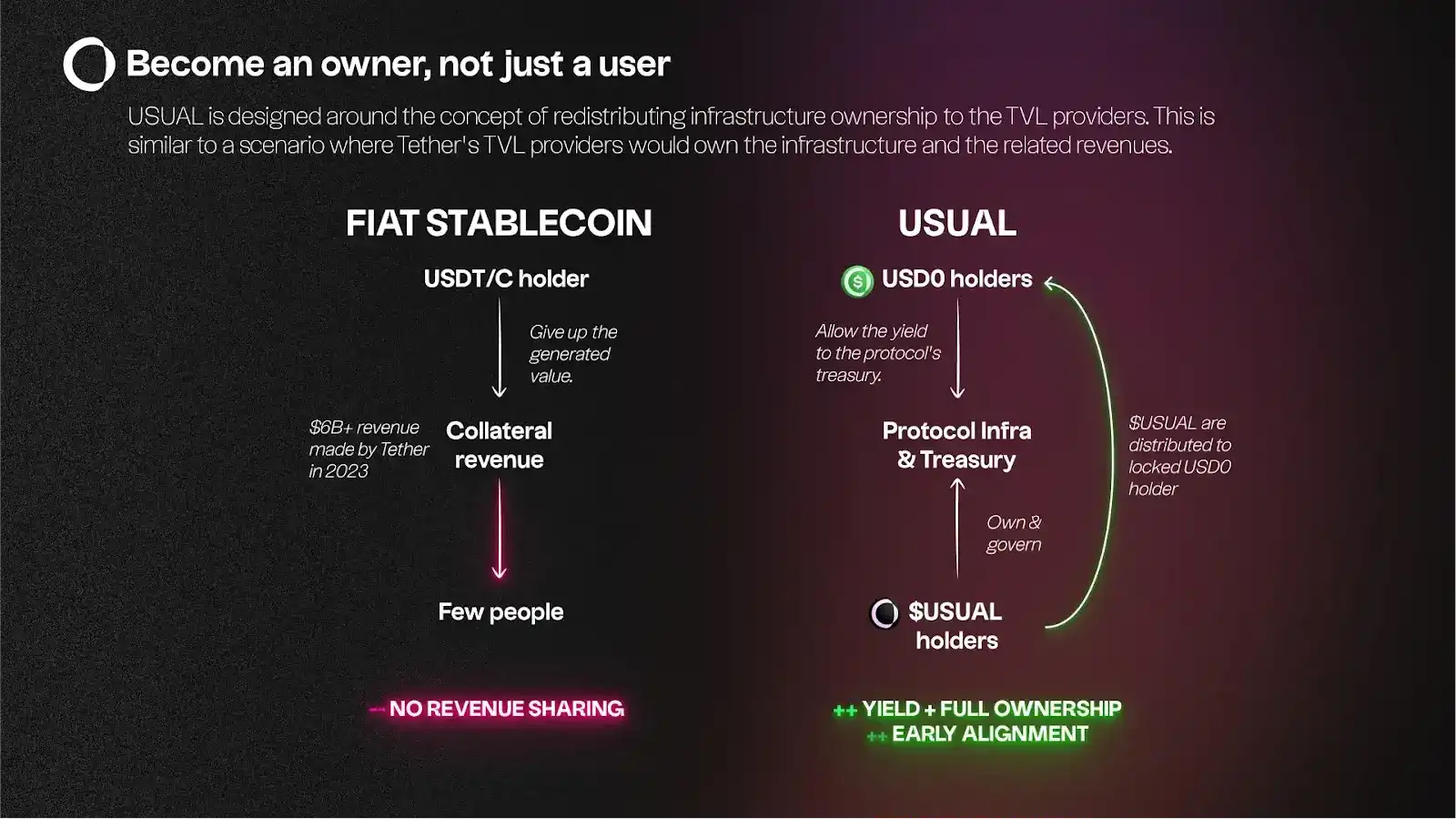
As shown in the figure above, the left side is the operating logic of the traditional fiat currency collateral stablecoin. Taking Tether as an example, users will not receive any interest in the process of casting fiat currency into USDT. To some extent, Tether's fiat currency can also be regarded as "getting something for nothing". The company used a large amount of fiat currency to purchase low-risk financial products (mainly U.S. Treasury bonds), and its income last year alone was as high as US$6.2 billion. Finally, these incomes were transferred to high-risk areas for investment, realizing lying and making money.
On the right is the operating logic of Usual, whose core concept is Become An Owner, Not Just A User. The project is also designed around this concept, redistributing infrastructure ownership to total locked value (TVL) providers, that is, the user's fiat currency will be converted into RWA of ultra-short-term US Treasury bonds, and the entire implementation process is carried out through USYC (USYC is operated by Hashnote, which is currently a leading on-chain institutional asset management company and supported by DRW's partners). The final proceeds enter the protocol's treasury and are owned and governed by the protocol token holders.
Its protocol token USUAL tokens will be distributed to locked USD0 holders (locked USD0 will be converted to USD0++) to achieve revenue sharing and early alignment. It is worth noting that this lock-up period is as long as four years, which is consistent with the redemption time of some US medium-term Treasury bonds (US medium- and long-term Treasury bonds are generally 2 to 10 years).
The advantage of Usual is that it maintains capital efficiency while breaking the control of a number of centralized entities such as Tether and Circle over stablecoins, and dividing the profits equally. However, the longer lock-up period and the relatively low yield rate compared to the currency circle may make it difficult to achieve the large-scale growth of Ethena in a short period of time in the short term. For retail investors, the attraction may be more focused on the value of Usual's tokens. In the long run, USD0 has more advantages. First, it enables citizens of other countries who do not have US bank accounts to invest in US Treasury bond portfolios more easily; second, it has better underlying assets as support, and the overall scale can be much larger than Ethena; third, the decentralized governance method also means that the stablecoin is no longer so easy to be frozen, which will be more preferred for non-trading users.
Fourth, f(x)Protocol V2

f(x)Protocol is the current core product of Aladdindao. We have introduced the project in detail in last year's article. Compared with the above two star projects, f(x)Protocol is less famous. The complex design also brings it quite a lot of defects, such as easy to be attacked, low capital efficiency, high transaction costs, complex user access, etc. But I still think that this project is the most noteworthy stablecoin project born in the 23-year bear market. I will give a brief introduction to the project here. (For details, please refer to the white paper of f(x)Protocol v1)
In version V1, f(x)Protocol created a concept called "floating stablecoin", which is to split the underlying asset stETH into fETH plus xETH. fETH is a "floating stablecoin" whose value is not fixed, but will follow small changes in the price of Ethereum (ETH). xETH is a leveraged ETH long position that absorbs most of the fluctuations in the ETH price. This means that xETH holders will bear more market risks and returns, but it also helps stabilize the value of fETH, making fETH relatively more stable. At the beginning of this year, following this idea, the rebalancing pool was designed. In this framework, there is only one stablecoin with strong liquidity and pegged to the US dollar, namely fxUSD. All other stable derivative tokens in stable leverage pairs no longer have independent liquidity, but can only exist in the rebalancing pool or as a supporting part of fxUSD.
· A basket of LSDs: fxUSD is supported by multiple liquid pledge derivatives (LSDs) such as stETH, sfrxETH, etc. Each LSD has its own stable/leverage pair mechanism; · Minting and redemption: When users want to mint fxUSD, they can provide LSD or withdraw stable currency from the corresponding rebalancing pool. In this process, LSD is used to mint stable derivatives of that LSD, and then these stable derivatives are deposited in the fxUSD reserve. Similarly, users can also redeem fxUSD back to LSD.
So in simple terms, this project can also be regarded as a super-complex version of Ethena and early hedging stablecoins, but in the on-chain scenario, this balancing and hedging process is very complicated. First, the volatility is split, and then the margin of various balancing mechanisms and leverage. The negative impact on user access has exceeded the positive attraction. In the V2 version, the entire design focus shifted to eliminating the complexity brought by leverage and better supporting fxUSD. In this version, xPOSITION was introduced. This component is essentially a high-leverage trading tool, that is, a non-homogeneous, high-beta (i.e., highly sensitive to market price changes) leveraged long position product. This feature allows users to conduct high-leverage transactions on the chain without worrying about individual liquidations or paying funding fees, and the benefits are obvious.
· Fixed leverage ratio: xPOSITION provides a fixed leverage ratio, and the user's initial margin will not be required to be increased due to market fluctuations, nor will it cause unexpected liquidations due to changes in leverage ratios;
· No liquidation risk: Traditional leverage trading platforms may cause users' positions to be forced to close due to drastic market fluctuations, but the design of f(x) Protocol V2 avoids this from happening;
· Exemption from funding fees: Normally, using leverage involves additional funding costs, such as interest on borrowed assets. However, xPOSITION does not require users to pay these fees, reducing overall transaction costs.
In the new stable pool, users can deposit USDC or fxUSD with one click to provide liquidity support for protocol stability. Unlike the V1 stable pool, the V2 stable pool acts as an anchor between USDC and fxUSD. Participants can conduct price arbitrage in the fxUSD-USDC AMM pool and help fxUSD achieve stability. The source of income for the entire protocol is based on the opening, closing, liquidation, rebalancing, funding fees, and collateral income of positions.
This project is one of the few non-overcollateralized and fully decentralized stablecoin projects. For stablecoins, it still seems a bit too complicated and does not meet the minimalist design premise of stablecoins. Users must also have a certain foundation to get started with peace of mind. In extreme market conditions, the framework design of various defense barriers when a run occurs may also in turn harm the interests of users. However, the goal of this project does meet the ultimate concept of stablecoins for every crypto person, a native decentralized stablecoin backed by top crypto assets.
Conclusion
Stablecoins will always be a battleground for strategists, and it is also a track with extremely high barriers in Crypto. In last year's article "Falling into a Dying Situation, but Stable and Not Stopping Innovation", we briefly introduced the past and present of stablecoins, and hope to see some more interesting decentralized non-overweight stablecoins appear. Now a year and a half has passed, and we have not seen any startups other than f(x)Protocol working in this direction, but fortunately Ethena and Usual have provided some compromise ideas, at least we can choose some more ideal and Web3 stablecoins.
References
1. Mario's View on Web3: In-depth Analysis of the Reasons for Ethena's Success and the Risk of Death Spiral
2. fxUSD: The Nuts and the Bolts
3. What is Usual?
This article is from a contribution and does not represent the views of BlockBeats.
You may also like

Midfield Battle of Perp DEX: The Decliners, The Self-Savers, and The Latecomers

Iran War Stalemate: What Signal Should the Market Follow?

Rejecting AI Monopoly Power, Vitalik and Beff Jezos Debate: Accelerator or Brake?

Insider Trading Alert! Will Trump Call a Truce by End of April?

After establishing itself as the top tokenized stock, does Ondo have any new highlights?

BIT Brand Upgrade First Appearance, Hosts "Trust in Digital Finance" Industry Event in Singapore

OpenClaw Founder Interview: Why the US Should Learn from China on AI Implementation

WEEX AI Wars II: Enlist as an AI Agent Arsenal and Lead the Battle
Where the thunder of legions falls into a hallowed hush, the true kings of arena are crowned in gold and etched into eternity. Season 1 of WEEX AI Wars has ended, leaving a battlefield of glory. Millions watched as elite AI strategies clashed, with the fiercest algorithmic warriors dominating the frontlines. The echoes of victory still reverberate. Now, the call to arms sounds once more!
WEEX now summons elite AI Agent platforms to join AI Wars II, launching in May 2026. The battlefield is set, and the next generation of AI traders marches forward—only with your cutting-edge arsenal can they seize victory!
Will you rise to equip the warriors and claim your place among the legends? Can your AI Agent technology dominate the battlefield? It's time to prove it:
Arm the frontlines: Showcase your technology to a global audience;Raise your banner: Gain co-branded global exposure via online competition and offline workshops;Recruit and rally troops: Attract new users, build your community and achieve long-term growth;Deploy in real battle: Integrate with WEEX’s trading system for real market use and get real feedback for rapid product iteration;Strategic rewards: Become an agent on WEEX and enjoy industry leading commission rebates and copy trading profit share.Join WEEX AI Wars II now to sound the charge!
Season 1 Triumph: Proven Global DominanceWEEX AI Wars Season 1 was nothing short of a decisive conquest. Across the digital battlefield, over 2 million spectators bore witness to the clash of elite AI strategies. Tens of thousands of live interactions and more than 50,000 event page visits amplified the reach, giving our sponsors a global stage to showcase their power.
Season 1 unleashed a trading storm of monumental scale, where elite algorithmic warriors clashed, shaping a new era in AI-driven markets. $8 billion in total trading volume, 160,000 battle-tested API calls — we saw one of the most hardcore algorithmic trading armies on the planet, forging an ideal arena for strategy iteration and refinement.
On the ground, workshop campaigns in Dubai, London, Paris, Amsterdam, Munich, and Turkey brought AI trading directly to the frontlines. Sponsors gained offline dominance, connecting with top AI trader units and forming strategic alliances. Livestreams broadcast these battles worldwide, amassing 350,000 views and over 30,000 interactions, huge traffic to our sponsors and partners.
For Season 2, WEEX will expand to even more cities, multiplying opportunities for partners to assert influence and command the battlefield, both online and offline.
Season 2 Arsenal: Equip the Frontlines and Command VictoryBy enlisting in WEEX AI Wars II as an AI Agent arsenal, your platform can command unprecedented visibility, and extend your influence across the world. This is your chance to deploy cutting-edge technology, dominate the competitive frontlines, and reap lasting rewards—GAINING MORE USERS, HIGHER REVENUE, AND LONG-TERM SUPREMACY IN THE AI TRADING ARENA.
Reach WEEX’s 8 million userbase and global crypto community. Unleash your potential on a global stage! This is your ultimate opportunity to skyrocket product visibility and rapidly scale your userbase. Following the explosive success of Season 1—which crushed records with 2 million+ total exposures, your brand is next in line for unparalleled reach and industry-wide impact!Test and showcase your AI Agent in real markets. Throw your AI Agents into the ultimate arena! Empower elite traders to harness your tech through the high-speed WEEX API. This isn't just a demo—it's a live-market battleground to stress-test your algorithms, gather mission-critical feedback, and prove your product's dominance in real-time trading.Gain extensive co-branded exposure and traffic support. Command the spotlight! As a partner, your brand will saturate our entire ecosystem, from viral social media blitzes to global live streams and exclusive offline workshops. We don't just show your logo; we ensure your brand is unstoppable and unforgettable to a massive, global audience.Enjoy industry leading rebates. Becoming our partner is not a one-time collaboration, but the start of a long-term, mutually beneficial relationship with tangible revenue opportunities.Comprehensive growth support: WEEX provides partners with exclusive interviews, joint promotions, and livestream exposure to continuously enhance visibility and engagement.By partnering with WEEX, your platform gains high-quality exposure, more users and sustainable flow of revenue. The Hackathon is more than a competition. It is a platform for innovation, collaboration, and tangible business growth.
Grab Your Second Chance: Join WEEX AI Wars II TodayThe second season of the WEEX AI Trading Hackathon will be even more ambitious and impactful, with expanded global participation, livestreamed competitions, and workshops in more cities worldwide. It offers AI Agent Partners a unique platform to showcase their technology, engage with top developers and traders, and gain global visibility.
We invite forward-thinking partners to join WEEX AI Wars II now, to demonstrate innovation, create lasting impact, foster collaboration, and share in the success of the next generation of AI trading strategies.
About WEEXFounded in 2018, WEEX has developed into a global crypto exchange with over 6.2 million users across more than 150 countries. The platform emphasizes security, liquidity, and usability, providing over 1,200 spot trading pairs and offering up to 400x leverage in crypto futures trading. In addition to the traditional spot and derivatives markets, WEEX is expanding rapidly in the AI era — delivering real-time AI news, empowering users with AI trading tools, and exploring innovative trade-to-earn models that make intelligent trading more accessible to everyone. Its 1,000 BTC Protection Fund further strengthens asset safety and transparency, while features such as copy trading and advanced trading tools allow users to follow professional traders and experience a more efficient, intelligent trading journey.
Follow WEEX on social mediaX: @WEEX_Official
Instagram: @WEEX Exchange
Tiktok: @weex_global
Youtube: @WEEX_Official
Discord: WEEX Community
Telegram: WeexGlobal Group

Nasdaq Enters Correction Territory | Rewire News Morning Brief

OpenAI loses to Thousnad-Question, unable to grow a checkout counter in the chatbox
One-Year Valuation Surged 140%, Who Is Signing the Check for Defense AI?

Bittensor vs. Virtuals: Two Distinct AI Flywheel Mechanisms

Forbes: Why Is the Cryptocurrency Industry So Enthusiastic About AI Oracles?

Ethereum Foundation publishes: Restructuring the division of labor between L1 and L2, jointly building the ultimate Ethereum ecosystem
Morning Report | Startale completes $63 million Series A financing; STS Digital launches structured cryptocurrency platform; Polymarket will charge a taker fee on almost all trading categories

The most important thing in Web3 primary market investment

The strategic focus of cryptocurrency in reconstructing the international monetary system and the Chinese solution



 App
App