
Metcalfe's Law "Bankruptcy": Why Has Cryptocurrency Been Overvalued?


Original Article Title: Crypto Is Priced for Network Effects It Doesn't Have
Original Article Author: Santiago Roel Santos, Founder of Inversion
Original Article Translation: AididiaoJP, Foresight News
The Dilemma of Cryptocurrency Network Effects
My previous view on "cryptocurrency trading prices far exceeding its fundamentals" has sparked discussions. The strongest opposition is not about usage or fees but stems from ideological differences:
· "Cryptocurrency is not a business"
· "Blockchain follows Metcalfe's Law"
· "The core value lies in network effects"
As a witness to the rise of Facebook, Twitter, and Instagram, I am well aware that early internet products also faced valuation challenges. However, a pattern gradually emerged: as more users joined the social circle, the product's value experienced exponential growth. User retention strengthened, engagement deepened, and the flywheel effect became clearly visible in the experience.
This is the true manifestation of network effects.
If one advocates for "evaluating the value of cryptocurrency from a network rather than a corporate perspective," then let us delve deeper.
Upon closer examination, a glaring issue emerges: Metcalfe's Law not only fails to support the current valuation but also exposes its vulnerability.
The Misunderstood "Network Effect"
In the cryptocurrency field, the so-called "network effect" is mostly a negative effect:
· User growth leads to degraded experience
· Soaring transaction fees
· Worsening network congestion
A deeper issue lies in:
· Open-source nature causing developer attrition
· Liquidity being profit-driven
· User Cross-Chain Migration with Incentive
· Institution Platform Switch Based on Short-Term Gain
A successful network has never operated this way; the experience did not degrade when Facebook added tens of millions of users.
But the New Blockchain Has Solved the Throughput Issue
This has indeed alleviated congestion but hasn’t addressed the fundamental issue of network effects. Increasing throughput merely eliminates friction and does not create compounded value.
The fundamental contradiction still exists:
· Liquidity may drain
· Developers may migrate
· Users may depart
· Code can fork
· Weak value-capture ability
Scaling improves availability, not inevitability.
The Truth Revealed by Fees
If an L1 blockchain truly has network effects, it should capture most of the value as iOS, Android, Facebook, or Visa do. The reality is:
· L1 holds 90% of the total market value
· Fee share plummeted from 60% to 12%
· DeFi contributes 73% of fees
· But accounts for less than 10% of the valuation
The market still prices based on the "Fat Protocol Theory," but the data points to the opposite conclusion: L1 is overvalued, applications are undervalued, and the ultimate value will aggregate towards the user layer.
User Valuation Comparison
Using a common metric, the per-user market value:
Meta (Facebook)
· 3.1 billion monthly active users
· $1.5 trillion market cap
· Per-user value $400-500
Cryptocurrency (Excluding Bitcoin)
· $1 Trillion Market Cap
· 400 Million General Users → $2,500 per Person
· 100 Million Active Users → $9,000 per Person
· 40 Million On-chain Users → $23,000 per Person
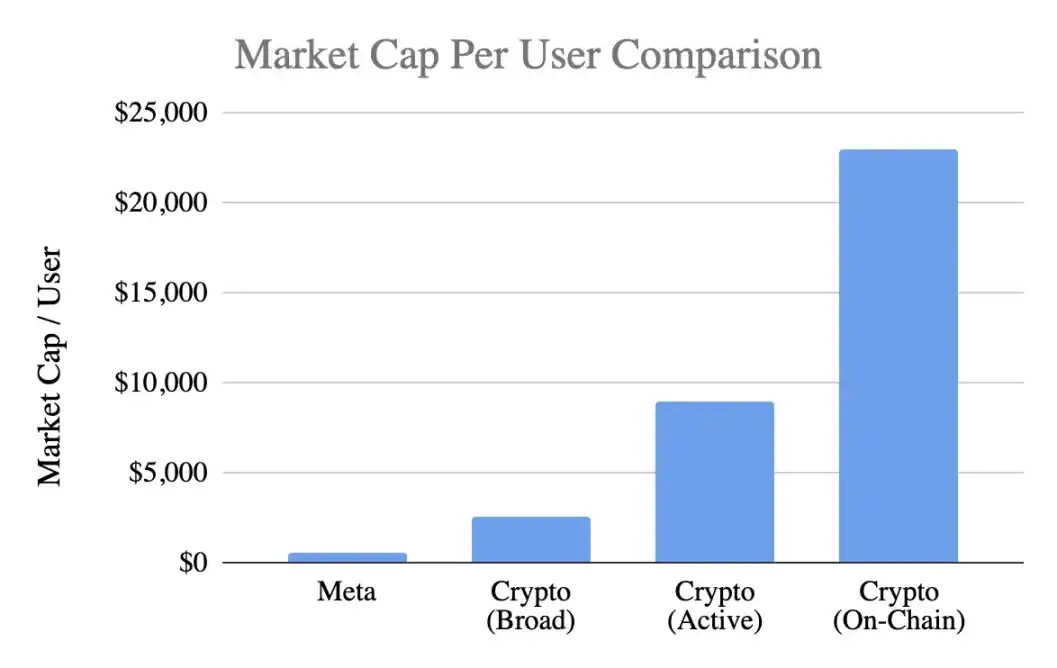
Valuation Levels Reached:
· Optimistic Premium of 5x
· Conservative Premium of 20x
· On-chain Activity-based Premium of 50x
Meanwhile, Meta is considered the most efficient monetization engine in consumer technology.
Analysis of Development Stage
The argument of "Facebook was also like this in its early days" is worth debating. While Facebook also lacked revenue in its early days, its product had already built:
· Daily Usage Habits
· Social Connections
· Identity Verification
· Community Membership
· Value Growth from User Expansion
In contrast, the core product of cryptocurrency remains speculative, leading to:
· Rapid User Adoption
· Faster Churn
· Lack of Stickiness
· Lack of Habit Formation
· No Improvement with Scale
Unless cryptocurrency becomes "Invisible Infrastructure," a bottom-layer service imperceptible to users, network effects are challenging to self-reinforce.
This is not a maturity issue but a product essence issue.
Metcalf Law Misuse
The law's description of value≈n² is indeed appealing, but its assumptions are biased:
· Deep interaction between users (actually rare)
· Network stickiness (actually lacking)
· Value concentration (actually dispersed)
· Existence of conversion costs (actually very low)
· Building defensive moats through scale (not yet evident)
Most cryptocurrencies do not meet these prerequisites.
Insights on Key Variable k Value
In the V=k·n² model, the k value represents:
· Monetization efficiency
· Level of trust
· Depth of engagement
· Retention capability
· Conversion costs
· Ecosystem maturity
The k value for Facebook and Tencent ranges from 10⁻⁹ to 10⁻⁷, being minute due to the massive network scale.
Estimated k values for cryptocurrencies (based on a $1 trillion market cap):
· 400 million users → k≈10⁻⁶
· 100 million users → k≈10⁻⁵
· 40 million users → k≈10⁻⁴
This implies that the market assumes each crypto user's value far exceeds that of a Facebook user, despite their disadvantages in retention rate, monetization ability, and stickiness. This is not early optimism but rather overdrawn future prospects.
Current State of Real Network Effects
Cryptocurrencies actually possess:
Bilateral network effects (users ↔ developers ↔ liquidity)
Platform effects (standards, tools, composability)
These effects indeed exist but are fragile: easily forked, slow to scale, far from reaching the n² flywheel effect of Facebook, WeChat, or Visa.
Rational Perspective on Future Outlook
The vision of the “Internet being built on a cryptographic network” is indeed appealing, but it needs to be clarified:
1. This future may be realized but has not yet arrived,
2. The existing economic models have not reflected it.
The current value distribution presents:
· Cost flowing to the application layer rather than L1
· Users controlled by exchanges and wallets
· MEV capturing surplus value
· Forks weakening barriers to entry
· L1 struggling to solidify created value
Value capture is undergoing a transition from the base layer→application layer→user aggregation layer, which is favorable to users but should not warrant a premature premium.
Characteristics of a Mature Network Effect
A healthy network should exhibit:
· Stable liquidity
· Developer ecosystem concentration
· Increased base layer fee capture
· Continued retention of institutional users
· Retention rate growth across cycles
· Composability to fend off forks
Currently, Ethereum is showing initial signs, Solana is gaining momentum, with most public chains still far apart.
Conclusion: Valuation Judgment Based on Network Effect Logic
If crypto users:
· Have lower stickiness
· Monetization is more difficult
· Have higher churn rates
Then their unit value should be lower than Facebook users, not 5-50 times higher. The current valuation has overestimated the nascent network effects, and market pricing seems to imply a strong effect already exists, when in fact, it is not the case, at least not yet.
You may also like

Why is a16z Crypto raising another $2.2 billion to heavily invest in Web3?

Polymarket Underlying Algorithm Explained

What do projects born in the crypto bear market do?

a16z founder's Stanford lecture: Whenever Wall Street and Silicon Valley have different ideas, it's Wall Street that ends up being wrong

Michael Saylor: After three consecutive quarters of losses, Strategy will sell Bitcoin to pay dividends

The toll station at Hormuz and the RMB that cannot be bought

Interview with Coinbase Institutional's Strategic Head: The Institutionalization of Crypto Reaches a Critical Point

Dialogue with Agora CEO Nick: The battle for stablecoin licenses has just begun

Morning Report | a16z Crypto completes $2.2 billion fundraising for its fifth fund; Bullish invests $4.2 billion to acquire share transfer agency Equiniti; PayPal's Q1 performance exceeds expectations

a16z Crypto: What We See Behind the $2.2 Billion New Fund
Web3 is dead, Web2+3 should rise
Stablecoins and Latin American Remittances: The Misunderstood $174 Billion Market

The arrival of the Web 3.0 era: A review of Hong Kong court rulings on digital assets

Track Markets At a Glance: New WEEX Price Widgets for iOS & Android
To streamline your market data access, WEEX has officially launched "Market Watchlist" desktop widgets

The billion-dollar lesson: The focus of DeFi security is shifting from code to operational governance
A Brief Analysis of Stablecoin Licenses and On-Chain Funding
BVNK Founder: Three Stages of Stablecoin Development
The truth about Trump's son's Bitcoin game: he made a staggering $100 million while retail investors lost $500 million
Why is a16z Crypto raising another $2.2 billion to heavily invest in Web3?
Polymarket Underlying Algorithm Explained
What do projects born in the crypto bear market do?
a16z founder's Stanford lecture: Whenever Wall Street and Silicon Valley have different ideas, it's Wall Street that ends up being wrong
Michael Saylor: After three consecutive quarters of losses, Strategy will sell Bitcoin to pay dividends
The toll station at Hormuz and the RMB that cannot be bought


