
Michael Saylor Microsoft Board Presentation: Bitcoin is the Corporate World's Best Treasury Reserve Asset


Original Author: Michael Saylor, Founder of MicroStrategy
Original Translation: Felix, PANews
Microsoft plans to vote on the proposal to "Evaluate Bitcoin Investment" at its annual meeting on December 10. If the proposal is approved, Microsoft will become the largest publicly traded crypto investment company, surpassing MicroStrategy and Tesla. Ahead of the voting, Michael Saylor gave a 3-minute speech to the Microsoft board, explaining why Bitcoin should be adopted. In his speech, Michael Saylor proposed that Bitcoin represents "digital capital," is the core opportunity of the next wave of technological innovation, embodies the greatest digital transformation of the 21st century, and suggested that Microsoft adopt Bitcoin as a core corporate strategy. Below are some highlights of the presentation slides used:
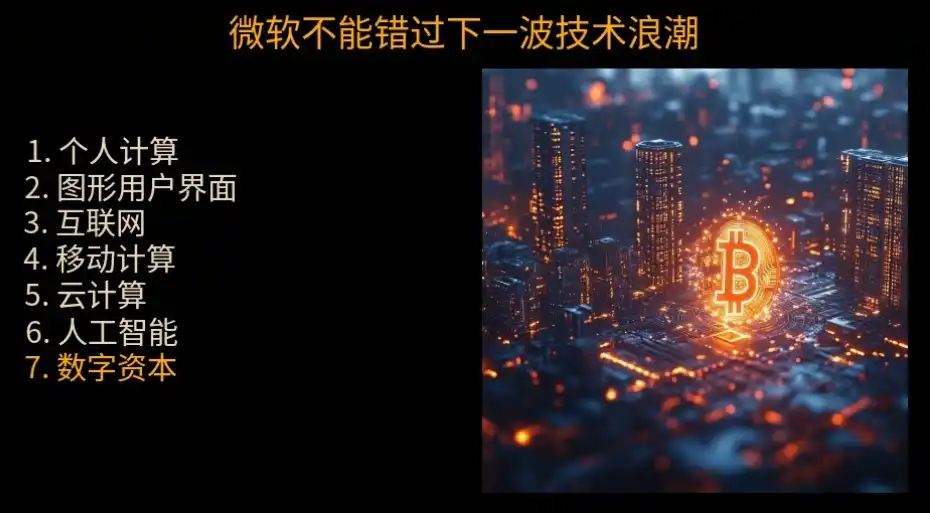
Microsoft cannot afford to miss the next wave of technological trends, which include 7:
· Personal Computing
· Graphical User Interface
· Internet
· Mobile Computing
· Cloud Computing
· Artificial Intelligence
· Digital Capital
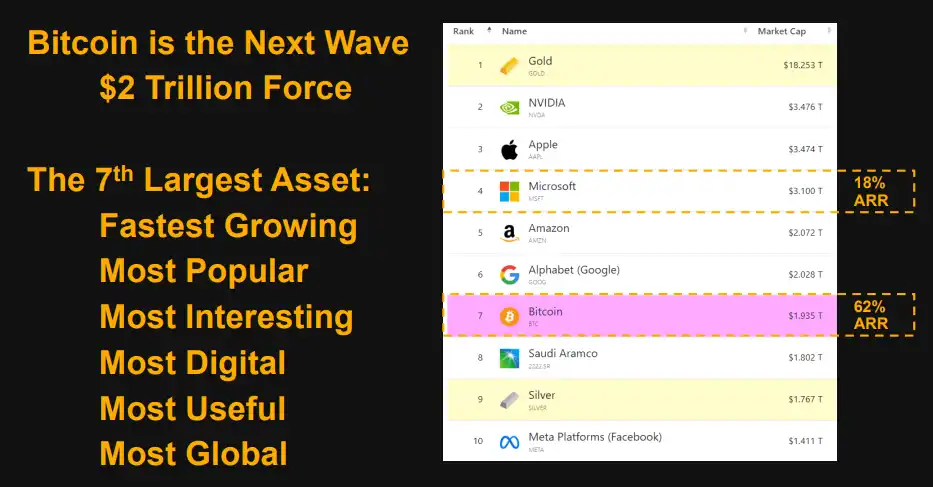
The greatest digital transformation of the 21st century is the transformation of capital, and Bitcoin is digital capital. Bitcoin is currently the world's seventh largest asset, with the fastest growth, most popularity, most intriguing, most digital nature, most utility, and most global. In addition, Microsoft's current Annual Recurring Revenue (ARR) is 18%, while Bitcoin's ARR is 62%.
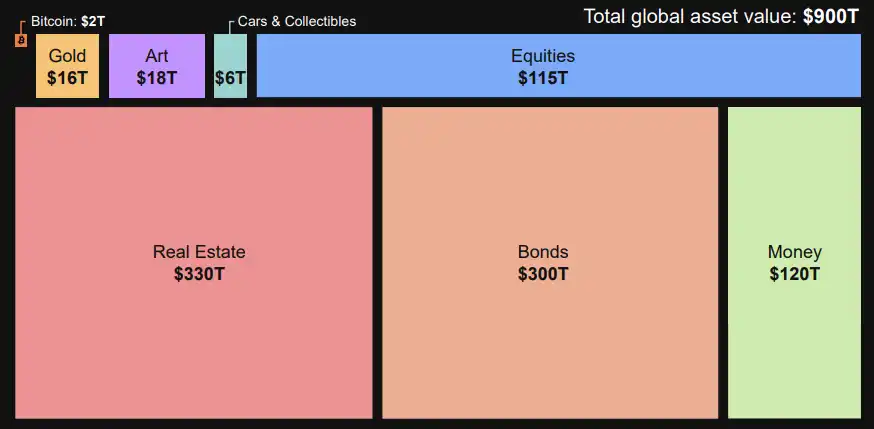
Currently, global wealth is distributed among various assets. In the current global asset market of around $90 trillion, Bitcoin's market cap is around $2 trillion.
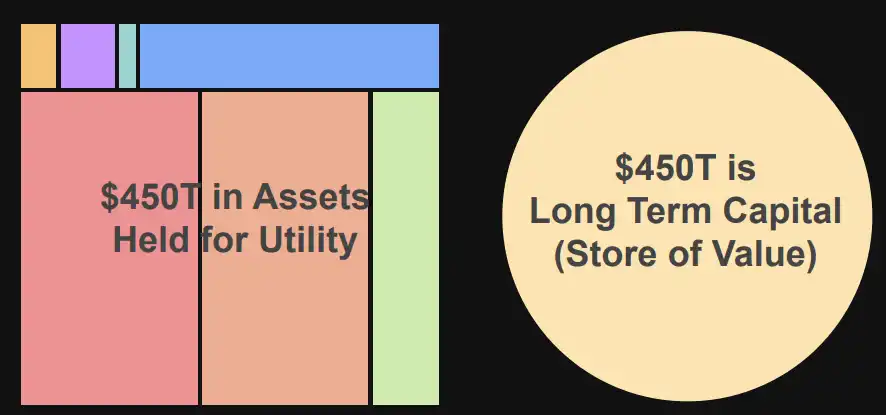
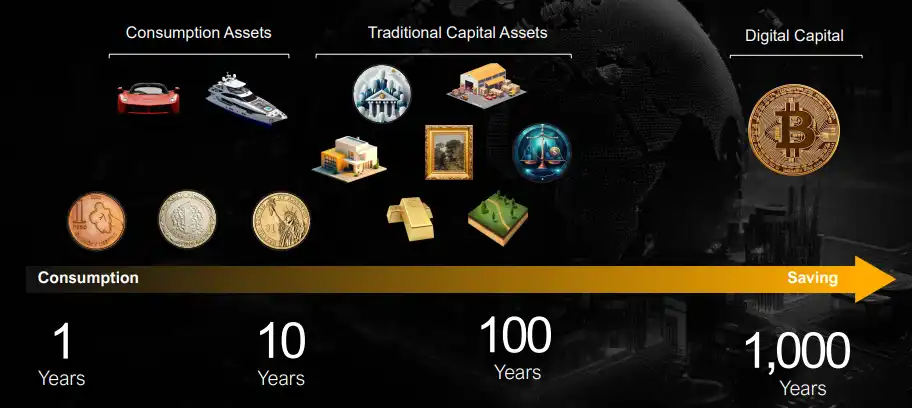
Global wealth is distributed between assets that provide utility and assets that serve as store of value. Of the $450 trillion belonging to long-term capital (value storage), more than $10 trillion of assets are lost each year due to risks such as regulation, taxation, competition, obsolescence, economic and political turmoil, and crime.
Digital capital is economically and technologically superior to physical capital, and long-term capital is transitioning to digital capital (Bitcoin). Bitcoin offers advantages similar to owning a building but without obvious, fixed asset liabilities. For example: no taxation, no need to consider traffic, tenants, encroachments, weather factors, building decay, and regulatory bodies. Instead, Bitcoin has properties such as intangibility, indestructibility, permanent existence, remote transferability, programmability, divisibility, convertibility, and configurability.
One could argue that Bitcoin is a revolutionary advancement in capital preservation.
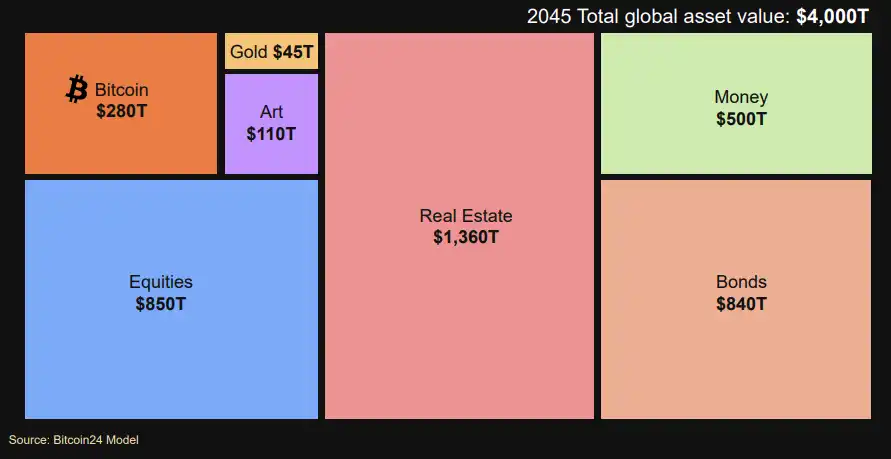
Furthermore, Bitcoin's market capitalization is expected to grow from the current $2 trillion to $280 trillion by 2045, surpassing traditional assets such as bonds and gold.
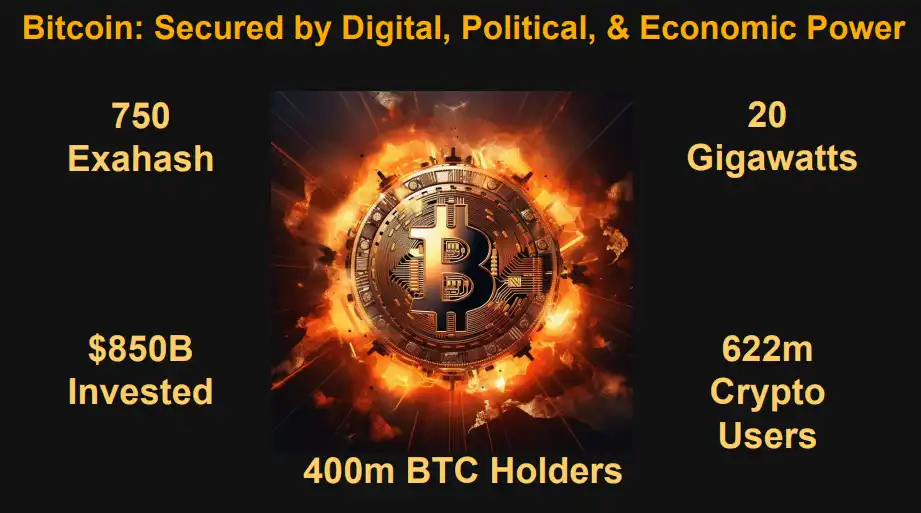
Additionally, Bitcoin is protected by digital, political, and economic forces. The current Bitcoin network has over 750 Exahashes of computing power, with 622 million crypto users and 400 million Bitcoin holders.
Based on a four-year annual asset performance chart, Bitcoin is the best-performing non-correlated asset on a corporate balance sheet.
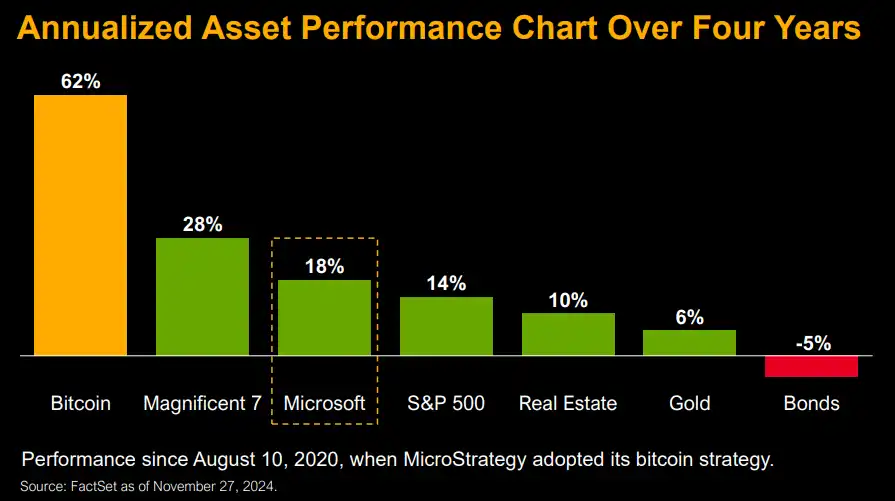
Performance since MicroStrategy adopted a Bitcoin strategy on August 10, 2020
Bitcoin's annual performance is ten times higher than Microsoft's, while bonds have performed less impressively.
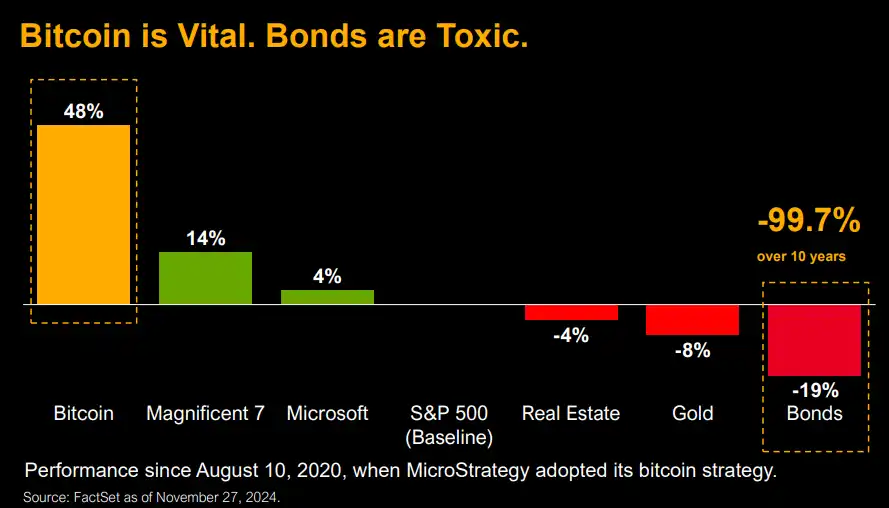
Performance since MicroStrategy adopted a Bitcoin strategy on August 10, 2020
The outstanding performance of corporate stocks is inseparable from Bitcoin (digital capital). Since MicroStrategy adopted a Bitcoin strategy on August 10, 2020, MicroStrategy's stock price has increased by 3045%, while Microsoft (MSFT) has only seen a 103% increase.
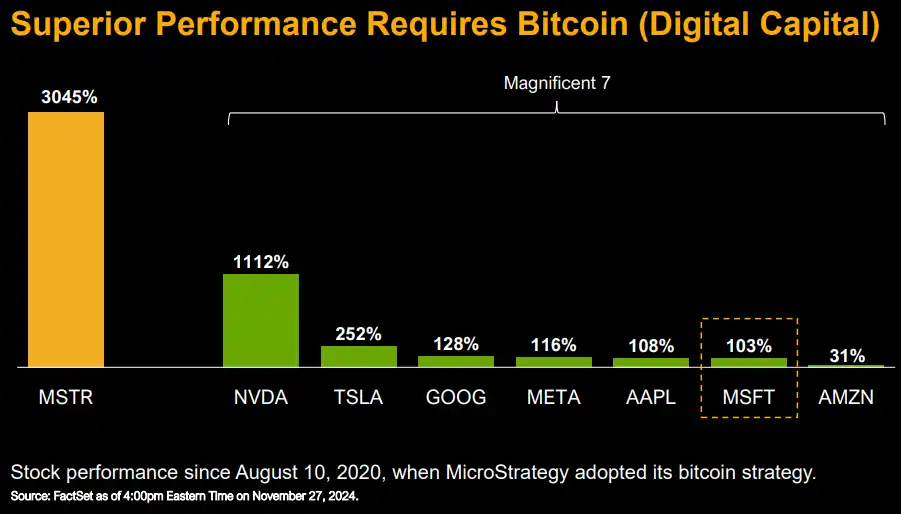
Performance since MicroStrategy adopted a Bitcoin strategy on August 10, 2020
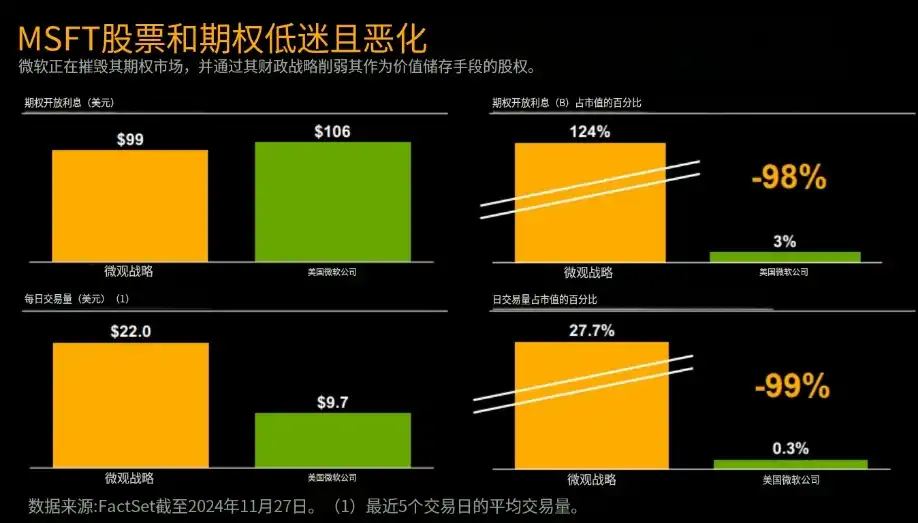
Furthermore, MSFT (Microsoft) stocks and options are weak and deteriorating (Microsoft is actively reducing the options market and stocks as a store of value through its financial strategy).
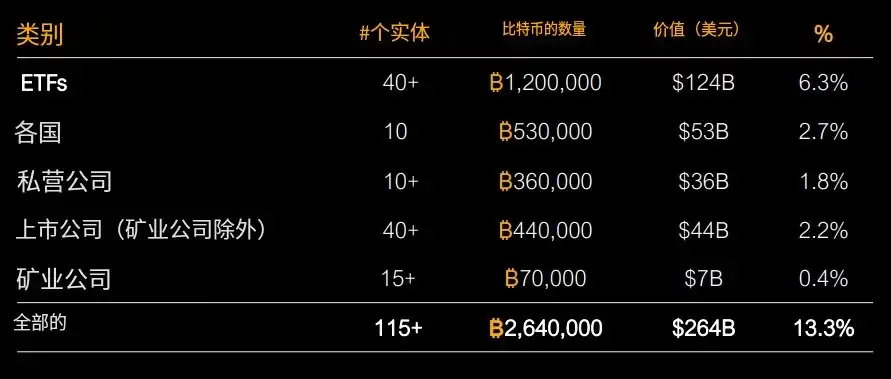
Today, Bitcoin has become an institutional asset, now seen as a viable alternative to corporate bonds. The number of public entities holding Bitcoin has surged:
In addition, a wave of political support for Bitcoin is surging, with endorsements from government, Wall Street, and several well-known political figures. Endorsements have come from the White House, Senate, House of Representatives, and Wall Street, with notable figures such as Donald Trump, JD Vance, Robert Kennedy, Howard Lutnick, and Musk. Meanwhile, support for the United States' strategic Bitcoin reserve is also growing rapidly, with Trump once saying, "Never sell your Bitcoin."
2025 will be the first year of a comprehensive cryptocurrency renaissance. Expect:
· Wall Street adopting ETFs
· FASB fair value accounting
· Over 250 cryptocurrency supporters in Congress
· Bitcoin Strategic Reserve Act
· Repeal of SAB 121
· End to legal battles over cryptocurrency
· Digital asset framework
In this scenario, Microsoft must make a choice:
· Stick to the past: A traditional financial strategy based on government bonds, buybacks, and dividends
· Embrace the future: An innovative financial strategy based on Bitcoin as a digital capital asset
· Step back: Buy back $100 billion annually, increase investor risk, and slow growth
· Move forward: Invest $100 billion annually, reduce investor risk, and accelerate growth
Microsoft has already bought back $200 billion in capital over five years.
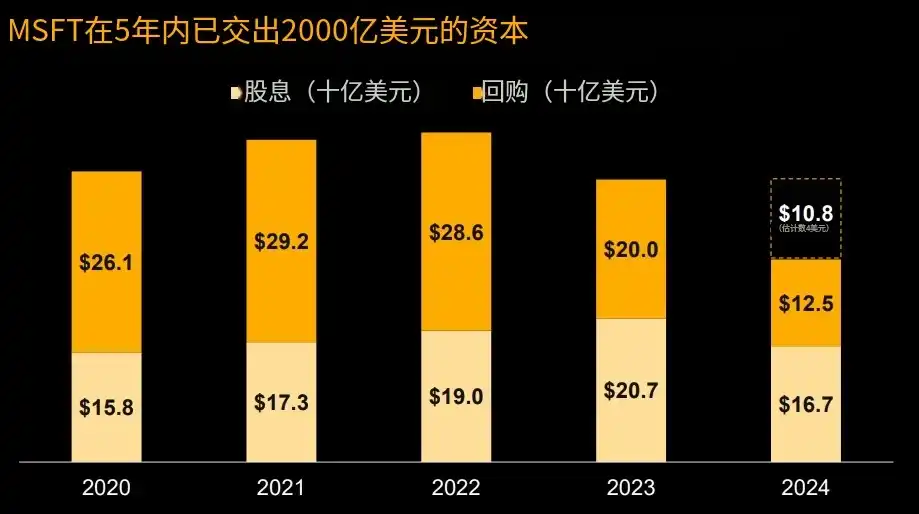
Buybacks and dividends amplify Microsoft's risk factors. Bitcoin is the best way to break free from this vicious cycle. As an asset, Bitcoin has no counterparty risk from competitors, nations, corporations, creditors, cultures, or currencies. It is recommended that Microsoft seize this era-defining opportunity and take a leading position in global digital financial innovation.
You may also like

CFTC Reportedly Plans New Prediction Market Rules Focused on Manipulation Risk and Public Interest Review
The CFTC is reportedly preparing new prediction market rules focused on manipulation risk, public interest review, and retail trader protections.

Meet the new WEEX trial fund—your gateway to greater profits

WEEX Labs Lands at Dutch Blockchain Week: A Disruptive Crypto × AI Conversation Sets Sail in Amsterdam

SK Hynix Reportedly Plans U.S. ADR Listing as Early as August, With SEC Approval Possible in Late June
SK Hynix may pursue a U.S. ADR listing as early as August, with SEC approval reportedly possible in late June amid strong AI chip supply chain demand.

SpaceX vs Tesla vs xAI: Which Elon Musk Trade Has the Biggest Upside in 2026?
OpenAI Reveals It Has Confidentially Submitted an S-1 to the SEC, Keeping the Door Open for a Future IPO
On June 9, according to an OpenAI announcement, the company recently confidentially submitted a draft S-1 registration statement to the U.S. Securities and Exchange Commission (SEC), beginning the preliminary compliance process for a potential initial public offering. OpenAI said it chose to disclose this proactively because it expected the news might leak; however, the company has not yet set a specific listing timeline, and related arrangements may still take some time.

Latest research from 13 top universities including Cornell University: The current state, challenges, and misconceptions of the fusion of Crypto and AI
Deconstructing Anthropic: The Best AI Company, Possibly Also a Type of Organizational Invention
Apollo and Blackstone Reportedly Back $35 Billion Anthropic Chip Financing as Deal Details Remain Unclear
On June 9, according to currently available news alerts, Apollo and Blackstone Group participated in a $35 billion financing for an Anthropic “chip project.” Based on the original wording of the report, the funding has already been raised, but public information remains limited. The financing structure, use of proceeds, project entity, and whether Apollo and Blackstone participated through equity, debt, or project financing have not yet been disclosed.

Humanity Protocol Security Incident Escalates: More Than $31 Million Stolen From Related Addresses as Attacker Continues Selling H for ETH
On June 9, according to monitoring by Onchain Lens, more than $31 million has been stolen from addresses linked to Humanity Protocol, and the attack is still ongoing, with the hacker continuously swapping H tokens for ETH. Project founder Terence Kwok later confirmed the security incident on X, saying the issue involved a private key leak.

Bloomberg: As Bitcoin Weakens, Stablecoins and RWA Continue to Drive Expansion in Crypto Businesses
In June, Bloomberg reported that despite Bitcoin falling below $60,000 last week, wiping out about $235 billion in market value within seven days, and dropping close to 50% from last year’s peak, some core businesses in the crypto industry are still expanding, mainly in stablecoins, real-world asset tokenization (RWA), payments, and infrastructure. The report also noted that overall altcoin activity has contracted significantly: altcoin market capitalization has fallen from a peak of about $431 billion in November 2021 to around $170 billion, and among the tens of millions of tokens issued in recent years, fewer than 1,700 still maintain meaningful trading activity.

Galaxy Deep Research Report: How Hyperliquid's HIP-4 Upgrade Changes the Landscape of Prediction Markets?
Binance Research: RWA Market Expected to Expand Nearly 6x from Early 2025, with Public Equities and Onchain Payments Heating Up Together
In June, Binance Research said in its monthly market report that the real-world asset (RWA) market is expected to grow by about 589% from the beginning of 2025. Bond- and money market fund-related RWA expanded by about $6.5 billion, up 83% year over year, while publicly traded equity RWAs grew by about 422%. The report also noted that monthly crypto debit card transaction volume exceeded $747 million in May, up 48.6% year to date.

Japan to Assess a Framework for Yen Stablecoins and Crypto ETFs as Asia’s Compliant Payments Narrative Heats Up
Recently, according to the original report, Japan is considering the launch of yen stablecoins and cryptocurrency ETFs. Public information remains limited at this stage, and there is still no complete policy text, regulatory draft, or clear implementation timeline, so this is better characterized as a “policy discussion” rather than formal implementation. The original wording also noted that advancing stablecoin regulation in Asia is driving XRP usage and supporting growth in the XRPL ecosystem. However, based on currently available public information, there is not enough evidence to directly establish a clear causal relationship between this round of discussion in Japan and XRP or XRPL.

ZachXBT: Humanity private key leak and abnormal surge in H token should be viewed separately
On June 9, according to related disclosures, on-chain investigator ZachXBT posted an update on Humanity’s roughly $31 million security incident, saying that after further analyzing fund flows, he currently tends to believe the project team was not involved in an “inside job” or a self-staged attack. According to him, the official explanation about the private key leak was broadly accurate, but before the token unlock, the price of H had been artificially pushed higher, and the hacker later took advantage of that market environment; therefore, the private key leak and the earlier abnormal price pumping should be regarded as two separate and independent events. This reframing has shifted the market’s understanding of the nature of the incident. Earlier discussion around Humanity had focused on whether the team directly participated in the attack or used the security incident to cover up internal operations. ZachXBT’s latest remarks shift the focus from “whether it was self-theft” to “whether there were pre-unlock market structure issues.” He also questioned whether the team may have.

Morning Report | OpenAI has submitted an S-1 registration statement draft to the U.S. SEC; Morpho completes $175 million financing

Morning Report | BitMine increased its holdings by 126,971 ETH last week; trader Eugene announced his exit from the crypto market

Wang Chuan: How can one not feel anxious after the neighbor Old Wang made thirty times profit by investing in storage stocks? (Seven) - A quarter-century cycle
CFTC Reportedly Plans New Prediction Market Rules Focused on Manipulation Risk and Public Interest Review
The CFTC is reportedly preparing new prediction market rules focused on manipulation risk, public interest review, and retail trader protections.
Meet the new WEEX trial fund—your gateway to greater profits
WEEX Labs Lands at Dutch Blockchain Week: A Disruptive Crypto × AI Conversation Sets Sail in Amsterdam
SK Hynix Reportedly Plans U.S. ADR Listing as Early as August, With SEC Approval Possible in Late June
SK Hynix may pursue a U.S. ADR listing as early as August, with SEC approval reportedly possible in late June amid strong AI chip supply chain demand.
SpaceX vs Tesla vs xAI: Which Elon Musk Trade Has the Biggest Upside in 2026?
OpenAI Reveals It Has Confidentially Submitted an S-1 to the SEC, Keeping the Door Open for a Future IPO
On June 9, according to an OpenAI announcement, the company recently confidentially submitted a draft S-1 registration statement to the U.S. Securities and Exchange Commission (SEC), beginning the preliminary compliance process for a potential initial public offering. OpenAI said it chose to disclose this proactively because it expected the news might leak; however, the company has not yet set a specific listing timeline, and related arrangements may still take some time.


