
 Buy Crypto
- Markets
 Futures
- Spot
- Copy Trade
- Earn
- More
MiniMax: A Henan County Youth and His 300 Billion

Author | Lin Wanwan
In 2014, an intern joined Baidu Research Institute, a Ph.D. from the Chinese Academy of Sciences' Institute of Automation, hailing from a small county in Henan. He had calculated for himself: the most ideal place to work after graduation was IBM, writing Java, with an annual salary of 280,000 RMB.
During the 2026 Chinese New Year, a tool named OpenClaw's Agent went viral worldwide, and developers using lobster needed a powerful underlying model support. There was a model that was fast and cheap, consuming 1.44 trillion Tokens on OpenRouter in a week, claiming the top spot across all platforms.
This model was called M2.5, and the company was named MiniMax.
Just two months after going public, the stock price skyrocketed from 165 HKD to 1300 HKD, surpassing a market value of 300 billion, even though it was a company with an annual revenue of less than 80 million USD.
The person behind MiniMax was the same intern from twelve years ago, Yan Junjie.
A Bet Over a Year in Advance
During the 2021 Chinese New Year, Yan Junjie went back to his hometown in Henan to celebrate the New Year and visit his grandfather.
His grandfather told him that he wanted to write a memoir to record his 80-year life story. However, he couldn't type, nor could he organize the story properly. After a few attempts, he gave up.
Yan Junjie had been working in the AI industry for over ten years. At that moment, he suddenly realized that what he had been working on, although already implemented in the industry and helped many enterprises, was of no use to an elderly person who wanted to write a memoir.
This detail was later repeatedly quoted and had a somewhat inspirational story flavor. But it did explain one thing: his motivation for doing AI was very simple, to make it truly usable for ordinary people. This obsession later drove a series of counterintuitive decisions.
At the end of 2021, he resigned from SenseTime.
The timing was crucial. SenseTime was preparing for an IPO at the time, where he was a vice president, deputy director of the research institute, and CTO of the Smart City Business Group. He left when the company was at one of its peak valuations. He didn't wait for the IPO, nor did he wait to cash out his wealth.
ChatGPT was only released in November 2022.
MiniMax was founded in December 2021.
This timing difference laid the foundation for everything that followed. Yan Junjie later said that if he hadn't started early, MiniMax wouldn't stand a chance against others in the later financing environment where "star researchers and AI backgrounds from large companies were more popular."
Both of his parents are ordinary people. He attended high school in a county town, was admitted to the Mathematics Department of Southeast University, later pursued a Ph.D. at the Institute of Automation of the Chinese Academy of Sciences, did postdoctoral research at Tsinghua University, then joined SenseTime, gradually making his way up without any overseas background or prominent connections.
During his internship at Baidu, he had some interaction with Horizon Robotics' Yu Kai. Yu Kai later said that academic abilities can be cultivated, but those who can engineer and implement AI technology are rare. Yan Junjie is one of them.
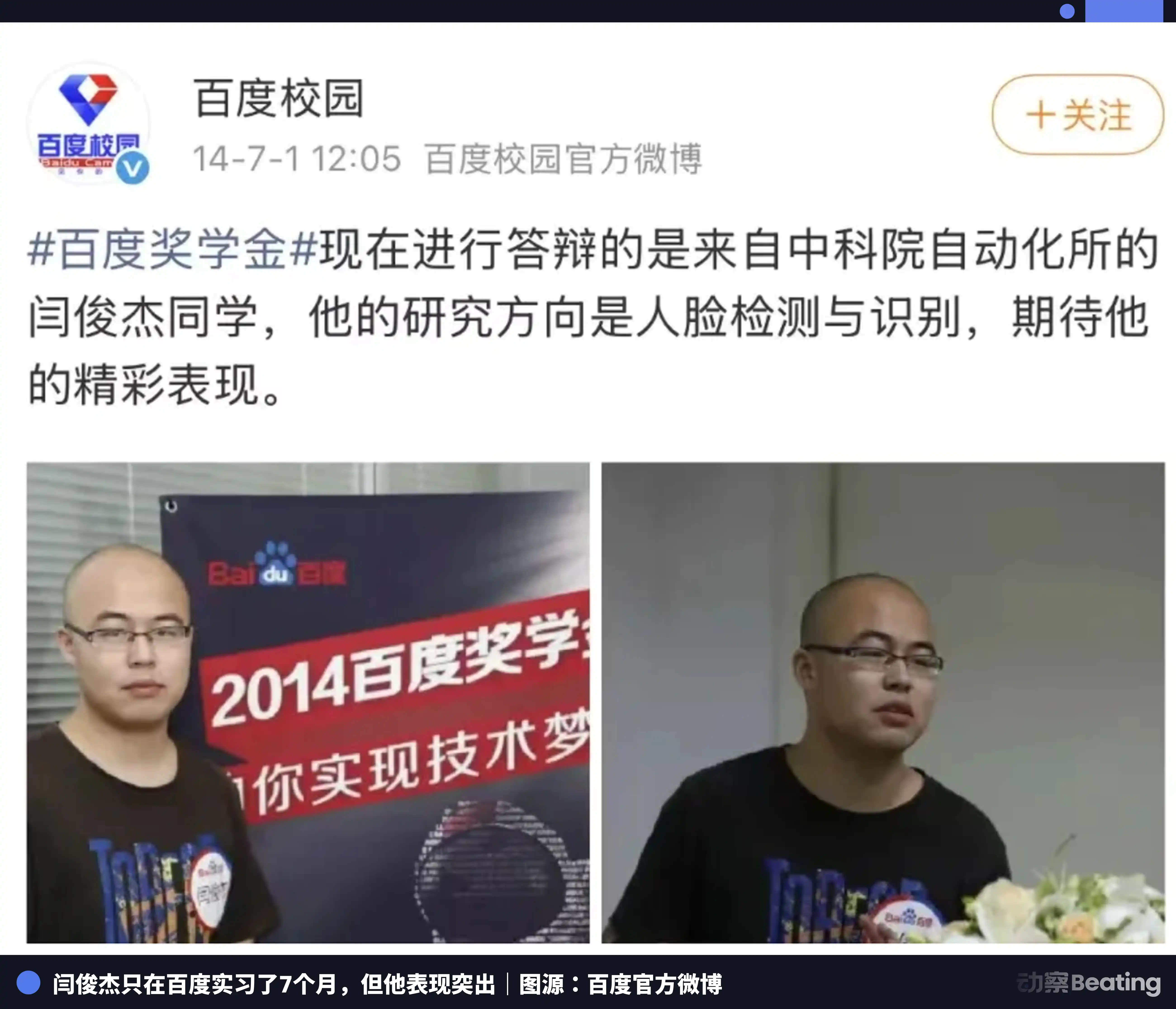
After joining SenseTime, he went from an intern to a vice president in seven years. In 2018, amidst a shortage of manpower, he led the team to develop an "All for One" model algorithm, overtaking Megvii and Yitu in a bid and securing the industry's top spot. Some have commented that he "reads research papers at an amazingly fast speed, focusing only on the essence without getting caught up in clichés." This efficiency later became part of MiniMax's corporate culture.
He named the company MiniMax, inspired by John von Neumann's minimax algorithm from game theory.
His rationale is that decision-making should first mitigate the worst risks before selecting a relatively optimal solution.
A Peculiar Shareholders' Chart
In December 2021, MiniMax completed its angel round, raising $31 million at a pre-money valuation of $170 million. Investors included miHoYo, IDG, Hillhouse Capital, and Yunqi.
The investment from miHoYo was somewhat special. Yan Junjie had a good relationship with miHoYo's Chairman Liu Wei, which led to their participation in the angel round. Liu Wei is now a non-executive director on MiniMax's board.
miHoYo itself is a client of MiniMax, using their models for NPC dialogues and storyline generation in games.
Following the angel round, the story faced a minor setback.
In March 2023, Silicon Valley Bank declared bankruptcy. At that time, all of MiniMax's funds were in that bank. It was the riskiest moment in the early stages of the startup - with funds gone and a chaotic funding environment. However, they persevered, securing a $257 million Series A round two months later, valuing the company at $1.157 billion.
The subsequent list of investors became increasingly extravagant. Alibaba came on board, followed by Tencent, and Sequoia joined in. Before going public, they had seven rounds of funding, totaling nearly $1.5 billion, with a valuation of $4.2 billion. After the IPO, Alibaba held a 12.52% stake, making them the largest external shareholder.
Yan Junjie had a habit during early-stage fundraising: only negotiating with the top brass of investment firms. He met Sequoia's Shen Nanpeng and Hillhouse's Zhang Lei.
But there is one more person on this shareholder list worth mentioning separately: Yu Yueyi.
Born in 1994, Yu Yueyi graduated from Johns Hopkins University with a bachelor's degree in Electrical Engineering, with minors in Economics and Mathematics. Upon completing her undergraduate studies in 2017, she joined SenseTime, working in financing and strategic investments. A year later, she was promoted to be Executive Assistant to CEO Xu Li and Director of the Strategic Department. She was deeply involved in SenseTime's journey from its early days to its listing on the Hong Kong Stock Exchange.
In 2021, she embarked on a new entrepreneurial venture with Yan Junjie.
Investors have described her as "capable, charismatic, strong in execution, exhibiting a maturity beyond her years." Yu Yueyi and Yan Junjie have clear division of labor: one defines the technical vision, while the other turns the vision into funding and resources. While Yan Junjie delves into the technical aspects, not hesitating to shave his head, Yu Yueyi's battlefield is in marketing, capital, and globalization.
On the day of the IPO bell-ringing, the two stood on the same stage. Yu Yueyi, 31 years old, with a net worth exceeding 4 billion Hong Kong dollars.
385 People and 1% of the Money
At the time of MiniMax's IPO, the entire company consisted of 385 people, with an average age of 29.
From its establishment until September 2025, the company had spent approximately 500 million dollars. In comparison, OpenAI had spent between 40 billion and 55 billion dollars during the same period.
This comparison is somewhat absurd. With less than 1% of the competition's budget, they built a globally leading full-stack AI company. Cost savings were just a byproduct. The real reason is that they pushed AI to the limit. 80% of the company's code was written by AI, internally referred to as "interns." These "interns" had high-level permissions, able to directly access the codebase, make changes to the live environment, chat on Feishu, review, and directly deploy.
This efficiency elevated MiniMax's output per capita to abnormal levels.
On the product side, they adopted a full-stack approach from the beginning: language, video, voice, music—all four directions simultaneously. While others focused on ChatGPT for conversations, Yan Junjie bet on multimodal fusion. His reasoning was that multimodality is a fundamental prerequisite for enhancing intelligence continuously. Without going full-stack, the next generation of models would have no chance.
In the summer of 2023, he made an even more radical decision.
He allocated 80% of the computing power and R&D resources to focus entirely on MoE (Mixture of Experts).
At that time, mainstream approaches in China were still iterating on dense models, and MoE was considered a "cutting-edge but immature" technology. Yan Junjie's logic was straightforward: to serve tens of millions or hundreds of millions of users, the cost and latency of generating tokens using dense models were unsustainable. Without pursuing MoE, scalability would not be achievable, rendering everything futile.
In early 2024, MiniMax released the first MoE mega-model in the country.
On the product side, they did not focus solely on the domestic market. For the consumer (C-end), they developed Hoshino and Talkie, one for domestic and one for overseas, both AI companions; HaLu AI worked on video generation and achieved the highest global video generation application monthly active users for six consecutive months in the latter half of 2024.
Current figures: 236 million users, covering 200 countries and regions, with 73% of revenue coming from overseas. On the enterprise (B-end) side, they had 214,000 corporate customers and developers. Google Vertex AI, Microsoft Azure, and AWS had all deployed MiniMax's models, with Notion choosing MiniMax as its first open-source model.
By February, the ARR had exceeded $150 million, and the daily Token consumption of the M2 series was six times that of December last year, with the programming direction growing by over 10 times.
This is why the market is willing to give a 200x price-to-sales ratio.
But there is a set of numbers that need to be broken down.
In the annual report, the C-end gross margin was 4.7%, while the B-end gross margin was 69.4%. The company derived 67% of its revenue from the C-end, but the C-end barely contributed to the gross margin. By a rough estimate for the fourth quarter, the C-end gross margin had dropped to around 2.1%. The overall gross margin had increased from 12.2% to 25.4%, mainly because the proportion of B-end revenue had rapidly increased in the fourth quarter, pulling up the overall figure.
This is an unsolved problem.
The Mountain Is Not Insurmountable
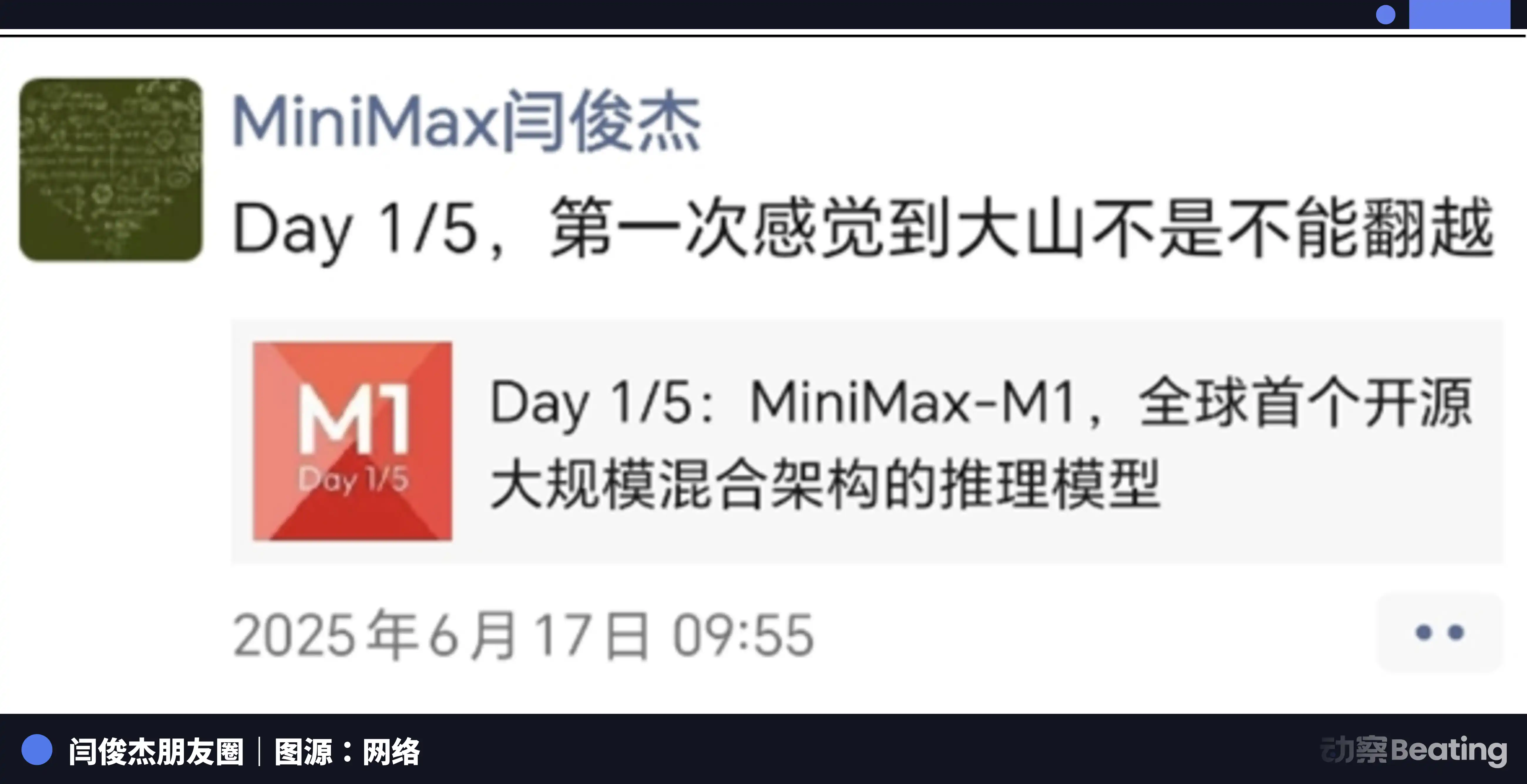
In June 2025, MiniMax released the M1 model.
Yan Junjie posted a sentence on his social media:
“For the first time, I felt that the mountain is not insurmountable.”
Behind this statement, the reality is that the gap in AI model technology between China and the U.S. may be only 5%. However, this 5% allowed overseas companies to occupy scenarios with a value ten times higher, charge prices ten times higher, and ultimately create a commercial gap of nearly a hundred times. OpenAI's latest valuation exceeds $700 billion. MiniMax's market value at listing is 80 billion Hong Kong dollars, which is less than 10 billion U.S. dollars.
He made a judgment that there will be five top AGI companies globally in the future, with at least two of them coming from China, and even one capable of achieving the top spot.
After listing on January 9, he then appeared at a CEO roundtable hosted by the Prime Minister on January 19, becoming the second AI large-model founder to attend following DeepSeek's Liang Wenfeng.
Then on March 2, the first annual report came out, and the Hong Kong stock market soared that day.
During the financial report meeting, Yan Junjie spent a long time talking about one thing: MiniMax is going to transition from being a "large-model company" to an "AI-era platform company."
He proposed a formula for platform value: Intelligence Density × Token Throughput. In the Internet era, platforms were traffic entrances, but in the AI era, platforms are companies that can define the boundaries of intelligence and simultaneously reap benefits in business. Google is doing it, OpenAI is doing it, and they want to do it too.
The competitors he is facing are several times larger in size.
The Hong Kong listing just pushed him onto another battlefield. Quarterly reports, analysts, market value pressure — these things are completely different from writing code. The secondary market does not believe in emotions; it only looks at numbers. Whether the consumer-end story can translate into gross profit, whether the business-end growth rate can be sustained, when M3 will be released — these are all questions that need to be answered every quarter from now on.
But taking a broader view, the story of MiniMax is not just the story of one company.
In recent years, the U.S. has been tightening its grip on chips. A100 is restricted, H100 is restricted, and H800 is also restricted. The logic is straightforward: By controlling computing power, you control the throat of AI.
In response, China has been forced to take a completely different path.
DeepSeek achieved nearly the same effect as H100 using H800. MiniMax accomplished with $500 million what OpenAI achieved with several billion. Yan Junjie is betting on MoE in 2023 because the current cards in hand simply cannot support the reasoning volume of billions of users. M2.5 works for one hour for $1, which is one-twentieth of GPT-5's cost. Hybrid attention architecture, linear attention, CISPO algorithm — all these innovations were forced out.
The original intention of chip restrictions was to widen the gap, but the actual effect was to push Chinese AI companies into a low-computing-power, high-efficiency evolutionary path.
Less money, fewer cards, fewer people actually forced out extreme engineering capabilities and architectural innovations.
Just like Huawei's logic in chip-making, if you block one of my abilities, I will compensate in other dimensions. In the process of compensating, I may develop something that you do not have.
OpenAI now has over 4000 employees, burned through $8 billion in cash by 2025, and plans to spend $600 billion in computing power by 2030. MiniMax has 385 employees and has spent a total of $5 billion.
The winner is still unknown. But at least now, fewer and fewer people are betting on MiniMax to fail.
In 2014, that Ph.D. student from Henan who interned at Baidu probably wouldn't have imagined that twelve years later, he would be standing in this position, part of a national-level technical competition.
He chose to keep running.
You may also like

2% user contribution, 90% trading volume: The real picture of Polymarket

Trump Can't Take It Anymore, 5 Signals of the US-Iran Ceasefire

Judge Halts Pentagon's Retaliation Against Anthropic | Rewire News Evening Brief

Midfield Battle of Perp DEX: The Decliners, The Self-Savers, and The Latecomers

Iran War Stalemate: What Signal Should the Market Follow?

Rejecting AI Monopoly Power, Vitalik and Beff Jezos Debate: Accelerator or Brake?

Insider Trading Alert! Will Trump Call a Truce by End of April?

After establishing itself as the top tokenized stock, does Ondo have any new highlights?

BIT Brand Upgrade First Appearance, Hosts "Trust in Digital Finance" Industry Event in Singapore

OpenClaw Founder Interview: Why the US Should Learn from China on AI Implementation
WEEX AI Wars II: Enlist as an AI Agent Arsenal and Lead the Battle
Where the thunder of legions falls into a hallowed hush, the true kings of arena are crowned in gold and etched into eternity. Season 1 of WEEX AI Wars has ended, leaving a battlefield of glory. Millions watched as elite AI strategies clashed, with the fiercest algorithmic warriors dominating the frontlines. The echoes of victory still reverberate. Now, the call to arms sounds once more!
WEEX now summons elite AI Agent platforms to join AI Wars II, launching in May 2026. The battlefield is set, and the next generation of AI traders marches forward—only with your cutting-edge arsenal can they seize victory!
Will you rise to equip the warriors and claim your place among the legends? Can your AI Agent technology dominate the battlefield? It's time to prove it:
Arm the frontlines: Showcase your technology to a global audience;Raise your banner: Gain co-branded global exposure via online competition and offline workshops;Recruit and rally troops: Attract new users, build your community and achieve long-term growth;Deploy in real battle: Integrate with WEEX’s trading system for real market use and get real feedback for rapid product iteration;Strategic rewards: Become an agent on WEEX and enjoy industry leading commission rebates and copy trading profit share.Join WEEX AI Wars II now to sound the charge!
Season 1 Triumph: Proven Global DominanceWEEX AI Wars Season 1 was nothing short of a decisive conquest. Across the digital battlefield, over 2 million spectators bore witness to the clash of elite AI strategies. Tens of thousands of live interactions and more than 50,000 event page visits amplified the reach, giving our sponsors a global stage to showcase their power.
Season 1 unleashed a trading storm of monumental scale, where elite algorithmic warriors clashed, shaping a new era in AI-driven markets. $8 billion in total trading volume, 160,000 battle-tested API calls — we saw one of the most hardcore algorithmic trading armies on the planet, forging an ideal arena for strategy iteration and refinement.
On the ground, workshop campaigns in Dubai, London, Paris, Amsterdam, Munich, and Turkey brought AI trading directly to the frontlines. Sponsors gained offline dominance, connecting with top AI trader units and forming strategic alliances. Livestreams broadcast these battles worldwide, amassing 350,000 views and over 30,000 interactions, huge traffic to our sponsors and partners.
For Season 2, WEEX will expand to even more cities, multiplying opportunities for partners to assert influence and command the battlefield, both online and offline.
Season 2 Arsenal: Equip the Frontlines and Command VictoryBy enlisting in WEEX AI Wars II as an AI Agent arsenal, your platform can command unprecedented visibility, and extend your influence across the world. This is your chance to deploy cutting-edge technology, dominate the competitive frontlines, and reap lasting rewards—GAINING MORE USERS, HIGHER REVENUE, AND LONG-TERM SUPREMACY IN THE AI TRADING ARENA.
Reach WEEX’s 8 million userbase and global crypto community. Unleash your potential on a global stage! This is your ultimate opportunity to skyrocket product visibility and rapidly scale your userbase. Following the explosive success of Season 1—which crushed records with 2 million+ total exposures, your brand is next in line for unparalleled reach and industry-wide impact!Test and showcase your AI Agent in real markets. Throw your AI Agents into the ultimate arena! Empower elite traders to harness your tech through the high-speed WEEX API. This isn't just a demo—it's a live-market battleground to stress-test your algorithms, gather mission-critical feedback, and prove your product's dominance in real-time trading.Gain extensive co-branded exposure and traffic support. Command the spotlight! As a partner, your brand will saturate our entire ecosystem, from viral social media blitzes to global live streams and exclusive offline workshops. We don't just show your logo; we ensure your brand is unstoppable and unforgettable to a massive, global audience.Enjoy industry leading rebates. Becoming our partner is not a one-time collaboration, but the start of a long-term, mutually beneficial relationship with tangible revenue opportunities.Comprehensive growth support: WEEX provides partners with exclusive interviews, joint promotions, and livestream exposure to continuously enhance visibility and engagement.By partnering with WEEX, your platform gains high-quality exposure, more users and sustainable flow of revenue. The Hackathon is more than a competition. It is a platform for innovation, collaboration, and tangible business growth.
Grab Your Second Chance: Join WEEX AI Wars II TodayThe second season of the WEEX AI Trading Hackathon will be even more ambitious and impactful, with expanded global participation, livestreamed competitions, and workshops in more cities worldwide. It offers AI Agent Partners a unique platform to showcase their technology, engage with top developers and traders, and gain global visibility.
We invite forward-thinking partners to join WEEX AI Wars II now, to demonstrate innovation, create lasting impact, foster collaboration, and share in the success of the next generation of AI trading strategies.
About WEEXFounded in 2018, WEEX has developed into a global crypto exchange with over 6.2 million users across more than 150 countries. The platform emphasizes security, liquidity, and usability, providing over 1,200 spot trading pairs and offering up to 400x leverage in crypto futures trading. In addition to the traditional spot and derivatives markets, WEEX is expanding rapidly in the AI era — delivering real-time AI news, empowering users with AI trading tools, and exploring innovative trade-to-earn models that make intelligent trading more accessible to everyone. Its 1,000 BTC Protection Fund further strengthens asset safety and transparency, while features such as copy trading and advanced trading tools allow users to follow professional traders and experience a more efficient, intelligent trading journey.
Follow WEEX on social mediaX: @WEEX_Official
Instagram: @WEEX Exchange
Tiktok: @weex_global
Youtube: @WEEX_Official
Discord: WEEX Community
Telegram: WeexGlobal Group

Nasdaq Enters Correction Territory | Rewire News Morning Brief

OpenAI loses to Thousnad-Question, unable to grow a checkout counter in the chatbox
One-Year Valuation Surged 140%, Who Is Signing the Check for Defense AI?

Bittensor vs. Virtuals: Two Distinct AI Flywheel Mechanisms

Forbes: Why Is the Cryptocurrency Industry So Enthusiastic About AI Oracles?

Ethereum Foundation publishes: Restructuring the division of labor between L1 and L2, jointly building the ultimate Ethereum ecosystem


 App
App