
 Buy Crypto
- Markets
 Futures
- Spot
- Copy Trade
- Earn
- More
「Money Printer」 PUMP.FUN Establishes Investment Arm, Can $3 Million Keep a Good Project?

Original Article Title: "Making 9 Billion with Only 3 Million Invested, How Does Pump.fun's Math Work?"
Original Article Author: angelilu, Foresight News
On January 20, Pump.fun, the most profitable Meme coin platform in the Solana ecosystem, announced the establishment of an investment department, Pump Fund, and kicked off its first hackathon with an initial investment of $3 million to fund 12 projects. This figure, compared to its total revenue of nearly $9 billion, presents a subtle contrast: for every approximately $300 earned by the platform, only $1 is allocated to invest in the ecosystem, representing about 0.33%.
A New Attempt Under Competitive Pressure
The timing of Pump Fund's launch is intriguing. According to Solana Launchpads' transaction volume data, while Pump.fun still maintains its dominance, the recent upstart platform Bags has quickly captured over 10% market share, directly causing a decline in Pump.fun's market share.
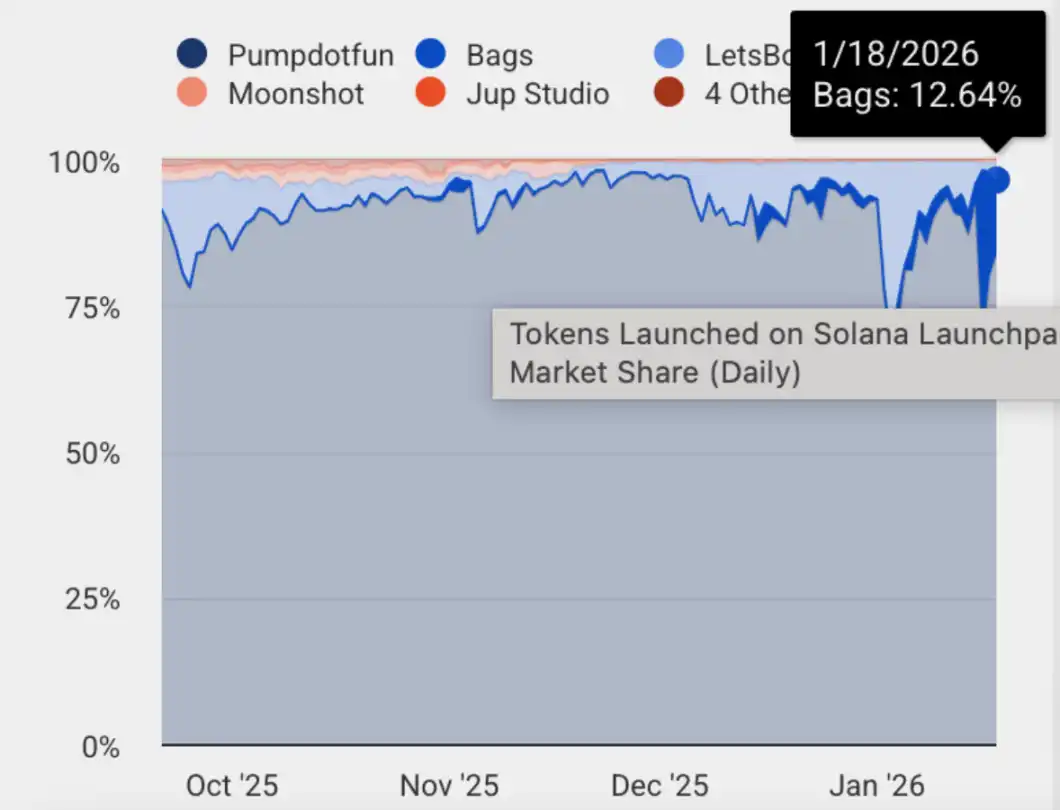
In this context, the $3 million ecosystem investment can be seen as an attempt at differentiation in competition. When the technical barrier between platforms is extremely low, and user loyalty is also extremely limited, Pump.fun chooses to establish new brand awareness through ecosystem investments—not just as a trading platform but also as a project incubator.
However, the question remains: is a 0.33% investment ratio sufficient to support this positioning? In comparison, even in relatively conservative technology companies, the investment ratio is many times higher than this number. From a business logic perspective, this is closer to an exploratory market experiment rather than a comprehensive strategic transformation.
Let the Market Be the Judge
The question that Pump Fund's experiment seeks to answer is: in the Web3 world, who should define what a "good project" is?
This global hackathon, called "Build in Public," adopts a set of rules that are completely different from traditional start-up competitions: no expert judges to score, no Demo Day pitches; instead, the market decides directly.

Specifically, participating teams must issue tokens on Pump.fun, publicly share their development progress daily, and showcase the building process through social media. The ultimate criterion is one—market response. If a project garners attention, trust, and trading volume, it proves worthy of investment; otherwise, it naturally gets eliminated. From the opening of applications on January 19 to the announcement of the first batch of winners on February 18, during these four weeks, all projects will undergo a real-time assessment in the open market. On February 18, at least one project will be selected and funded.
In the hackathon rules, the platform explicitly states that "in addition to the project's social media appeal, the long-term sustainability of the project will also be evaluated." However, it is currently unclear how to find a balance between market hype and long-term value, and what specific criteria will be used to judge.
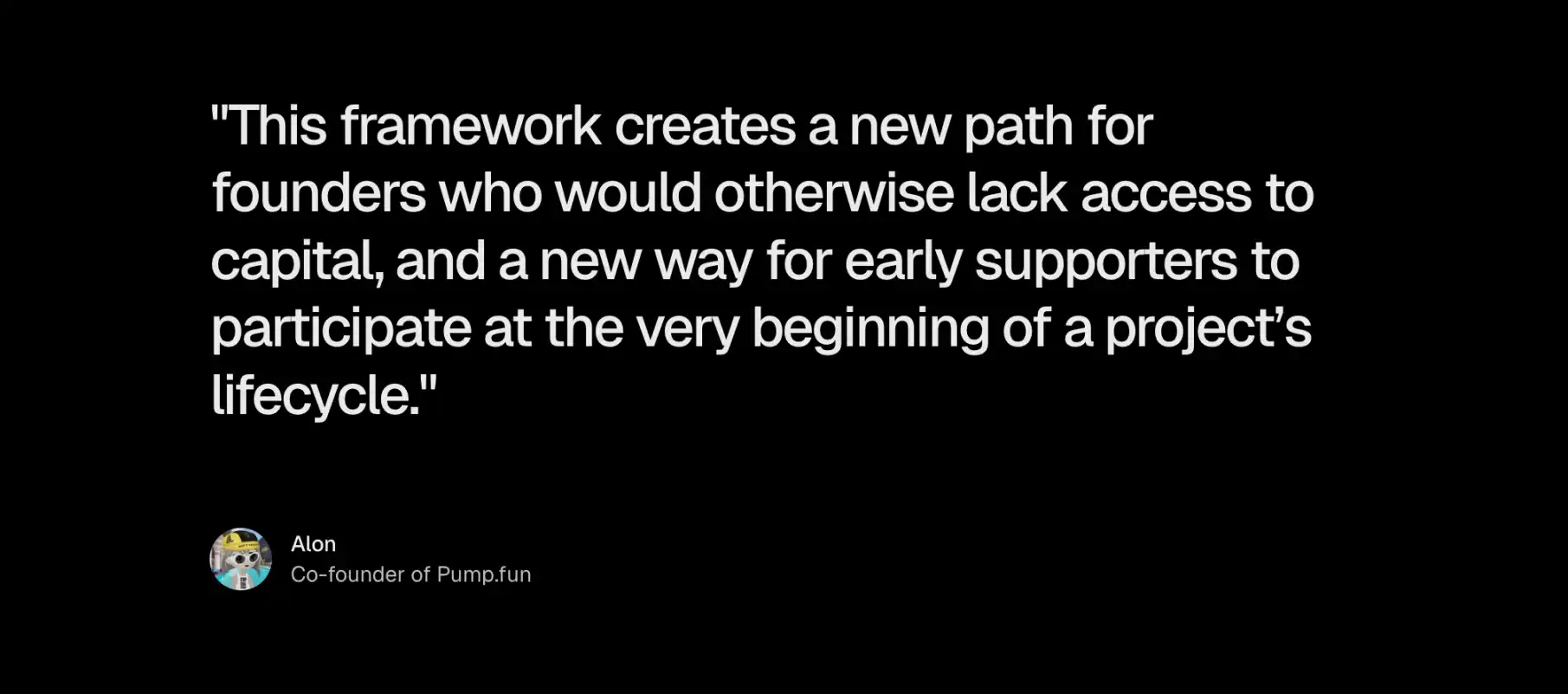
As Pump.fun co-founder Alon puts it, "this framework creates a new path for founders who cannot access traditional capital." In a sense, this is a challenge to traditional VC investment logic—since Web3 emphasizes decentralization, why should the success of a project still be determined by a few investors.
A Deeper Business Dilemma
Aside from the mechanism design, Pump Fund also faces a more fundamental problem: even if high-quality projects are successfully incubated, will these projects stay on Pump.fun?
This is the structural dilemma of Meme coin platforms. The Nasdaq invests in tech companies going public, and companies like Microsoft and Apple continue to trade on the Nasdaq after listing, contributing long-term value to the platform. But Meme coin projects operate under different logic. If a project achieves initial success on Pump.fun, builds a user base and market recognition, what will be the next step? It is likely to migrate to a platform with greater liquidity, such as Binance or Coinbase, or even establish its own independent community.
Pump.fun is essentially a "launchpad," and projects will naturally seek a broader market as they mature. More fatally, the platform's revenue model makes it difficult to truly retain high-quality projects. Pump.fun relies on early high-frequency trading to earn fees, but as a project matures, the trading frequency tends to decrease, long-term hodlers increase, and speculative trading diminishes. From a revenue perspective, the platform always makes the most money from those "fast-moving consumer goods" that are short-term pumps, rather than the "value projects" built for the long term.
This may explain why the investment ratio is only 0.33%. In the current business model, large-scale investment ecosystems not only have uncertain returns but may even be making a wedding dress for others. This is not simply "stinginess" but a manifestation of business rationality.
Four weeks later, when the first batch of award-winning projects is announced, we may get a preliminary answer. However, the longer-term question remains: in the Meme coin field with low technical barriers and weak user loyalty, can ecosystem investment truly become a moat? As competitors like Bags continue to eat away at market share, can this $3 million experiment help Pump.fun maintain its position?
You may also like

After two years, Hong Kong's first batch of stablecoin licenses finally issued: HSBC, Standard Chartered make the cut

The person who helped TAO rise by 90% has now single-handedly crashed the price again today

3-Minute Guide to Participating in the SpaceX IPO on Bitget

Top 5 Cryptos to Buy in 2026 Q1: A ChatGPT Deep Dive Analysis
Explore the top 5 cryptos to buy in Q1 2026 including BTC, ETH, SOL, TAO, and ONDO. See price outlooks, key narratives, and institutional catalysts shaping the next market move.

How to Earn $15,000 with Idle USDT Before Altcoin Season 2026
Wondering if altcoin season is coming in 2026? Get the latest market update, and learn how to turn your idle stablecoins waiting for entry into extra rewards up to 15,000 USDT.
Can You Win Joker Returns Without Large Trading Volume? 5 Mistakes New Players Make In WEEX Joker Returns Season 2
Can small traders win WEEX Joker Returns 2026 without huge volume? Yes—if you avoid these 5 costly mistakes. Learn how to maximize card draws, use Jokers wisely, and turn small deposits into 15,000 USDT rewards.

Altcoin Season 2026: 4 Stages to Profit (Before the Crowd FOMO In)
Altcoin Season 2026 is starting — discover the 4 key stages of capital rotation (from ETH to PEPE) and how to position before the peak. Learn which tokens will lead each phase and avoid missing the rally.

Will Alt season come in 2026? 5 Tips to Spot the Next 100x Crypto Opportunities
Will altcoin season arrive in 2026? Discover 5 rotation stages, early signals smart traders watch, and the key crypto sectors where the next 100x altcoin opportunities may emerge.

The bear market has arrived, and cryptocurrency ETF issuers are also getting involved

The richest man had a quarrel with his former boss

BTC Firm Above 70K! Saylor’s "Institutional Logic" vs. Moon’s "Retail Faith": Who is Really Harvesting the Market?
Bitcoin is holding firm above the $70,000 support level following a massive short squeeze that liquidated $427 million. As the "Four-Year Cycle" narrative shifts, the market is split: Michael Saylor’s cold, institutional "indiscriminate stacking" vs. Carl Moon’s high-energy retail "hopium." This article decodes these two polar-opposite strategies for the 2026 bull run and reveals how WEEX’s institutional-grade liquidity and AI trading tools empower every type of investor to convert market volatility into profit.

The Girl Who Created the SBTI Test: A Story of a Doomed Cyber Love, an E-Widow Ratfolk

B.AI Officially Launched: Building AI Agent Financial Bedrock Platform, Driving AGI Era Business Underlying Logic

B.AI Officially Launched: Breaking Down A2A Collaboration Barriers to Unlock the Smart Body Economy's Full Potential
We helped Xu Mingxing write a book called "<OK Life>".

Rare APY of 400%, is TradeXYZ handing out money to oil bulls?
a16z: Perpetual Contracts are Rewriting Global Trading Rules
Bitcoin Hits $73,000 Triggering $427M Short Liquidation | Carl Moon: $200,000 is the Target
April 9, 2026 (UTC+0), 22:17. Bitcoin (BTC) executed a high-velocity surge within minutes, heavy-hitting the $73,000 psychological barrier and touching a local high near $74,000. While the price has since retraced to consolidate above $72,000, this "instant ambush" successfully completed a $427M liquidation of short positions.
After two years, Hong Kong's first batch of stablecoin licenses finally issued: HSBC, Standard Chartered make the cut
The person who helped TAO rise by 90% has now single-handedly crashed the price again today
3-Minute Guide to Participating in the SpaceX IPO on Bitget
Top 5 Cryptos to Buy in 2026 Q1: A ChatGPT Deep Dive Analysis
Explore the top 5 cryptos to buy in Q1 2026 including BTC, ETH, SOL, TAO, and ONDO. See price outlooks, key narratives, and institutional catalysts shaping the next market move.
How to Earn $15,000 with Idle USDT Before Altcoin Season 2026
Wondering if altcoin season is coming in 2026? Get the latest market update, and learn how to turn your idle stablecoins waiting for entry into extra rewards up to 15,000 USDT.
Can You Win Joker Returns Without Large Trading Volume? 5 Mistakes New Players Make In WEEX Joker Returns Season 2
Can small traders win WEEX Joker Returns 2026 without huge volume? Yes—if you avoid these 5 costly mistakes. Learn how to maximize card draws, use Jokers wisely, and turn small deposits into 15,000 USDT rewards.


 App
App