
 Buy Crypto
- Markets
 Futures
- Spot
- Copy Trade
- Earn
- More
Next-Generation Software Built for Trillion-Agent Scale

Original Article Title: Building for trillions of agents
Original Article Author: Aaron Levie, Box
Translation: Peggy, BlockBeats
Editor's Note: As large-scale model capabilities continue to advance, AI Agents are evolving from mere "chat tools" into digital labor capable of independently performing tasks. From coding and contract processing to financial auditing and research data analysis, Agents are beginning to permeate nearly every aspect of knowledge work.
With the number of Agents concurrently operating within enterprises far surpassing the employee count, the primary users of software may also shift from "human" to "machine." In light of this trend, software design, infrastructure, and even business models are undergoing transformation. This article takes "building software for Agents" as a focal point to discuss how the software form and infrastructure of the Agent era will evolve.
Note: The author of this article, Aaron Levie, is the co-founder and CEO of Box, an enterprise cloud storage company, and a long-time technology industry thought leader focusing on AI and enterprise software trends.
Below is the original article:
Over the past few months, a significant shift has been occurring in the Agent domain. Around the end of last year, we entered a phase where programming-based Agents were able to independently complete longer tasks without the need for frequent human guidance throughout the development process.
These Agents are no longer just chatbots equipped with simple tools. Today, they often have their own isolated computing environment where they can autonomously write and execute code to address encountered issues, directly access APIs and CLIs, interact with various systems, and possess their own file system and long-term memory capabilities, among others. With these foundational capabilities, coupled with the maturation of best practices around running Agents in an agentic harness and significant advancements in models for tool invocation and software development, we are beginning to see a possibility: Agents will be able to handle virtually any task assigned to them.
Initially, this architecture was primarily driven by a group of programming-based Agents such as Claude Code, Devin, Codex, Factory, Cursor, Replit, and more. However, recently, this pattern has transcended early tech circles and is starting to enter broader personal experience and knowledge work domains, such as Claude Cowork, Perplexity Computer, Manus, and, of course, OpenClaw. The latter has taken this direction even further—it can run 24/7 in a persistent environment.
As capabilities advance rapidly, Agents will be introduced into almost every field of work. They will be used to review every contract, handle a large volume of front-line customer support issues, audit corporate finances, comb through massive medical research to drive drug discovery, generate the majority of software code, create sales and consulting presentations, and even complete transactions on behalf of consumers on the internet. Overall, they will be involved in almost all economically valuable work in society.
Moreover, this is not just about doing what we are already doing today. Agents will enable us to do more, such as running complex simulations that were previously too costly, rapidly generating multiple prototypes for every idea because the cost of starting a project has significantly decreased, making it easy to stop a project; we will advance more projects simultaneously; we will also be able to analyze almost all data, no longer relying only on sampling.
Taking these trends together, it can be foreseen that in future organizations, almost every employee will have multiple Agents working for them. It is not hard to imagine an enterprise having 100 times or even 1000 times the number of Agents as employees. When tens of trillions of Agents are operating simultaneously, they will become the primary users of future software.
However, most software was originally designed for humans. This means that the form of software is likely to undergo a significant change. So what will happen next?
Creating Software "Agent-Worthy"
Paul Graham once summarized the principles of software entrepreneurship in an extremely simple phrase: Make something people want.
This idea has given rise to the most successful batch of software companies in the 21st century and has also driven a new product methodology — tools should be simple, user-friendly, easy to get started with, solve explicit problems, avoid obscure terms, and have clear pricing.
And now, this phrase may need to be rewritten as: Make software that Agents want to use.
Currently, the people who use Agents the most are often developers or users with strong technical skills, and they usually have their own tool preferences. But as Agents begin to handle various tasks for knowledge workers, this user preference will gradually weaken. Unless a unified tool is already specified within the organization, in many workflows, the real decision maker will be the Agent.
This means: they will decide which tools to use, what code to write, which libraries to call, and which skills to apply. Platforms that are more easily accessible to Agents and can better solve problems will gain an advantage more quickly than other products. Agents will not attend your online events or see your ads; they will only choose the most effective tools to complete tasks, and of course, you want that to be your product.
The key insight from this proposal is: everything must be API-centric (API-first).
If a feature doesn't have an API, it's almost as if it doesn't exist.
If a feature can't be invoked through CLI or MCP server calls, you are already behind.
If the API design is convoluted, with path conflicts that make it difficult for the Agent to use, then you are essentially willingly forfeiting the opportunity to be an Agent tool.
At Box, we are focused on building a file system oriented towards the Agent, so we are meticulously examining every detail of the API, considering where issues may arise in an Agent environment. This level of detail has historically only been seen in user experience (UX) design.
Just as designing software for users requires thinking from the user's perspective, designing software for Agents also requires the same approach. For example, Y Combinator's Jared Friedman has reminded developers: "Even the best developer tools mostly don't let you sign up via API. This was a huge problem in the Claude Code era because it meant Claude couldn't sign up for itself. Now, putting all account management functionality into the API should be table stakes."
If Agents can't easily sign up and start using your service, then in their eyes, you might as well not exist.
Changes in Business Models Will Follow
When Agents become the primary users of software, business models will also shift.
In some cases, models triggered by user seats that drive Agent execution may still apply. However, there will also be a significant number of Agents no longer tied to specific users, or their workload far exceeding traditional software usage. For instance, with just a few lines of input, an Agent could perform the equivalent of hours of human work within the software and only present the final result to the user.
As a result, the business models of some software products will evolve. Any tool looking to survive in the "Agent era" will need to introduce some form of usage-based or compute-based billing, even supporting Agents to handle payments on their own.
Next-Generation Infrastructure for Agents
Perplexity founder Aravind Srinivas once said, "Giving computers to humans was a good idea, but giving computers to computers to do work for us is a better idea."
As Agents have their own computing environment, can write and execute code, invoke skills to perform repetitive tasks, and integrate with various external tools and services, a whole new technical ecosystem will also emerge. Just as humans need on computers, Agents also need a similar but specifically designed infrastructure for them.
Some of these services will come from existing companies, as Agents still need access to existing data or need to collaborate between human users and Agents.
However, at the same time, a plethora of new product categories will emerge because the problems Agents face are entirely different from humans, and designing new services from scratch often makes more sense.
For example, Agents clearly need their own infrastructure, and the scale may be unprecedented. The next generation of hyperscale cloud platforms (or upgraded versions of existing giants) is likely to be built around this idea: the future data center will no longer primarily run our applications but will run our Agents instead. Companies like E2B, Daytona, Modal, Cloudflare, and others are already moving in this direction, and the scale of these sandbox computing environments may reach unprecedented levels.
Agents also need access to core enterprise files and manage their own data and memory to support long-running tasks. Similarly, enterprise systems also need to shift to API-first to allow Agents to access key data and services such as HR systems, CRM, workflow systems, data lakes, and more. Platforms that enable Agents to seamlessly operate on this data anytime, anywhere are most likely to take on future workloads.
Agents may also need their own identity system and the ability to communicate with each other. For example, Agent mail is providing email for Agents, giving them a persistent email address. Meanwhile, companies like Exa, Parallel, and others are also reimagining search engines to adapt to a world where "Agents are the primary search users." Many Agents also need to manage their own budgets, for example, by using wallets provided by Stripe or Coinbase for payments, which could even drive microtransactions to truly take off, allowing Agents to access paid tools and data resources.
Of course, security, compliance, and governance will also present significant challenges. In a world where Agents handle sensitive information, and even execute regulated processes (such as in pharmaceuticals or banking), companies must be able to audit and track every task completed by Agents. Long-running Agents may need independent identities to log into various systems, tightly restrict the operations they can perform, and the data they can access. We will need a whole new set of software and platforms to address these issues, much like we have built a security system for human users and applications in the past.
Overall, we are entering a new era of software. In this era, software must be designed from the ground up for massive-scale Agent use. As trillions of Agents work on behalf of humanity, our relationship with software will also be completely reshaped.
You may also like

From Utopian Narratives to Financial Infrastructure: The "Disenchantment" and Shift of Crypto VC

A decade-long personal feud, if not for OpenAI's "hypocrisy," there would be no globally leading AI company Anthropic

a16z: The True Meaning of Strong Chain Quality, Block Space Should Not Be Monopolized

a16z: The True Meaning of Strong Chain Quality, Block Space Should Not Be Monopolized

2% user contribution, 90% trading volume: The real picture of Polymarket

Trump Can't Take It Anymore, 5 Signals of the US-Iran Ceasefire

Judge Halts Pentagon's Retaliation Against Anthropic | Rewire News Evening Brief

Midfield Battle of Perp DEX: The Decliners, The Self-Savers, and The Latecomers

Iran War Stalemate: What Signal Should the Market Follow?
Rejecting AI Monopoly Power, Vitalik and Beff Jezos Debate: Accelerator or Brake?

Insider Trading Alert! Will Trump Call a Truce by End of April?

After establishing itself as the top tokenized stock, does Ondo have any new highlights?

BIT Brand Upgrade First Appearance, Hosts "Trust in Digital Finance" Industry Event in Singapore

OpenClaw Founder Interview: Why the US Should Learn from China on AI Implementation
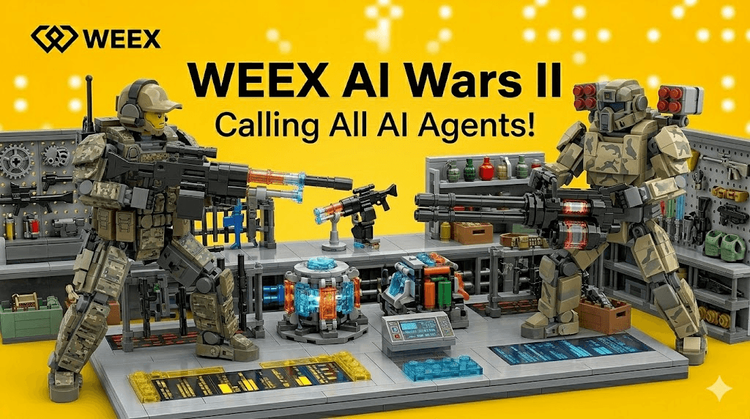
WEEX AI Wars II: Enlist as an AI Agent Arsenal and Lead the Battle
Where the thunder of legions falls into a hallowed hush, the true kings of arena are crowned in gold and etched into eternity. Season 1 of WEEX AI Wars has ended, leaving a battlefield of glory. Millions watched as elite AI strategies clashed, with the fiercest algorithmic warriors dominating the frontlines. The echoes of victory still reverberate. Now, the call to arms sounds once more!
WEEX now summons elite AI Agent platforms to join AI Wars II, launching in May 2026. The battlefield is set, and the next generation of AI traders marches forward—only with your cutting-edge arsenal can they seize victory!
Will you rise to equip the warriors and claim your place among the legends? Can your AI Agent technology dominate the battlefield? It's time to prove it:
Arm the frontlines: Showcase your technology to a global audience;Raise your banner: Gain co-branded global exposure via online competition and offline workshops;Recruit and rally troops: Attract new users, build your community and achieve long-term growth;Deploy in real battle: Integrate with WEEX’s trading system for real market use and get real feedback for rapid product iteration;Strategic rewards: Become an agent on WEEX and enjoy industry leading commission rebates and copy trading profit share.Join WEEX AI Wars II now to sound the charge!
Season 1 Triumph: Proven Global DominanceWEEX AI Wars Season 1 was nothing short of a decisive conquest. Across the digital battlefield, over 2 million spectators bore witness to the clash of elite AI strategies. Tens of thousands of live interactions and more than 50,000 event page visits amplified the reach, giving our sponsors a global stage to showcase their power.
Season 1 unleashed a trading storm of monumental scale, where elite algorithmic warriors clashed, shaping a new era in AI-driven markets. $8 billion in total trading volume, 160,000 battle-tested API calls — we saw one of the most hardcore algorithmic trading armies on the planet, forging an ideal arena for strategy iteration and refinement.
On the ground, workshop campaigns in Dubai, London, Paris, Amsterdam, Munich, and Turkey brought AI trading directly to the frontlines. Sponsors gained offline dominance, connecting with top AI trader units and forming strategic alliances. Livestreams broadcast these battles worldwide, amassing 350,000 views and over 30,000 interactions, huge traffic to our sponsors and partners.
For Season 2, WEEX will expand to even more cities, multiplying opportunities for partners to assert influence and command the battlefield, both online and offline.
Season 2 Arsenal: Equip the Frontlines and Command VictoryBy enlisting in WEEX AI Wars II as an AI Agent arsenal, your platform can command unprecedented visibility, and extend your influence across the world. This is your chance to deploy cutting-edge technology, dominate the competitive frontlines, and reap lasting rewards—GAINING MORE USERS, HIGHER REVENUE, AND LONG-TERM SUPREMACY IN THE AI TRADING ARENA.
Reach WEEX’s 8 million userbase and global crypto community. Unleash your potential on a global stage! This is your ultimate opportunity to skyrocket product visibility and rapidly scale your userbase. Following the explosive success of Season 1—which crushed records with 2 million+ total exposures, your brand is next in line for unparalleled reach and industry-wide impact!Test and showcase your AI Agent in real markets. Throw your AI Agents into the ultimate arena! Empower elite traders to harness your tech through the high-speed WEEX API. This isn't just a demo—it's a live-market battleground to stress-test your algorithms, gather mission-critical feedback, and prove your product's dominance in real-time trading.Gain extensive co-branded exposure and traffic support. Command the spotlight! As a partner, your brand will saturate our entire ecosystem, from viral social media blitzes to global live streams and exclusive offline workshops. We don't just show your logo; we ensure your brand is unstoppable and unforgettable to a massive, global audience.Enjoy industry leading rebates. Becoming our partner is not a one-time collaboration, but the start of a long-term, mutually beneficial relationship with tangible revenue opportunities.Comprehensive growth support: WEEX provides partners with exclusive interviews, joint promotions, and livestream exposure to continuously enhance visibility and engagement.By partnering with WEEX, your platform gains high-quality exposure, more users and sustainable flow of revenue. The Hackathon is more than a competition. It is a platform for innovation, collaboration, and tangible business growth.
Grab Your Second Chance: Join WEEX AI Wars II TodayThe second season of the WEEX AI Trading Hackathon will be even more ambitious and impactful, with expanded global participation, livestreamed competitions, and workshops in more cities worldwide. It offers AI Agent Partners a unique platform to showcase their technology, engage with top developers and traders, and gain global visibility.
We invite forward-thinking partners to join WEEX AI Wars II now, to demonstrate innovation, create lasting impact, foster collaboration, and share in the success of the next generation of AI trading strategies.
About WEEXFounded in 2018, WEEX has developed into a global crypto exchange with over 6.2 million users across more than 150 countries. The platform emphasizes security, liquidity, and usability, providing over 1,200 spot trading pairs and offering up to 400x leverage in crypto futures trading. In addition to the traditional spot and derivatives markets, WEEX is expanding rapidly in the AI era — delivering real-time AI news, empowering users with AI trading tools, and exploring innovative trade-to-earn models that make intelligent trading more accessible to everyone. Its 1,000 BTC Protection Fund further strengthens asset safety and transparency, while features such as copy trading and advanced trading tools allow users to follow professional traders and experience a more efficient, intelligent trading journey.
Follow WEEX on social mediaX: @WEEX_Official
Instagram: @WEEX Exchange
Tiktok: @weex_global
Youtube: @WEEX_Official
Discord: WEEX Community
Telegram: WeexGlobal Group

Nasdaq Enters Correction Territory | Rewire News Morning Brief

OpenAI loses to Thousnad-Question, unable to grow a checkout counter in the chatbox


 App
App