
 Buy Crypto
- Markets
 Futures
- Spot
- Copy Trade
- Earn
- More
On the eve of the Fed meeting, are traders starting to bet on a rate hike?

At the beginning of this year, the global financial market sentiment was actually quite positive.
Although the Federal Reserve was very cautious at its final meeting last year, hinting at only a symbolic rate cut for the whole year, Wall Street clearly had its own judgment system. Established institutions like Goldman Sachs, Morgan Stanley, and Bank of America almost unanimously gave a more "optimistic" answer: at least two rate cuts. Citigroup and some Chinese securities firms had even more aggressive projections, even betting on three cuts.
Analysts' consensus, besides economic data, also cited political reasons: the November midterm elections in the U.S.
For those in power, votes are everything, and to secure votes, they need to boost the economy. And interest rates are the most direct thermostat, but monetary policy takes time to have an effect. Doing the math, if the Trump administration wants to see results in November, the Fed must make significant rate cuts before October.
So at that time, major institutions scheduled the rate cuts for the first half of the year: Goldman Sachs favored March and June, while Nomura eyed June and September.
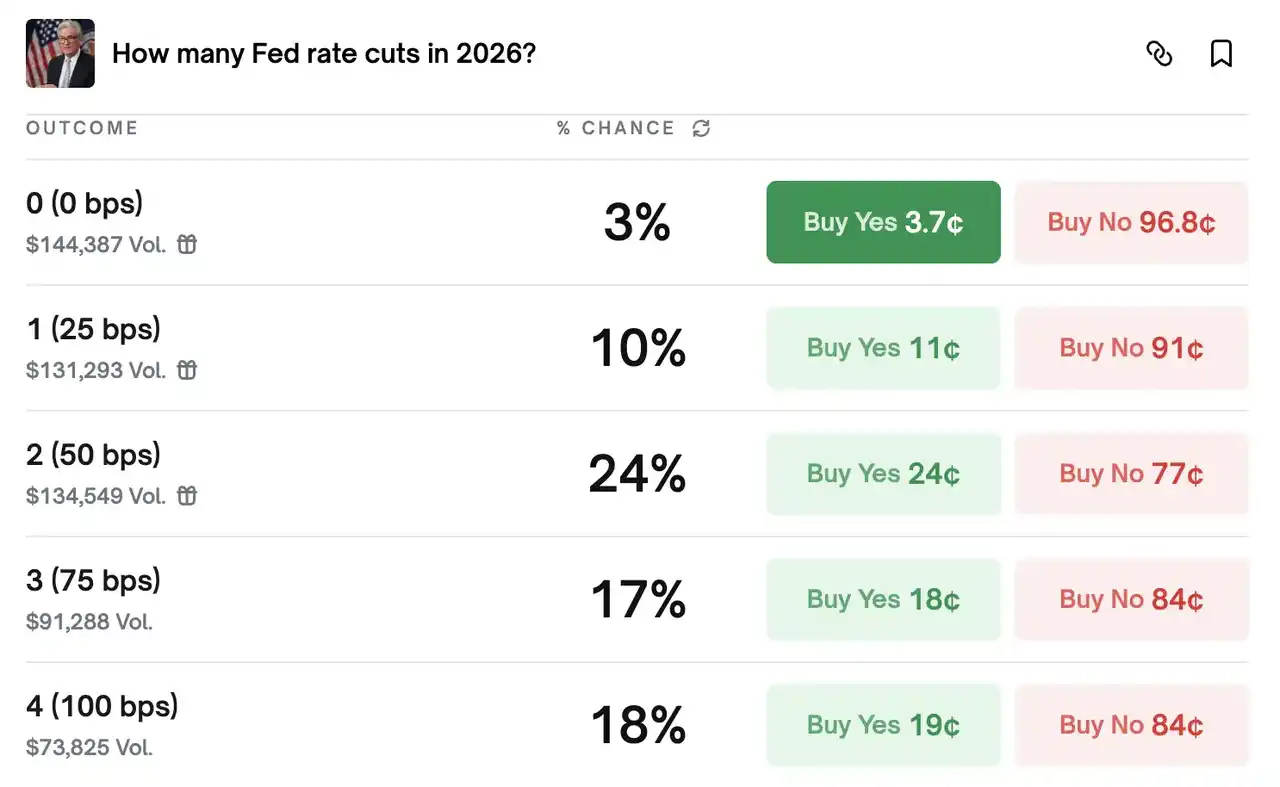
At the beginning of this year, the prediction on Polymarket for the number of rate cuts in 2026 with the highest probability was 2.
Everyone felt that a liquidity "downpour" was just around the corner.
Traders Start Betting on Rate Hikes
However, Trump has never been one to play by the rules and in mid-March, he started a war.
In mid-March, tensions in the Middle East escalated suddenly. The tense situation in the Strait of Hormuz quickly spread to the energy market, causing oil prices to soar by nearly 50% in just two weeks, with some grades briefly reaching $100. This surge in energy prices directly squeezed the Fed's room for rate cuts.
The CPI data for February already showed inflation above the 2% target, and now with the added fuel of oil prices, the Fed had to take a stronger stance.
The previously "100% rate cut" expectation has been shaken, with even a few discussions about "returning to rate hikes."
Originally expected to be the starting gun for rate cuts, today's interest rate meeting has now shifted to a "hawkish pause." According to the latest data, the market is almost 100% certain that the Fed will hold steady this time.
What's even more unsettling is that CME Group's FedWatch Tool shows that there is actually a 1.1% probability of a rate hike. While this percentage is very small, it sends a warning signal: the inflation monster may be back.
Analysts' sentiment has also shifted accordingly.
Goldman Sachs' Chief Economist, Jan Hatzius, revised the forecast on March 12, directly pushing back the expected rate cut from June to September, anticipating only 2 rate cuts this year.
Moreover, JPMorgan Chase bluntly stated that the current interest rates may have failed to contain the economy. If inflation continues to rise, the Fed's next move could indeed be a rate hike: the argument for "rate restraint" is becoming unsustainable. If the labor market remains strong, the Fed may maintain high rates in the long term.
More aggressive views come from strategists at EY-Parthenon and Carson Group. EY-Parthenon analyst Gregory Daco believes there may not be a single rate cut this year. Meanwhile, Carson Group analyst Sonu Varghese clearly points out that due to the surge in oil prices triggered by the Iran conflict, the Fed may not only refrain from cutting rates but may even discuss a rate hike later this year.
The latest forward-looking analyses from Caijing and Wall Street News also indicate that due to rising terminal rate expectations, the 2-year U.S. Treasury yield has surpassed 3.75%, which is usually a precursor to the market sensing policy tightening. Therefore, some traders believe that the possibility of a rate hike before the end of the year has increased from 0% to around 35%.
At 2:00 a.m. China time on Thursday night, the Fed will announce its final rate decision, whether to hike, cut, or hold rates.
Then at 2:30 a.m., Powell will hold a press conference to speak about monetary policy, the inflation path, and economic outlook.
It is worth noting that the Fed is currently in a delicate political window: Powell's term ends on May 15. This is his penultimate press conference as Fed Chair, and the market is currently in a policy vacuum waiting period. He himself is under significant political pressure, with Trump publicly criticizing Powell multiple times and calling for an emergency meeting for a substantial rate cut. This external pressure, along with the internal anti-inflation logic conflict, adds to the policy uncertainty.
In addition to the Fed, global central banks also have similar expectations.
This week, 21 central banks covering two-thirds of the global economy will announce their latest rate decisions. As this is the first "Super Central Bank Week" after the Middle East conflict broke out, the global market is closely watching to see if global central bank decisions will be influenced by the developments in the Middle East.
The Reserve Bank of Australia (RBA) just raised interest rates by 0.25 percentage points yesterday, making it the first major central bank this year among developed economies to tighten monetary policy.
In addition, the European Central Bank (ECB) is expected to keep rates unchanged at its meeting on March 19, with policymakers warning that global trade policy and geopolitical risks are limiting the outlook for future rate cuts. The Bank of England (BoE) is also expected to hold rates steady this Thursday, despite some internal voices supporting a rate cut, the focus remains on stability.
How Much Longer Will Oil Prices Rise?
If we peel back all the variables, we find an almost inescapable core: oil prices.
As long as oil prices keep rising, the room for rate cuts will be compressed; once oil prices fall back, monetary policy will have room to maneuver.
Therefore, the question becomes more direct: How much longer will oil prices rise?
From recent information released by the U.S. government, the answer seems less pessimistic than the market imagined.
On March 8, U.S. Energy Secretary Chris Wright gave a precise timeline in an interview: he believes the current oil price surge is just a temporary fear premium that will last "only a few weeks at most in the worst-case scenario, not months," before improving.
This is in line with White House Press Secretary Karoline Leavitt's statement a few days ago that "the rally in oil prices will only last another 2-3 weeks."
Similarly, Trump's statement on March 10 was more explicit. He said the action against Iran was much faster than expected, even stating, "I think this war is very close to being over." On the same day, the Energy Secretary's social media account was involved in a "post-deletion controversy."
Most intriguing is the adjustment in diplomatic timing.
Trump was scheduled to visit China in early April but suddenly announced a one-month postponement. The official reason was that the "war is too busy" and "the war needs him to stay in Washington." However, if we compare this one-month time difference with the "2-3 week recovery period" mentioned by the Energy Secretary, the one-month delay, which is around 4-5 weeks, conveniently covers the "2-3 week recovery period" and the post-war early handling time.
Therefore, we boldly speculate that the Trump administration's script may be as follows: end large-scale military operations by the end of March; in the following 2-3 weeks, in conjunction with the release of strategic oil reserves, forcibly push oil prices back below $80; by the time he visits in May, the Middle East situation is settled, inflation threats are removed, he can take on the posture of a "victor," not only demanding a substantial rate cut from the Federal Reserve but also seizing absolute initiative in the "U.S.-China" trade negotiations.
The optimism at the beginning of the year was built on the assumption of "manageable inflation + proactive policies"; however, the sudden change in the Middle East situation has shaken one of its key cornerstones—energy prices.
When the oil price loses its anchor, so does inflation; when inflation loses its anchor, the path of interest rates naturally becomes less clear.
In the coming period, what will determine global asset prices depends on those distant places, those oil tanker routes that have not yet come to a halt, and the gunfire that has not fully ceased.
You may also like

2% user contribution, 90% trading volume: The real picture of Polymarket

Trump Can't Take It Anymore, 5 Signals of the US-Iran Ceasefire

Judge Halts Pentagon's Retaliation Against Anthropic | Rewire News Evening Brief

Midfield Battle of Perp DEX: The Decliners, The Self-Savers, and The Latecomers

Iran War Stalemate: What Signal Should the Market Follow?

Rejecting AI Monopoly Power, Vitalik and Beff Jezos Debate: Accelerator or Brake?

Insider Trading Alert! Will Trump Call a Truce by End of April?

After establishing itself as the top tokenized stock, does Ondo have any new highlights?

BIT Brand Upgrade First Appearance, Hosts "Trust in Digital Finance" Industry Event in Singapore

OpenClaw Founder Interview: Why the US Should Learn from China on AI Implementation
WEEX AI Wars II: Enlist as an AI Agent Arsenal and Lead the Battle
Where the thunder of legions falls into a hallowed hush, the true kings of arena are crowned in gold and etched into eternity. Season 1 of WEEX AI Wars has ended, leaving a battlefield of glory. Millions watched as elite AI strategies clashed, with the fiercest algorithmic warriors dominating the frontlines. The echoes of victory still reverberate. Now, the call to arms sounds once more!
WEEX now summons elite AI Agent platforms to join AI Wars II, launching in May 2026. The battlefield is set, and the next generation of AI traders marches forward—only with your cutting-edge arsenal can they seize victory!
Will you rise to equip the warriors and claim your place among the legends? Can your AI Agent technology dominate the battlefield? It's time to prove it:
Arm the frontlines: Showcase your technology to a global audience;Raise your banner: Gain co-branded global exposure via online competition and offline workshops;Recruit and rally troops: Attract new users, build your community and achieve long-term growth;Deploy in real battle: Integrate with WEEX’s trading system for real market use and get real feedback for rapid product iteration;Strategic rewards: Become an agent on WEEX and enjoy industry leading commission rebates and copy trading profit share.Join WEEX AI Wars II now to sound the charge!
Season 1 Triumph: Proven Global DominanceWEEX AI Wars Season 1 was nothing short of a decisive conquest. Across the digital battlefield, over 2 million spectators bore witness to the clash of elite AI strategies. Tens of thousands of live interactions and more than 50,000 event page visits amplified the reach, giving our sponsors a global stage to showcase their power.
Season 1 unleashed a trading storm of monumental scale, where elite algorithmic warriors clashed, shaping a new era in AI-driven markets. $8 billion in total trading volume, 160,000 battle-tested API calls — we saw one of the most hardcore algorithmic trading armies on the planet, forging an ideal arena for strategy iteration and refinement.
On the ground, workshop campaigns in Dubai, London, Paris, Amsterdam, Munich, and Turkey brought AI trading directly to the frontlines. Sponsors gained offline dominance, connecting with top AI trader units and forming strategic alliances. Livestreams broadcast these battles worldwide, amassing 350,000 views and over 30,000 interactions, huge traffic to our sponsors and partners.
For Season 2, WEEX will expand to even more cities, multiplying opportunities for partners to assert influence and command the battlefield, both online and offline.
Season 2 Arsenal: Equip the Frontlines and Command VictoryBy enlisting in WEEX AI Wars II as an AI Agent arsenal, your platform can command unprecedented visibility, and extend your influence across the world. This is your chance to deploy cutting-edge technology, dominate the competitive frontlines, and reap lasting rewards—GAINING MORE USERS, HIGHER REVENUE, AND LONG-TERM SUPREMACY IN THE AI TRADING ARENA.
Reach WEEX’s 8 million userbase and global crypto community. Unleash your potential on a global stage! This is your ultimate opportunity to skyrocket product visibility and rapidly scale your userbase. Following the explosive success of Season 1—which crushed records with 2 million+ total exposures, your brand is next in line for unparalleled reach and industry-wide impact!Test and showcase your AI Agent in real markets. Throw your AI Agents into the ultimate arena! Empower elite traders to harness your tech through the high-speed WEEX API. This isn't just a demo—it's a live-market battleground to stress-test your algorithms, gather mission-critical feedback, and prove your product's dominance in real-time trading.Gain extensive co-branded exposure and traffic support. Command the spotlight! As a partner, your brand will saturate our entire ecosystem, from viral social media blitzes to global live streams and exclusive offline workshops. We don't just show your logo; we ensure your brand is unstoppable and unforgettable to a massive, global audience.Enjoy industry leading rebates. Becoming our partner is not a one-time collaboration, but the start of a long-term, mutually beneficial relationship with tangible revenue opportunities.Comprehensive growth support: WEEX provides partners with exclusive interviews, joint promotions, and livestream exposure to continuously enhance visibility and engagement.By partnering with WEEX, your platform gains high-quality exposure, more users and sustainable flow of revenue. The Hackathon is more than a competition. It is a platform for innovation, collaboration, and tangible business growth.
Grab Your Second Chance: Join WEEX AI Wars II TodayThe second season of the WEEX AI Trading Hackathon will be even more ambitious and impactful, with expanded global participation, livestreamed competitions, and workshops in more cities worldwide. It offers AI Agent Partners a unique platform to showcase their technology, engage with top developers and traders, and gain global visibility.
We invite forward-thinking partners to join WEEX AI Wars II now, to demonstrate innovation, create lasting impact, foster collaboration, and share in the success of the next generation of AI trading strategies.
About WEEXFounded in 2018, WEEX has developed into a global crypto exchange with over 6.2 million users across more than 150 countries. The platform emphasizes security, liquidity, and usability, providing over 1,200 spot trading pairs and offering up to 400x leverage in crypto futures trading. In addition to the traditional spot and derivatives markets, WEEX is expanding rapidly in the AI era — delivering real-time AI news, empowering users with AI trading tools, and exploring innovative trade-to-earn models that make intelligent trading more accessible to everyone. Its 1,000 BTC Protection Fund further strengthens asset safety and transparency, while features such as copy trading and advanced trading tools allow users to follow professional traders and experience a more efficient, intelligent trading journey.
Follow WEEX on social mediaX: @WEEX_Official
Instagram: @WEEX Exchange
Tiktok: @weex_global
Youtube: @WEEX_Official
Discord: WEEX Community
Telegram: WeexGlobal Group

Nasdaq Enters Correction Territory | Rewire News Morning Brief

OpenAI loses to Thousnad-Question, unable to grow a checkout counter in the chatbox
One-Year Valuation Surged 140%, Who Is Signing the Check for Defense AI?

Bittensor vs. Virtuals: Two Distinct AI Flywheel Mechanisms

Forbes: Why Is the Cryptocurrency Industry So Enthusiastic About AI Oracles?

Ethereum Foundation publishes: Restructuring the division of labor between L1 and L2, jointly building the ultimate Ethereum ecosystem


 App
App