
 Buy Crypto
- Markets
 Futures
- Spot
- Copy Trade
- Earn
- More
Predicting markets has taken the spotlight, but the Perp DEX has been quietly waging war on traditional exchanges.

Original Title: "Profiting from the US-Iran War, More Than Just Market Predictions"
Original Author: Eric, Foresight News
Starting at the end of February 2025, the Middle East situation suddenly escalated. The US and Israel launched large-scale airstrikes against Iran, causing a global financial market shock.
During a weekend of ongoing conflict, as the traditional financial markets were closed and Wall Street traders could only anxiously await Monday's opening, another wave of investors was busy trading on-chain.
They were not trading cryptocurrencies, but rather gold, oil, silver.
Prediction markets such as Polymarket and Kalshi saw a massive increase in trading volume due to war-related contracts, becoming the focus of the market.
On the other side of the lens, decentralized exchanges (DEX) offering perpetual contracts, including Hyperliquid, also capitalized on the war: the volume of commodity contracts on the platform surged, and on-chain derivatives of traditional assets such as gold, oil, and silver experienced an unprecedented liquidity explosion.
The War Dividend of Prediction Markets
Before delving into the world of perp DEX, it is necessary to first review the performance of prediction markets in this geopolitical crisis. After all, it was the impressive data from Polymarket and Kalshi that first made people truly feel that the 'everything is bettable' era has arrived.
According to Dune Analytics, as of the week ending March 1, 2025, traders wagered a staggering $425.4 million on geopolitical topics on Polymarket, far exceeding the previous week's $163.9 million. The total platform trading volume reached a record $2.4 billion, a significant increase from the previous week's $1.8 billion. Kalshi also performed well, with its contract on 'Will Khamenei step down?' attracting over $54.5 million in volume.
Behind these numbers is the intense stimulation of user trading appetite by the globally recognized event of war. When missiles tore through the Tehran night sky, and when Trump announced on social media 'Khamenei is dead,' the price curves in prediction markets reflected the 'truth' faster than any news release.
However, it is essential to clarify that 'profiting from the war' here is not pejorative. Prediction markets offer an unprecedented way for people to express judgments on significant events with real money. As Kalshi CEO Tarek Mansour put it, the essence of these platforms is to "make uncertainty priceable," and war has simply pushed this pricing demand to the extreme.
Hyperliquid's "Crazy Saturday"
Prediction markets are undoubtedly playing a direct role in the Web3 space due to the war, but another slightly "outdated" track has also opened the door to the new world because of this conflict.
On March 1st, the second day of the US-Iran war, on that morning, the Iranian side confirmed that the Supreme Leader Khamenei had been killed in the war. That day, the cryptocurrency market quickly recovered after a short dip, with Bitcoin's intraday volatility slightly exceeding 7%, which was not particularly intense.
It was a weekend, and most people's focus was still on cryptocurrency because, in their eyes, cryptocurrency is the only "commodity" that can be traded without any restrictions over the weekend, but the reality is no longer the case.
Bloomberg reported on March 1st that on the first day of the war, which was a Saturday, the price of the oil perpetual contract on Hyperliquid rose by about 5% to $70.6 per barrel, while the prices of gold and silver perpetual contracts rose by about 1.3% and 2% to $5,323 per ounce and $94.9 per ounce, respectively. Silver futures had a trading volume of over $227 million in 24 hours, and gold futures had a trading volume of about $173 million.
The perpetual contract trading markets for gold, silver, and crude oil had already been launched on Hyperliquid's largest HIP-3 market, trade.xyz, by the end of 2025 and the beginning of 2026.
Furthermore, February 28th was not the peak trading volume day. On January 29th, when silver hit a historic high of $120 per ounce, the single-day trading volume of silver contracts on Hyperliquid exceeded $1.2 billion, and this number was even refreshed to over $3.5 billion on February 5th, accounting for 68% of the total trading volume in the HIP-3 RWA market that day.
The performance of crude oil, which debuted on the on-chain market, was equally impressive.
Before the conflict broke out, the average daily trading volume of crude oil contracts on Hyperliquid was only around $20 million. After the war broke out and as the price of oil continued to rise, the daily trading volume of crude oil contracts on Hyperliquid quickly surpassed $100 million. On March 9th, this number reached nearly $2 billion, second only to the trading volume of Bitcoin contracts on the platform, and far exceeded Ethereum.
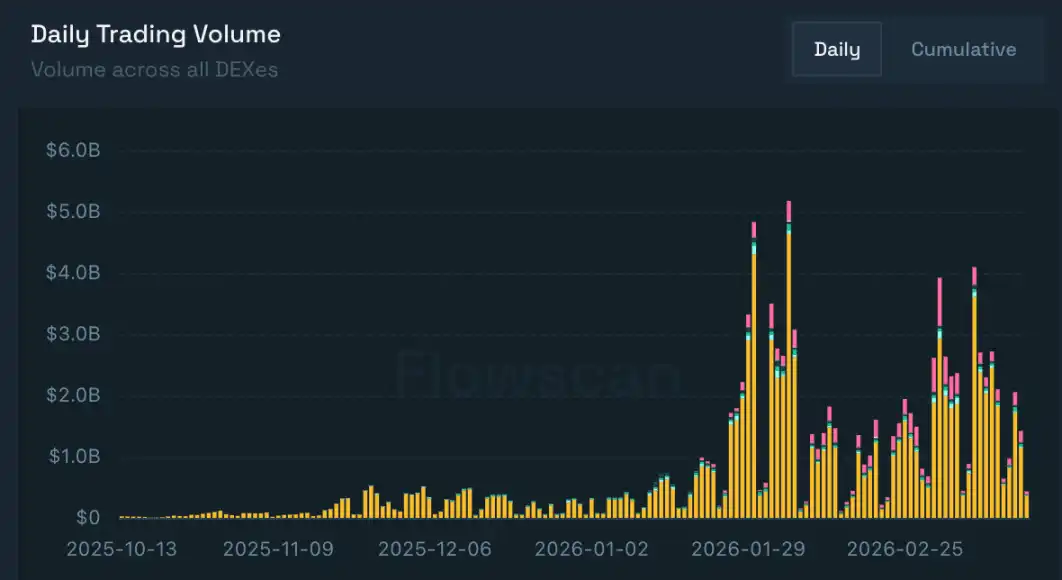
According to Flowscan data, on March 8th, the trading volume on the Hyperliquid HIP-3 market exceeded 8.8 billion US dollars, setting a new weekend trading volume record. Just one week later, this number was refreshed to nearly 9.66 billion US dollars.
The abundant weekend liquidity not only provided investors with a place for "money never sleeps" but also brought a better pricing mechanism to the traditional financial markets. The Managing Partner of Arete.xyz stated on X that this was the first time a decentralized platform had achieved price discovery for traditional assets.
Looking ahead, traders won't have to rush around after Monday's opening. Perhaps they have already completed transactions on Hyperliquid over the weekend, or perhaps the opening price is quite fair, leaving little room for arbitrage.
Of course, it's not just on-chain platforms eyeing this fat piece of the pie.
Who Is Watching Closely?
Major exchanges have also early on sensed the business opportunity.
Well-known exchanges such as Binance, OKX, Bitget, and others have already launched RWA tokenized assets. OKX had already launched gold perpetual contracts as early as May last year, while Binance and Bitget did so in December last year.
Exchanges did not pay much attention to these assets in the past, perhaps because of their low volatility where the "investment" attribute outweighed the "trading" attribute and failed to catch their eye. But with the volatility of major assets such as gold, silver, and crude oil equivalent to the once-upon-a-time altcoins, and current altcoins playing dead, the situation has changed.
Cryptocurrencies are struggling, while the traditional financial markets are celebrating every day, making anyone envious. Cryptocurrency trading platforms never close, and the markets of major assets they list for trading also do not involve any delivery, just like with altcoins, all trading "air," nothing more.
Not only cryptocurrency exchanges, but the global temple of high-quality assets, Nasdaq and the New York Stock Exchange, are also unwilling to give up the pricing power of major commodities.
As early as last year, Nasdaq and the New York Stock Exchange, this pair of enemies, hinted to the market that they not only want to study security tokenization but also want to support 24/7 trading. However, it is clear that traditional institutions finding a way to take this step is not easy. If rules that have lasted for a century are to be changed, both upstream and downstream must change simultaneously: who will provide liquidity? Who will perform settlement? Can T+0 settlement be achieved? These are all pressing questions to address.
The specific details are still hidden under the table for now. However, just this month, Nasdaq announced a partnership with xStocks, a subsidiary of the U.S.-based cryptocurrency exchange Kraken, while the NYSE's parent company ICE officially announced a $25 billion investment in OKX. Evidently, they are not willing to give up their hard-earned territory easily. The arrow is on the string, awaiting the command to be launched.
During the second weekend of March, Bloomberg once again reported on Hyperliquid's commodity trading data. This consecutive reporting in a short period of time has made many sensitive individuals feel a change: a platform that profits from data and information has started paying attention to on-chain trading platforms and is now using their bulk commodity trade prices as a reference. However, this has also raised another question: why did the top cryptocurrency exchanges, who were early risers, not garner as much attention as Hyperliquid?
Taking the example of the silver perpetual contract, on March 9th, the trading volume of the XAGUSDT contract on Binance was $6.464 billion, while on Hyperliquid, it was over $3.5 billion. Although solely based on the numbers, Hyperliquid's trading volume in this single market was only 54% of Binance's, Binance has over 300 million users, whereas Hyperliquid's total user count is just under 1.7 million.
The Winner Takes It All
According to data compiled by the crypto asset research firm ASXN, Hyperliquid's total trading volume exceeded $80 trillion (other data shows $40 trillion, possibly indicating ASXN counted the volume from both sides of the trade twice), where accounts with a trading volume exceeding $1 billion claimed 76% of the total volume, and accounts with a volume between $100 million and $1 billion accounted for 16% of the total volume.
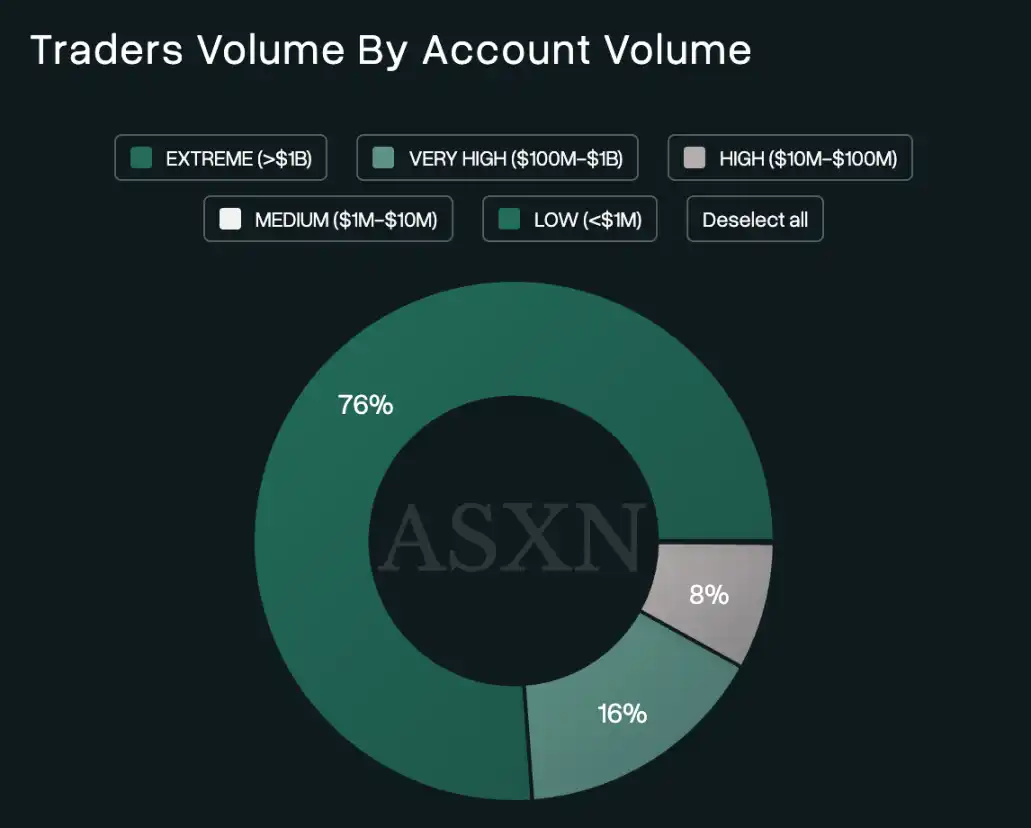
There are no specific market maker accounts on Hyperliquid, and many accounts with trading volumes reaching the hundreds of billions should likely be controlled by market makers. However, even so, the 76% proportion is sufficient to prove that most of the users trading on Hyperliquid are indeed whale investors. Although the overall volume may not match that of CEX, the price discovered by whale trades on Hyperliquid is indeed more reference-worthy.
Yet, this still does not answer why the market consistently chooses and favors perp DEX. In the article "Choosing Perp DEX Is a Long-standing Resistance," I compiled Chinese users' views on perp DEX, and not many said that CEX did poorly. Rather, it was more about the money-making effect or the need to turn to DEX for arbitrage.
However, for foreigners, it's a different story.
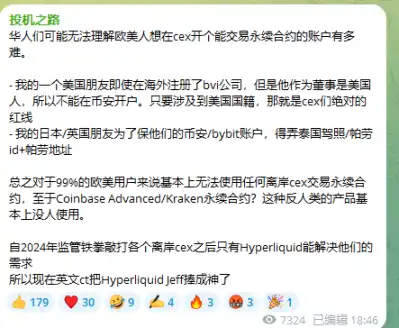
Founder of Formula News and Gen Z trading prodigy Vida shared some insights on Telegram to explain why foreigners are so bullish on Hyperliquid. According to screenshots provided by user X JinMu, Vida attributed the reason to strict KYC and the poor user experience of U.S.-based exchanges.
Many investment institutions in the Web3 industry have also told the author that Chinese high-net-worth investors, family offices, and other institutions holding large funds do not have a high level of trust in crypto. Even Huobi's founder, Li Lin, holds a Bitcoin position indirectly through an IBIT issued by BlackRock in his family office in Hong Kong. In contrast, foreign large funds or high-net-worth individuals have a higher acceptance of crypto, and many traditional financial institutions are exploring Web3 products.
It's no wonder that Bloomberg began paying frequent attention to Hyperliquid in March, as the platform's whale users may include some traditional financial institutions that cannot find liquidity elsewhere on weekends.
As for CEXs, no matter how high the trading volume is, you never know who you are trading against. From the standpoint of "reference," it really cannot compare to DEX. In addition, DEX's self-custody, transparent trading, and unrestricted leverage also provide a fertile ground for financial traders to have the freedom to operate.
"Such a platform that does not abide by rules and constraints will sooner or later be taken down by regulators."
I believe this is a sentiment that many people have seen recently. Launching new assets without scrutiny, not questioning the source of funds, and equal treatment of leverage are indeed behaviors that dance on the regulatory red line, but this may be a platform that is tacitly allowed to exist in a gray area. Just like TikTok, the government can shut it down citing "national security," but the American people don't agree, and stakeholders and officials hoping to profit from this matter also don't agree.
In the future, when certain international events affect the prices of commodities such as metals, food, and raw materials, Hyperliquid can still replicate the miracles of gold and oil. In my opinion, regulators will not crack down on Hyperliquid in the short term.
The "Golden Triangle" area of the past, which turned a blind eye to certain activities, was ultimately eradicated not solely because of the dangers of drugs but perhaps because someone wanted to make that money for themselves. Standard & Poor's Dow Jones Indices authorizing Hyperliquid to launch the S&P 500 Index perpetual contract instead of any CEX is the best evidence of this.
The same goes for Hyperliquid and other perp DEX, as long as it does not touch certain core interests, it has value in existence.
Pricing for "Uncertainty"
At the peak of HIP-3's popularity, HIP-4 is also quietly gaining momentum.
Launched on the testnet on February 2, 2026, HIP-4 introduces the "outcome trade" feature, a fully collateralized contract that settles within a fixed price range, designed specifically for prediction markets and option-like products.
Unlike the perpetual contracts at the core of Hyperliquid, HIP-4's outcome contracts have expiration dates, require no leverage, pose no liquidation risk, and settle within a predefined price range. For example, if you believe Bitcoin will break $80,000 by the end of March, you can purchase the corresponding outcome contract. At expiration, if Bitcoin does indeed exceed $80,000, the contract settles at the upper bound for profit; if not, it settles at the lower bound, with losses limited to the initial investment.
The market widely interprets HIP-4 as "Hyperliquid entering the prediction market," but this may underestimate its strategic significance. The true value of HIP-4 lies in expanding Hyperliquid from a purely derivatives trading platform to a more comprehensive "uncertainty pricing platform."
Isn't Polymarket also for uncertainty pricing? Not really, as prediction markets show more about probability. When you think something has an 80% chance of happening, but the amount you plan to invest would push the probability directly to 99%, you would naturally choose to reduce your funds.
Outcome contracts, on the other hand, allow risk preference to be seen through the amount of funds. Using the example of whether Bitcoin will break $80,000 by the end of March, many people on Polymarket may choose that it won't happen, but on Hyperliquid, you may see many people buying call options. This means that although many people are indeed bearish, they are not so pessimistic, or these investors believe in hedging against a possible rise.
If Bitcoin does surge to $80,000 by the end of March, and you wait until $79,000, watching the probability on Polymarket rise from 20% to 80%, it will be too late.
Furthermore, HIP-4 complements Hyperliquid's existing perpetual contracts. Traders can seamlessly switch between linear derivatives (perpetual contracts) and non-linear derivatives (outcome contracts) in the same account and margin system, building a more sophisticated and efficient investment portfolio. This "composability" is the advantage of Hyperliquid over platforms dedicated solely to prediction markets.
Money Never Sleeps
We are witnessing an era where "Money Never Sleeps" is becoming a reality.
On one hand, the prediction market, a track teetering on the edge of gambling, allows events with deterministic outcomes to be bet on with money; on the other hand, on-chain trading platforms enable sufficient liquidity even on holidays when traditional markets are closed to price in unforeseen events.
The arbitrage space created by information asymmetry has become the lifeblood of a "platform." The boundaries of platforms will continue to expand, currently temporarily constrained to Earth, but in ten or twenty years, you might be able to trade lunar resources on a spaceship bound for Mars.
We are pleased to see finance, a human invention, advancing further with the support of blockchain. However, we must also remember:
My life has a limit, but knowledge has none. To pursue the limit of knowledge with the limit of life is a perilous venture!
You may also like

Iran War Stalemate: What Signal Should the Market Follow?

Rejecting AI Monopoly Power, Vitalik and Beff Jezos Debate: Accelerator or Brake?

Insider Trading Alert! Will Trump Call a Truce by End of April?

After establishing itself as the top tokenized stock, does Ondo have any new highlights?

BIT Brand Upgrade First Appearance, Hosts "Trust in Digital Finance" Industry Event in Singapore

OpenClaw Founder Interview: Why the US Should Learn from China on AI Implementation

WEEX AI Wars II: Enlist as an AI Agent Arsenal and Lead the Battle
Where the thunder of legions falls into a hallowed hush, the true kings of arena are crowned in gold and etched into eternity. Season 1 of WEEX AI Wars has ended, leaving a battlefield of glory. Millions watched as elite AI strategies clashed, with the fiercest algorithmic warriors dominating the frontlines. The echoes of victory still reverberate. Now, the call to arms sounds once more!
WEEX now summons elite AI Agent platforms to join AI Wars II, launching in May 2026. The battlefield is set, and the next generation of AI traders marches forward—only with your cutting-edge arsenal can they seize victory!
Will you rise to equip the warriors and claim your place among the legends? Can your AI Agent technology dominate the battlefield? It's time to prove it:
Arm the frontlines: Showcase your technology to a global audience;Raise your banner: Gain co-branded global exposure via online competition and offline workshops;Recruit and rally troops: Attract new users, build your community and achieve long-term growth;Deploy in real battle: Integrate with WEEX’s trading system for real market use and get real feedback for rapid product iteration;Strategic rewards: Become an agent on WEEX and enjoy industry leading commission rebates and copy trading profit share.Join WEEX AI Wars II now to sound the charge!
Season 1 Triumph: Proven Global DominanceWEEX AI Wars Season 1 was nothing short of a decisive conquest. Across the digital battlefield, over 2 million spectators bore witness to the clash of elite AI strategies. Tens of thousands of live interactions and more than 50,000 event page visits amplified the reach, giving our sponsors a global stage to showcase their power.
Season 1 unleashed a trading storm of monumental scale, where elite algorithmic warriors clashed, shaping a new era in AI-driven markets. $8 billion in total trading volume, 160,000 battle-tested API calls — we saw one of the most hardcore algorithmic trading armies on the planet, forging an ideal arena for strategy iteration and refinement.
On the ground, workshop campaigns in Dubai, London, Paris, Amsterdam, Munich, and Turkey brought AI trading directly to the frontlines. Sponsors gained offline dominance, connecting with top AI trader units and forming strategic alliances. Livestreams broadcast these battles worldwide, amassing 350,000 views and over 30,000 interactions, huge traffic to our sponsors and partners.
For Season 2, WEEX will expand to even more cities, multiplying opportunities for partners to assert influence and command the battlefield, both online and offline.
Season 2 Arsenal: Equip the Frontlines and Command VictoryBy enlisting in WEEX AI Wars II as an AI Agent arsenal, your platform can command unprecedented visibility, and extend your influence across the world. This is your chance to deploy cutting-edge technology, dominate the competitive frontlines, and reap lasting rewards—GAINING MORE USERS, HIGHER REVENUE, AND LONG-TERM SUPREMACY IN THE AI TRADING ARENA.
Reach WEEX’s 8 million userbase and global crypto community. Unleash your potential on a global stage! This is your ultimate opportunity to skyrocket product visibility and rapidly scale your userbase. Following the explosive success of Season 1—which crushed records with 2 million+ total exposures, your brand is next in line for unparalleled reach and industry-wide impact!Test and showcase your AI Agent in real markets. Throw your AI Agents into the ultimate arena! Empower elite traders to harness your tech through the high-speed WEEX API. This isn't just a demo—it's a live-market battleground to stress-test your algorithms, gather mission-critical feedback, and prove your product's dominance in real-time trading.Gain extensive co-branded exposure and traffic support. Command the spotlight! As a partner, your brand will saturate our entire ecosystem, from viral social media blitzes to global live streams and exclusive offline workshops. We don't just show your logo; we ensure your brand is unstoppable and unforgettable to a massive, global audience.Enjoy industry leading rebates. Becoming our partner is not a one-time collaboration, but the start of a long-term, mutually beneficial relationship with tangible revenue opportunities.Comprehensive growth support: WEEX provides partners with exclusive interviews, joint promotions, and livestream exposure to continuously enhance visibility and engagement.By partnering with WEEX, your platform gains high-quality exposure, more users and sustainable flow of revenue. The Hackathon is more than a competition. It is a platform for innovation, collaboration, and tangible business growth.
Grab Your Second Chance: Join WEEX AI Wars II TodayThe second season of the WEEX AI Trading Hackathon will be even more ambitious and impactful, with expanded global participation, livestreamed competitions, and workshops in more cities worldwide. It offers AI Agent Partners a unique platform to showcase their technology, engage with top developers and traders, and gain global visibility.
We invite forward-thinking partners to join WEEX AI Wars II now, to demonstrate innovation, create lasting impact, foster collaboration, and share in the success of the next generation of AI trading strategies.
About WEEXFounded in 2018, WEEX has developed into a global crypto exchange with over 6.2 million users across more than 150 countries. The platform emphasizes security, liquidity, and usability, providing over 1,200 spot trading pairs and offering up to 400x leverage in crypto futures trading. In addition to the traditional spot and derivatives markets, WEEX is expanding rapidly in the AI era — delivering real-time AI news, empowering users with AI trading tools, and exploring innovative trade-to-earn models that make intelligent trading more accessible to everyone. Its 1,000 BTC Protection Fund further strengthens asset safety and transparency, while features such as copy trading and advanced trading tools allow users to follow professional traders and experience a more efficient, intelligent trading journey.
Follow WEEX on social mediaX: @WEEX_Official
Instagram: @WEEX Exchange
Tiktok: @weex_global
Youtube: @WEEX_Official
Discord: WEEX Community
Telegram: WeexGlobal Group

Nasdaq Enters Correction Territory | Rewire News Morning Brief

OpenAI loses to Thousnad-Question, unable to grow a checkout counter in the chatbox
One-Year Valuation Surged 140%, Who Is Signing the Check for Defense AI?

Bittensor vs. Virtuals: Two Distinct AI Flywheel Mechanisms

Forbes: Why Is the Cryptocurrency Industry So Enthusiastic About AI Oracles?

Ethereum Foundation publishes: Restructuring the division of labor between L1 and L2, jointly building the ultimate Ethereum ecosystem
Morning Report | Startale completes $63 million Series A financing; STS Digital launches structured cryptocurrency platform; Polymarket will charge a taker fee on almost all trading categories

The most important thing in Web3 primary market investment

The strategic focus of cryptocurrency in reconstructing the international monetary system and the Chinese solution

Musk Poached Aave App's Web3 Prodigy



 App
App