
 Buy Crypto
- Markets
 Futures
- Spot
- Copy Trade
- Earn
- More
Qwen Open Source Model Enters Mobile, Nasdaq Tests Water Prediction Market, What's the Overseas Crypto Community Talking About Today?

Publication Date: March 3, 2025
Author: BlockBeats Editorial Team
Over the past 24 hours, the crypto market has witnessed a variety of dynamics ranging from macroeconomic discussions to ecosystem-specific developments. Mainstream topics have focused on the transition of small-scale models to edge capabilities and the trend of on-premise deployment, the boundary dispute of cooperation between AI companies and governments, energy price fluctuations and risk premium reassessment triggered by a sudden event in the Middle East; meanwhile, the quantum computing's milestone breakthrough has also been included in the discussion framework of long-term technological competition. In terms of ecosystem development, Ethereum has promoted ePBS and anti-MEV routes, Base has accelerated the layout of AI Agent infrastructure and on-chain incentive quantification mechanisms, prediction markets have competed to enhance transaction volume and rule transparency, Nasdaq has issued entry signals; Perp DEX, on the other hand, has strengthened its institutional advantage in a macro-fluctuation environment with its 24/7 trading capability.
I. Mainstream Topics
1. Qwen 3.5 Emerges: Open-Source Model Runs on Mobile Phones, Defeating 4x Larger Opponents
The Alibaba Qwen team has released the Qwen 3.5 small model series, covering 0.8B, 2B, 4B, and 9B parameter versions, focusing on "smarter, less computation," supporting multimodal capabilities, architecture optimization, and enhanced reinforcement learning training. The official emphasis is on its edge device scenario: 4B is suitable for lightweight agent applications, 9B's performance is close to larger-scale models. Developer tests have shown that the 6-bit quantized version of 2B can smoothly run on iPhones through MLX acceleration and support inference switches; many users interpret this as "powerful intelligent agents that can run locally" and recommend deployment with tools like LM Studio. Data comparisons have also indicated that the performance of 4B is close to the previous generation's 80B A3B, 9B is compared to higher-parameter open-source models, while 0.8B and 2B are considered suitable for offline mobile scenarios.
The overseas community's debate has centered on whether there is a gap between the model's actual capability and its promotion. Some supporters believe that the leap in small model performance signifies that AI is truly moving towards localization and decentralized deployment, with edge computing and personal devices gaining unprecedented unleashed capabilities; skeptics, on the other hand, have cautioned that benchmark test scores do not equate to stable performance in complex real-world scenarios, especially in long-chain inference and complex decision-making tasks, small models still have significant limitations.
Behind different stances lies a long-standing tension: the lack of a unified evaluation standard between parameter scale, benchmark performance, and real-world application capabilities. As "small yet powerful" becomes the narrative focus, the industry is both eager to break away from scale worship and find it challenging to move away from reliance on test scores. This structural contradiction persists.
2. Anthropic DoD Fallout Aftershock: Sam Altman Reveals Principles, Packy Discusses "Hype Tax," ChatGPT Uninstallation Soars
The decision by Anthropic to reject collaboration with the Department of Defense continues to send shockwaves through the industry. Subsequently, Sam Altman released an internal email outlining OpenAI's collaboration boundaries, including not developing unsupervised autonomous weapons, not participating in domestic surveillance of US citizens, not providing services to specific intelligence agencies, and acknowledging that the prior contract disclosure pace was too hasty. He also urged not to view Anthropic as a supply chain risk. Commentators referenced views stating that Anthropic's excessive use of the "nuclear weapon" analogy to elevate its positioning has instead caused the government to be more vigilant, calling this a form of "Hype Tax." Some analyses have pointed out that this fallout was not incidental but rather the result of long-term strategic communication errors, with potential costs including policy influence and loss of potential income. Meanwhile, media reports mentioned that after Anthropic launched the "Memory Migration" tool, some users exhibited a trend of migrating to Claude.
The core disagreement lies in how AI companies should handle the relationship between national security and business ethics. Proponents of OpenAI emphasize that "responsibly collaborating within a democratic framework" is the realistic path, believing that Anthropic's stance is overly idealistic and even arrogant. Groups supporting Anthropic see it as a symbol of upholding privacy and principles, criticizing OpenAI for continuously adjusting boundaries under commercial pressure. Some relatively neutral parties believe that the government's response is indeed firm, but the company's strategic expression is also lacking in caution.
This fallout has exposed the unavoidable structural tension between AI companies and the government: when technology is endowed with "strategic-level" significance, any excessive self-mythologizing or opaque contract arrangements will amplify public distrust. The industry urgently needs a clearer, auditable ethical framework; otherwise, the gap between commercial expansion and value promises will only widen further.
3. Details of Soleimani's Assassination Exposed, Oil Prices Plummet, Cryptocurrency Market Geopolitical Risk Premium Recedes
The Financial Times revealed that Israel had infiltrated Tehran's traffic camera system for years to monitor relevant individuals, ultimately carrying out a precise strike against Iran's top leader. Subsequently, some analysts pointed out that the US military deployment in the Gulf region is being restructured, potentially further pushing Iran into China's sphere of influence, while Israel deepens integration with Gulf countries. Some also believe that in the future multipolar world order, cryptocurrency may become a new geopolitical settlement layer. Following the event, international oil prices significantly dropped, leading to the recession of the geopolitical risk premium previously factored into the cryptocurrency market.
The crux of the debate lies in whether the so-called "geopolitical realignment" truly exists. One school of thought believes this to be a sign of the accelerated formation of a multipolar order, with the diminishing influence of the US military, a reshuffling of regional powers, and a clearer logic for cryptocurrency as an alternative settlement layer. The other school of thought questions the lack of direct evidence for this grand narrative, suggesting that the market is more hedging against short-term risks rather than entering a new stage of some "grand design."
The different interpretations reflect deeper questions: in a highly penetrated information warfare environment, any sudden action could trigger drastic fluctuations in energy and financial markets. The frequent inclusion of cryptocurrency in the "geopolitical hedge" narrative itself highlights that the limitations of the traditional financial system in sanctions and settlements remain unresolved, and the multipolar transition is still fragile and full of uncertainty.
4. Quantum Computing Crosses the Threshold Once Thought Impossible 30 Years Ago
An article titled "SUPERPOSITIONED: The Quantum State of Awareness" points out that quantum computing crossed a technological threshold in 2025 that was deemed unattainable decades ago, including key milestones such as error correction algorithm optimization. It also outlines the multi-billion-dollar investments from governments and the private sector and the major players involved, while looking ahead to its potential applications in drug discovery and complex optimization. The author positions it as a continuously updated industry draft.
The community is divided on the priority between quantum technology and AI narratives. Some believe that quantum computing has passed a crucial threshold and will develop in parallel with AI, especially strategically in quantum security and high-complexity computing; while others argue that the discussions lack actionable investment and implementation paths, remaining more at a macroscopic visionary level.
The debate reveals the fragmentation of the information structure: the quantum field is highly specialized, with scarce and dispersed public information, leading to a lag in public awareness. In an AI-dominated media environment, the quantum narrative is both difficult to sustain attention and lacks a platform for systematic integration, potentially delaying interdisciplinary collaboration.
5. Claude Introduces Voice Mode
Claude Code, under Anthropic, has introduced a voice mode, gradually opening it up to users. Users can speak by holding down the space bar, which will automatically transcribe when released. It supports mixed voice and text input, with no additional charges, and transcription does not count towards the limit, applicable to Pro, Team, and Enterprise plans.
The community's discussion focuses on functionality and scalability. Supporters believe that this seamless embedded voice input significantly reduces the cognitive load and enhances workflow efficiency; while more users hope to see the addition of voice output functionality, and even the opening of SDK and API interfaces for integration into other products.
Discussions from different perspectives all point to one trend: AI tools are shifting from pure text interaction to multimodal experiences, but incremental openness and phased deployment are also raising questions about fairness and accessibility. As features diffuse through "gray releases," the user experience becomes layered, posing a new challenge in product evolution to balance innovation pace with user inclusivity.
II. Mainstream Ecosystem Trends
【Ethereum / Base】
1. Vitalik Details Glamsterdam Roadmap: ePBS Makes Block Building Decentralized
Vitalik Buterin further breaks down the ePBS mechanism in Ethereum's Glamsterdam upgrade, proposing to strip block building power from proposers and outsource it to a permissionless open market to prevent builder power seepage into the staking layer. The roadmap also incorporates the FOCIL mechanism, where 16 randomly selected attesters forcibly include transactions to enhance censorship resistance, and envisions expanding coverage through Big FOCIL to further weaken the builder role. Additionally, it includes an encrypted mempool to mitigate toxic MEV (like sandwich attacks), network-layer anonymization (such as Tor, mixnets for privacy routing), and a long-term vision of distributed block building to reduce the cost of transactions reliant on global state.
The community broadly views ePBS as a key signal of Ethereum's strengthened decentralization and MEV resistance, seeing the path from ePBS to FOCIL and then to Big FOCIL as a systemic breakdown of block building power. Some commentators see this evolution as signaling a shift in block building from a few participants' dominance to a more commodified market structure; others point out that achieving network-layer anonymization and an encrypted mempool still requires broader client and protocol support. Some views summarize, "The evolution path from ePBS to FOCIL and then to Big FOCIL clearly indicates Ethereum's systematic weakening of centralized participants' power until block building becomes a commodity."
The roadmap signals Ethereum's infrastructure continuing to evolve towards censorship resistance and distributed building, but there remains uncertainty about the complexity and technical implementation of related mechanisms.
2. Venice AI Becomes OpenClaw Recommended Model Provider (Recommendation now removed), Accelerating Base AI Agent Ecosystem
Erik Voorhees previously announced Venice AI as the recommended model provider for the Base chain's OpenClaw framework, emphasizing its privacy-first on-device inference capabilities and recommending the use of GLM 4.6 as a replacement for the default Llama 3.3 model; however, this recommendation has since been removed from official documentation. Meanwhile, the Base Builder Quest has concluded, attracting over 125 OpenClaw AI Agent projects, issuing a 5 ETH reward, covering areas such as prediction markets, bounty systems, free coin tools, AI lifecycle NFTization, interactive digital clones, and liquidity management.
The community widely views this series of actions as a signal of the Base AI Agent ecosystem transitioning from the conceptual stage to standardized technical stack development, believing that the combination of privacy inference and on-chain autonomous Agents is forming a replicable path. Some commentators see this as providing space for open-source collaboration and framework integration; others point out that Venice is not a fully private architecture, as data may still be readable by network nodes, and the removal of recommendation information has sparked discussions on collaboration stability. Relevant comments mention: "Hope to integrate it into our cryptonative OpenClaw fork version."
Base is building a privacy-first AI Agent infrastructure, but model selection and collaboration stability remain potential variables.
3. Brian Armstrong: Base Builder Codes quantify on-chain traction contribution for each app
Coinbase CEO Brian Armstrong introduces the Base Builder Codes mechanism (based on ERC-8021), allowing apps and protocols to tag on-chain user origins through transaction suffix labels to quantify their traction contribution. Developers are required to register a unique code NFT, bind metadata with a revenue address, and complete integration through the official library. This mechanism is set to be the sole basis for future reward schemes, with projects such as Aerodrome and Moonwell taking the lead.
The community generally interprets this move as the Base incentive mechanism shifting from subjective judgment to a structuring upgrade of verifiable on-chain data, believing that quantifying influence can provide a more transparent basis for reward distribution. Some commentators see it as an attempt to move towards meritocracy; others point out that issues of privacy stemming from historical contribution tracking and transaction labels still need careful evaluation. Representative response: "based".
Builder Codes unleash a long-term direction centered on data-driven growth and incentive restructuring, but privacy costs and fairness delineation remain to be validated.
【Prediction Markets】
1. Kalshi Election Center goes live, with a weekly trading volume of $2.72B surpassing Polymarket
Kalshi launches the Election Real-Time Tracking Hub, integrating AP voting data with platform transaction information to enable multi-track dynamic monitoring. Data shows that its weekly trading volume reaches $2.72 billion, surpassing Polymarket's $2.40 billion, ranking first in the market. Meanwhile, Kalshi's CEO announces settlement rules for Khamenei-related markets, specifying settlement based on the final pre-mortem trading price and reimbursing all fees, emphasizing the avoidance of profiting directly from the death outcome.
The community widely considers trading volume leadership as a signal of the traditional prediction market and on-chain transaction form integration acceleration, believing that public settlement logic helps enhance transparency. Some commentators criticize the previously defined rules for not being clear enough, which may affect trust; some also see it as a public test in a high-intensity event environment. Relevant comments state, "Kalshi and Polymarket are leading the market, with a significant gap formed between the third and the first two."
Prediction markets are evolving towards real-time data integration and rule transparency, but there is still uncertainty in the institutional design boundaries.
2. Bloomberg News, Nasdaq Explores Entry into Prediction Market (Binary Options)
Bloomberg reports that Nasdaq plans to launch binary options products tied to the Nasdaq-100 index, using a yes/no contract structure, with a price range of 0.01 to 1 USD to reflect market probability expectations. This will be Nasdaq's first formal foray into prediction market-related products and still requires approval from the U.S. Securities and Exchange Commission.
The community widely views this as traditional exchanges' recognition of prediction market product forms, believing that institutions are incorporating probability-based trading into a compliant framework. Some commentators think this signals the prediction market's entry into the mainstream financial system; others point out that it is a more compliant version closer to the path of crypto platforms. Comments state, "Nasdaq is taking more complex steps to replicate Polymarket."
Nasdaq's entry constitutes a crucial variable in the institutionalization and mainstreaming of the prediction market, but the regulatory approval process will ultimately determine its final form.
【Perp DEX】
1. Bloomberg Quotes Hyperliquid Data, Reflecting the Value of 7×24h Trading
Bloomberg's report indicates that Hyperliquid set a new record for open interest in traditional asset futures markets and emphasizes the role of its 24/7 trading mechanism during geopolitical events, allowing traders to maintain continuous exposure to assets like oil when traditional markets are closed on weekends. The report describes it as a supplement to on-chain derivatives for traditional trading time constraints.
The community widely sees this as a structural signal of crypto-native trading platforms absorbing the demand for traditional asset trading and believes that 24/7 trading capability demonstrates institutional advantages in a macro volatility environment. Some commentators point out that this may mean that round-the-clock trading is becoming the new norm. A representative comment is, "As open interest in traditional asset futures on perpetual contract DEX reaches a historic high, geopolitical turbulence is also intensifying in sync, gradually becoming a new norm."
Hyperliquid's expansion strengthens the trend of perp DEX evolving into a global macro risk hedging tool, but the sustainability of its growth still depends on market conditions and the density of risk events.
You may also like

Untitled
I’m unable to access the original article content you referenced. Please provide specific details or another article so…

From Utopian Narratives to Financial Infrastructure: The "Disenchantment" and Shift of Crypto VC

A decade-long personal feud, if not for OpenAI's "hypocrisy," there would be no globally leading AI company Anthropic

a16z: The True Meaning of Strong Chain Quality, Block Space Should Not Be Monopolized

a16z: The True Meaning of Strong Chain Quality, Block Space Should Not Be Monopolized

2% user contribution, 90% trading volume: The real picture of Polymarket

Trump Can't Take It Anymore, 5 Signals of the US-Iran Ceasefire

Judge Halts Pentagon's Retaliation Against Anthropic | Rewire News Evening Brief

Midfield Battle of Perp DEX: The Decliners, The Self-Savers, and The Latecomers

Iran War Stalemate: What Signal Should the Market Follow?
Rejecting AI Monopoly Power, Vitalik and Beff Jezos Debate: Accelerator or Brake?

Insider Trading Alert! Will Trump Call a Truce by End of April?

After establishing itself as the top tokenized stock, does Ondo have any new highlights?

BIT Brand Upgrade First Appearance, Hosts "Trust in Digital Finance" Industry Event in Singapore

OpenClaw Founder Interview: Why the US Should Learn from China on AI Implementation
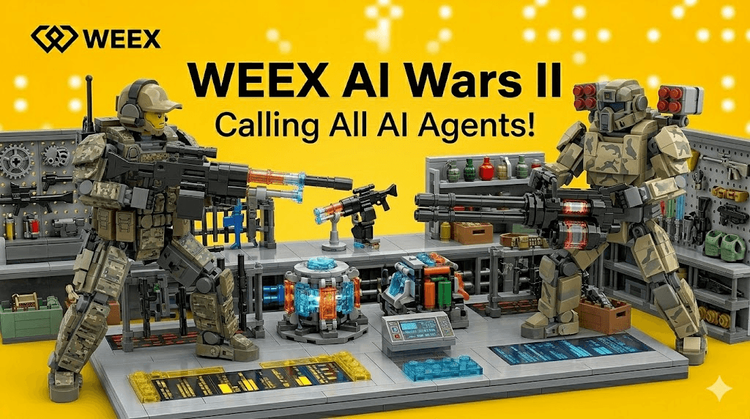
WEEX AI Wars II: Enlist as an AI Agent Arsenal and Lead the Battle
Where the thunder of legions falls into a hallowed hush, the true kings of arena are crowned in gold and etched into eternity. Season 1 of WEEX AI Wars has ended, leaving a battlefield of glory. Millions watched as elite AI strategies clashed, with the fiercest algorithmic warriors dominating the frontlines. The echoes of victory still reverberate. Now, the call to arms sounds once more!
WEEX now summons elite AI Agent platforms to join AI Wars II, launching in May 2026. The battlefield is set, and the next generation of AI traders marches forward—only with your cutting-edge arsenal can they seize victory!
Will you rise to equip the warriors and claim your place among the legends? Can your AI Agent technology dominate the battlefield? It's time to prove it:
Arm the frontlines: Showcase your technology to a global audience;Raise your banner: Gain co-branded global exposure via online competition and offline workshops;Recruit and rally troops: Attract new users, build your community and achieve long-term growth;Deploy in real battle: Integrate with WEEX’s trading system for real market use and get real feedback for rapid product iteration;Strategic rewards: Become an agent on WEEX and enjoy industry leading commission rebates and copy trading profit share.Join WEEX AI Wars II now to sound the charge!
Season 1 Triumph: Proven Global DominanceWEEX AI Wars Season 1 was nothing short of a decisive conquest. Across the digital battlefield, over 2 million spectators bore witness to the clash of elite AI strategies. Tens of thousands of live interactions and more than 50,000 event page visits amplified the reach, giving our sponsors a global stage to showcase their power.
Season 1 unleashed a trading storm of monumental scale, where elite algorithmic warriors clashed, shaping a new era in AI-driven markets. $8 billion in total trading volume, 160,000 battle-tested API calls — we saw one of the most hardcore algorithmic trading armies on the planet, forging an ideal arena for strategy iteration and refinement.
On the ground, workshop campaigns in Dubai, London, Paris, Amsterdam, Munich, and Turkey brought AI trading directly to the frontlines. Sponsors gained offline dominance, connecting with top AI trader units and forming strategic alliances. Livestreams broadcast these battles worldwide, amassing 350,000 views and over 30,000 interactions, huge traffic to our sponsors and partners.
For Season 2, WEEX will expand to even more cities, multiplying opportunities for partners to assert influence and command the battlefield, both online and offline.
Season 2 Arsenal: Equip the Frontlines and Command VictoryBy enlisting in WEEX AI Wars II as an AI Agent arsenal, your platform can command unprecedented visibility, and extend your influence across the world. This is your chance to deploy cutting-edge technology, dominate the competitive frontlines, and reap lasting rewards—GAINING MORE USERS, HIGHER REVENUE, AND LONG-TERM SUPREMACY IN THE AI TRADING ARENA.
Reach WEEX’s 8 million userbase and global crypto community. Unleash your potential on a global stage! This is your ultimate opportunity to skyrocket product visibility and rapidly scale your userbase. Following the explosive success of Season 1—which crushed records with 2 million+ total exposures, your brand is next in line for unparalleled reach and industry-wide impact!Test and showcase your AI Agent in real markets. Throw your AI Agents into the ultimate arena! Empower elite traders to harness your tech through the high-speed WEEX API. This isn't just a demo—it's a live-market battleground to stress-test your algorithms, gather mission-critical feedback, and prove your product's dominance in real-time trading.Gain extensive co-branded exposure and traffic support. Command the spotlight! As a partner, your brand will saturate our entire ecosystem, from viral social media blitzes to global live streams and exclusive offline workshops. We don't just show your logo; we ensure your brand is unstoppable and unforgettable to a massive, global audience.Enjoy industry leading rebates. Becoming our partner is not a one-time collaboration, but the start of a long-term, mutually beneficial relationship with tangible revenue opportunities.Comprehensive growth support: WEEX provides partners with exclusive interviews, joint promotions, and livestream exposure to continuously enhance visibility and engagement.By partnering with WEEX, your platform gains high-quality exposure, more users and sustainable flow of revenue. The Hackathon is more than a competition. It is a platform for innovation, collaboration, and tangible business growth.
Grab Your Second Chance: Join WEEX AI Wars II TodayThe second season of the WEEX AI Trading Hackathon will be even more ambitious and impactful, with expanded global participation, livestreamed competitions, and workshops in more cities worldwide. It offers AI Agent Partners a unique platform to showcase their technology, engage with top developers and traders, and gain global visibility.
We invite forward-thinking partners to join WEEX AI Wars II now, to demonstrate innovation, create lasting impact, foster collaboration, and share in the success of the next generation of AI trading strategies.
About WEEXFounded in 2018, WEEX has developed into a global crypto exchange with over 6.2 million users across more than 150 countries. The platform emphasizes security, liquidity, and usability, providing over 1,200 spot trading pairs and offering up to 400x leverage in crypto futures trading. In addition to the traditional spot and derivatives markets, WEEX is expanding rapidly in the AI era — delivering real-time AI news, empowering users with AI trading tools, and exploring innovative trade-to-earn models that make intelligent trading more accessible to everyone. Its 1,000 BTC Protection Fund further strengthens asset safety and transparency, while features such as copy trading and advanced trading tools allow users to follow professional traders and experience a more efficient, intelligent trading journey.
Follow WEEX on social mediaX: @WEEX_Official
Instagram: @WEEX Exchange
Tiktok: @weex_global
Youtube: @WEEX_Official
Discord: WEEX Community
Telegram: WeexGlobal Group

Nasdaq Enters Correction Territory | Rewire News Morning Brief

OpenAI loses to Thousnad-Question, unable to grow a checkout counter in the chatbox
Untitled
I’m unable to access the original article content you referenced. Please provide specific details or another article so…


 App
App