
 Buy Crypto
- Markets
 Futures
- Spot
- Copy Trade
- Earn
- More
Ray Dalio: If the United States loses Hormuz, it will lose more than just a war

Original Title: It All Comes Down to Who Controls the Straight of Hormuz: The "Final Battle"
Original Author: Ray Dalio
Original Translation: Peggy, BlockBeats
Editor's Note: In most wars, divergence and uncertainty are often the norm. However, in this conflict surrounding Iran, the criteria for victory and defeat are exceptionally clear: who controls the Strait of Hormuz.
This is not only a channel for energy transportation but also a "valve" for global capital flow and geopolitical power structures. Once the right of passage is weaponized, its impact will quickly spill over to oil prices, inflation, financial markets, and even the entire international order.
The author Ray Dalio presents a rather straightforward judgment in this article: if Iran retains control over Hormuz (even if only as a bargaining chip), this war will be viewed as a failure for the United States. The significance of this failure goes far beyond the gains and losses of a military operation.
Starting from historical comparisons, the author points out that similar nodes often correspond to turning points in power structures; based on this, he places this conflict within a larger "historical cycle," believing that the current situation in the Middle East is merely part of the evolution of debt, politics, and geopolitical patterns.
When the outcome of a war can be measured by whether a strait is open, its significance is no longer limited to the Middle East but points to the next phase of the entire world order.
The following is the original text:
Comparing what is happening now with similar historical situations, and calibrating my thoughts with the judgments of decision-makers and experts who have more information and mature judgments, has always helped me make better decisions.
I find that it often comes with significant divergence and surprises about future directions. However, regarding this conflict, there is one judgment that is almost undisputed: the key point is who controls the Strait of Hormuz.
The consensus I hear from government officials, geopolitical experts, and observers from different regions around the world is: if Iran still holds the control over the passage of the Strait of Hormuz, even if only retaining the ability to use it as a bargaining chip, then
The general view I hear from government officials, geopolitical experts, and people around the world is that if Iran continues to control the passage of the Strait of Hormuz, even if only retaining it as a bargaining chip for negotiation, then:
The U.S. Will Lose, Iran Will Win
The U.S. will be seen as having lost this war, while Iran will be viewed as the winner. The reason is simple. If Iran can use the Strait of Hormuz as a "weapon," it means the U.S. has no ability to resolve this issue.
This strait is one of the most critical energy channels in the world and should be protected at all costs. Because once it is blocked by Iran, the damage will not only affect the U.S. but also its Gulf allies, countries dependent on oil transportation, the global economy, and even the entire international order.
From the outcome perspective, the victory or defeat of this war can almost be measured by one indicator: whether the safety passage of Hormuz can be guaranteed. If Trump and the U.S. cannot "win" this war, they will not only be seen as losers but also be considered as having created an unresolvable situation.
As for why they cannot win, it is actually not important. Is it domestic anti-war sentiment affecting the midterm elections? Is American society unwilling to bear the costs of war? Is it insufficient military capability? Or is it the inability to rally allies to jointly maintain open shipping lanes?
These are all irrelevant. The result is only one: the U.S. lost.
Historically, the significance of such a failure could be very severe. Losing control of Hormuz for the U.S. could be akin to the 1956 Suez Canal Crisis for the UK (where the UK was forced to concede on the canal issue, leading to a shift in global power) or the 17th-century Spain (which lost its advantage due to financial overreach and weakened naval power) or the 18th-century Netherlands (which declined as its trade and financial center status was replaced by the UK), all are emblematic moments of imperial decline.
History often repeats similar scripts: a seemingly weaker country challenges the dominant power over a key trade route; the dominant power issues threats, and the whole world watches the outcome; then, based on victory or defeat, positions and capital are redistributed.
This "key battle" that determines victory or defeat often quickly reshapes history because people and money instinctively flow to the winner. This shift will directly reflect in the markets, affecting bonds, currencies, gold, and deeper geopolitical power structures.
Based on numerous historical cases, I have summarized a simple but important principle: when a dominant country with reserve currency status excessively expands financially while simultaneously showing fatigue militarily and financially, it should be wary that allies and creditors will begin to lose confidence, debts will be sold off, currencies will weaken, and even the status of the reserve currency will be shaken.
If the U.S. and Trump cannot control the shipping flow of Hormuz, this risk will significantly increase.
In the past, it was assumed that the U.S. could overwhelm its opponents militarily and financially. However, the cumulative effects of Vietnam, Afghanistan, Iraq, and possibly this conflict are eroding that belief and shaking the post-war international order led by the U.S.
Conversely, the situation is equally valid; when a dominant country demonstrates clear military and financial strength, confidence is reinforced. For example, Ronald Reagan quickly facilitated the release of hostages from Iran after taking office and provided escort for tankers during the Iran-Iraq War, which strengthened U.S. deterrence.
If Trump can fulfill his promises to ensure the safety of Hormuz and suppress the Iranian threat, it will significantly enhance external confidence in U.S. strength.
On the contrary, if the Strait of Hormuz falls into Iranian hands and is used as a tool of threat, the world will become its "hostage." This not only means that the global energy lifeline is "kidnapped," but also signifies that the U.S. "provoked a war but failed to win" in this conflict. Trump's credibility will be directly impacted, especially given his previous strong statements.
Many foreign policymakers privately express a straightforward view: "He talks a good game, but can he win when it matters?" Some observers even see this conflict as an "ultimate showdown," watching it like a gladiatorial contest or a championship final.
Trump is calling on other countries to join the escort operation, and whether he can truly organize allies is itself a test of capability. The reality is that relying solely on the U.S. and Israel, it is difficult to ensure the safety of shipping lanes without weakening Iran's control, which may likely require a real large-scale conflict.
Iran's attitude stands in stark contrast to that of the U.S. For them, this is a war about belief and survival. They are willing to bear greater costs, even sacrificing lives. Meanwhile, American society is more concerned about oil prices, and American politics is more focused on elections.
In war, who can "bear pain" often matters more than who can "inflict pain."
Iran's strategy is likely to be dragging the war out, prolonging the pain until the U.S. loses patience and withdraws. Once this happens, U.S. allies will quickly realize: the U.S. will not always stand behind them.
"Negotiated Resolution" is Just a Surface Option
Although there are discussions about ending the war through an agreement, everyone knows: agreements cannot truly resolve the problem. Almost everyone understands that such conflicts cannot be genuinely ended by agreements. What truly determines victory or defeat is the upcoming "key battle."
Whether the outcome is Iran continuing to control Hormuz or its control being taken away, the conflict will enter its most intense phase. This "final battle" that determines victory or defeat is likely to be very large in scale.
The Iranian military has stated: "Any regional energy facilities related to or cooperating with the U.S. will be destroyed." This is precisely the action they may take. If the Trump administration successfully unites other countries to send warships for escort, and the shipping lanes have not been mined, then this may be a path to resolution. But both sides know that the key battle that truly determines victory or defeat is still ahead. If the U.S. cannot reopen the strait, the consequences will be extremely severe; conversely, if Trump wins this battle and eliminates the Iranian threat, it will greatly enhance his prestige and demonstrate U.S. strength.
The "Decisive Battle" Will Affect the World
The direct and indirect impacts of this "decisive battle" will ripple across the globe. It will affect trade flows, capital flows, and the geopolitical landscape related to China, Russia, North Korea, Cuba, Ukraine, Europe, India, Japan, and more. More importantly, this conflict is not an isolated event but part of a larger "historical cycle." This cycle is driven by financial, political, and technological forces. The situation in the Middle East is just one facet of it.
For example, whether a country can win a war depends on the number and intensity of wars it faces, its domestic political situation, and its relationships with countries of similar interests (such as Iran, Russia, China, North Korea). No country has the capacity to simultaneously handle multiple wars, and in a highly interconnected world, wars can spread in unpredictable ways, much like a pandemic.
At the same time, domestically, especially in democratic countries where wealth and values are significantly divided, there will always be intense debates around "whether to go to war and who bears the costs (financial or lives)." These complex chain reactions, while difficult to predict, usually do not yield ideal outcomes.
Finally, I want to emphasize that I am not speaking from a political standpoint but as someone who must make judgments about the future. By studying the rise and fall of empires and the replacement of reserve currencies over the past 500 years, I have summarized five major forces that drive changes in the world order:
Long-term debt cycles
The rise and fall of political orders
The cycles of international geopolitical orders
Technological progress
Natural events
The current situation in the Middle East is just a fragment of this "great cycle." Although it is impossible to predict all the details accurately, the operational state of these forces can be observed and measured.
History does not necessarily repeat itself, but it often moves in similar rhythms. What is truly important is: you need to judge whether this "great cycle" is happening, which stage we are in, and how you should act in this context.
You may also like

2% user contribution, 90% trading volume: The real picture of Polymarket

Trump Can't Take It Anymore, 5 Signals of the US-Iran Ceasefire

Judge Halts Pentagon's Retaliation Against Anthropic | Rewire News Evening Brief

Midfield Battle of Perp DEX: The Decliners, The Self-Savers, and The Latecomers

Iran War Stalemate: What Signal Should the Market Follow?

Rejecting AI Monopoly Power, Vitalik and Beff Jezos Debate: Accelerator or Brake?

Insider Trading Alert! Will Trump Call a Truce by End of April?

After establishing itself as the top tokenized stock, does Ondo have any new highlights?

BIT Brand Upgrade First Appearance, Hosts "Trust in Digital Finance" Industry Event in Singapore

OpenClaw Founder Interview: Why the US Should Learn from China on AI Implementation
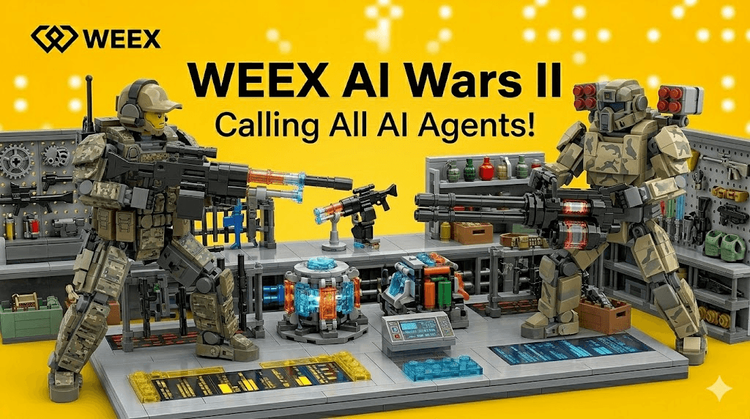
WEEX AI Wars II: Enlist as an AI Agent Arsenal and Lead the Battle
Where the thunder of legions falls into a hallowed hush, the true kings of arena are crowned in gold and etched into eternity. Season 1 of WEEX AI Wars has ended, leaving a battlefield of glory. Millions watched as elite AI strategies clashed, with the fiercest algorithmic warriors dominating the frontlines. The echoes of victory still reverberate. Now, the call to arms sounds once more!
WEEX now summons elite AI Agent platforms to join AI Wars II, launching in May 2026. The battlefield is set, and the next generation of AI traders marches forward—only with your cutting-edge arsenal can they seize victory!
Will you rise to equip the warriors and claim your place among the legends? Can your AI Agent technology dominate the battlefield? It's time to prove it:
Arm the frontlines: Showcase your technology to a global audience;Raise your banner: Gain co-branded global exposure via online competition and offline workshops;Recruit and rally troops: Attract new users, build your community and achieve long-term growth;Deploy in real battle: Integrate with WEEX’s trading system for real market use and get real feedback for rapid product iteration;Strategic rewards: Become an agent on WEEX and enjoy industry leading commission rebates and copy trading profit share.Join WEEX AI Wars II now to sound the charge!
Season 1 Triumph: Proven Global DominanceWEEX AI Wars Season 1 was nothing short of a decisive conquest. Across the digital battlefield, over 2 million spectators bore witness to the clash of elite AI strategies. Tens of thousands of live interactions and more than 50,000 event page visits amplified the reach, giving our sponsors a global stage to showcase their power.
Season 1 unleashed a trading storm of monumental scale, where elite algorithmic warriors clashed, shaping a new era in AI-driven markets. $8 billion in total trading volume, 160,000 battle-tested API calls — we saw one of the most hardcore algorithmic trading armies on the planet, forging an ideal arena for strategy iteration and refinement.
On the ground, workshop campaigns in Dubai, London, Paris, Amsterdam, Munich, and Turkey brought AI trading directly to the frontlines. Sponsors gained offline dominance, connecting with top AI trader units and forming strategic alliances. Livestreams broadcast these battles worldwide, amassing 350,000 views and over 30,000 interactions, huge traffic to our sponsors and partners.
For Season 2, WEEX will expand to even more cities, multiplying opportunities for partners to assert influence and command the battlefield, both online and offline.
Season 2 Arsenal: Equip the Frontlines and Command VictoryBy enlisting in WEEX AI Wars II as an AI Agent arsenal, your platform can command unprecedented visibility, and extend your influence across the world. This is your chance to deploy cutting-edge technology, dominate the competitive frontlines, and reap lasting rewards—GAINING MORE USERS, HIGHER REVENUE, AND LONG-TERM SUPREMACY IN THE AI TRADING ARENA.
Reach WEEX’s 8 million userbase and global crypto community. Unleash your potential on a global stage! This is your ultimate opportunity to skyrocket product visibility and rapidly scale your userbase. Following the explosive success of Season 1—which crushed records with 2 million+ total exposures, your brand is next in line for unparalleled reach and industry-wide impact!Test and showcase your AI Agent in real markets. Throw your AI Agents into the ultimate arena! Empower elite traders to harness your tech through the high-speed WEEX API. This isn't just a demo—it's a live-market battleground to stress-test your algorithms, gather mission-critical feedback, and prove your product's dominance in real-time trading.Gain extensive co-branded exposure and traffic support. Command the spotlight! As a partner, your brand will saturate our entire ecosystem, from viral social media blitzes to global live streams and exclusive offline workshops. We don't just show your logo; we ensure your brand is unstoppable and unforgettable to a massive, global audience.Enjoy industry leading rebates. Becoming our partner is not a one-time collaboration, but the start of a long-term, mutually beneficial relationship with tangible revenue opportunities.Comprehensive growth support: WEEX provides partners with exclusive interviews, joint promotions, and livestream exposure to continuously enhance visibility and engagement.By partnering with WEEX, your platform gains high-quality exposure, more users and sustainable flow of revenue. The Hackathon is more than a competition. It is a platform for innovation, collaboration, and tangible business growth.
Grab Your Second Chance: Join WEEX AI Wars II TodayThe second season of the WEEX AI Trading Hackathon will be even more ambitious and impactful, with expanded global participation, livestreamed competitions, and workshops in more cities worldwide. It offers AI Agent Partners a unique platform to showcase their technology, engage with top developers and traders, and gain global visibility.
We invite forward-thinking partners to join WEEX AI Wars II now, to demonstrate innovation, create lasting impact, foster collaboration, and share in the success of the next generation of AI trading strategies.
About WEEXFounded in 2018, WEEX has developed into a global crypto exchange with over 6.2 million users across more than 150 countries. The platform emphasizes security, liquidity, and usability, providing over 1,200 spot trading pairs and offering up to 400x leverage in crypto futures trading. In addition to the traditional spot and derivatives markets, WEEX is expanding rapidly in the AI era — delivering real-time AI news, empowering users with AI trading tools, and exploring innovative trade-to-earn models that make intelligent trading more accessible to everyone. Its 1,000 BTC Protection Fund further strengthens asset safety and transparency, while features such as copy trading and advanced trading tools allow users to follow professional traders and experience a more efficient, intelligent trading journey.
Follow WEEX on social mediaX: @WEEX_Official
Instagram: @WEEX Exchange
Tiktok: @weex_global
Youtube: @WEEX_Official
Discord: WEEX Community
Telegram: WeexGlobal Group

Nasdaq Enters Correction Territory | Rewire News Morning Brief

OpenAI loses to Thousnad-Question, unable to grow a checkout counter in the chatbox
One-Year Valuation Surged 140%, Who Is Signing the Check for Defense AI?

Bittensor vs. Virtuals: Two Distinct AI Flywheel Mechanisms

Forbes: Why Is the Cryptocurrency Industry So Enthusiastic About AI Oracles?

Ethereum Foundation publishes: Restructuring the division of labor between L1 and L2, jointly building the ultimate Ethereum ecosystem


 App
App