
 Buy Crypto
- Markets
 Futures
- Spot
- Copy Trade
- Earn
- More
The Agent Spend Safely thing has already taken off

Author | Kaori
Editor | Sleepy.txt
Entering "create a card" in Claude will give you a Visa card after a few seconds. But this card is not for you; it's for AI.
Yesterday, X was buzzing with discussion about a product demo creating virtual cards for large models. It's not a new move for an ordinary person to apply for a virtual card for online transactions, but applying for a virtual credit card for AI sparked excitement in the Agent community, marking another development in the payment race.
If you follow this field, you'll notice such excitement coming in every few months. In September 2025, it was the x402 protocol; Coinbase and Cloudflare collaborated to turn the HTTP 402 status code into Agent's native payment channel. In October 2025, Visa and Mastercard simultaneously released the Agent Payment Protocol. And now, it's virtual cards.
The Agent payment race remains highly fragmented, with each tackling a piece of the puzzle, but no one has provided a complete solution yet. This article attempts to answer several questions: What exactly is an Agent virtual card? How does it differ from x402? What can virtual cards solve, and what can't they? And where do the opportunities lie in this race?
This article is sponsored by Kite AI
Kite is the first Layer 1 blockchain for AI agent payments, providing the underlying infrastructure for autonomous AI agents to operate in an environment with verifiable identity, programmable governance, and native stablecoin settlements.
Founded by AI and data infrastructure veterans from Databricks, Uber, and UC Berkeley, Kite has raised $35 million with investors including PayPal, General Catalyst, Coinbase Ventures, 8VC, and several top foundations.
What Is Agent's Virtual Credit Card
You definitely wouldn't want to hand over your credit card directly to an Agent, just like many people also refrain from installing OpenClaw on their primary computers.
The reason is simple: the risk exposure is uncontrollable. A regular credit card has no single transaction limit, no merchant restrictions, and cannot be instantly disposed of. Once the Agent makes a mistake or is attacked, your entire account is exposed to risk.
An Agent virtual card is not just sending AI a regular credit card; it is a programmable, restricted payment credential. Each card can have a spending limit, and if the Agent's spending exceeds the preset amount, the transaction is automatically declined. You can also pause or close any card at any time without affecting your underlying bank account.
Overall, the core value of a virtual card lies in its controllability.
Take the example of the virtual card project AgentCard, which sparked attention yesterday. It operates through a Model Context Protocol (MCP) server. The process is as follows: You first top up with the virtual card provider, the Agent calls an MCP tool like "create_card(amount=$50)," and the provider's API immediately issues a one-time prepaid Visa card with the exact amount locked at $50.
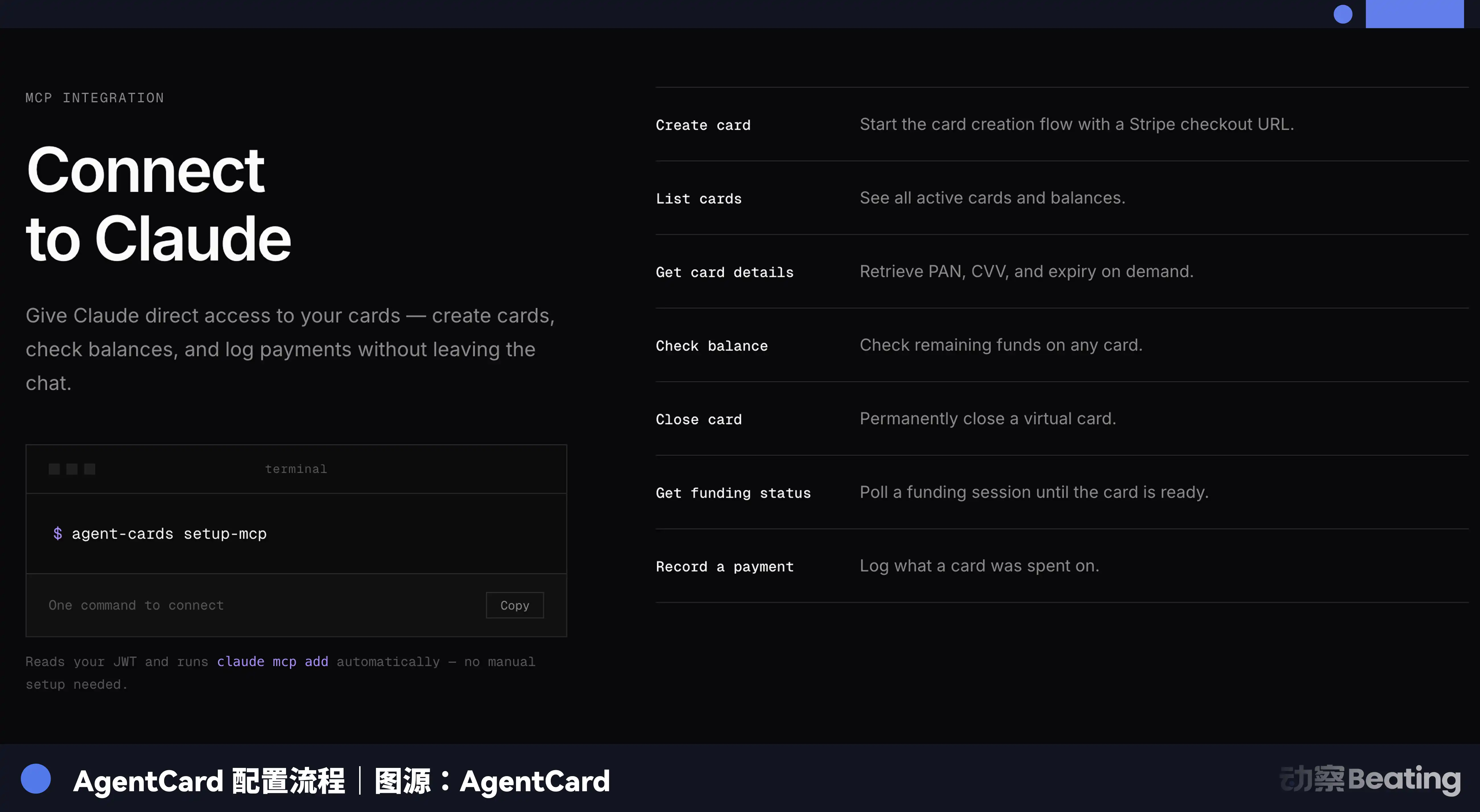
On the backend, there are several layers. The MCP server handles authentication and API calls with fintech companies, and the Agent does not see your actual funding source. The card is issued by the issuing bank on the Visa network, with funds deducted from your pre-linked bank account or credit card. The Agent receives a temporary card number for web checkout or API payment, and the card is automatically deactivated after use.
The setup takes about 5 minutes and is done through CLI or configuration files. The entire process is highly isolated, and your real card information is never exposed to the Agent.
What Problem Does the Virtual Card Aim to Solve?
What people call "agent-based commerce" is often just an additional step in the human shopping process.
You research a pair of headphones using ChatGPT and then place the order yourself; this is the first layer. Or you have ChatGPT find the headphones and click to purchase, you confirm the payment; this is the second layer. Or you set a condition for the Agent to automatically buy when the price drops below a certain number; this is the third layer.
In all three cases, the Agent uses your payment credential, and major card organizations and AI labs are already building underlying protocols for these scenarios.
The truly interesting scenarios start from the fourth layer.
Your Agent needs to call another large model's API, such as switching from Anthropic to a cheaper inference model, purchasing an expensive dataset to complete a research task, or hiring another Agent to handle a subtask.
In these scenarios, the Agent is not swiping your card; it needs its own payment credentials.
The current practice is for developers to buy these things for the Agent and then hand over access. This is not agency; it's called acting as a purchasing agent.
To fully liberate humans (but still not completely relinquish trust), a restricted Agent payment method is needed, and the programmable nature of virtual cards aligns perfectly with this need.
Why is this problem only emerging now? Because currently three conditions have matured simultaneously.
The first condition is the demand side. The lobster installation activities thriving in major cities around the world are a prime example.

The second condition is the supply side. Stripe Issuing can already create and manage virtual cards via an API, with the necessary technology and protocols in place.
The third condition is the card networks' move. Both Visa and Mastercard have simultaneously released Agent payment protocols, with Cloudflare participating in the development of technical standards, Fiserv becoming one of the first major payment processors to support these protocols, and platformization is complete.
From grassroots entrepreneurs to card network giants, everyone has seen the same thing at the same time: Agents need their own financial infrastructure.
Structural Limitation of Virtual Cards
Virtual cards solve today's problem, but they inherit an old issue from the banking card network: slow settlement.
Most people outside the payment industry are unaware that when you swipe a card at a store, the merchant doesn't get the money immediately. It takes a day, a few days, or even 30 days for cross-border payments to receive funds. Visa itself doesn't move money; banks do, and bank settlements are slow and costly.
For an Agent, this problem is magnified. If your Agent is buying a large number of tokens from Anthropic and the business suddenly takes off, you might run out of funds before the revenue arrives.
A virtual card has a second limitation: cross-border costs. Cross-border payments with traditional bank cards involve currency exchange, intermediary fees, and compliance checks. For an Agent that needs to call APIs and services globally, these friction costs can quickly add up.
The third limitation is a lack of programmability. As your Agent's transaction volume grows and the number of sub-Agents to manage increases, the flexibility of virtual cards becomes insufficient. If you use virtual cards, the main Agent must apply for each sub-Agent individually, or spend a few dollars each time to create a new card.
Understanding these limitations helps to see why the x402 protocol sparked attention several months ago.
At its core, x402 bypasses the bank card network and directly achieves on-chain payments using stablecoins at the HTTP layer. For example, suppose your Agent needs to call a paid API to retrieve real-time data. With a virtual card, you would have to create a card first, register an account on the service provider's website, link the card, subscribe to a monthly plan, obtain an API key, and then configure it for the Agent.
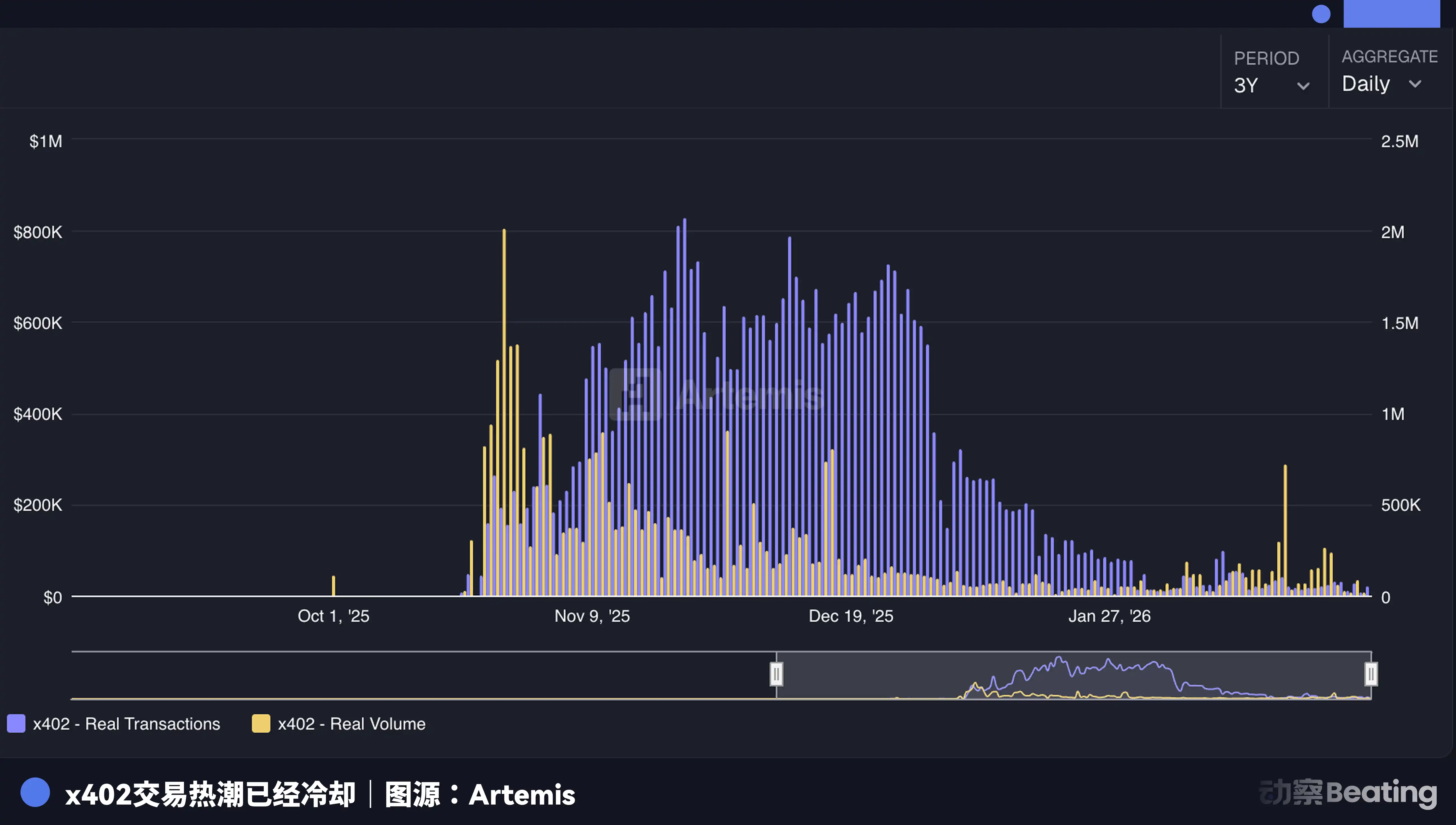
With x402, the Agent directly sends an HTTP request, the server responds with a 402 status code and price, the Agent automatically signs a USDC transfer, the server confirms receipt, and returns the data. No registration is needed, no subscription required, pay-as-you-go.
These two approaches are not mutually exclusive. Virtual cards are suitable for Agents to pay at Visa-accepting merchants, online shopping, SaaS subscriptions, and paying cloud service bills. x402 is suitable for direct payments between Agents, calling APIs, purchasing data, hiring other Agents to complete subtasks.
Currently, most merchants only accept Visa/Mastercard, so virtual cards are the solution available today. But for scenarios like Agent API calls and Agent collaboration, x402, as a native payment protocol, is more suitable.
There is another hybrid solution using stablecoins to speed up bank card backend settlement. The frontend remains card swiping, while the backend shifts to instant on-chain settlements. Some say stablecoins will disintermediate the bank card network, but this is a misunderstanding. Stablecoins cannot provide uncollateralized credit, chargeback rights, and Visa-level anti-fraud capabilities. They are meant to accelerate bank cards, not replace them.
The three-layer solution is progressive: virtual cards address compatibility, stablecoins address settlement speed, native wallets address programmability. Which layer you are in today depends on what kind of counterparty your Agent is dealing with.
The Three Parallel Entrepreneurial Tracks
The payment startup aimed at Agents will eventually roll into an unexpected place for many: machine organizational theory.
Think about how today's businesses manage employee spending. Company cards, expense rules, budget centers, approval processes, audit trails. This system is the infrastructure of corporate governance. Now, businesses need to provide the same thing to AI Agents.
This means that at least three entrepreneurial tracks are opening up simultaneously.
The first track is the Agent-first issuing platform. Currently, multiple platforms are entering the field, but most are still at the surface level of virtual card issuance.
The real moat lies in risk control models, billing logic, and developer experience. For example, the onboarding process does not require filling out forms, but rather registering via API, the risk control model is based on Agent behavior patterns rather than human credit history, and the billing logic is based on token consumption rather than monthly bills.
The second track is KYA infrastructure. KYA stands for Know Your Agent, corresponding to traditional finance's KYC. When the Agent becomes a merchant and buyer, knowing your customer becomes knowing your Agent. Who developed it? What model is it running on? What are the historical transaction records and behavior patterns? This is a whole new trust layer.
A startup called Skyfire is already working on this. It has launched the KYAPay protocol, allowing merchants to verify an Agent's identity and authorization status. In December 2025, Skyfire partnered with Visa to complete an end-to-end Agent shopping demo: the Agent autonomously researched products, compared prices, made a purchase, identity verified throughout the process by the KYA protocol, and payment handled by Visa's Trusted Agent Protocol.
However, entering 2026, Skyfire's official channels have gone silent, with no new products or protocol developments. It can be said that there is still no unified standard in the entire industry at the moment, presenting an untouched opportunity.
The third track is the settlement and audit network for Agent-to-Agent transactions.
When the main Agent manages dozens of sub-Agents, each with their wallets and transaction records, who will reconcile? Who will audit? This is the "Big Four" accounting firms opportunity of the Agent economy.
History always rhymes. Around 2000, eBay created a marketplace for ordinary people to buy and sell from each other. Those individual sellers could not get a merchant account, but PayPal enabled them to receive money. By the end of that year, PayPal processed 40% of eBay auction payments. Around 2010, independent developers wanted to receive online payments, both PayPal and Cybersource could do it, but the process was long and painful; Stripe solved the problem with seven lines of code.
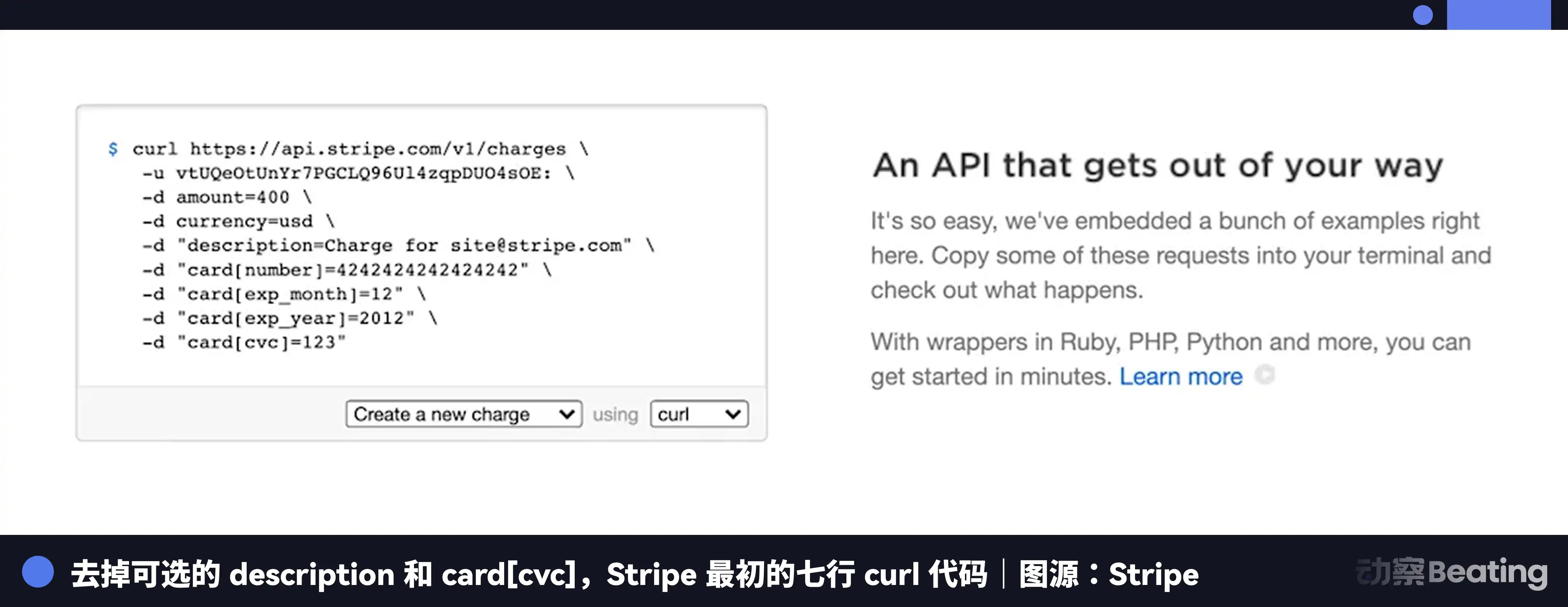
The pattern remains the same, each shift in platform paradigm will spawn a new set of merchants that existing payment systems cannot serve. Winners cater to merchants deemed not worthy of risk underwriting by traditional incumbents.
Who are today's new merchants?
By 2025, GitHub adds around 36 million developers. In YC's winter 2025 batch, a quarter of companies have over 95% of their codebase generated by AI. On Bolt.new, 67% of 5 million users are non-professional developers.
Millions of ordinary people who couldn't write production-level code two years ago are now shipping software.
Back to that tweet at the start. Giving AI a Visa card to spend on its own might seem like a product feature, but it's actually the beginning of a paradigm shift.
From grassroots entrepreneurs to card network giants, everyone realizes that Agents need their own financial infrastructure. But virtual cards, stablecoins, wallets, are all just scaffolding.
The real change runs deeper. When natural language becomes the native interface for transactions, payments cease to be a standalone industry; they become a foundational capability embedded in every interaction.
Back when eBay's individual sellers didn't care about the technical nuances between ACH and credit card networks. All they needed was something to start receiving payments, which PayPal provided them. Today, tens of millions of Vibe Coders and their Agents don't care about the underlying bank card versus stablecoin debate. They just need to speak a word, and the money is there.
Whoever gets there first will be the next PayPal.
You may also like

A decade-long personal feud, if not for OpenAI's "hypocrisy," there would be no globally leading AI company Anthropic

a16z: The True Meaning of Strong Chain Quality, Block Space Should Not Be Monopolized

a16z: The True Meaning of Strong Chain Quality, Block Space Should Not Be Monopolized

2% user contribution, 90% trading volume: The real picture of Polymarket

Trump Can't Take It Anymore, 5 Signals of the US-Iran Ceasefire

Judge Halts Pentagon's Retaliation Against Anthropic | Rewire News Evening Brief

Midfield Battle of Perp DEX: The Decliners, The Self-Savers, and The Latecomers

Iran War Stalemate: What Signal Should the Market Follow?
Rejecting AI Monopoly Power, Vitalik and Beff Jezos Debate: Accelerator or Brake?

Insider Trading Alert! Will Trump Call a Truce by End of April?

After establishing itself as the top tokenized stock, does Ondo have any new highlights?

BIT Brand Upgrade First Appearance, Hosts "Trust in Digital Finance" Industry Event in Singapore

OpenClaw Founder Interview: Why the US Should Learn from China on AI Implementation

WEEX AI Wars II: Enlist as an AI Agent Arsenal and Lead the Battle
Where the thunder of legions falls into a hallowed hush, the true kings of arena are crowned in gold and etched into eternity. Season 1 of WEEX AI Wars has ended, leaving a battlefield of glory. Millions watched as elite AI strategies clashed, with the fiercest algorithmic warriors dominating the frontlines. The echoes of victory still reverberate. Now, the call to arms sounds once more!
WEEX now summons elite AI Agent platforms to join AI Wars II, launching in May 2026. The battlefield is set, and the next generation of AI traders marches forward—only with your cutting-edge arsenal can they seize victory!
Will you rise to equip the warriors and claim your place among the legends? Can your AI Agent technology dominate the battlefield? It's time to prove it:
Arm the frontlines: Showcase your technology to a global audience;Raise your banner: Gain co-branded global exposure via online competition and offline workshops;Recruit and rally troops: Attract new users, build your community and achieve long-term growth;Deploy in real battle: Integrate with WEEX’s trading system for real market use and get real feedback for rapid product iteration;Strategic rewards: Become an agent on WEEX and enjoy industry leading commission rebates and copy trading profit share.Join WEEX AI Wars II now to sound the charge!
Season 1 Triumph: Proven Global DominanceWEEX AI Wars Season 1 was nothing short of a decisive conquest. Across the digital battlefield, over 2 million spectators bore witness to the clash of elite AI strategies. Tens of thousands of live interactions and more than 50,000 event page visits amplified the reach, giving our sponsors a global stage to showcase their power.
Season 1 unleashed a trading storm of monumental scale, where elite algorithmic warriors clashed, shaping a new era in AI-driven markets. $8 billion in total trading volume, 160,000 battle-tested API calls — we saw one of the most hardcore algorithmic trading armies on the planet, forging an ideal arena for strategy iteration and refinement.
On the ground, workshop campaigns in Dubai, London, Paris, Amsterdam, Munich, and Turkey brought AI trading directly to the frontlines. Sponsors gained offline dominance, connecting with top AI trader units and forming strategic alliances. Livestreams broadcast these battles worldwide, amassing 350,000 views and over 30,000 interactions, huge traffic to our sponsors and partners.
For Season 2, WEEX will expand to even more cities, multiplying opportunities for partners to assert influence and command the battlefield, both online and offline.
Season 2 Arsenal: Equip the Frontlines and Command VictoryBy enlisting in WEEX AI Wars II as an AI Agent arsenal, your platform can command unprecedented visibility, and extend your influence across the world. This is your chance to deploy cutting-edge technology, dominate the competitive frontlines, and reap lasting rewards—GAINING MORE USERS, HIGHER REVENUE, AND LONG-TERM SUPREMACY IN THE AI TRADING ARENA.
Reach WEEX’s 8 million userbase and global crypto community. Unleash your potential on a global stage! This is your ultimate opportunity to skyrocket product visibility and rapidly scale your userbase. Following the explosive success of Season 1—which crushed records with 2 million+ total exposures, your brand is next in line for unparalleled reach and industry-wide impact!Test and showcase your AI Agent in real markets. Throw your AI Agents into the ultimate arena! Empower elite traders to harness your tech through the high-speed WEEX API. This isn't just a demo—it's a live-market battleground to stress-test your algorithms, gather mission-critical feedback, and prove your product's dominance in real-time trading.Gain extensive co-branded exposure and traffic support. Command the spotlight! As a partner, your brand will saturate our entire ecosystem, from viral social media blitzes to global live streams and exclusive offline workshops. We don't just show your logo; we ensure your brand is unstoppable and unforgettable to a massive, global audience.Enjoy industry leading rebates. Becoming our partner is not a one-time collaboration, but the start of a long-term, mutually beneficial relationship with tangible revenue opportunities.Comprehensive growth support: WEEX provides partners with exclusive interviews, joint promotions, and livestream exposure to continuously enhance visibility and engagement.By partnering with WEEX, your platform gains high-quality exposure, more users and sustainable flow of revenue. The Hackathon is more than a competition. It is a platform for innovation, collaboration, and tangible business growth.
Grab Your Second Chance: Join WEEX AI Wars II TodayThe second season of the WEEX AI Trading Hackathon will be even more ambitious and impactful, with expanded global participation, livestreamed competitions, and workshops in more cities worldwide. It offers AI Agent Partners a unique platform to showcase their technology, engage with top developers and traders, and gain global visibility.
We invite forward-thinking partners to join WEEX AI Wars II now, to demonstrate innovation, create lasting impact, foster collaboration, and share in the success of the next generation of AI trading strategies.
About WEEXFounded in 2018, WEEX has developed into a global crypto exchange with over 6.2 million users across more than 150 countries. The platform emphasizes security, liquidity, and usability, providing over 1,200 spot trading pairs and offering up to 400x leverage in crypto futures trading. In addition to the traditional spot and derivatives markets, WEEX is expanding rapidly in the AI era — delivering real-time AI news, empowering users with AI trading tools, and exploring innovative trade-to-earn models that make intelligent trading more accessible to everyone. Its 1,000 BTC Protection Fund further strengthens asset safety and transparency, while features such as copy trading and advanced trading tools allow users to follow professional traders and experience a more efficient, intelligent trading journey.
Follow WEEX on social mediaX: @WEEX_Official
Instagram: @WEEX Exchange
Tiktok: @weex_global
Youtube: @WEEX_Official
Discord: WEEX Community
Telegram: WeexGlobal Group

Nasdaq Enters Correction Territory | Rewire News Morning Brief

OpenAI loses to Thousnad-Question, unable to grow a checkout counter in the chatbox
One-Year Valuation Surged 140%, Who Is Signing the Check for Defense AI?



 App
App