
 Buy Crypto
- Markets
 Futures
- Spot
- Copy Trade
- Earn
- More
The new center of Crypto

Original Title: Crypto Finally Has a Center
Original Author: Azeem, Co-founder of Miden, Contributor at Forbes Crypto
Original Compilation: Ken, ChainCatcher
When I wrote for CoinDesk in 2024 about whether the cryptocurrency conference circuit was beneficial for the industry, there was no clear center in the crypto space. The entire industry resembled a fluid city, moving between conferences around the world. Two years later, the situation looks entirely different. Cryptocurrency finally has a center again, and it is becoming increasingly clear that this center is New York.
I have spent over five years in this circuit, and this experience has gradually changed my perspective on the actual role that conferences play in this industry.
At that time, the conference circuit had practical utility. The industry was geographically very dispersed. Developers, investors, and founders were spread out across the globe in a truly decentralized manner, and conferences were often the only moments when the entire ecosystem could reliably gather in one place. Around each major event, hundreds of peripheral gatherings would emerge. Teams would spend months traveling throughout the year.
My argument back then was simple: if this industry wants to achieve true mainstream adoption, we need to ask ourselves whether spending so much time on the road truly helps us create anything meaningful.
Launching in the Conference Circuit
Shortly after writing that article, I joined Miden in April 2024, when the project had just spun off from Polygon and announced a $25 million funding round led by a16z crypto, 1kx, and Hack VC. At that stage, I felt that the conference circuit indeed played a substantive role.
Privacy issues were gradually becoming an important topic of discussion in the cryptocurrency space, and launching new protocols meant explaining what we were building and why it was so important. This meant that for most of the next year, we would spend our time speaking at various conferences, participating in podcasts, and meeting developers, investors, and institutions trying to understand the future direction of the industry, especially within the more pure crypto-native communities.
Like many other cryptocurrency practitioners, I spent much of 2025 hopping between events in Asia, Europe, Latin America, and the United States. Korean Blockchain Week, Token2049 in Singapore, Devconnect in Buenos Aires, and Abu Dhabi Finance Week were all stops on my journey.
For teams launching new projects, conferences remained one of the fastest ways to meet people across the ecosystem and start building relationships. And I believe this approach was indeed effective. In a short period, we transformed from a project known only under the Polygon banner to one of the most talked-about privacy projects in the industry today.
Momentum of the Bull Market
Even as some sectors of the market began to slow down, the entire industry did not immediately change its behavior.
The tail end of the bull market cycle continued into 2025, largely driven by the meme coin frenzy that had prevailed the previous year. Capital was still flowing. Teams still had travel budgets. Conferences continued to expand on the calendar.
Around major gatherings, various peripheral events proliferated. Teams flew from one city to the next, often attending multiple conferences within a month.
When the market is strong, these temptations are hard to resist. Conferences can provide visibility, opportunities to connect with investors, and reinforce project narratives in a cycle where "attention itself is often a currency." When this attention leads to token price increases, it is hard to argue against its benefits, but when the bear market arrives, the situation changes.
For a time, despite the objective conditions supporting the conference circuit beginning to change, it continued to operate at full speed. People were reluctant to acknowledge that the situation was rapidly changing and wanted to continue using the methods that had worked in the past. This is often a "reliable" path that ultimately leads to failure.
A Market That Now Requires Discipline
Now, in 2026, the broader environment looks entirely different.
Funding has become tighter. Venture capital firms are betting larger amounts on fewer companies. Budgets across the industry are shrinking, and teams are becoming more cautious about how they spend time and money.
The cost of attending conferences is high. Tickets, flights, hotels, and sponsorship fees quickly add up to a significant sum. But the real cost is time. When small teams pull multiple members away from their work for days or even weeks, the opportunity cost becomes enormous.
The industry is finally starting to ask a question that should have been raised long ago: what is the actual return on investment?
Regulatory Shifts
Since I wrote that initial article, another significant change has been the regulatory environment in the United States.
For most of the past four years, the industry has operated under the oversight of the Biden administration and the U.S. Securities and Exchange Commission led by Gary Gensler. During this time, regulatory clarity around cryptocurrency has largely been lacking. Enforcement actions have dominated discussions, while companies have struggled to understand how digital assets will ultimately be governed by U.S. law.
As a result, the industry has increasingly looked overseas. Cities like Singapore, Hong Kong, and Dubai have competed to position themselves as global cryptocurrency hubs, while many companies have one foot outside the U.S. to avoid regulatory uncertainty.
With Donald Trump's election and the transition to a new SEC led by Paul Atkins, along with continued leadership from Commissioner Hester Peirce and the establishment of a "crypto task force" focused on promoting innovation, this environment has begun to change.
From a regulatory perspective, this shift is significant. The tone towards developers and entrepreneurs is clearly more constructive than it was a few years ago, and many companies are feeling for the first time in a long while that the U.S. is a place where cryptocurrency can thrive rather than just barely survive.
Last year, Washington also saw a concrete milestone. The passage of the GENIUS Act established the first comprehensive federal framework for stablecoins. Companies issuing centralized stablecoins received clearer guidance for the first time on how to hold reserves, what types of collateral are needed, and what consumer protection measures must be implemented. This marked an important step towards regulatory clarity for one of the most widely used components in the crypto ecosystem.
The next major development to watch is the progress of the CLARITY Act, which aims to address broader market structure issues surrounding digital assets. If passed, it will further clarify how cryptocurrency companies operate within the U.S. regulatory framework.
These developments collectively indicate that the U.S. is beginning to move from a period of regulatory ambiguity towards a more defined digital asset framework. For developers and investors, this shift changes the rationale for where to establish companies and deploy capital.
At the same time, it would be dishonest not to acknowledge the other side of the equation. While the government has taken some favorable regulatory steps for the industry, the evolution of certain political ecosystems surrounding cryptocurrency has also raised legitimate concerns. In particular, the proximity of cryptocurrency activities to actions that seem to benefit the president and his family poses a risk to the industry's credibility.
These two realities coexist. Regulators are more supportive of innovation, but in some cases, the optics surrounding cryptocurrency in Washington have made the industry's image worse, even more so than the damage that many critics could inflict on their own.
Why Conferences Are a Bad Time to Network
Around the same time, I began to notice another thing.
Conferences are excellent venues for reconnecting and maintaining relationships. But they are often one of the worst environments for doing truly meaningful work.
Everyone's schedules are packed. Those who fly in for the conference are busy. Locals are even busier, as they host dinners, meetings, and peripheral events all week long.
Conversations become rushed. Conference time is short. The people you really need to spend time with are pulled in various directions and stretched thin.
In many ways, conferences have turned into places where people simply catch up, complaining about the market, regulations, or whatever topic the industry is debating that week.
Staying After the Conference
By the end of 2025, I decided to try a different approach.
I was invited to speak on a privacy panel at Abu Dhabi Finance Week. But instead of rushing off after the panel, I stayed in the UAE for over a month.
Initially, even my own team didn’t fully understand this decision. I couldn’t completely explain why staying so long would be beneficial. But they trusted my judgment.
The reasoning was simple. If conferences are the worst time to network in a city, what happens if you stay after everyone leaves? You can truly invest meaningful time to get everything done that is needed for business collaborations.
The answer was clear. In the weeks following the conference, we were able to engage in deeper conversations with banks, regulators, and fintech companies in the region.
These conversations led to partnerships with a bank, collaboration with CBIx, and business discussions with two large fintech companies. Some of this work has yet to be made public. Given the current geopolitical events happening in the Middle East, we chose to be thoughtful about whether now is the right time to announce new business partnerships in the region.
The conference opened the door. The real work happened afterward.
Real Business Collaborations Happen Outside the Circuit
I brought this experience into early 2026.
I didn’t attend the Consensus conference in Hong Kong; instead, I leveraged the connections I made in the UAE to go to Uzbekistan and Kazakhstan.
In Tashkent, Astana, and Almaty, I met with central banks, regulators, commercial banks, and fintech companies to discuss how crypto infrastructure could integrate into their financial systems.
These conversations were far more substantive than anything that typically happens during conference week.
Around the same time, I attended ETHDenver, which has been one of the most important Ethereum developer conferences in North America for years.
However, this year’s scale was noticeably smaller than in previous years, at about a quarter of the size of the previous year. Part of the reason was scheduling. The conference coincided with the Chinese New Year and the Korean Lunar New Year, which meant many developers from Asia simply couldn’t attend. Organizers also reported that many of the visa invitation letters they issued were rejected, further limiting international attendance.
Despite this, the signals sent to the industry were still strong. I personally scheduled so many meetings that I couldn’t attend them all during the conference. But this experience also confirmed another thing: as the industry matures, events like ETHDenver may begin to feel less like global gatherings and more like powerful regional conferences.
Parallel Worlds in the Cryptocurrency Space
Some of the issues are structural.
Historically, cryptocurrency conferences have existed on parallel tracks.
Developer conferences focus on developers and protocol teams. Institutional gatherings bring together banks, regulators, and financial firms. Industry conferences gather founders, investors, and media in one place.
Each environment has its value, but they rarely intersect.
Developers talk to developers. Institutions talk to institutions. Investors talk to investors.
True progress in the cryptocurrency space will occur when these groups begin to merge and intersect.
New York Becomes the Center
As regulatory clarity in the U.S. begins to improve, another shift is also becoming clear. Over the past two years, New York has quietly emerged as the center of the cryptocurrency industry.
Young developers are gathering in Brooklyn, often working in co-working spaces like Brass Factory in Williamsburg. Venture capital firms like Dragonfly, a16z Crypto, and Bain Capital Crypto are concentrated around Union Square and Soho in Manhattan.
Several major projects, including Uniswap, Aave, Gauntlet, and Monad, have now established offices in the city. Plume recently even rented an entire floor of the Empire State Building.
Opening an office in New York is increasingly becoming a sign that a company has established a foothold in the cryptocurrency space.
It should not be surprising that New York is becoming the center of cryptocurrency. The city has long been the financial, media, and fashion capital of the world. When an industry reaches a certain level of maturity, it naturally gravitates towards places where capital, talent, and influence have already converged. Additionally, for young developers deciding where to settle, New York remains one of the most attractive cities in the world to live in, aside from work, which is undoubtedly a plus.
For decades, the same logic has applied to traditional finance. If you wanted to find the best job in finance, you had to move to New York. Cryptocurrency is beginning to follow the same pattern.
If New York is becoming the center of the cryptocurrency industry, it is only natural that the city will eventually host a defining conference for it. We are already beginning to see early versions of this trend. The Digital Asset Summit is held annually in New York, and its influence continues to grow, while ETHGlobal plans to host a major event in the city later this year. What remains unclear is which gathering will ultimately become the iconic conference that anchors the New York cryptocurrency calendar.
San Francisco vs. New York
Meanwhile, another geographical shift is occurring.
Artificial intelligence is increasingly centered in San Francisco, while cryptocurrency is increasingly centered in New York.
As AI agents and automated financial systems evolve, these ecosystems will eventually converge more deeply.
But the time required for this convergence may be longer than many expect compared to the hype we see online today. As someone who has been in this circle for a while, I know that everything in life always takes longer than you expect.
Becoming "Small Fish" Again
As the industry matures, cryptocurrency companies will also need to adapt to environments where they are no longer the center of attention.
For years, the conference circuit in cryptocurrency allowed the industry to operate within its own bubble. Founders and investors became the "cool kids in high school," moving from one event to another, invited to private dinners and exclusive gatherings.
The next phase of growth will look different.
Companies cannot simply attend crypto-native conferences; they will increasingly need to participate in larger financial and tech events, such as Davos, Money20/20, or conferences hosted by major financial institutions.
In these environments, cryptocurrency becomes the small fish in a big pond. But this is precisely where true mainstream adoption happens. It simply depends on who can navigate this transition smoothly.
Integration, Not Disappearance
Conferences will not disappear.
The conference circuit is more likely to move towards integration. The industry will no longer be scattered across dozens of globally impactful events but will revolve around a few major gatherings, while other conferences evolve into regional events.
Events that can successfully bring together developers, capital, and institutions will become the most important conferences in the cryptocurrency space.
The End of the Fluid City
For many in the cryptocurrency space, the conference circuit has also been a culture.
Here, you meet friends, attend dinners, and catch up with the same group multiple times a year. For a long time, cryptocurrency felt like a fluid city, moving between various conferences.
Some may nostalgically look back on that era. In that period, the industry was smaller, work felt lighter, and the same group moved from one event to the next.
But the market is evolving. By 2026, companies that can adapt to the new environment will survive, while those that continue to rely on the old script may find themselves facing extinction. Some companies have inevitably shut down this year due to their failure to keep pace with market evolution.
The conference circuit has not disappeared. It is simply changing.
Cryptocurrency finally has a center again. As the industry matures, the endless global circuit that once held the entire industry together will give way to fewer, more focused gatherings that are closely tied to places where real work is being done.
You may also like

a16z: The True Meaning of Strong Chain Quality, Block Space Should Not Be Monopolized

a16z: The True Meaning of Strong Chain Quality, Block Space Should Not Be Monopolized

2% user contribution, 90% trading volume: The real picture of Polymarket

Trump Can't Take It Anymore, 5 Signals of the US-Iran Ceasefire

Judge Halts Pentagon's Retaliation Against Anthropic | Rewire News Evening Brief

Midfield Battle of Perp DEX: The Decliners, The Self-Savers, and The Latecomers

Iran War Stalemate: What Signal Should the Market Follow?
Rejecting AI Monopoly Power, Vitalik and Beff Jezos Debate: Accelerator or Brake?

Insider Trading Alert! Will Trump Call a Truce by End of April?

After establishing itself as the top tokenized stock, does Ondo have any new highlights?

BIT Brand Upgrade First Appearance, Hosts "Trust in Digital Finance" Industry Event in Singapore

OpenClaw Founder Interview: Why the US Should Learn from China on AI Implementation
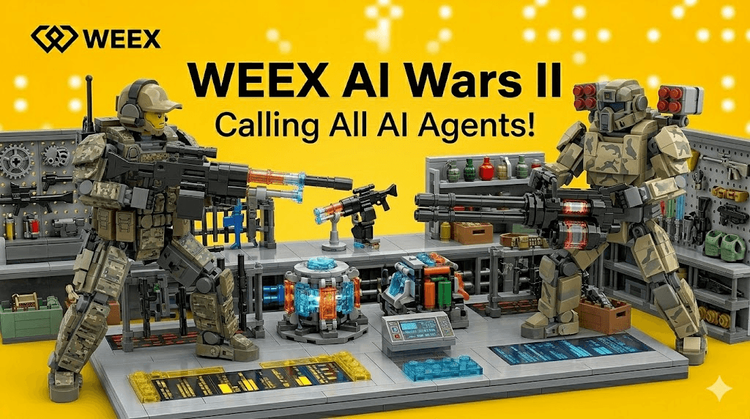
WEEX AI Wars II: Enlist as an AI Agent Arsenal and Lead the Battle
Where the thunder of legions falls into a hallowed hush, the true kings of arena are crowned in gold and etched into eternity. Season 1 of WEEX AI Wars has ended, leaving a battlefield of glory. Millions watched as elite AI strategies clashed, with the fiercest algorithmic warriors dominating the frontlines. The echoes of victory still reverberate. Now, the call to arms sounds once more!
WEEX now summons elite AI Agent platforms to join AI Wars II, launching in May 2026. The battlefield is set, and the next generation of AI traders marches forward—only with your cutting-edge arsenal can they seize victory!
Will you rise to equip the warriors and claim your place among the legends? Can your AI Agent technology dominate the battlefield? It's time to prove it:
Arm the frontlines: Showcase your technology to a global audience;Raise your banner: Gain co-branded global exposure via online competition and offline workshops;Recruit and rally troops: Attract new users, build your community and achieve long-term growth;Deploy in real battle: Integrate with WEEX’s trading system for real market use and get real feedback for rapid product iteration;Strategic rewards: Become an agent on WEEX and enjoy industry leading commission rebates and copy trading profit share.Join WEEX AI Wars II now to sound the charge!
Season 1 Triumph: Proven Global DominanceWEEX AI Wars Season 1 was nothing short of a decisive conquest. Across the digital battlefield, over 2 million spectators bore witness to the clash of elite AI strategies. Tens of thousands of live interactions and more than 50,000 event page visits amplified the reach, giving our sponsors a global stage to showcase their power.
Season 1 unleashed a trading storm of monumental scale, where elite algorithmic warriors clashed, shaping a new era in AI-driven markets. $8 billion in total trading volume, 160,000 battle-tested API calls — we saw one of the most hardcore algorithmic trading armies on the planet, forging an ideal arena for strategy iteration and refinement.
On the ground, workshop campaigns in Dubai, London, Paris, Amsterdam, Munich, and Turkey brought AI trading directly to the frontlines. Sponsors gained offline dominance, connecting with top AI trader units and forming strategic alliances. Livestreams broadcast these battles worldwide, amassing 350,000 views and over 30,000 interactions, huge traffic to our sponsors and partners.
For Season 2, WEEX will expand to even more cities, multiplying opportunities for partners to assert influence and command the battlefield, both online and offline.
Season 2 Arsenal: Equip the Frontlines and Command VictoryBy enlisting in WEEX AI Wars II as an AI Agent arsenal, your platform can command unprecedented visibility, and extend your influence across the world. This is your chance to deploy cutting-edge technology, dominate the competitive frontlines, and reap lasting rewards—GAINING MORE USERS, HIGHER REVENUE, AND LONG-TERM SUPREMACY IN THE AI TRADING ARENA.
Reach WEEX’s 8 million userbase and global crypto community. Unleash your potential on a global stage! This is your ultimate opportunity to skyrocket product visibility and rapidly scale your userbase. Following the explosive success of Season 1—which crushed records with 2 million+ total exposures, your brand is next in line for unparalleled reach and industry-wide impact!Test and showcase your AI Agent in real markets. Throw your AI Agents into the ultimate arena! Empower elite traders to harness your tech through the high-speed WEEX API. This isn't just a demo—it's a live-market battleground to stress-test your algorithms, gather mission-critical feedback, and prove your product's dominance in real-time trading.Gain extensive co-branded exposure and traffic support. Command the spotlight! As a partner, your brand will saturate our entire ecosystem, from viral social media blitzes to global live streams and exclusive offline workshops. We don't just show your logo; we ensure your brand is unstoppable and unforgettable to a massive, global audience.Enjoy industry leading rebates. Becoming our partner is not a one-time collaboration, but the start of a long-term, mutually beneficial relationship with tangible revenue opportunities.Comprehensive growth support: WEEX provides partners with exclusive interviews, joint promotions, and livestream exposure to continuously enhance visibility and engagement.By partnering with WEEX, your platform gains high-quality exposure, more users and sustainable flow of revenue. The Hackathon is more than a competition. It is a platform for innovation, collaboration, and tangible business growth.
Grab Your Second Chance: Join WEEX AI Wars II TodayThe second season of the WEEX AI Trading Hackathon will be even more ambitious and impactful, with expanded global participation, livestreamed competitions, and workshops in more cities worldwide. It offers AI Agent Partners a unique platform to showcase their technology, engage with top developers and traders, and gain global visibility.
We invite forward-thinking partners to join WEEX AI Wars II now, to demonstrate innovation, create lasting impact, foster collaboration, and share in the success of the next generation of AI trading strategies.
About WEEXFounded in 2018, WEEX has developed into a global crypto exchange with over 6.2 million users across more than 150 countries. The platform emphasizes security, liquidity, and usability, providing over 1,200 spot trading pairs and offering up to 400x leverage in crypto futures trading. In addition to the traditional spot and derivatives markets, WEEX is expanding rapidly in the AI era — delivering real-time AI news, empowering users with AI trading tools, and exploring innovative trade-to-earn models that make intelligent trading more accessible to everyone. Its 1,000 BTC Protection Fund further strengthens asset safety and transparency, while features such as copy trading and advanced trading tools allow users to follow professional traders and experience a more efficient, intelligent trading journey.
Follow WEEX on social mediaX: @WEEX_Official
Instagram: @WEEX Exchange
Tiktok: @weex_global
Youtube: @WEEX_Official
Discord: WEEX Community
Telegram: WeexGlobal Group

Nasdaq Enters Correction Territory | Rewire News Morning Brief

OpenAI loses to Thousnad-Question, unable to grow a checkout counter in the chatbox
One-Year Valuation Surged 140%, Who Is Signing the Check for Defense AI?

Bittensor vs. Virtuals: Two Distinct AI Flywheel Mechanisms



 App
App