
Tokenomics' Year of Reckoning
Original Article Title: "The Debunked Year of the Tokenomics"
Original Article Authors: Kaori, Sleepy.txt, Dynamic Observation Beating
When the Bitcoin ETF was approved in early 2024, many cryptocurrency practitioners jokingly referred to each other as "esteemed Wall Street traders." However, when the New York Stock Exchange actually planned to develop on-chain stocks, enable 24/7 trading, and integrate tokens into the traditional financial agenda, the crypto community belatedly realized that the crypto industry had not taken over Wall Street.
On the contrary, Wall Street had been betting on convergence from the beginning and has now slowly transitioned into an era of mutual acquisitions, with crypto companies buying traditional finance's licenses, clients, and regulatory capabilities, and traditional finance acquiring crypto's technology, pipelines, and innovation capabilities. Both sides are permeating each other, and the boundaries are gradually disappearing. In three to five years, there may be no distinction between crypto companies and traditional financial institutions, only financial companies.
This assimilation and integration are being legally facilitated by the "Clear Market Regulation for Digital Assets Act" (hereinafter referred to as the CLARITY Act), transforming a wildly growing crypto space into a shape familiar to Wall Street at the institutional level. The first thing to be reformed is the concept of token rights, which is unlike stablecoins and less popular in the pure crypto space.
The Era of Binary Choices
For a long time, crypto practitioners and investors have been in an uneasy state of anxiety, often subjected to enforcement-style regulation by government agencies worldwide. This tension has not only stifled innovation but has also left token holders with token rights in an awkward position. Unlike stockholders in the traditional financial market, token holders not only lack legal protection for information rights but also lack the right to recourse for insider trading by project teams.
Therefore, when the CLARITY Act was overwhelmingly passed in the U.S. House of Representatives last July, the entire industry pinned high hopes on it. The market's core demand was very clear: to define whether a token is a digital commodity or a security, ending the years-long jurisdictional tug-of-war between the U.S. Securities and Exchange Commission (SEC) and the Commodity Futures Trading Commission (CFTC).
The Act stipulates that only assets that are completely decentralized and have no actual controllers can be considered digital commodities under CFTC jurisdiction, akin to gold or soybeans. Any assets showing traces of centralization and raising funds through promised returns are all classified as restricted digital assets or securities, falling under the iron-fisted jurisdiction of the SEC.
For networks like Bitcoin and Ethereum that have long had no actual controllers, this is a good thing. But for the vast majority of DeFi projects and DAOs, this is almost a catastrophe.
The bill requires any intermediary involved in digital asset transactions to register and implement strict Anti-Money Laundering (AML) and Know Your Customer (KYC) procedures. For DeFi protocols running on smart contracts, this is an impossible task.
The bill summary expressly states that some decentralized financial activities related to maintaining the blockchain network will be exempted, but enforcement authority for anti-fraud and anti-manipulation will still apply. This is a typical regulatory compromise, allowing behavior such as code writing and frontend interface creation to exist, but once it involves transaction matching, revenue distribution, and intermediation services, it must be brought into a heavier regulatory framework.
It is precisely because of this compromise that the CLARITY Act did not truly reassure the industry after the summer of 2025, as it forces all projects to answer a brutal question—what are you really?
If you claim to be a decentralized protocol and comply with the CLARITY Act, your token cannot have actual value. If you don't want to mistreat token holders, you must acknowledge the importance of the equity structure and subject the token to scrutiny under securities law.
People Over Coins
This dilemma replayed itself in 2025.
In December 2025, a merger announcement triggered vastly different reactions in Wall Street and the crypto community.
Global stablecoin issuer Circle announced the acquisition of the core development team of the cross-chain protocol Axelar at Interop Labs. In the eyes of traditional financial media, this was a standard talent acquisition case where Circle gained a top cross-chain technology team to enhance the circulation capabilities of its stablecoin USDC in the multi-chain ecosystem. Circle's valuation was thus strengthened, and Interop Labs' founders and early equity investors exited satisfactorily with cash or Circle's shares.
However, in the cryptocurrency secondary market, this news sparked panic selling.
Investors, upon dissecting the transaction terms, discovered that Circle's acquisition was limited to the development team, explicitly excluding the AXL token, the Axelar network, and the Axelar Foundation. This discovery instantly shattered previous bullish expectations. After the announcement, the AXL token not only erased all previous gains from the acquisition rumors but also plunged even further into a deep sell-off.
For a long time, cryptocurrency project investors had implicitly assumed a narrative where buying tokens was equivalent to investing in the startup. With the efforts of the development team, protocol usage would increase, and the token's value would consequently rise.
The Circle acquisition shattered this illusion, declaring from a legal and practical standpoint that the development company (Labs) and the protocol network (Network) are two completely separate entities.
"This is legalized robbery," wrote an investor who had held AXL for over two years on social media. But he couldn't sue anyone because in the legal disclaimers of the IPO prospectus and white paper, the token was never promised residual claim rights to the development company.
Looking back at the 2025 wave of acquisitions of tokenized crypto projects, these acquisitions typically involve the transfer of the technical team and underlying architecture but do not include token equity, causing significant repercussions for investors.
In July, Kraken's Layer 2 network Ink acquired the engineering team of Vertex Protocol and its underlying trading architecture. Subsequently, Vertex Protocol announced the closure of services, and its token VRTX was abandoned.
In October, Pump.fun acquired the trading terminal Padre. At the same time as the announcement, the project team declared the token PADRE deprecated with no future plans.
In November, Coinbase acquired the trading terminal technology built by Tensor Labs, a move that similarly did not involve token TNSR equity.
At least in the 2025 M&A wave, more and more acquisitions tend to only buy the team and technology, disregarding the tokens. This has increasingly angered many investors in the crypto industry, with some saying, "Either give tokens the same value as stocks, or don't issue them at all."
The DeFi Dividend Dilemma
If we say that the Circle acquisition was a tragedy caused by external M&A, then Uniswap and Aave have shown the ongoing internal conflicts faced at different stages of development in the crypto market.
Aave, long seen as the king of the DeFi lending sector, found itself embroiled in a fierce internal battle over who gets the money at the end of 2025, with the conflict centered around frontend revenue of the protocol.
Most users do not directly interact with smart contracts on the blockchain but instead operate through the web interface developed by Aave Labs. In December 2025, the community keenly noticed that Aave Labs quietly modified the frontend code to redirect the high fees generated by users' token exchange transactions on the website to Labs' own company account instead of the decentralized autonomous organization (DAO) Aave treasury.
The rationale behind Aave Labs aligns with traditional business logic — we built the website, we pay for the servers, we shoulder the compliance risks, and the traffic monetization should rightfully belong to the company. However, to token holders, this is seen as a betrayal.
“Users came for the decentralized Aave protocol, not for your HTML webpage.” This debate led to a $5 billion evaporation of Aave’s token market value in a short period.
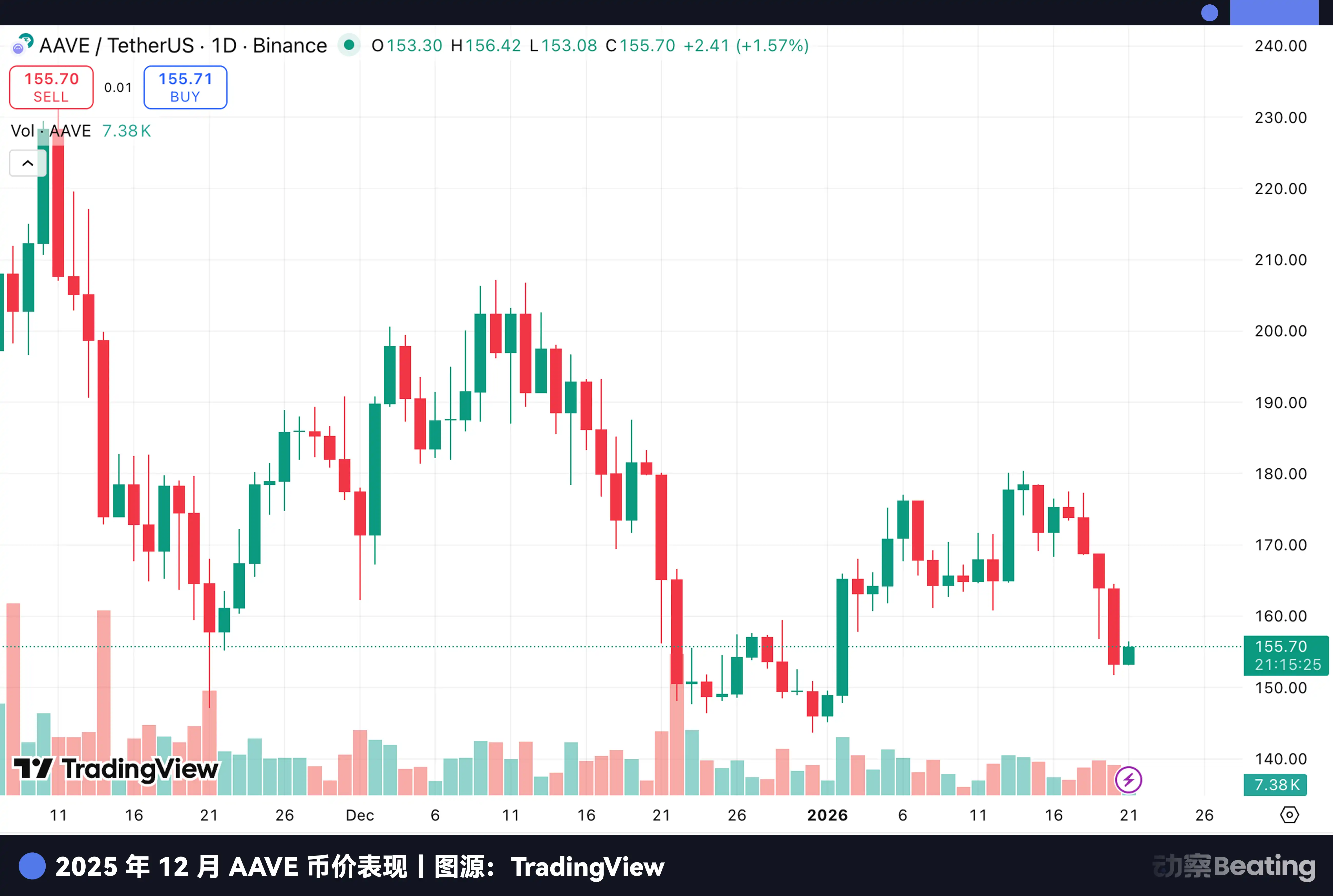
Although both parties eventually reached some form of compromise under immense public pressure, Labs pledged to put forth a proposal to share non-protocol revenue with token holders, but the crack was irreparable. While the protocol may be decentralized, the traffic entry point is always centralized. Whoever controls the entry holds the actual taxation power over the protocol’s economy.
Meanwhile, in order to comply, the decentralized exchange behemoth Uniswap also had to opt for self-censorship.
Between 2024 and 2025, Uniswap finally advanced its highly-anticipated fee switch proposal, which aimed to allocate a portion of the protocol’s trading fees to buy back and burn UNI tokens, attempting to transform the token from a dormant governance vote into a deflationary yield-bearing asset.
However, to evade SEC security classification, Uniswap had to undergo an incredibly intricate architectural split, physically isolating the entity responsible for dividends from the development team. They even registered a new entity in Wyoming called DUNA, a decentralized non-person non-profit association, in an attempt to find a compliant haven on the edge.
On December 26, Uniswap’s fee switch proposal governance vote was finally passed, with key elements including the burning of 1 billion UNI tokens and Uniswap Labs shutting down frontend fees, further focusing on protocol-layer development, etc.
The struggles of Uniswap and the internal conflict of Aave collectively point to an awkward reality — the dividends that investors crave are precisely the core basis for regulatory agencies to deem something a security. Striving to give value to a token invites a penalty from the SEC; seeking to circumvent regulations requires the token to remain in a state of no actual value.
Having the right to map out, and then what?
As we seek to understand the token rights crisis of 2025, we may cast our eyes to a more mature capital market. There lies a highly instructive reference point, the American Depositary Receipts (ADRs) of Chinese concept stocks and the Variable Interest Entity (VIE) structure.
If you buy Alibaba (BABA) stock on the Nasdaq, seasoned traders will tell you that you are not buying direct ownership of the entity company operating Taobao in Hangzhou, China. Due to legal restrictions, what you hold is an equity interest in a holding company based in the Cayman Islands, which, through a series of complex agreements, controls the operating entity in China.
This sounds a lot like some altcoins, where you are buying a representation rather than the actual asset itself.
But the lesson of 2025 tells us that there is a significant difference between ADS and tokens: legal recourse.
While the ADS structure may be circuitous, it is built on decades of international commercial law trust, a robust auditing system, and a tacit understanding between Wall Street and regulators. Most importantly, ADS holders have residual claim rights under the law. This means that if Alibaba were to be acquired or taken private, the acquirer must, through a legal process, swap your ADS for cash or the equivalent.
In contrast, tokens, especially those governance tokens that were once highly anticipated, exposed their nature in the 2025 merger frenzy—they are neither on the liability side of the balance sheet nor on the owner's equity side.
Prior to the enactment of the CLARITY Act, this fragile relationship was maintained through community consensus and bull market faith. Developers implied that tokens were akin to stocks, and investors pretended they were VCs. Yet, when the hammer of 2025 compliance struck, everyone began to realize that, within the traditional corporate law framework, token holders are neither creditors nor shareholders; they are more like fans who have purchased an expensive membership card.
When assets can be traded, rights can be divided. When rights are divided, value gravitates toward the end most recognizable by the law, most capable of cash flow, and most enforceable.
In this sense, the crypto industry of 2025 has not failed but has been integrated into financial history. It has begun, like all mature financial markets, to undergo judgment in terms of capital structure, legal texts, and regulatory boundaries.
As crypto converges with traditional finance in an irreversible trend, a sharper question arises: where will the industry's value flow next?
Many believe that fusion implies victory, but historical experience often suggests the opposite. When a new technology is embraced by the old system, it gains scale but may not preserve the original promised distribution. The old system excels at domesticating innovation into a form that is regulatory compliant, accountable, and balance-sheetable, firmly anchoring residual claim rights to existing structures of power.
The compliance of crypto may not necessarily return value to token holders but is more likely to return value to familiar legal entities—companies, equities, licenses, regulated accounts, and contracts that can be liquidated and enforced in court.
The rights of the coin will continue to exist, just as ADS will continue to exist. They are both rights mappings allowed to trade in financial engineering. But the question is, which layer of mapping are you actually buying?
You may also like
Decoding Strategy’s Latest Financial Report: After a $12.4 Billion Loss, How Long Can the Bitcoin Flywheel Keep Spinning?
When earnings reports become electrocardiograms of Bitcoin’s price, Strategy is not merely a company—it’s an experiment testing whether faith can overcome gravity.

Discover How to Participate in Staking
Staking is a digital asset yield product launched by the WEEX platform. By subscribing to Staking products, users can stake their idle digital assets and earn corresponding Staking rewards.

WEEX AI Trading Hackathon Rules & Guidelines
This article explains the rules, requirements, and prize structure for the WEEX AI Trading Hackathon Finals, where finalists compete using AI-driven trading strategies under real market conditions.

From 0 to $1 Million: Five Steps to Outperform the Market Through Wallet Tracking

Token Cannot Compound, Where Is the Real Investment Opportunity?

February 6th Market Key Intelligence, How Much Did You Miss?

China's Central Bank and Eight Other Departments' Latest Regulatory Focus: Key Attention to RWA Tokenized Asset Risk
Foreword: Today, the People's Bank of China's website published the "Notice of the People's Bank of China, National Development and Reform Commission, Ministry of Industry and Information Technology, Ministry of Public Security, State Administration for Market Regulation, China Banking and Insurance Regulatory Commission, China Securities Regulatory Commission, State Administration of Foreign Exchange on Further Preventing and Dealing with Risks Related to Virtual Currency and Others (Yinfa [2026] No. 42)", the latest regulatory requirements from the eight departments including the central bank, which are basically consistent with the regulatory requirements of recent years. The main focus of the regulation is on speculative activities such as virtual currency trading, exchanges, ICOs, overseas platform services, and this time, regulatory oversight of RWA has been added, explicitly prohibiting RWA tokenization, stablecoins (especially those pegged to the RMB). The following is the full text:
To the people's governments of all provinces, autonomous regions, and municipalities directly under the Central Government, the Xinjiang Production and Construction Corps:
Recently, there have been speculative activities related to virtual currency and Real-World Assets (RWA) tokenization, disrupting the economic and financial order and jeopardizing the property security of the people. In order to further prevent and address the risks related to virtual currency and Real-World Assets tokenization, effectively safeguard national security and social stability, in accordance with the "Law of the People's Republic of China on the People's Bank of China," "Law of the People's Republic of China on Commercial Banks," "Securities Law of the People's Republic of China," "Law of the People's Republic of China on Securities Investment Funds," "Law of the People's Republic of China on Futures and Derivatives," "Cybersecurity Law of the People's Republic of China," "Regulations of the People's Republic of China on the Administration of Renminbi," "Regulations on Prevention and Disposal of Illegal Fundraising," "Regulations of the People's Republic of China on Foreign Exchange Administration," "Telecommunications Regulations of the People's Republic of China," and other provisions, after reaching consensus with the Cyberspace Administration of China, the Supreme People's Court, and the Supreme People's Procuratorate, and with the approval of the State Council, the relevant matters are notified as follows:
(I) Virtual currency does not possess the legal status equivalent to fiat currency. Virtual currencies such as Bitcoin, Ether, Tether, etc., have the main characteristics of being issued by non-monetary authorities, using encryption technology and distributed ledger or similar technology, existing in digital form, etc. They do not have legal tender status, should not and cannot be circulated and used as currency in the market.
The business activities related to virtual currency are classified as illegal financial activities. The exchange of fiat currency and virtual currency within the territory, exchange of virtual currencies, acting as a central counterparty in buying and selling virtual currencies, providing information intermediary and pricing services for virtual currency transactions, token issuance financing, and trading of virtual currency-related financial products, etc., fall under illegal financial activities, such as suspected illegal issuance of token vouchers, unauthorized public issuance of securities, illegal operation of securities and futures business, illegal fundraising, etc., are strictly prohibited across the board and resolutely banned in accordance with the law. Overseas entities and individuals are not allowed to provide virtual currency-related services to domestic entities in any form.
A stablecoin pegged to a fiat currency indirectly fulfills some functions of the fiat currency in circulation. Without the consent of relevant authorities in accordance with the law and regulations, any domestic or foreign entity or individual is not allowed to issue a RMB-pegged stablecoin overseas.
(II)Tokenization of Real-World Assets refers to the use of encryption technology and distributed ledger or similar technologies to transform ownership rights, income rights, etc., of assets into tokens (tokens) or other interests or bond certificates with token (token) characteristics, and carry out issuance and trading activities.
Engaging in the tokenization of real-world assets domestically, as well as providing related intermediary, information technology services, etc., which are suspected of illegal issuance of token vouchers, unauthorized public offering of securities, illegal operation of securities and futures business, illegal fundraising, and other illegal financial activities, shall be prohibited; except for relevant business activities carried out with the approval of the competent authorities in accordance with the law and regulations and relying on specific financial infrastructures. Overseas entities and individuals are not allowed to illegally provide services related to the tokenization of real-world assets to domestic entities in any form.
(III) Inter-agency Coordination. The People's Bank of China, together with the National Development and Reform Commission, the Ministry of Industry and Information Technology, the Ministry of Public Security, the State Administration for Market Regulation, the China Banking and Insurance Regulatory Commission, the China Securities Regulatory Commission, the State Administration of Foreign Exchange, and other departments, will improve the work mechanism, strengthen coordination with the Cyberspace Administration of China, the Supreme People's Court, and the Supreme People's Procuratorate, coordinate efforts, and overall guide regions to carry out risk prevention and disposal of virtual currency-related illegal financial activities.
The China Securities Regulatory Commission, together with the National Development and Reform Commission, the Ministry of Industry and Information Technology, the Ministry of Public Security, the People's Bank of China, the State Administration for Market Regulation, the China Banking and Insurance Regulatory Commission, the State Administration of Foreign Exchange, and other departments, will improve the work mechanism, strengthen coordination with the Cyberspace Administration of China, the Supreme People's Court, and the Supreme People's Procuratorate, coordinate efforts, and overall guide regions to carry out risk prevention and disposal of illegal financial activities related to the tokenization of real-world assets.
(IV) Strengthening Local Implementation. The people's governments at the provincial level are overall responsible for the prevention and disposal of risks related to virtual currencies and the tokenization of real-world assets in their respective administrative regions. The specific leading department is the local financial regulatory department, with participation from branches and dispatched institutions of the State Council's financial regulatory department, telecommunications regulators, public security, market supervision, and other departments, in coordination with cyberspace departments, courts, and procuratorates, to improve the normalization of the work mechanism, effectively connect with the relevant work mechanisms of central departments, form a cooperative and coordinated working pattern between central and local governments, effectively prevent and properly handle risks related to virtual currencies and the tokenization of real-world assets, and maintain economic and financial order and social stability.
(5) Enhanced Risk Monitoring. The People's Bank of China, China Securities Regulatory Commission, National Development and Reform Commission, Ministry of Industry and Information Technology, Ministry of Public Security, State Administration of Foreign Exchange, Cyberspace Administration of China, and other departments continue to improve monitoring techniques and system support, enhance cross-departmental data analysis and sharing, establish sound information sharing and cross-validation mechanisms, promptly grasp the risk situation of activities related to virtual currency and real-world asset tokenization. Local governments at all levels give full play to the role of local monitoring and early warning mechanisms. Local financial regulatory authorities, together with branches and agencies of the State Council's financial regulatory authorities, as well as departments of cyberspace and public security, ensure effective connection between online monitoring, offline investigation, and fund tracking, efficiently and accurately identify activities related to virtual currency and real-world asset tokenization, promptly share risk information, improve early warning information dissemination, verification, and rapid response mechanisms.
(6) Strengthened Oversight of Financial Institutions, Intermediaries, and Technology Service Providers. Financial institutions (including non-bank payment institutions) are prohibited from providing account opening, fund transfer, and clearing services for virtual currency-related business activities, issuing and selling financial products related to virtual currency, including virtual currency and related financial products in the scope of collateral, conducting insurance business related to virtual currency, or including virtual currency in the scope of insurance liability. Financial institutions (including non-bank payment institutions) are prohibited from providing custody, clearing, and settlement services for unauthorized real-world asset tokenization-related business and related financial products. Relevant intermediary institutions and information technology service providers are prohibited from providing intermediary, technical, or other services for unauthorized real-world asset tokenization-related businesses and related financial products.
(7) Enhanced Management of Internet Information Content and Access. Internet enterprises are prohibited from providing online business venues, commercial displays, marketing, advertising, or paid traffic diversion services for virtual currency and real-world asset tokenization-related business activities. Upon discovering clues of illegal activities, they should promptly report to relevant departments and provide technical support and assistance for related investigations and inquiries. Based on the clues transferred by the financial regulatory authorities, the cyberspace administration, telecommunications authorities, and public security departments should promptly close and deal with websites, mobile applications (including mini-programs), and public accounts engaged in virtual currency and real-world asset tokenization-related business activities in accordance with the law.
(8) Strengthened Entity Registration and Advertisement Management. Market supervision departments strengthen entity registration and management, and enterprise and individual business registrations must not contain terms such as "virtual currency," "virtual asset," "cryptocurrency," "crypto asset," "stablecoin," "real-world asset tokenization," or "RWA" in their names or business scopes. Market supervision departments, together with financial regulatory authorities, legally enhance the supervision of advertisements related to virtual currency and real-world asset tokenization, promptly investigating and handling relevant illegal advertisements.
(IX) Continued Rectification of Virtual Currency Mining Activities. The National Development and Reform Commission, together with relevant departments, strictly controls virtual currency mining activities, continuously promotes the rectification of virtual currency mining activities. The people's governments of various provinces take overall responsibility for the rectification of "mining" within their respective administrative regions. In accordance with the requirements of the National Development and Reform Commission and other departments in the "Notice on the Rectification of Virtual Currency Mining Activities" (NDRC Energy-saving Building [2021] No. 1283) and the provisions of the "Guidance Catalog for Industrial Structure Adjustment (2024 Edition)," a comprehensive review, investigation, and closure of existing virtual currency mining projects are conducted, new mining projects are strictly prohibited, and mining machine production enterprises are strictly prohibited from providing mining machine sales and other services within the country.
(X) Severe Crackdown on Related Illegal Financial Activities. Upon discovering clues to illegal financial activities related to virtual currency and the tokenization of real-world assets, local financial regulatory authorities, branches of the State Council's financial regulatory authorities, and other relevant departments promptly investigate, determine, and properly handle the issues in accordance with the law, and seriously hold the relevant entities and individuals legally responsible. Those suspected of crimes are transferred to the judicial authorities for processing according to the law.
(XI) Severe Crackdown on Related Illegal and Criminal Activities. The Ministry of Public Security, the People's Bank of China, the State Administration for Market Regulation, the China Banking and Insurance Regulatory Commission, the China Securities Regulatory Commission, as well as judicial and procuratorial organs, in accordance with their respective responsibilities, rigorously crack down on illegal and criminal activities related to virtual currency, the tokenization of real-world assets, such as fraud, money laundering, illegal business operations, pyramid schemes, illegal fundraising, and other illegal and criminal activities carried out under the guise of virtual currency, the tokenization of real-world assets, etc.
(XII) Strengthen Industry Self-discipline. Relevant industry associations should enhance membership management and policy advocacy, based on their own responsibilities, advocate and urge member units to resist illegal financial activities related to virtual currency and the tokenization of real-world assets. Member units that violate regulatory policies and industry self-discipline rules are to be disciplined in accordance with relevant self-regulatory management regulations. By leveraging various industry infrastructure, conduct risk monitoring related to virtual currency, the tokenization of real-world assets, and promptly transfer issue clues to relevant departments.
(XIII) Without the approval of relevant departments in accordance with the law and regulations, domestic entities and foreign entities controlled by them may not issue virtual currency overseas.
(XIV) Domestic entities engaging directly or indirectly in overseas external debt-based tokenization of real-world assets, or conducting asset securitization activities abroad based on domestic ownership rights, income rights, etc. (hereinafter referred to as domestic equity), should be strictly regulated in accordance with the principles of "same business, same risk, same rules." The National Development and Reform Commission, the China Securities Regulatory Commission, the State Administration of Foreign Exchange, and other relevant departments regulate it according to their respective responsibilities. For other forms of overseas real-world asset tokenization activities based on domestic equity by domestic entities, the China Securities Regulatory Commission, together with relevant departments, supervise according to their division of responsibilities. Without the consent and filing of relevant departments, no unit or individual may engage in the above-mentioned business.
(15) Overseas subsidiaries and branches of domestic financial institutions providing Real World Asset Tokenization-related services overseas shall do so legally and prudently. They shall have professional personnel and systems in place to effectively mitigate business risks, strictly implement customer onboarding, suitability management, anti-money laundering requirements, and incorporate them into the domestic financial institutions' compliance and risk management system. Intermediaries and information technology service providers offering Real World Asset Tokenization services abroad based on domestic equity or conducting Real World Asset Tokenization business in the form of overseas debt for domestic entities directly or indirectly venturing abroad must strictly comply with relevant laws and regulations. They should establish and improve relevant compliance and internal control systems in accordance with relevant normative requirements, strengthen business and risk control, and report the business developments to the relevant regulatory authorities for approval or filing.
(16) Strengthen organizational leadership and overall coordination. All departments and regions should attach great importance to the prevention of risks related to virtual currencies and Real World Asset Tokenization, strengthen organizational leadership, clarify work responsibilities, form a long-term effective working mechanism with centralized coordination, local implementation, and shared responsibilities, maintain high pressure, dynamically monitor risks, effectively prevent and mitigate risks in an orderly and efficient manner, legally protect the property security of the people, and make every effort to maintain economic and financial order and social stability.
(17) Widely carry out publicity and education. All departments, regions, and industry associations should make full use of various media and other communication channels to disseminate information through legal and policy interpretation, analysis of typical cases, and education on investment risks, etc. They should promote the illegality and harm of virtual currencies and Real World Asset Tokenization-related businesses and their manifestations, fully alert to potential risks and hidden dangers, and enhance public awareness and identification capabilities for risk prevention.
(18) Engaging in illegal financial activities related to virtual currencies and Real World Asset Tokenization in violation of this notice, as well as providing services for virtual currencies and Real World Asset Tokenization-related businesses, shall be punished in accordance with relevant regulations. If it constitutes a crime, criminal liability shall be pursued according to the law. For domestic entities and individuals who knowingly or should have known that overseas entities illegally provided virtual currency or Real World Asset Tokenization-related services to domestic entities and still assisted them, relevant responsibilities shall be pursued according to the law. If it constitutes a crime, criminal liability shall be pursued according to the law.
(19) If any unit or individual invests in virtual currencies, Real World Asset Tokens, and related financial products against public order and good customs, the relevant civil legal actions shall be invalid, and any resulting losses shall be borne by them. If there are suspicions of disrupting financial order and jeopardizing financial security, the relevant departments shall deal with them according to the law.
This notice shall enter into force upon the date of its issuance. The People's Bank of China and ten other departments' "Notice on Further Preventing and Dealing with the Risks of Virtual Currency Trading Speculation" (Yinfa [2021] No. 237) is hereby repealed.

Former Partner's Perspective on Multicoin: Kyle's Exit, But the Game He Left Behind Just Getting Started
Why Bitcoin Is Falling Now: The Real Reasons Behind BTC's Crash & WEEX's Smart Profit Playbook
Bitcoin's ongoing crash explained: Discover the 5 hidden triggers behind BTC's plunge & how WEEX's Auto Earn and Trade to Earn strategies help traders profit from crypto market volatility.

Wall Street's Hottest Trades See Exodus

Vitalik Discusses Ethereum Scaling Path, Circle Announces Partnership with Polymarket, What's the Overseas Crypto Community Talking About Today?

Believing in the Capital Markets - The Essence and Core Value of Cryptocurrency

Polymarket's 'Weatherman': Predict Temperature, Win Million-Dollar Payout
$15K+ Profits: The 4 AI Trading Secrets WEEX Hackathon Prelim Winners Used to Dominate Volatile Crypto Markets
How WEEX Hackathon's top AI trading strategies made $15K+ in crypto markets: 4 proven rules for ETH/BTC trading, market structure analysis, and risk management in volatile conditions.

A nearly 20% one-day plunge, how long has it been since you last saw a $60,000 Bitcoin?

Raoul Pal: I've seen every single panic, and they are never the end.

Key Market Information Discrepancy on February 6th - A Must-Read! | Alpha Morning Report

2026 Crypto Industry's First Snowfall
Decoding Strategy’s Latest Financial Report: After a $12.4 Billion Loss, How Long Can the Bitcoin Flywheel Keep Spinning?
When earnings reports become electrocardiograms of Bitcoin’s price, Strategy is not merely a company—it’s an experiment testing whether faith can overcome gravity.
Discover How to Participate in Staking
Staking is a digital asset yield product launched by the WEEX platform. By subscribing to Staking products, users can stake their idle digital assets and earn corresponding Staking rewards.
WEEX AI Trading Hackathon Rules & Guidelines
This article explains the rules, requirements, and prize structure for the WEEX AI Trading Hackathon Finals, where finalists compete using AI-driven trading strategies under real market conditions.