
Underestimated Veteran Public Chain: ETF Application Drives HBAR to Rise Again




Original Article Title: "Applying for a Spot ETF, Monthly Growth Exceeds 104%, What is HBAR?"
Original Article Author: Golem, Odaily Planet Daily
Today, the L1 blockchain Hedera's native token, HBAR, has broken through 0.38 USDT, reaching a high of 0.39 USDT, with a 24-hour increase of over 40%. In the past month, the price has surged over 104%, returning to November 2021 levels.
The Hedera blockchain was launched as early as 2019. On November 13th this year, the crypto investment firm Canary Capital submitted an HBAR ETF application to the US SEC. Compared to the widespread attention and discussion sparked by ETF applications for SOL, XRP, and LTC, the heat around HBAR has always been less intense, with many crypto newcomers in this bull market round not even having heard of the project.
So, where does the Hedera blockchain come from? What are the other reasons behind the explosive rise in HBAR price? Odaily Planet Daily will briefly introduce and analyze Hedera in this article.
Hedera Introduction
Hedera is a decentralized open-source proof-of-stake public blockchain, with its underlying technology utilizing a leaderless, asynchronous Byzantine Fault Tolerant (ABFT) Hashgraph consensus algorithm. According to its official website data, Hedera blockchain finality only takes 2.9 seconds, with an average transaction cost of $0.0001, and the network has low energy consumption, with an average energy consumption per transaction as low as 0.000003 kWh, whereas Solana's energy consumption is 170 times that amount.
Developers can use the Hedera blockchain for real asset tokenization, building DeFi and NFT ecosystems, creating decentralized identities, and using native consensus timestamps to create low-cost, scalable, and publicly verifiable data logs — recording payment events, supply chain origins, IoT sensor data, etc.
The Hedera blockchain is governed by a board and the Hedera Governing Council, which consists of up to 39 rotating, highly diverse leading organizations and enterprises, including well-known companies and institutions such as Google, Dell, and abrdn.
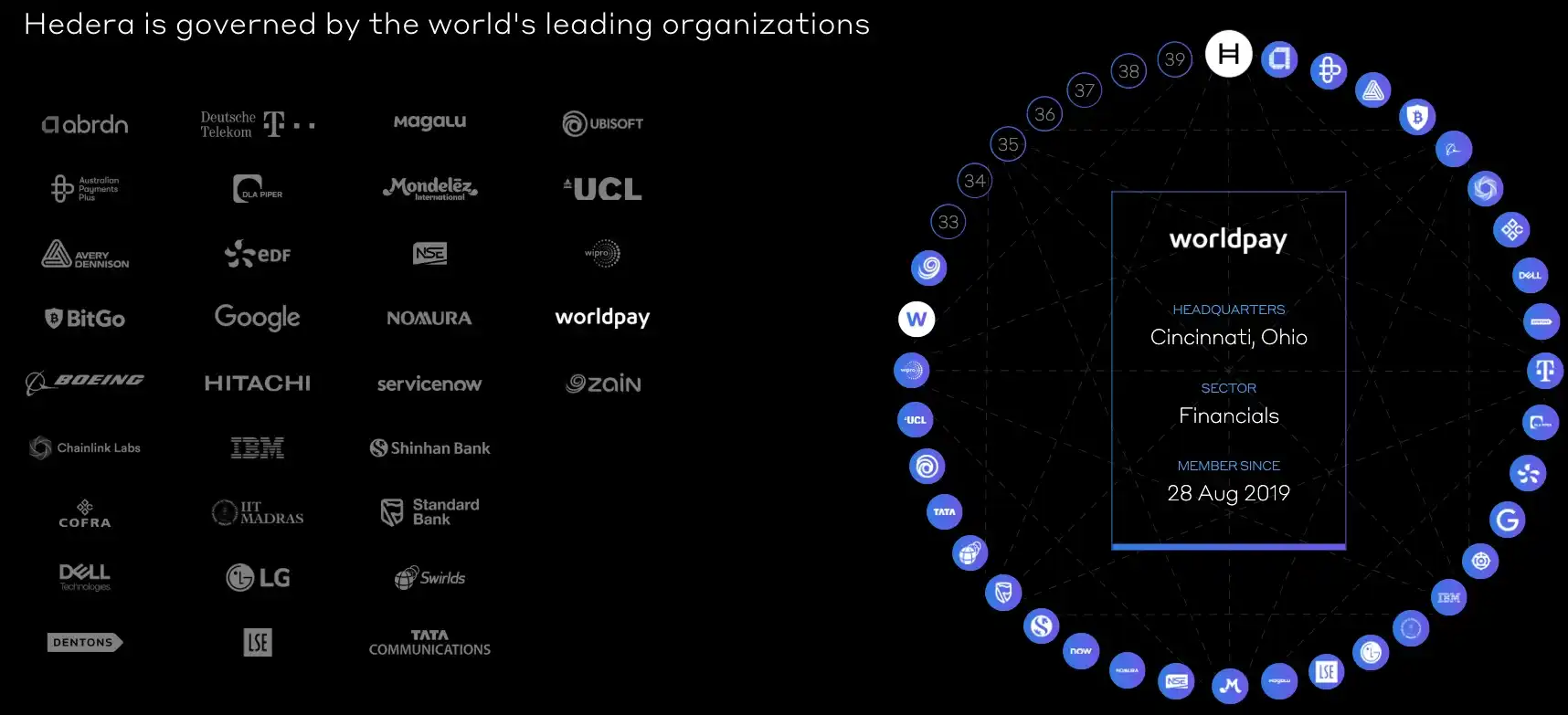
HBAR is Hedera blockchain's native token, used for network fees and as a staking token for the POS mechanism. The total supply of HBAR is 500 billion, with a current circulation exceeding 381.9 billion, a circulating market cap of 13.28 billion US dollars, and a crypto market rank of 19th.
So far, the impression of Hedera has been nothing more than a run-of-the-mill old L1.
Why Did HBAR Price Skyrocket?
As the price of the HBAR token surged, the market generally attributed the main reason to the favorable HBAR ETF application submitted by Canary Capital on November 13, with HBAR rising over 30% on the day of the announcement.
Generally speaking, token price surges triggered by news events do not last long. On November 26, Bloomberg ETF analyst James Seyffart also stated that the SEC's decision on SOL, XRP, LTC, and HBAR ETFs may be delayed until the end of 2025.
With the favorable news of the ETF still pending, and actual ETF approval a distant prospect, many thought that the HBAR price would retreat. However, the HBAR price remains in an upward trend, reaching levels from the November 2021 bull market. For this reason, Odaily Planet Daily summarizes the following four reasons:
Altcoin ETF Emergence, HBAR Undervalued Compared to Other Tokens
Currently, altcoin ETFs are emerging, with SOL, XRP, LTC, and HBAR ETF applications being submitted in succession. Additionally, according to ETF Store President Nate Geraci, at least one issuer is currently attempting to apply for an ETF for ADA (Cardano) or AVAX (Avalanche). Despite HBAR's token price surging by 104% in the past month, far exceeding the 40%, 32%, and 25% increases for SOL, XRP, and LTC, respectively, HBAR's market capitalization remains low and still ranks below DOT, in 19th place.
In fact, before Canary Capital submitted the HBAR ETF application, in October, Canary Capital launched the HBAR Trust in the United States, specifically catering to eligible individuals and institutional investors. Steven McClurg, CEO of Canary Capital and former CIO of Valkyrie Funds, also stated that this move was to pave the way for the future launch of the HBAR ETF.
Therefore, as one of the few altcoins currently backed by institutions and with an ETF application submitted, investors may believe that the HBAR token is undervalued and still has significant room for growth.
HBAR Board Member Could Become Next SEC Chairman
With the upcoming inauguration of President Trump, the next Chairman of the U.S. Securities and Exchange Commission (SEC) is also drawing significant attention from the crypto market. HBAR board member Brian Brooks is among the potential candidates for the next SEC Chairman. According to prediction market data from Kalshi, while former SEC Commissioner Paul Atkins from the George W. Bush administration has a 70% chance of winning, Brian Brooks still has a 20% chance.
If Brian Brooks is successfully nominated by Trump as the next SEC Chairman, it would not only mean that the SEC may become more crypto-friendly, but it would also be a huge benefit for HBAR. This expectation is also sustaining the upward trend of the HBAR price.
Additionally, according to FOX Business reporter Eleanor Terrett, sources have revealed that Trump will announce the new SEC Chairman to succeed Gary Gensler as soon as tomorrow. It is believed that this answer will be revealed shortly. (BlockBeats Note: Trump announced on December 4th that Paul Atkins was his nominee for SEC Chairman, but sources indicate that Paul Atkins is not willing to take on the position.)
Driving Development in the RWA Track
The RWA track is also gradually gaining momentum, with institutions increasing their investment in RWAs. Stablecoin USDT issuer Tether launched the asset tokenization platform Hadron by Tether on November 14th, and Visa introduced the Visa Tokenized Asset Platform (VTAP). The Hedera blockchain is also actively developing RWAs. According to official Hedera data, the value of assets tokenized through the Hedera blockchain has reached $50 million, providing tokenization services to well-known companies such as Dovu, abrdn, and Shinban Bank.
Steven McClurg, CEO of Canary Capital and former CIO of Valkyrie Funds, also stated that Hedera embodies the type of enterprise technology that connects cryptocurrency to real-world scalability, and he expects further growth in technological applications.
Korean Market FOMO
In terms of trading volume, HBAR is also experiencing Korean market FOMO. According to CoinGecko data, on South Korea's largest exchange Upbit, the highest 24-hour trading volume is for XRP, with a trading volume of over $5.372 billion; next is HBAR, with a 24-hour trading volume of over $1.353 billion, which is 3 times the volume of BTC. Additionally, compared to Binance, HBAR has a trading volume of over $1.289 billion in the last 24 hours, which is less than Upbit.
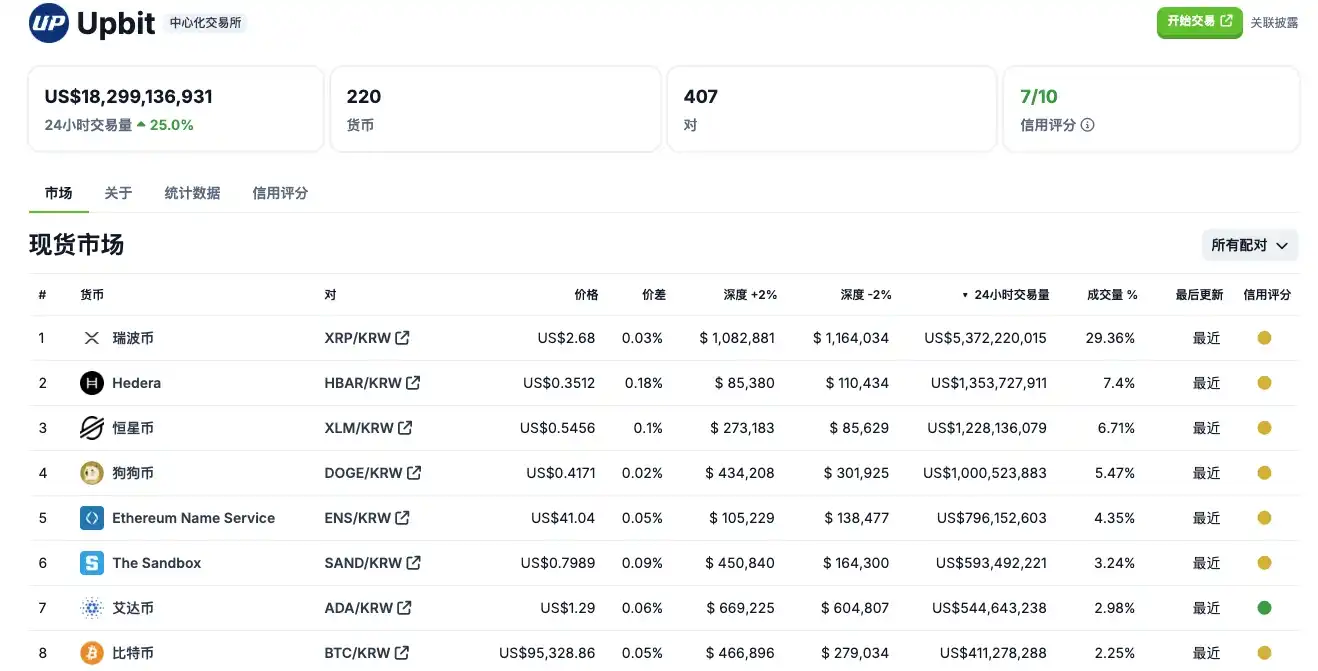
Simultaneously, on another Korean exchange Bithumb, HBAR's 24-hour trading volume reached $1.43 billion, surpassing not only BTC's volume on that platform but even exceeding Upbit's 24-hour HBAR trading volume.
It is evident that the Korean market is not only a major buyer market for XRP but also a major buyer for HBAR.
Altseason Arrives, Old Tokens Can Revitalize
Trends are always unstoppable. In the past year, altcoins have been underperforming, first falling into controversy over VC coins' "high valuation and low circulation" and massive unlockings, then facing the slump in the altcoin market as BTC repeatedly hit new highs, and finally having to deal with the onslaught of meme coins. To the point that even industry veterans, such as Fish the Founder and CEO of Cobo, previously asserted that "this cycle has no altseason."
As a result, the sector rotation, though delayed, has arrived, and altseason has finally come. According to an analysis by Nanzhi from Odaily Star Daily, the funding rate is in the safe zone, and the market share of altcoins has approached the launch point of 2021. (Related Reading: Looking back at market data from the past 4 years, which stage of the bull market are we currently in?)
The market is accustomed to finding reasons for price increases, and HBAR may be just a microcosm, symbolizing that even in a true altseason, even "old tokens" can make market participants dizzy with their rise. Instead of lamenting, it is worth joining the trend.
You may also like

Galaxy Deep Research Report: How Hyperliquid's HIP-4 Upgrade Changes the Landscape of Prediction Markets?

Binance Research: RWA Market Expected to Expand Nearly 6x from Early 2025, with Public Equities and Onchain Payments Heating Up Together
In June, Binance Research said in its monthly market report that the real-world asset (RWA) market is expected to grow by about 589% from the beginning of 2025. Bond- and money market fund-related RWA expanded by about $6.5 billion, up 83% year over year, while publicly traded equity RWAs grew by about 422%. The report also noted that monthly crypto debit card transaction volume exceeded $747 million in May, up 48.6% year to date.

Japan to Assess a Framework for Yen Stablecoins and Crypto ETFs as Asia’s Compliant Payments Narrative Heats Up
Recently, according to the original report, Japan is considering the launch of yen stablecoins and cryptocurrency ETFs. Public information remains limited at this stage, and there is still no complete policy text, regulatory draft, or clear implementation timeline, so this is better characterized as a “policy discussion” rather than formal implementation. The original wording also noted that advancing stablecoin regulation in Asia is driving XRP usage and supporting growth in the XRPL ecosystem. However, based on currently available public information, there is not enough evidence to directly establish a clear causal relationship between this round of discussion in Japan and XRP or XRPL.

ZachXBT: Humanity private key leak and abnormal surge in H token should be viewed separately
On June 9, according to related disclosures, on-chain investigator ZachXBT posted an update on Humanity’s roughly $31 million security incident, saying that after further analyzing fund flows, he currently tends to believe the project team was not involved in an “inside job” or a self-staged attack. According to him, the official explanation about the private key leak was broadly accurate, but before the token unlock, the price of H had been artificially pushed higher, and the hacker later took advantage of that market environment; therefore, the private key leak and the earlier abnormal price pumping should be regarded as two separate and independent events. This reframing has shifted the market’s understanding of the nature of the incident. Earlier discussion around Humanity had focused on whether the team directly participated in the attack or used the security incident to cover up internal operations. ZachXBT’s latest remarks shift the focus from “whether it was self-theft” to “whether there were pre-unlock market structure issues.” He also questioned whether the team may have.

Morning Report | OpenAI has submitted an S-1 registration statement draft to the U.S. SEC; Morpho completes $175 million financing

Morning Report | BitMine increased its holdings by 126,971 ETH last week; trader Eugene announced his exit from the crypto market

Wang Chuan: How can one not feel anxious after the neighbor Old Wang made thirty times profit by investing in storage stocks? (Seven) - A quarter-century cycle

Cryptocurrency CEXs are flocking to sell US stocks, and traditional brokerages are facing an "uninvited guest."
$75 billion in foreign capital has fled, and South Korean retail investors have absorbed it all using leverage

Japan’s Three Megabanks Plan Joint Stablecoin Issuance in Fiscal 2026
MUFG, SMBC, and Mizuho reportedly plan to jointly issue fiat-pegged stablecoins in fiscal 2026, signaling Japan’s growing push into bank-led digital payment infrastructure.

Humanity Discloses H Token Dual-Chain Attack Details, With Losses on Ethereum and BSC Exceeding $36 Million
Humanity said the H token attack across Ethereum and BSC caused more than $36 million in losses after leaked ProxyAdmin keys enabled malicious contract upgrades and token minting.
White House Discusses CLARITY Act With Law Enforcement Ahead of Senate Vote
The White House discussed the CLARITY Act with law enforcement ahead of a Senate vote, focusing on illicit finance risks and developer protections.

Bitcoin Trading Guide 2026: Strategies for Experienced Traders

What Is XAUT and PAXG? Why Tokenized Gold Is Booming in 2026

Will the SpaceX IPO Hurt Bitcoin? Here's What Traders Are Watching

Foreign selling in the South Korean stock market accelerates, with cumulative net sales reportedly reaching $75 billion this year
On June 9, The Kobeissi Letter, citing Goldman Sachs data, reported that global investors are selling South Korean stocks at an unusually rapid pace. In the latest trading session, foreign investors sold about $801 million worth of Kospi constituent stocks again; total foreign outflows last week reached about $10 billion, and the market has been in net foreign selling on nearly every trading day over the past month. According to the data cited in the report, foreign investors have sold about $75 billion worth of South Korean stocks so far this year. Meanwhile, South Korean retail and institutional investors together recorded roughly $69 billion in net buying over the same period, suggesting that the market’s main buying support has come from domestic capital rather than returning overseas funds. The information currently disclosed still mainly comes from The Kobeissi Letter’s retelling and Goldman Sachs data summaries, while public details on the statistical period and the specific definition of “selling” remain relatively limited.

Fortune Warns of Strategy’s Financing Structure Risks as Bitcoin Premium Narrows
Fortune warned that Strategy’s Bitcoin treasury model faces growing financing risks as MSTR’s net asset premium narrows and preferred stock dividend pressure increases.

Ferrari Challenge Le Mans: Carl Moon to Dominate in WEEX Livery
Galaxy Deep Research Report: How Hyperliquid's HIP-4 Upgrade Changes the Landscape of Prediction Markets?
Binance Research: RWA Market Expected to Expand Nearly 6x from Early 2025, with Public Equities and Onchain Payments Heating Up Together
In June, Binance Research said in its monthly market report that the real-world asset (RWA) market is expected to grow by about 589% from the beginning of 2025. Bond- and money market fund-related RWA expanded by about $6.5 billion, up 83% year over year, while publicly traded equity RWAs grew by about 422%. The report also noted that monthly crypto debit card transaction volume exceeded $747 million in May, up 48.6% year to date.
Japan to Assess a Framework for Yen Stablecoins and Crypto ETFs as Asia’s Compliant Payments Narrative Heats Up
Recently, according to the original report, Japan is considering the launch of yen stablecoins and cryptocurrency ETFs. Public information remains limited at this stage, and there is still no complete policy text, regulatory draft, or clear implementation timeline, so this is better characterized as a “policy discussion” rather than formal implementation. The original wording also noted that advancing stablecoin regulation in Asia is driving XRP usage and supporting growth in the XRPL ecosystem. However, based on currently available public information, there is not enough evidence to directly establish a clear causal relationship between this round of discussion in Japan and XRP or XRPL.
ZachXBT: Humanity private key leak and abnormal surge in H token should be viewed separately
On June 9, according to related disclosures, on-chain investigator ZachXBT posted an update on Humanity’s roughly $31 million security incident, saying that after further analyzing fund flows, he currently tends to believe the project team was not involved in an “inside job” or a self-staged attack. According to him, the official explanation about the private key leak was broadly accurate, but before the token unlock, the price of H had been artificially pushed higher, and the hacker later took advantage of that market environment; therefore, the private key leak and the earlier abnormal price pumping should be regarded as two separate and independent events. This reframing has shifted the market’s understanding of the nature of the incident. Earlier discussion around Humanity had focused on whether the team directly participated in the attack or used the security incident to cover up internal operations. ZachXBT’s latest remarks shift the focus from “whether it was self-theft” to “whether there were pre-unlock market structure issues.” He also questioned whether the team may have.
Morning Report | OpenAI has submitted an S-1 registration statement draft to the U.S. SEC; Morpho completes $175 million financing
Morning Report | BitMine increased its holdings by 126,971 ETH last week; trader Eugene announced his exit from the crypto market


