
 Buy Crypto
- Markets
 Futures
- Spot
- Copy Trade
- Earn
- More
Understand Tokenization, Differentiating Between the DTCC Model and the Direct Ownership Model

Original Article Title: DTCC Isn't Tokenizing Shares, Here is What's Actually Changing
Original Article Author: @ingalvarezsol
Translation: Peggy, BlockBeats
Editor's Note: The "tokenization" promoted by DTCC is not about putting shares on the blockchain, but rather a digital upgrade of security entitlements, with the core goal of enhancing the efficiency and settlement capabilities of the existing market system. Running parallel to this is a more radical path that involves tokenizing share ownership itself, reshaping self-custody and on-chain composability.
These two modes are not mutually exclusive but rather serve stable scalability and functional innovation respectively. This article attempts to clarify this difference and point out that the real change lies not in who replaces whom but in investors gaining the right to choose different ownership models.
Below is the full text:
Introduction: Tokenization, but Not as You Think
The Depository Trust & Clearing Corporation (DTCC) has received a no-action letter from the U.S. Securities and Exchange Commission (SEC), allowing it to start tokenizing its own securities infrastructure. This marks a significant upgrade to the "underlying plumbing" of the U.S. capital markets: DTCC holds around $99 trillion in securities assets and supports transaction volumes of tens of trillions of dollars annually.
However, the market reaction to this news has revealed a clear gap between expectations and reality. What has been tokenized is not "shares" but security entitlements, and this difference determines the nature of almost all subsequent questions.
The current discussion around "tokenized securities" is not about a single future that is universally arriving but rather about two different models emerging at different levels simultaneously: one that transforms the holding and transfer of securities within the existing indirect ownership system and another that fundamentally reshapes what it means to "hold a share of stock."
Note: For ease of expression, the following text will no longer differentiate between DTCC's subsidiary DTC (Depository Trust Company) and its parent company DTCC.
How Securities Ownership Actually Works Today
In the U.S. public markets, investors do not hold shares of stock directly from the issuing companies. Ownership of shares is held within a chain of multiple intermediaries.
At the lowest level is the issuer's shareholder register, usually maintained by a transfer agent. For almost all listed stocks, this register typically only lists one name: Cede & Co., the DTCC-designated nominal holder. This is done to avoid the issuer having to maintain records of millions of individual shareholders.
One level up is the DTCC itself. It centrally holds these shares in a process called immobilization. The DTCC's direct participants are known as clearing brokers, representing retail brokers serving end customers, responsible for custody and settlement. The DTCC records in the system: how many shares each party is entitled to.
At the top level is the investor themselves. The investor does not hold specific, identifiable shares but holds a legally protected security entitlement — their claim against a broker; and the broker, in turn, holds the corresponding entitlement within the DTCC system through a clearing broker.
What has been tokenized this time are these "entitlements" within the DTCC system, not the shares themselves.
This upgrade can indeed improve system efficiency, but it cannot address the fundamental limitations inherent in the multi-layered intermediary structure.
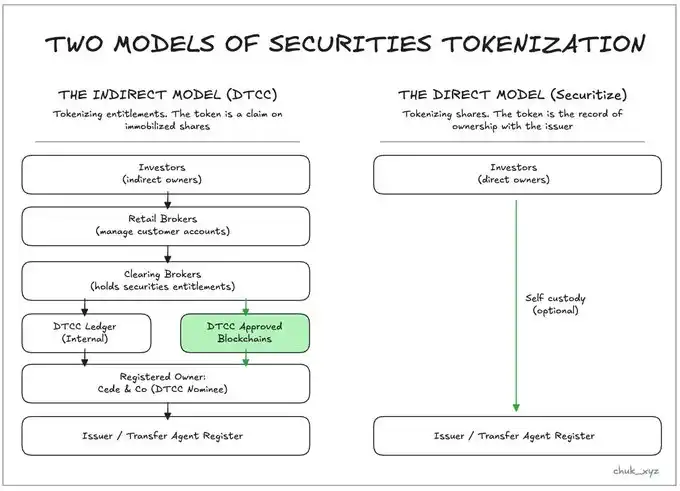
DTCC tokenizes "ownership claims," while direct tokenization models "the shares themselves." Both are termed "tokenization," but they solve entirely different issues.
Why Upgrade?
The U.S. securities system itself is quite robust, but its architecture still has clear limitations. Settlement relies on processes with time delays and work hour constraints; corporate actions (such as dividends, stock splits) and reconciliation are still primarily done through batch message processing rather than shared state. Ownership being nested within a complex intermediary network — each layer having its own tech upgrade cycle — means realizing real-time workflows is nearly impossible without all layers being onboard simultaneously, with DTCC being the critical "gatekeeper" in this system.
These design choices also lead to capital inefficiencies. The extended settlement periods require billions in collateral between trade and final settlement to manage risks. These optimization schemes were originally designed for the "slow and costly capital transfer" world.
If the settlement cycle is shortened or instant settlement is achieved for voluntary participants, the required capital scale will significantly decrease, costs will decrease accordingly, and market competition will intensify.
Part of this efficiency improvement can be achieved by upgrading existing infrastructure; however, some — especially those involving direct ownership and the ability for faster innovation iteration — require a completely new model.
Tokenizing Existing Systems (DTCC Model)
In the DTCC path, the underlying securities remain in a centralized custodial state and continue to be registered under Cede & Co. What truly changes is the expression of ownership records: these "equities," which originally only existed in a proprietary ledger, are endowed with a "digital twin" token existing on an approved blockchain.
The significance of this lies in the fact that, without disrupting the current market structure, it achieves a modernized upgrade. DTCC can introduce 24/7 equity transfers between participating institutions, reduce reconciliation costs, and gradually drive these equities toward faster collateral liquidity and automated workflow evolution while still retaining the efficiency advantages of centralized systems such as netting settlement.
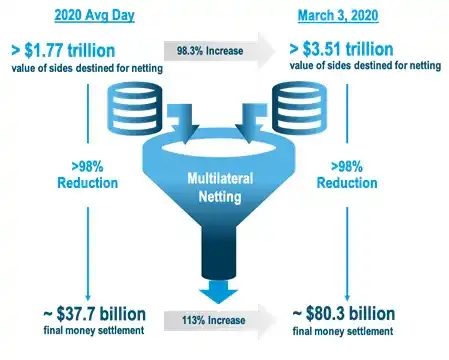
Through multilateral netting, the total transaction activity amounting to trillions of dollars can be compressed into a final settlement amount of only hundreds of billions of dollars. This efficiency constitutes the core of today's market structure, even as new ownership models are gradually emerging.
However, the boundaries of this system are intentionally set. These tokens do not make holders direct shareholders of the company. They remain permissioned, revocable claim rights existing within the same legal framework: they cannot become freely composable collateral in DeFi, cannot bypass DTC participating institutions, and will not alter the issuer's shareholder registry.
In short, this approach optimizes our existing system while fully retaining the existing intermediary structures and their efficiency advantages.
Tokenizing "Ownership Itself" (Direct Model)
The second model starts where the DTCC model cannot reach: it tokenizes the stocks themselves. Ownership is directly recorded on the issuer's shareholder register and maintained by a transfer agent. When the token transfers occur, the on-record shareholder changes accordingly, and Cede & Co. is no longer in the ownership chain.
This unlocks a series of capabilities that are structurally impossible under the DTCC model: self-custody, direct relationships between investors and issuers, peer-to-peer transfers, and programmability and composability combined with on-chain financial infrastructure — including collateralization, lending, and many yet-to-be-invented new financial structures.
This pattern is not merely theoretical. Galaxy Digital shareholders can already tokenize their equity through Superstate and hold it on-chain, directly reflected in the issuer's cap table. By early 2026, Securitize will also offer similar capabilities and introduce 24/7 trading supported by compliant brokerage systems.
Of course, the trade-offs of this model are equally real. Once detached from the indirect holding system, liquidity will tend to fragment, and the efficiency of multilateral net settlement will disappear; brokerage services such as margining and lending need to be redesigned; operational risks will more heavily shift to the holders themselves, rather than intermediaries.
However, it is precisely the agency brought by direct ownership that allows investors to actively choose whether to accept these trade-offs rather than passively inherit them. Within the DTCC framework, this space for choice is almost non-existent — because any innovation regarding "ownership" must pass through layers of governance, operation, and regulation.
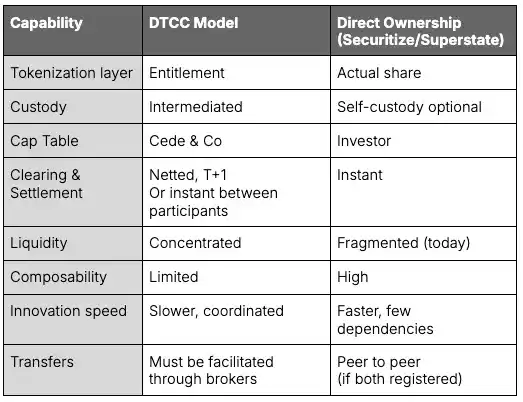
There is a key difference between these two models. The DTCC model is much stronger in terms of compatibility and scalability with the existing system, while the direct ownership model opens up greater space for innovations like self-custody.
Why They Are (Temporarily) Not Competing Visions
The DTCC model and the direct ownership model are not competing paths; they address different issues.
The DTCC's path involves upgrading the existing indirect holding system, retaining core advantages such as net settlement, liquidity concentration, and systemic stability. It targets institutional participants who require operational scalability, settlement finality, and regulatory continuity.
The direct ownership model caters to a different set of needs: self-custody, programmable assets, and on-chain composability. It serves investors and issuers who seek entirely new functionalities, not just a "more efficient pipeline."
Even if direct ownership may reshape the market structure in the future, this transformation is inevitably a multi-year process that needs to advance synchronously in technology, regulation, and liquidity migration; it cannot happen quickly. Clearing rules, issuer behavior, participant readiness, and global interoperability, among others, are progressing much more slowly than the technology itself.
Therefore, a more realistic prospect is coexistence: on one hand, the modernization upgrade of infrastructure, and on the other hand, innovation at the ownership level. Today, neither party can replace the other in fulfilling its mission.
What This Means for Different Market Participants
These two tokenization paths have different impacts on various levels of market participants.
Retail Investors
For retail users, the upgrade by the DTCC is almost imperceptible. Retail brokers have long shielded users from most frictions (such as fractional shares, instant buying power, weekend trading), and these experiences will continue to be provided by brokers.
What truly brings change is the direct ownership model: self-custody, peer-to-peer transfers, instant settlement, and the possibility of using stocks as on-chain collateral. Today, stock trading has already begun to appear on some platforms and wallets, but most implementations still rely on a form of "wrapping/mapping." In the future, these tokens may directly represent real stocks on the registry, rather than a synthetic layer.
Institutional Investors
Institutions will be the biggest beneficiaries of DTCC tokenization. Their operations heavily rely on collateral flow, securities lending, ETF fund flows, and multilateral reconciliation—areas where tokenized "equities" can significantly reduce operating costs and improve speed.
Direct ownership is more appealing to some institutions, especially opportunistic trading firms seeking programmable collateral and settlement advantages. However, due to liquidity fragmentation, broader adoption will gradually unfold from the market's edge.
Brokers and Clearing Institutions
Brokers are at the center of transformation. In the DTCC model, their role is further strengthened, but innovation is converging towards them: clearing brokers who first adopt tokenized ownership can create differentiation, while vertically integrated institutions can directly build new products.
In the direct ownership model, brokers are not "removed" but reshaped. Licensing and compliance are still necessary, but a batch of native on-chain intermediaries will emerge, competing with traditional institutions for users who value direct ownership features.
Conclusion: The Real Winner is "Choice"
The future of tokenized securities lies not in one model winning out, but in how these two models evolve in parallel and interact with each other.
Equities tokenization will continue to modernize the core of the public markets; direct ownership will grow at the fringe where programmability, self-custody, and new financial structures are highly valued. The transition between the two will become increasingly seamless.
The end result is a broader market interface: both existing rails becoming faster and cheaper, while also creating new rails for behaviors that the existing system cannot support. Both paths will have winners and losers, but as long as the path of direct ownership exists, the investor is the ultimate winner — gaining better infrastructure through competition and the ability to choose freely between different modes.
You may also like

Found a "meme coin" that skyrocketed in just a few days. Any tips?

TAO is Elon Musk, who invested in OpenAI, and Subnet is Sam Altman

The era of "mass coin distribution" on public chains comes to an end

Soaring 50 times, with an FDV exceeding 10 billion USD, why RaveDAO?

1 billion DOTs were minted out of thin air, but the hacker only made 230,000 dollars

After the blockade of the Strait of Hormuz, when will the war end?

Before using Musk's "Western WeChat" X Chat, you need to understand these three questions
The X Chat will be available for download on the App Store this Friday. The media has already covered the feature list, including self-destructing messages, screenshot prevention, 481-person group chats, Grok integration, and registration without a phone number, positioning it as the "Western WeChat." However, there are three questions that have hardly been addressed in any reports.
There is a sentence on X's official help page that is still hanging there: "If malicious insiders or X itself cause encrypted conversations to be exposed through legal processes, both the sender and receiver will be completely unaware."
No. The difference lies in where the keys are stored.
In Signal's end-to-end encryption, the keys never leave your device. X, the court, or any external party does not hold your keys. Signal's servers have nothing to decrypt your messages; even if they were subpoenaed, they could only provide registration timestamps and last connection times, as evidenced by past subpoena records.
X Chat uses the Juicebox protocol. This solution divides the key into three parts, each stored on three servers operated by X. When recovering the key with a PIN code, the system retrieves these three shards from X's servers and recombines them. No matter how complex the PIN code is, X is the actual custodian of the key, not the user.
This is the technical background of the "help page sentence": because the key is on X's servers, X has the ability to respond to legal processes without the user's knowledge. Signal does not have this capability, not because of policy, but because it simply does not have the key.
The following illustration compares the security mechanisms of Signal, WhatsApp, Telegram, and X Chat along six dimensions. X Chat is the only one of the four where the platform holds the key and the only one without Forward Secrecy.
The significance of Forward Secrecy is that even if a key is compromised at a certain point in time, historical messages cannot be decrypted because each message has a unique key. Signal's Double Ratchet protocol automatically updates the key after each message, a mechanism lacking in X Chat.
After analyzing the X Chat architecture in June 2025, Johns Hopkins University cryptology professor Matthew Green commented, "If we judge XChat as an end-to-end encryption scheme, this seems like a pretty game-over type of vulnerability." He later added, "I would not trust this any more than I trust current unencrypted DMs."
From a September 2025 TechCrunch report to being live in April 2026, this architecture saw no changes.
In a February 9, 2026 tweet, Musk pledged to undergo rigorous security tests of X Chat before its launch on X Chat and to open source all the code.
As of the April 17 launch date, no independent third-party audit has been completed, there is no official code repository on GitHub, the App Store's privacy label reveals X Chat collects five or more categories of data including location, contact info, and search history, directly contradicting the marketing claim of "No Ads, No Trackers."
Not continuous monitoring, but a clear access point.
For every message on X Chat, users can long-press and select "Ask Grok." When this button is clicked, the message is delivered to Grok in plaintext, transitioning from encrypted to unencrypted at this stage.
This design is not a vulnerability but a feature. However, X Chat's privacy policy does not state whether this plaintext data will be used for Grok's model training or if Grok will store this conversation content. By actively clicking "Ask Grok," users are voluntarily removing the encryption protection of that message.
There is also a structural issue: How quickly will this button shift from an "optional feature" to a "default habit"? The higher the quality of Grok's replies, the more frequently users will rely on it, leading to an increase in the proportion of messages flowing out of encryption protection. The actual encryption strength of X Chat, in the long run, depends not only on the design of the Juicebox protocol but also on the frequency of user clicks on "Ask Grok."
X Chat's initial release only supports iOS, with the Android version simply stating "coming soon" without a timeline.
In the global smartphone market, Android holds about 73%, while iOS holds about 27% (IDC/Statista, 2025). Of WhatsApp's 3.14 billion monthly active users, 73% are on Android (according to Demand Sage). In India, WhatsApp covers 854 million users, with over 95% Android penetration. In Brazil, there are 148 million users, with 81% on Android, and in Indonesia, there are 112 million users, with 87% on Android.
WhatsApp's dominance in the global communication market is built on Android. Signal, with a monthly active user base of around 85 million, also relies mainly on privacy-conscious users in Android-dominant countries.
X Chat circumvented this battlefield, with two possible interpretations. One is technical debt; X Chat is built with Rust, and achieving cross-platform support is not easy, so prioritizing iOS may be an engineering constraint. The other is a strategic choice; with iOS holding a market share of nearly 55% in the U.S., X's core user base being in the U.S., prioritizing iOS means focusing on their core user base rather than engaging in direct competition with Android-dominated emerging markets and WhatsApp.
These two interpretations are not mutually exclusive, leading to the same result: X Chat's debut saw it willingly forfeit 73% of the global smartphone user base.
This matter has been described by some: X Chat, along with X Money and Grok, forms a trifecta creating a closed-loop data system parallel to the existing infrastructure, similar in concept to the WeChat ecosystem. This assessment is not new, but with X Chat's launch, it's worth revisiting the schematic.
X Chat generates communication metadata, including information on who is talking to whom, for how long, and how frequently. This data flows into X's identity system. Part of the message content goes through the Ask Grok feature and enters Grok's processing chain. Financial transactions are handled by X Money: external public testing was completed in March, opening to the public in April, enabling fiat peer-to-peer transfers via Visa Direct. A senior Fireblocks executive confirmed plans for cryptocurrency payments to go live by the end of the year, holding money transmitter licenses in over 40 U.S. states currently.
Every WeChat feature operates within China's regulatory framework. Musk's system operates within Western regulatory frameworks, but he also serves as the head of the Department of Government Efficiency (DOGE). This is not a WeChat replica; it is a reenactment of the same logic under different political conditions.
The difference is that WeChat has never explicitly claimed to be "end-to-end encrypted" on its main interface, whereas X Chat does. "End-to-end encryption" in user perception means that no one, not even the platform, can see your messages. X Chat's architectural design does not meet this user expectation, but it uses this term.
X Chat consolidates the three data lines of "who this person is, who they are talking to, and where their money comes from and goes to" in one company's hands.
The help page sentence has never been just technical instructions.
Parse Noise's newly launched Beta version, how to "on-chain" this heat?

Is Lobster a Thing of the Past? Unpacking the Hermes Agent Tools that Supercharge Your Throughput to 100x

Declare War on AI? The Doomsday Narrative Behind Ultraman's Residence in Flames
Crypto VCs Are Dead? The Market Extinction Cycle Has Begun
Claude's Journey to Foolishness in Diagrams: The Cost of Thriftiness, or How API Bill Increased 100-Fold

Edge Land Regress: A Rehash Around Maritime Power, Energy, and the Dollar
Arthur Hayes Latest Interview: How Should Retail Investors Navigate the Iran Conflict?
Just now, Sam Altman was attacked again, this time by gunfire

Straits Blockade, Stablecoin Recap | Rewire News Morning Edition
From High Expectations to Controversial Turnaround, Genius Airdrop Triggers Community Backlash


 App
App