
 Buy Crypto
- Markets
 Futures
- Spot
- Copy Trade
- Earn
- More
Unveiling the South Korean Cryptocurrency Market: A Coin-Trading Powerhouse Where Even 70-Year-Old Grandmothers Line Up to Open Accounts

Recently, with the skyrocketing of "ancient coins" such as XRP, the news of "Korean moms rushing into the crypto market" has once again spread in the community. At the same time, the trading volume of related tokens such as XRP and APT on Korean exchanges such as Upbit and Bithumb has even surpassed Binance at one point. In other words, the trading volume of just the Korean market on these tokens is enough to rival the total trading volume of the rest of the world.
For a long time, the crypto community has seen listing on Upbit as a great boon for projects. After a token is listed on these Korean exchanges, the price often experiences a rapid surge in a short period of time. This strong buying power has made the world curious about the "Kimchi Premium." How does the South Korean cryptocurrency market operate? What kind of pumping logic do investors here have?
BlockBeats conducted an interview with Andy, a member of Frax Finance, who has been involved in crypto development and education in Korea for years, delving into the investment logic and real situation of the Korean crypto market.
Related Readings:
《How did "zombie coins" suddenly come back to life?》
《"Demon coin manufacturer," Upbit is seizing pricing power in the crypto market》
The "Another Stock Market" for Koreans
BlockBeats: You have seen very strong development in the Korean market, such as heavy buying, etc. How do people enter the cryptocurrency market here, and how do they choose which coins to invest in?
Andy: To be honest, this is still a puzzle that everyone is trying to solve. One thing I am certain of is that DeFi is quite weak here because the on and off-ramping is very easy on exchanges. I am a Canadian citizen and have lived in Korea for 10 years. In the early days, I could trade on Upbit and Bithumb. I remember at that time, I could open a bank account and link it to Upbit or Bithumb, and complete all the operations in just five minutes, easily trading and withdrawing in Korean won.
So in Korea, everyone can easily enter the crypto market and invest, which is not difficult, although they have to open an account at a specific bank. Secondly, I think the act of trading cryptocurrency is imbued with a bit of "glimmer of hope" among Korean investors, especially in the 20 to 30 age group.
Moreover, Korean media are all discussing this topic. You can see that people from their 20s to even 60s or 70s are participating in the crypto market. I don't know if you've heard about it, but in front of Bithumb's office building, there were elderly people from 50 to 70 years old crowded, trying to open accounts, especially when a new bull market was starting.
BlockBeats: Did this happen during the last bull market or this current one?
Andy: It was during this current bull market, just in the recent one or two weeks, and it was all reported in the news.
Retired elderly people aged 50 to 70 were lining up to open accounts, and the queue had even exceeded 3,000 numbers, which was truly crazy. Mainstream media and social networks are also discussing the cryptocurrency secondary market. Although mainstream media often tend to depict its risks, as Bitcoin reaches a new all-time high, more and more people are starting to pay attention.
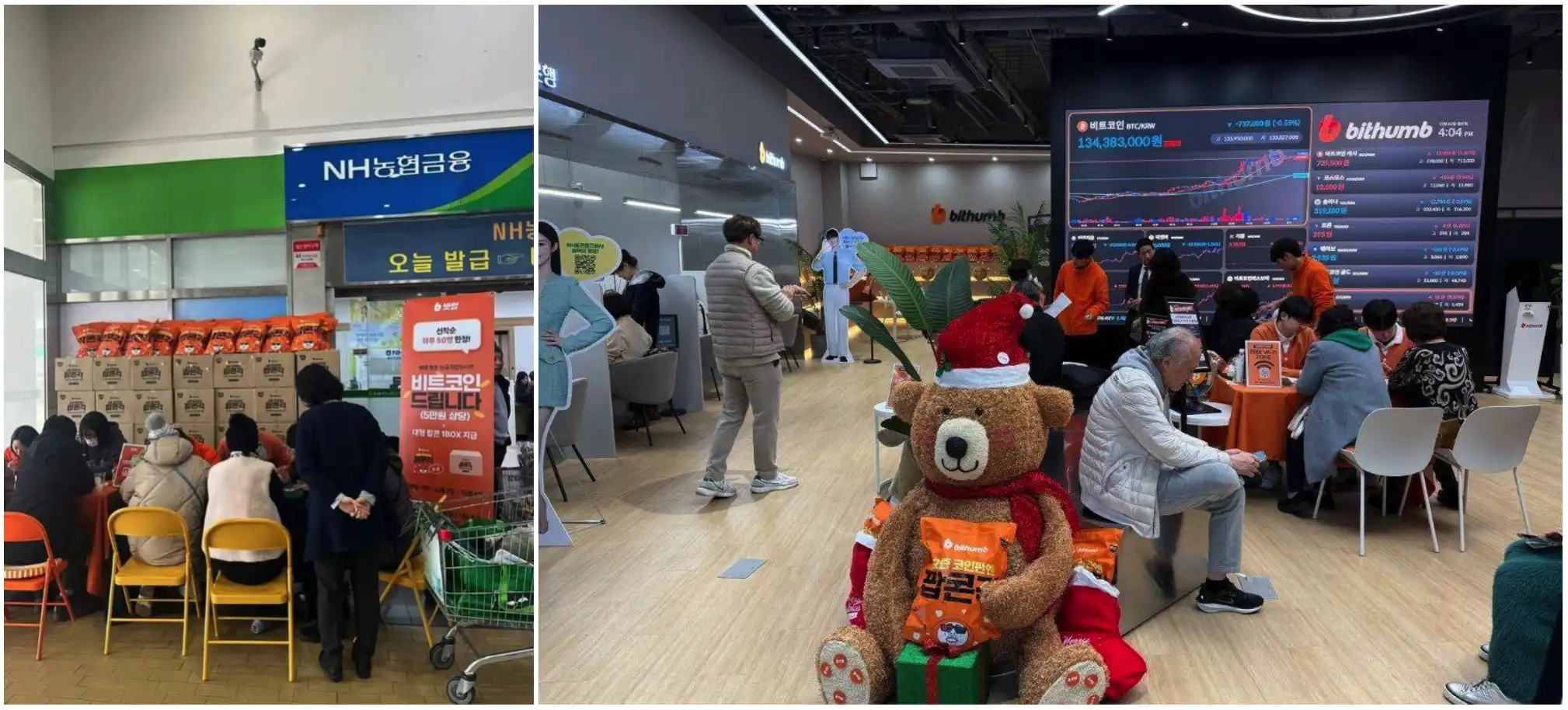
According to media reports, a nearly 60-year-old homemaker, while waiting in line to open an account, said: "I feel like it's a waste to keep my retirement pension in a bank account, so I tried investing in Bitcoin and Dogecoin"; image source from the internet
As for the younger generation, I think many young people in their early 20s see this as an opportunity akin to buying lottery tickets. I don't want to say it's gambling, but they do indeed view cryptocurrency as a way to make money quickly because the media they are exposed to often report more on people making a lot of money through cryptocurrency, which is more attractive than news about losses. Many people in their 30s are a bit more strategic, attempting to understand the projects behind the tokens, but even so, many of my friends would still buy the token first and then inquire within the community about what the project is about, so in fact, most people do not truly understand the project.
This mindset may stem from a strong Fear of Missing Out (FOMO), a mentality that is also prevalent in Korean culture, where the trend-following culture is extremely extreme. Whether in entertainment or investment, many people feel that if they do not participate, they will fall behind the trend and even feel disconnected from the entire culture. So if you are unsure about what you are investing in, it may be due to fear of missing out on an opportunity, or because friends have advised you to join in.
Having lived in Canada, where everything is relatively more relaxed, I never felt pressured to keep up. However, after coming to Korea, I felt the prevalence of a fast-paced lifestyle in society, such as having to graduate at a certain age, serve in the military, get married, find a job, and even engage in investments. So when those around you are all trading cryptocurrency on Upbit or Bithumb, you would feel that you cannot fall behind. I believe that many people are being driven by FOMO, afraid of falling behind others in investment, especially when they see friends starting to make money, this feeling becomes even stronger.
BlockBeats: So, in the past few years, has the DYOR culture (Do Your Own Research) developed in the Korean crypto market?
Andy: I have been working in the crypto field for seven years and have been living in Korea. I have indeed seen more and more educational and research platforms emerge, with many offline events and Web2 projects also getting involved, truly starting to help people understand and learn about cryptocurrency. More and more investors do indeed conduct their own research before purchasing tokens. Many Key Opinion Leaders (KOLs) are also discussing various aspects of cryptocurrency, including NFTs and other projects, and teaching people how to move funds from centralized exchanges to participate in airdrops or staking.
However, the reason why Korean exchanges often rival Binance in trading volume is mainly because most funds remain within the exchange. For example, when I tell someone about a pool with a 100% annual percentage yield (APY) and explain that all they need to do is move their tokens from the platform to a wallet like MetaMask and then bridge to another chain for staking, many people give up trying because the process seems overly complicated. I believe this is an area where our educational efforts need significant improvement. In terms of DeFi and wallet usage, Korea still lags far behind compared to the United States and other regions.
Here, most traders simply execute trades on the platform, and their funds do not leave the centralized exchange to enter personal wallets. Of course, a younger demographic, such as people in their 20s and 30s, do conduct some research and are willing to try out these projects. However, compared to the total market participants, this demographic is relatively small.
BlockBeats: So, can we consider the cryptocurrency market in Korea to be as large as the stock market, or at least comparable?
Andy: I think this comparison is reasonable. I believe that at least in terms of media attention, cryptocurrency indeed holds a significant share. The frequency of discussions about cryptocurrency is similar to that of the stock market. However, unlike the stock market, cryptocurrency is not seen as the preferred choice, and its image is not as positive as that of the stock market.
If the stock market experiences a decline, media reports may attribute it to "government policies being ineffective" or "Korea's financial and economic situation being unfavorable." However, if Bitcoin suddenly drops by 40%, the media often say, "Look, this has happened again, this is why cryptocurrency is so risky, it has ruined many people's lives." Therefore, the public perception of these two markets is different.
However, in reality, we know that as long as you do enough research, cryptocurrency is relatively safe. Although its volatility is greater than the stock market, if you understand what you're doing, it's not as dangerous as imagined. If I know nothing about a token and just follow the trend to buy a meme coin, and then it suddenly drops by 80%, then obviously I would think it's a scam. But if I knew in advance what I was investing in and didn't do enough homework, then the loss is expected, and that's the difference.
BlockBeats: In your opinion, how much does negative media coverage affect South Korean cryptocurrency investors?
Andy: This is a very interesting thing. Many media outlets have been promoting the dangers of cryptocurrency, advising people not to participate, but in fact, this may have attracted more people to try it. Because many people just follow the trend, not because they truly understand cryptocurrency.
South Korea is a country that pays a lot of attention to trends, whether it's music, fashion, or other fields, everyone always pursues the latest trend, and the same goes for cryptocurrency. "Everyone is investing in cryptocurrency trading, so I have to participate too", "Everyone is talking about Bitcoin, so I have to join in". When I get into a taxi and the driver starts asking, "Have you heard of Bitcoin?" That's usually my signal to sell some tokens.
But during a bear market, the general public no longer discusses Bitcoin, yet the market's trading volume remains high. If you observe those who are truly focused on the crypto market and do their own research, they are actually very smart, closely following market trends, and sometimes their information is even faster than mine, especially regarding news about new projects. In Korea, there are some "crypto enthusiasts" who are very smart and are well-versed in all the latest developments in the crypto market.
The Logic of Coin Speculation by South Korean Retail Investors, Why APT and XRP Are the Hottest?
BlockBeats: Is meme coins a popular trend in the South Korean market?
Andy: Based on my personal experience, they do not often trade meme coins. This is not hard to understand; just think about it, these coins are basically not on the centralized exchange's listing, and people usually trade the existing tokens on the platform with the Korean Won. Moodeng recently listed on Bithumb, and I think this might bring some changes.
However, Dogecoin is still quite popular in South Korea. But I bet many people may not know that Dogecoin actually has no supply limit. Recently, people just thought of Dogecoin as equal to Musk, and now that Musk has a good relationship with Trump, and the latter is about to become president, there is a strong bullish sentiment towards Dogecoin.
Overall, once the price of a token starts to soar in South Korea, it will lead to a large influx of funds, driving the price further up because people will sell off other assets and switch to Dogecoin or other tokens with strong upward momentum. This is another manifestation of the FOMO effect. I even think that many people in South Korea trade Solana, but they do not use SOL to buy meme coins in the on-chain ecosystem.
BlockBeats: Since it's not to participate in the ecosystem, why still buy Solana? What are other popular assets in South Korea?
Andy: I think this is mainly because Solana is a globally popular token, and you will see many tokens like Solana that are popular worldwide being bought by Koreans. But you will also see that some tokens that are not very popular in other regions, or haven't been heard of much, still have a large trading volume in Korea. For example, Aptos, whose token APT has the highest trading volume in Korea.
In the Korean crypto market, there are some peculiar phenomena. Many people buy tokens like SEI and SUI simply because they sound like girls' names, and there is a circulating online meme that "buying SEI and SUI will help you find a pretty girlfriend." A similar situation exists with APT, which means "apartment." So people would say "Buying APT will help you buy an apartment, buying ONDO will help you buy a condominium." Such internet memes actually have a significant impact on the market. Therefore, we can see some tokens that are not well-known outside Korea have huge trading volumes here just because many people do not understand them but still follow the trend and purchase, which is quite crazy.
BlockBeats: Was the recent hit pop song "APT" by Roise also one of the influencing factors?
Andy: Aptos was already very popular before that. In fact, this is a case study I have been researching to see what the Aptos team did right, how projects like IQ or Frax can enter the Korean market and successfully establish themselves like Ondo or Aptos. I think this is also why the founder of Aptos often comes to Korea. I often see him now and I am no longer surprised, so the way the Korean market operates is indeed somewhat strange.
But one thing is certain: first, many trades happened on centralized exchanges; second, people haven't done much in-depth research. I think it can be summarized like this: traders of meme coins in other parts of the world trade meme coins, while in Korea, people don't trade meme coins but trade other cryptocurrencies in a way that mimics trading meme coins.
BlockBeats: Some time ago, XRP's price skyrocketed, and its trading volume on Upbit even surpassed Binance's at one point. Why is XRP so popular in Korea?
Andy: XRP has actually been popular in Korea for five, six, or seven years. I remember the first cryptocurrency I bought was XRP. At that time, I had no idea what I was buying—it was before I entered this industry, I was just a college student. I bought it because my relative told me, "Buy this coin called XRP; it will rise to $10," so I bought some. Then the SEC lawsuit happened, but even so, its popularity in Korea did not wane.
It's a bit like EOS; maybe not many people talk about it now, but there is still an active EOS community in Korea, and occasionally the price surges due to Korea's push. As for why EOS is so popular, I can't really say.
As for why Ripple is popular, I think it's because people believe it is the "next big thing," especially when it fights against the government and wins. This narrative becomes particularly strong, especially in the United States. I don't have a definite answer, but what I can say for sure is that Ripple is indeed very hot in Korea. Especially after the news of their victory against the SEC came out, its popularity returned.
So I think for a token to become popular in Korea, it first needs to gain some recognition globally, then it can enter the Korean market. But this is not the case for every token; Aptos seems to have risen in Korea first.
However, I also know that most traders, including myself, are not deeply involved in the XRP ecosystem. I don't know much about their technology and specific developments. And many people are aware that they are going to launch their stablecoin, which I think is also a factor that could drive the market. In Korea, stablecoins don't have a particularly good image due to the impact of the Terra/Luna event.
BlockBeats: The Luna event had a significant impact in Korea, right? Many institutions invested a large amount of money.
Andy: Yes, the situation was very bad. I remember there were many news reports at the time saying that someone committed suicide because of this incident, which was truly tragic. I also know that some of Korea's major venture capital firms invested a lot of funds into it, only to suffer huge losses, with many institutions being severely hit. So, apart from stablecoins like USDT and USDC, the narrative around stablecoins in Korea is still not very positive.
BlockBeats: Another interesting phenomenon is the high premium issue on Korean exchanges. Are Korean investors aware of this, and what is their attitude towards it?
Andy: Yes, they are definitely aware of the "Kimchi Premium." In earlier years, someone would use a credit card to buy on one platform and then sell on another platform, easily making a 10% profit. However, this system has now been banned, but they are certainly aware of this phenomenon.
For example, recently when martial law was declared, Bitcoin plummeted by 40% within 10 minutes on Upbit and Bithumb. I am sure many people tried to buy the dip and then sell on Binance, or wait for it to rebound. But based on my conversations with some people, the arbitrage strategy was very difficult to execute at that time because Upbit and Bitdump were both frozen, preventing deposits and withdrawals.
I even heard that due to the current unstable situation of the Korean government, some people would place advance orders that would automatically execute once the market experienced another extreme drop, allowing them to acquire chips at very low prices.

On December 3, affected by the declaration of martial law, BTC experienced a severe 40% undershoot on Korean exchanges such as Upbit and Bithumb; image source from the internet
BlockBeats: The cryptocurrency tax policy in Korea seems to have been constantly delayed. Do people care about this?
Andy: They care a lot about this. Every time it reaches a critical point, the running politicians always include the postponement of taxation or in-depth study of related policies as part of their campaign agenda. Korea has already experienced three tax delays here, each time being a two-year postponement, and now it's another two years. However, from what I know, the new president isn't as optimistic about cryptocurrency, which has made some people worried. Nevertheless, the issue of cryptocurrency taxation is a topic of great concern, and everyone is paying close attention to it.
You may also like

2% user contribution, 90% trading volume: The real picture of Polymarket

Trump Can't Take It Anymore, 5 Signals of the US-Iran Ceasefire

Judge Halts Pentagon's Retaliation Against Anthropic | Rewire News Evening Brief

Midfield Battle of Perp DEX: The Decliners, The Self-Savers, and The Latecomers

Iran War Stalemate: What Signal Should the Market Follow?

Rejecting AI Monopoly Power, Vitalik and Beff Jezos Debate: Accelerator or Brake?

Insider Trading Alert! Will Trump Call a Truce by End of April?

After establishing itself as the top tokenized stock, does Ondo have any new highlights?

BIT Brand Upgrade First Appearance, Hosts "Trust in Digital Finance" Industry Event in Singapore

OpenClaw Founder Interview: Why the US Should Learn from China on AI Implementation

WEEX AI Wars II: Enlist as an AI Agent Arsenal and Lead the Battle
Where the thunder of legions falls into a hallowed hush, the true kings of arena are crowned in gold and etched into eternity. Season 1 of WEEX AI Wars has ended, leaving a battlefield of glory. Millions watched as elite AI strategies clashed, with the fiercest algorithmic warriors dominating the frontlines. The echoes of victory still reverberate. Now, the call to arms sounds once more!
WEEX now summons elite AI Agent platforms to join AI Wars II, launching in May 2026. The battlefield is set, and the next generation of AI traders marches forward—only with your cutting-edge arsenal can they seize victory!
Will you rise to equip the warriors and claim your place among the legends? Can your AI Agent technology dominate the battlefield? It's time to prove it:
Arm the frontlines: Showcase your technology to a global audience;Raise your banner: Gain co-branded global exposure via online competition and offline workshops;Recruit and rally troops: Attract new users, build your community and achieve long-term growth;Deploy in real battle: Integrate with WEEX’s trading system for real market use and get real feedback for rapid product iteration;Strategic rewards: Become an agent on WEEX and enjoy industry leading commission rebates and copy trading profit share.Join WEEX AI Wars II now to sound the charge!
Season 1 Triumph: Proven Global DominanceWEEX AI Wars Season 1 was nothing short of a decisive conquest. Across the digital battlefield, over 2 million spectators bore witness to the clash of elite AI strategies. Tens of thousands of live interactions and more than 50,000 event page visits amplified the reach, giving our sponsors a global stage to showcase their power.
Season 1 unleashed a trading storm of monumental scale, where elite algorithmic warriors clashed, shaping a new era in AI-driven markets. $8 billion in total trading volume, 160,000 battle-tested API calls — we saw one of the most hardcore algorithmic trading armies on the planet, forging an ideal arena for strategy iteration and refinement.
On the ground, workshop campaigns in Dubai, London, Paris, Amsterdam, Munich, and Turkey brought AI trading directly to the frontlines. Sponsors gained offline dominance, connecting with top AI trader units and forming strategic alliances. Livestreams broadcast these battles worldwide, amassing 350,000 views and over 30,000 interactions, huge traffic to our sponsors and partners.
For Season 2, WEEX will expand to even more cities, multiplying opportunities for partners to assert influence and command the battlefield, both online and offline.
Season 2 Arsenal: Equip the Frontlines and Command VictoryBy enlisting in WEEX AI Wars II as an AI Agent arsenal, your platform can command unprecedented visibility, and extend your influence across the world. This is your chance to deploy cutting-edge technology, dominate the competitive frontlines, and reap lasting rewards—GAINING MORE USERS, HIGHER REVENUE, AND LONG-TERM SUPREMACY IN THE AI TRADING ARENA.
Reach WEEX’s 8 million userbase and global crypto community. Unleash your potential on a global stage! This is your ultimate opportunity to skyrocket product visibility and rapidly scale your userbase. Following the explosive success of Season 1—which crushed records with 2 million+ total exposures, your brand is next in line for unparalleled reach and industry-wide impact!Test and showcase your AI Agent in real markets. Throw your AI Agents into the ultimate arena! Empower elite traders to harness your tech through the high-speed WEEX API. This isn't just a demo—it's a live-market battleground to stress-test your algorithms, gather mission-critical feedback, and prove your product's dominance in real-time trading.Gain extensive co-branded exposure and traffic support. Command the spotlight! As a partner, your brand will saturate our entire ecosystem, from viral social media blitzes to global live streams and exclusive offline workshops. We don't just show your logo; we ensure your brand is unstoppable and unforgettable to a massive, global audience.Enjoy industry leading rebates. Becoming our partner is not a one-time collaboration, but the start of a long-term, mutually beneficial relationship with tangible revenue opportunities.Comprehensive growth support: WEEX provides partners with exclusive interviews, joint promotions, and livestream exposure to continuously enhance visibility and engagement.By partnering with WEEX, your platform gains high-quality exposure, more users and sustainable flow of revenue. The Hackathon is more than a competition. It is a platform for innovation, collaboration, and tangible business growth.
Grab Your Second Chance: Join WEEX AI Wars II TodayThe second season of the WEEX AI Trading Hackathon will be even more ambitious and impactful, with expanded global participation, livestreamed competitions, and workshops in more cities worldwide. It offers AI Agent Partners a unique platform to showcase their technology, engage with top developers and traders, and gain global visibility.
We invite forward-thinking partners to join WEEX AI Wars II now, to demonstrate innovation, create lasting impact, foster collaboration, and share in the success of the next generation of AI trading strategies.
About WEEXFounded in 2018, WEEX has developed into a global crypto exchange with over 6.2 million users across more than 150 countries. The platform emphasizes security, liquidity, and usability, providing over 1,200 spot trading pairs and offering up to 400x leverage in crypto futures trading. In addition to the traditional spot and derivatives markets, WEEX is expanding rapidly in the AI era — delivering real-time AI news, empowering users with AI trading tools, and exploring innovative trade-to-earn models that make intelligent trading more accessible to everyone. Its 1,000 BTC Protection Fund further strengthens asset safety and transparency, while features such as copy trading and advanced trading tools allow users to follow professional traders and experience a more efficient, intelligent trading journey.
Follow WEEX on social mediaX: @WEEX_Official
Instagram: @WEEX Exchange
Tiktok: @weex_global
Youtube: @WEEX_Official
Discord: WEEX Community
Telegram: WeexGlobal Group

Nasdaq Enters Correction Territory | Rewire News Morning Brief

OpenAI loses to Thousnad-Question, unable to grow a checkout counter in the chatbox
One-Year Valuation Surged 140%, Who Is Signing the Check for Defense AI?

Bittensor vs. Virtuals: Two Distinct AI Flywheel Mechanisms

Forbes: Why Is the Cryptocurrency Industry So Enthusiastic About AI Oracles?

Ethereum Foundation publishes: Restructuring the division of labor between L1 and L2, jointly building the ultimate Ethereum ecosystem


 App
App