
 Buy Crypto
- Markets
 Futures
- Spot
- Copy Trade
- Earn
- More
Why Did Market Sentiment Completely Collapse in 2025? Decoding Messari's Ten-Thousand-Word Annual Report

Original Title: "Why Did Market Sentiment Completely Collapse in 2025? | Interpreting the Messari Ten-Thousand-Word Annual Report (Part One)"
Original Source: Merkle3s Capital
This article is based on Messari's annual report released in December 2025 The Crypto Theses 2026. The report is over ten thousand words long, with an official estimated reading time of 401 minutes. The information in this article is for reference only, does not constitute any investment advice or invitation, we do not take responsibility for the accuracy of the content, nor do we bear any consequences arising from it.
Introduction | This Is the Worst Year for Sentiment, But Not the Most Fragile Year for the System
If we only look at sentiment indicators, the crypto market in 2025 could almost be sentenced to "death penalty".
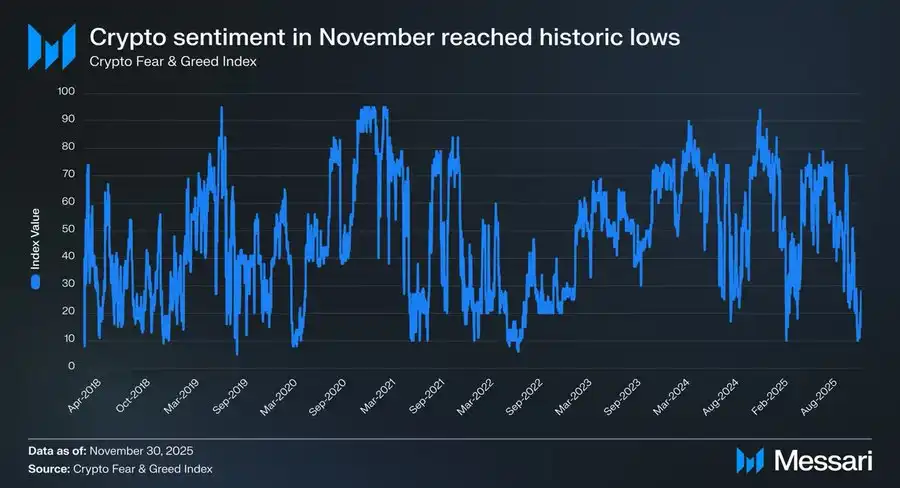
In November 2025, the Crypto Fear & Greed Index dropped to 10, entering the "extreme fear" zone.
In history, there have been few moments when sentiment has dropped to this level:
- March 2020, liquidity stampede triggered by the global pandemic
- May 2021, cascading liquidations due to leverage
- May-June 2022, systemic collapse of Luna and 3AC
- 2018-2019, industry-level bear market
These periods all have one thing in common: the industry itself is failing, and the future is highly uncertain.
But 2025 does not fit this description. There was no top exchange misappropriating user funds, no Ponzi projects with multi-billion dollar market caps dominating the narrative, the total market cap did not fall below the previous cycle high, stablecoin volumes instead hit a historical high, and the regulatory and institutionalization processes continued to advance.
On a "factual level," this was not a year in which the industry was collapsing. However, on a "perception level," it may have been the most painful year for many practitioners, investors, and longstanding users.
Why Did Sentiment Collapse?
Messari started its report with a highly impactful comparison:
If you were allocating crypto assets in a Wall Street office, 2025 might have been the best year since you entered this industry. But if you were staying up late watching charts on Telegram or Discord, searching for Alpha, this was probably the year you most missed the "old days."
Same market, two almost completely opposite experiences. This is not just a random emotional swing, nor a simple bull-to-bear transition, but a deeper structural misalignment: the market is changing participants, yet most people are still using old identities to engage with the new system.
This Is Not a Market Recap
This article is not intended to discuss short-term price trends or attempt to answer "will it go up next."
It is more like a structural explanation:
· Why, as institutions, funds, and infrastructure continue to strengthen,
· has market sentiment slid to historic lows?
· Why do many feel they've "picked the wrong track," yet the system itself has not failed?
In this hundred-thousand-word report, Messari chooses to start from an extremely basic question: If crypto assets ultimately are a form of "money," then who truly deserves to be treated as money?
Understanding this is key to understanding the full-scale meltdown of market sentiment in 2025.
Chapter One | Why Is Sentiment Abnormally Low?
Looking only at the outcome, the sentiment collapse in 2025 is nearly "incomprehensible."
In a scenario where there was no exchange platform rug pull, no systemic credit collapse, and no core narrative bankruptcy, the market provided feedback close to historic lows in sentiment.
Messari's assessment is very straightforward: this is an extreme case of "decoupling of emotion from reality."
1. Sentiment Indicators Have Entered "Historic Anomaly Territory"
The Crypto Fear & Greed Index dropping to 10 is not a normal pullback signal.
Over the past decade, this value has only appeared in very few moments, and each time it did, it was accompanied by a real and profound industry-level crisis:
· Financial System Breakdown
· Credit Chain Collapse
· Market Doubt About the "Existence of the Future"
However, none of these issues arose in 2025.
There was no core infrastructure failure, no mainstream assets liquidated to zero, and no systemic event significant enough to shake the industry's legitimacy. From a statistical standpoint, this sentiment reading does not match any known historical template.
2. The Market Did Not Fail; It Was the "Individual Experience" That Failed
The collapse of sentiment did not come from the market itself but from the subjective experiences of participants. Messari repeatedly emphasized in the report a fact that had been overlooked: 2025 was a year in which institutional experiences far surpassed retail experiences.
For institutions, this was an extremely clear and even comfortable environment:
· ETFs provided a low-friction, low-risk allocation channel
· Digital Asset Treasuries (DAT) became stable, predictable long-term buyers
· Regulatory frameworks started to clarify, and compliance boundaries gradually became visible
But for a large number of participants under old structures, this year was unusually harsh:
· Alpha significantly decreased
· Narrative rotation failed
· Most assets long-term underperformed BTC
· The relationship between "effort" and "result" was completely broken
The market did not reject people; it just changed its reward mechanism.
3. "Not Making Money" Was Misinterpreted as "Industry Decline"
The true trigger of sentiment was not the price drop but a cognitive gap. In multiple past cycles, the implicit assumption in crypto was: as long as you were diligent enough, early enough, and aggressive enough, you could achieve outsized returns.
However, in 2025, this assumption was systematically shattered for the first time.
· Most assets no longer received a premium for their "storytelling"
· L1 ecosystem growth no longer automatically translated into token returns
· High volatility no longer meant high returns
As a result, many participants began to fall into a misconception: if I didn't make money, then the entire industry must be in trouble. Yet, Messari's conclusion was precisely the opposite: the industry is becoming more like a mature financial system rather than a machine that continues to generate speculative returns.
4. The Essence of Emotional Breakdown is Identity Misalignment
Considering all phenomena, the implicit answer given by Messari is only one: The emotional breakdown in 2025 is fundamentally an identity misalignment.
· The market is tilting towards "asset allocators," "long-term holders," and "institutional participants"
· However, a large number of participants still exist in the identity of "short-term Alpha seekers"
When the incentive logic of the system changes, and participation does not adjust synchronously, emotions will inevitably collapse first. This is not a matter of individual capability but the friction cost of role transition in the era.
Summary | Emotions Do Not Tell You the Truth
The market sentiment in 2025 truly reflects the participants' pain but does not accurately reflect the state of the system.
· Emotional breakdown ≠ Industry failure
· Intensified pain ≠ Value disappearance
It simply indicates one thing: the old way of participation is rapidly becoming obsolete. Understanding this point is a prerequisite for entering the next chapter.
Chapter 2 | The True Root of Emotional Breakdown: The Monetary System is Failing
If we only stay at the market structure level, the explanation of the emotional breakdown in 2025 is still incomplete. The real problem is not:
· Alpha diminishing
· BTC being too strong
· Institutions coming in
These are all superficial phenomena. A deeper judgment given by Messari in the report is: The collapse of market sentiment fundamentally stems from a long-overlooked fact—the monetary system we are in is continually pressuring savers.
A Must-Be-Confronted Chart: Global Government Debt Out of Control
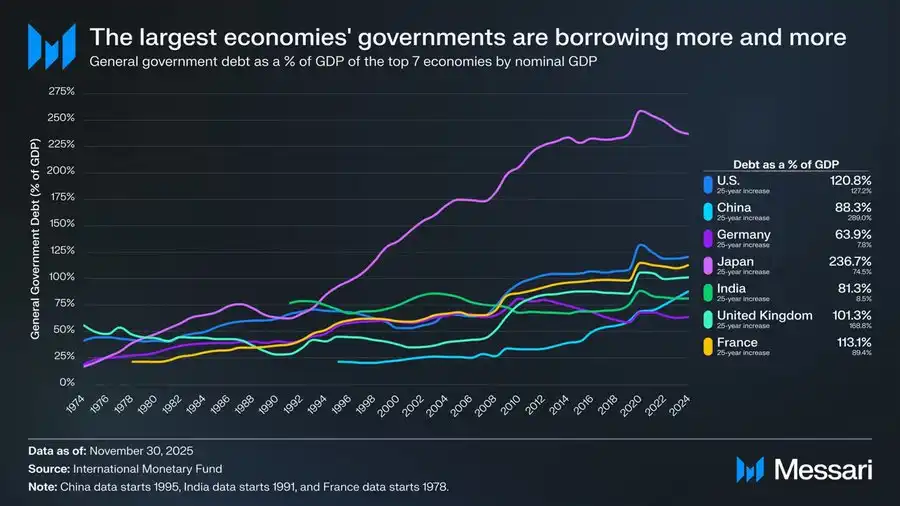
This chart is not a decorative macro background but the logical starting point of the entire Cryptomoney argument.
Over the past 50 years, the government debt-to-GDP ratio of major global economies has shown a highly consistent and almost irreversible upward trend:
· US: 120.8%
· Japan: 236.7%
· France: 113.1%
· UK: 101.3%
· China: 88.3%
· India: 81.3%
· Germany: 63.9%
This is not the result of governance failure in any one country, but a common outcome spanning institutions, political structures, and stages of development. Whether in democratic countries, authoritarian states, advanced economies, or emerging markets, government debt has outpaced economic growth in the long run.
What this chart truly illustrates is not "high debt," but "savings being systematically sacrificed"
When government debt grows faster than economic output over the long term, the system can only maintain stability through three means:
1. Inflation
2. Long-term low real interest rates
3. Financial repression (capital controls, withdrawal restrictions, regulatory intervention)
Regardless of which path is taken, the ultimate cost will be borne by the same group of people: savers. Messari used a highly restrained but weighty phrase in the report: When debt grows faster than economic output, the costs fall most heavily on savers. In other words, when debt outpaces growth, savers are destined to be the sacrificed party.
Why will sentiment collapse in 2025?
Because in 2025, an increasing number of participants will clearly realize this for the first time.
Prior to this:
· "Inflation is just temporary"
· "Cash is always safe"
· "In the long run, fiat is stable"
And reality is continuously refuting these assumptions.
When people realize:
· Hard work ≠ Wealth preservation
· Saving behavior itself is continually eroding
· Asset allocation difficulty has significantly increased
The collapse of sentiment is not from Crypto, but from a shaken confidence in the entire financial system. Crypto is just the first place where this impact is perceived.
The significance of Cryptomoney is not in "higher returns"
This is also a point that Messari emphasizes repeatedly but is easily misinterpreted. Cryptomoney does not exist to promise higher returns.
Its core value lies in:
· Predictable rules
· Monetary policy not subject to arbitrary changes by a single entity
· Assets that can be self-custodied
· Value that can be transferred across borders without permission
In other words, it doesn't provide a "get-rich-quick scheme," but rather: a reempowerment of individual currency choice in a high-debt, low-certainty world.
Emotional Collapse is Actually a Form of "Awakening"
When you juxtapose this debt chart with the market sentiment of 2025, you'll arrive at a counterintuitive conclusion: Extreme emotional pessimism doesn't signify industry failure but instead signals an increasing realization that the issues in the old system are indeed real.
Crypto's issue has never been "uselessness." The real issue is: It no longer creates effortless outsized returns for everyone.
Summary | From Emotion, to Structure, to the Currency Itself
This chapter tackles a fundamental question: Why, in the absence of a systemic collapse, did market sentiment plummet to historic lows? The answer isn't in the candlestick charts but in the currency's structure.
· Emotional collapse is a symptom
· Paradigm rupture is a process
· Monetary system imbalance is the root cause
And this is precisely why Messari chose to start this entire report from "money" rather than from "applications."
Chapter Three | Why Only BTC Is Regarded as "Real Money"
If you've read this far, you might easily raise a question: If the issue lies within the monetary system, why is BTC the answer and not something else?
Messari's judgment in the report is exceptionally clear: BTC is no longer on the same competitive plane as other crypto assets.
1. Money is Not a Technical Issue, but a Consensus Issue
This is the first key to understanding BTC. Messari repeatedly emphasizes in the original text a fact that engineers easily overlook: Money is a social consensus, not a technical optimization problem. In other words:
· Money isn't about being the "fastest"
· Not about being the "cheapest"
· Nor is it about being the "most feature-rich"
It's about being perceived as a long-term, stable store of value. From this perspective, Bitcoin's triumph is not mysterious.
2. Three Years of Data, and the Answer is Already Clear
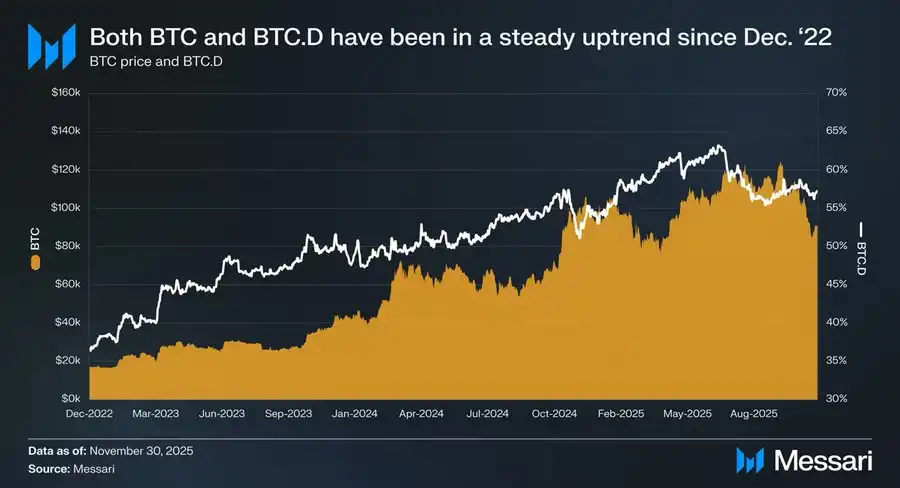
From December 1, 2022, to November 30, 2025:
· BTC has appreciated by 429%
· Market cap has grown from $318 billion to $1.81 trillion
· Entered the top ten global asset ranking
More importantly, the relative performance: BTC.D has grown from 36.6% to 57.3%. In a period that theoretically should have seen an altcoin frenzy, funds have continued to flow back to BTC. This is not a fluke of a market cycle; this is a market reclassifying assets.
3. ETFs and Corporate Treasury Strategies are Essentially Formalizing Consensus
Messari's assessment of ETFs is very restrained, yet the conclusion is profound. A Bitcoin ETF is not merely about "new buying pressure"; what it truly changes is: who is buying + why they are buying + how long they can hold
· An ETF transforms BTC into a compliant asset
· A Corporate Treasury Strategy makes BTC a part of a company's balance sheet
· National reserves elevate BTC to a "strategic asset" level
When BTC is held by these actors, it is no longer seen as: a high volatility asset that can be dumped at any time, but rather as: a currency asset that must be held long term and cannot be easily mismanaged. Once money is treated this way, it's hard to revert.
4. Why the More "Boring" BTC Gets, the More It Resembles Money
This might be the most counterintuitive point of 2025:
· BTC has no use case
· No narrative shift
· No ecosystem story
· There is not even any "new thing"
But precisely because of this, it meets all the characteristics of "money":
· Does not rely on future promises
· Does not need a growth narrative
· Does not require ongoing team delivery
It just needs to not be wrong.
And in a high-debt, low-certainty world, "not being wrong" itself is a scarce asset.
5. BTC's Strength is Not a Market Failure
Many people's pain comes from a misconception: "BTC's strength means the market is not right." Messari's assessment is quite the opposite: BTC's strength is the market becoming more rational.
When the system begins to reward:
· Stability
· Predictability
· Long-term credibility
Then all strategies relying on "high volatility equals high returns" will increasingly appear painful. This is not an issue with BTC; it is an issue with the method of participation.
Summary | BTC Didn't Win, It Was Chosen
BTC did not "beat" other assets. It was simply repeatedly validated by the market in an era where the monetary system was continuously failing as:
· The least explanatory asset
· The least reliant on trust asset
· The asset least in need of future commitments
This is not the result of a single market cycle but a confirmation of a role.
Chapter 4 | When the Market Only Needs One Kind of "Money," the L1 Story Begins to Malfunction
After confirming that BTC has been chosen by the market as the "main Cryptomoney," one question cannot be avoided: if money already has an answer, what is left for Layer 1? Messari did not directly provide a conclusion, but after reading through this section, a trend is very clear: L1 valuation is being forced to transition from "future narratives" back to "real-world constraints."
1. A Harsh but True Fact: 81% of Market Value is in the "Money" Narrative
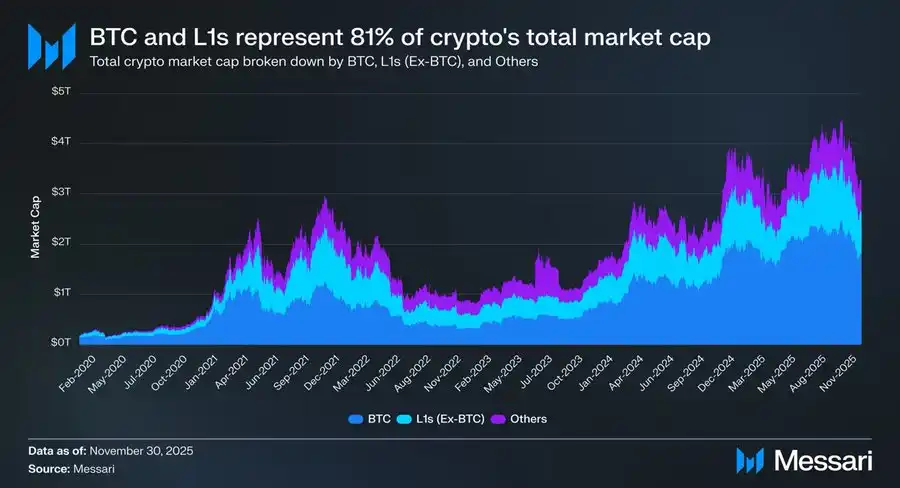
By the end of 2025, the entire crypto market cap is about $3.26T:
· BTC: $1.80T
· Other L1: ~$0.83T
· Other Assets: <$0.63T
Overall, approximately 81% of the cryptocurrency asset market cap is considered "money" or "potential money" by the market in terms of pricing. What does this mean? It means that the valuation of L1 is no longer based on the pricing logic of being an "application platform" but rather on the pricing logic of "whether it qualifies as money."
2. The Issue Is: Most L1s Are Not Worthy
The data provided by Messari is very straightforward and quite stark.
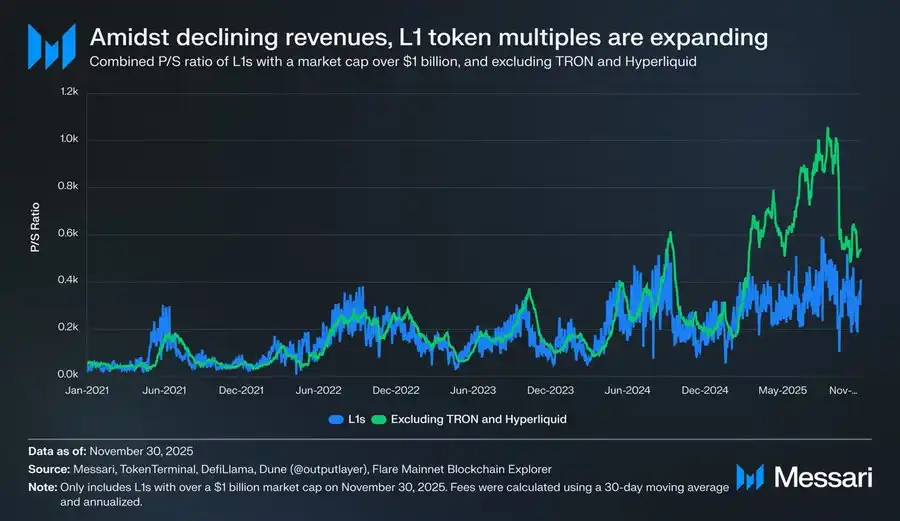
After excluding outliers like TRON and Hyperliquid with unusually high revenue:
· The overall revenue of L1s is continuously declining
· But the valuation multiple is continuously increasing
The adjusted P/S ratios are as follows:
· 2021: 40x
· 2022: 212x
· 2023: 137x
· 2024: 205x
· 2025: 536x
Meanwhile, the total L1 revenue during the same period is:
· 2021: $12.3B
· 2022: $4.9B
· 2023: $2.7B
· 2024: $3.6B
· 2025 (annualized): $1.7B
This is a discrepancy that cannot be reasonably explained by "future growth."
3. L1s Are Not "Undervalued" but "Reclassified"
Many people's anguish stems from a misunderstanding: "Has the market mistakenly underestimated L1s?" Messari's assessment is quite the opposite: the market has not underestimated L1s but has reduced their 'monetary imagination space.'
If an asset:
· Cannot function as a stable store of value
· Cannot be held long term
· And cannot provide a predictable cash flow
Then it ultimately only has one way to be priced: as a high-beta risk asset.
4. The Example of Solana Actually Says It All
SOL is one of the few L1s that outperformed BTC in 2025. However, Messari pointed out a highly impactful fact:
· SOL's ecosystem data grew 20–30 times
· Price only outperformed BTC by 87%
In other words: in order to achieve "significant alpha" against BTC, an L1 needs a order-of-magnitude ecosystem explosion. This is not due to "not trying hard enough," but because the reward function has been rewritten.
5. When BTC Becomes "Money," the Burden on L1s Becomes Heavier
This is a structural change that many people have not realized. Before BTC had a clear monetary status:
· L1s could tell a story of "becoming money in the future"
· The market was willing to prepay for this possibility
And now:
· BTC has solidified its position
· The market is no longer willing to pay the same premium for "second money"
Therefore, L1s face a tougher question: If you are not money, then what are you?
Conclusion|The Issue with L1s is Not Competition, But Positioning
L1s did not "lose to BTC." What they lost in is:
· In the monetary dimension
· The market no longer needs more answers
And once the protection of the "money narrative" is lost, all valuations must realign with reality.
This is the direct source of the emotional breakdown of many participants in 2025.
You may also like

Found a "meme coin" that skyrocketed in just a few days. Any tips?

TAO is Elon Musk, who invested in OpenAI, and Subnet is Sam Altman

The era of "mass coin distribution" on public chains comes to an end

Soaring 50 times, with an FDV exceeding 10 billion USD, why RaveDAO?

1 billion DOTs were minted out of thin air, but the hacker only made 230,000 dollars

After the blockade of the Strait of Hormuz, when will the war end?

Before using Musk's "Western WeChat" X Chat, you need to understand these three questions
The X Chat will be available for download on the App Store this Friday. The media has already covered the feature list, including self-destructing messages, screenshot prevention, 481-person group chats, Grok integration, and registration without a phone number, positioning it as the "Western WeChat." However, there are three questions that have hardly been addressed in any reports.
There is a sentence on X's official help page that is still hanging there: "If malicious insiders or X itself cause encrypted conversations to be exposed through legal processes, both the sender and receiver will be completely unaware."
No. The difference lies in where the keys are stored.
In Signal's end-to-end encryption, the keys never leave your device. X, the court, or any external party does not hold your keys. Signal's servers have nothing to decrypt your messages; even if they were subpoenaed, they could only provide registration timestamps and last connection times, as evidenced by past subpoena records.
X Chat uses the Juicebox protocol. This solution divides the key into three parts, each stored on three servers operated by X. When recovering the key with a PIN code, the system retrieves these three shards from X's servers and recombines them. No matter how complex the PIN code is, X is the actual custodian of the key, not the user.
This is the technical background of the "help page sentence": because the key is on X's servers, X has the ability to respond to legal processes without the user's knowledge. Signal does not have this capability, not because of policy, but because it simply does not have the key.
The following illustration compares the security mechanisms of Signal, WhatsApp, Telegram, and X Chat along six dimensions. X Chat is the only one of the four where the platform holds the key and the only one without Forward Secrecy.
The significance of Forward Secrecy is that even if a key is compromised at a certain point in time, historical messages cannot be decrypted because each message has a unique key. Signal's Double Ratchet protocol automatically updates the key after each message, a mechanism lacking in X Chat.
After analyzing the X Chat architecture in June 2025, Johns Hopkins University cryptology professor Matthew Green commented, "If we judge XChat as an end-to-end encryption scheme, this seems like a pretty game-over type of vulnerability." He later added, "I would not trust this any more than I trust current unencrypted DMs."
From a September 2025 TechCrunch report to being live in April 2026, this architecture saw no changes.
In a February 9, 2026 tweet, Musk pledged to undergo rigorous security tests of X Chat before its launch on X Chat and to open source all the code.
As of the April 17 launch date, no independent third-party audit has been completed, there is no official code repository on GitHub, the App Store's privacy label reveals X Chat collects five or more categories of data including location, contact info, and search history, directly contradicting the marketing claim of "No Ads, No Trackers."
Not continuous monitoring, but a clear access point.
For every message on X Chat, users can long-press and select "Ask Grok." When this button is clicked, the message is delivered to Grok in plaintext, transitioning from encrypted to unencrypted at this stage.
This design is not a vulnerability but a feature. However, X Chat's privacy policy does not state whether this plaintext data will be used for Grok's model training or if Grok will store this conversation content. By actively clicking "Ask Grok," users are voluntarily removing the encryption protection of that message.
There is also a structural issue: How quickly will this button shift from an "optional feature" to a "default habit"? The higher the quality of Grok's replies, the more frequently users will rely on it, leading to an increase in the proportion of messages flowing out of encryption protection. The actual encryption strength of X Chat, in the long run, depends not only on the design of the Juicebox protocol but also on the frequency of user clicks on "Ask Grok."
X Chat's initial release only supports iOS, with the Android version simply stating "coming soon" without a timeline.
In the global smartphone market, Android holds about 73%, while iOS holds about 27% (IDC/Statista, 2025). Of WhatsApp's 3.14 billion monthly active users, 73% are on Android (according to Demand Sage). In India, WhatsApp covers 854 million users, with over 95% Android penetration. In Brazil, there are 148 million users, with 81% on Android, and in Indonesia, there are 112 million users, with 87% on Android.
WhatsApp's dominance in the global communication market is built on Android. Signal, with a monthly active user base of around 85 million, also relies mainly on privacy-conscious users in Android-dominant countries.
X Chat circumvented this battlefield, with two possible interpretations. One is technical debt; X Chat is built with Rust, and achieving cross-platform support is not easy, so prioritizing iOS may be an engineering constraint. The other is a strategic choice; with iOS holding a market share of nearly 55% in the U.S., X's core user base being in the U.S., prioritizing iOS means focusing on their core user base rather than engaging in direct competition with Android-dominated emerging markets and WhatsApp.
These two interpretations are not mutually exclusive, leading to the same result: X Chat's debut saw it willingly forfeit 73% of the global smartphone user base.
This matter has been described by some: X Chat, along with X Money and Grok, forms a trifecta creating a closed-loop data system parallel to the existing infrastructure, similar in concept to the WeChat ecosystem. This assessment is not new, but with X Chat's launch, it's worth revisiting the schematic.
X Chat generates communication metadata, including information on who is talking to whom, for how long, and how frequently. This data flows into X's identity system. Part of the message content goes through the Ask Grok feature and enters Grok's processing chain. Financial transactions are handled by X Money: external public testing was completed in March, opening to the public in April, enabling fiat peer-to-peer transfers via Visa Direct. A senior Fireblocks executive confirmed plans for cryptocurrency payments to go live by the end of the year, holding money transmitter licenses in over 40 U.S. states currently.
Every WeChat feature operates within China's regulatory framework. Musk's system operates within Western regulatory frameworks, but he also serves as the head of the Department of Government Efficiency (DOGE). This is not a WeChat replica; it is a reenactment of the same logic under different political conditions.
The difference is that WeChat has never explicitly claimed to be "end-to-end encrypted" on its main interface, whereas X Chat does. "End-to-end encryption" in user perception means that no one, not even the platform, can see your messages. X Chat's architectural design does not meet this user expectation, but it uses this term.
X Chat consolidates the three data lines of "who this person is, who they are talking to, and where their money comes from and goes to" in one company's hands.
The help page sentence has never been just technical instructions.
Parse Noise's newly launched Beta version, how to "on-chain" this heat?

Is Lobster a Thing of the Past? Unpacking the Hermes Agent Tools that Supercharge Your Throughput to 100x

Declare War on AI? The Doomsday Narrative Behind Ultraman's Residence in Flames
Crypto VCs Are Dead? The Market Extinction Cycle Has Begun
Claude's Journey to Foolishness in Diagrams: The Cost of Thriftiness, or How API Bill Increased 100-Fold

Edge Land Regress: A Rehash Around Maritime Power, Energy, and the Dollar
Arthur Hayes Latest Interview: How Should Retail Investors Navigate the Iran Conflict?
Just now, Sam Altman was attacked again, this time by gunfire

Straits Blockade, Stablecoin Recap | Rewire News Morning Edition
From High Expectations to Controversial Turnaround, Genius Airdrop Triggers Community Backlash


 App
App