
Why does Hyperliquid earn less than Coinbase?

Original Article Title: Hyperliquid at the Crossroads: Robinhood or Nasdaq Economics
Original Author: @shaundadevens
Translation: Peggy, BlockBeats
Editor's Note: As Hyperliquid's trading volume approaches that of traditional exchanges, what truly deserves attention is no longer just "how large the volume is," but rather where it chooses to sit in the market structure. This article uses the traditional financial industry's "Broker vs. Exchange" division as a reference to analyze why Hyperliquid has proactively adopted a low-fee market layer positioning, and how Builder Codes and HIP-3, while amplifying the ecosystem, exert long-term pressure on platform fees.
Hyperliquid's path reflects the core issue that the entire crypto trading infrastructure is facing: once scale is achieved, how should profits be allocated.
The following is the original text:
Hyperliquid is processing perpetual contract trading volume close to Nasdaq levels, but its profit structure also exhibits "Nasdaq-level" characteristics.
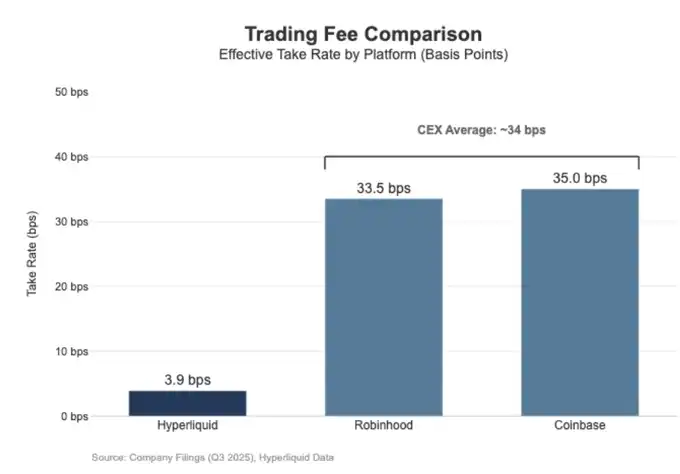
In the past 30 days, Hyperliquid has cleared $205.6 billion in perpetual contract notional trading volume (approximately $617 billion on a quarterly annualized basis), but has generated only $8.03 million in fee revenue, resulting in an effective fee rate of about 3.9 basis points (bps).
This means that Hyperliquid's monetization method is more akin to a wholesale execution venue rather than a retail-oriented high-fee trading platform.
For comparison, Coinbase recorded $295 billion in trading volume in Q3 2025, but achieved $1.046 billion in trading revenue, implying an effective fee rate of about 35.5 basis points.
Robinhood's monetization logic in its crypto business is similar: its $80 billion in crypto asset notional trading volume resulted in $268 million in trading revenue, implying a fee rate of around 33.5 basis points; meanwhile, Robinhood's stock notional trading volume in Q3 2025 reached a high of $647 billion.
Overall, Hyperliquid has risen to the ranks of top-tier trading infrastructure in terms of trading volume, but in terms of fees and business model, it resembles a low-fee execution layer catering to professional traders rather than a retail-oriented platform.
The difference is not only reflected in the fee level, but also in the breadth of monetization dimensions. Retail platforms are often able to profit on multiple income "interfaces" simultaneously. In the third quarter of 2025, Robinhood generated a total of $730 million in trading-related revenue, along with $456 million in net interest income, and $88 million in other revenue (mainly from the Gold subscription service).
In contrast, Hyperliquid currently relies much more on trading fees, and these fees are structurally compressed at single-digit basis point levels at the protocol layer. This means that Hyperliquid's revenue model is more concentrated, more singular, and closer to a low-fee, high-throughput infrastructure role, rather than a retail platform that achieves deep monetization through multiple product lines.
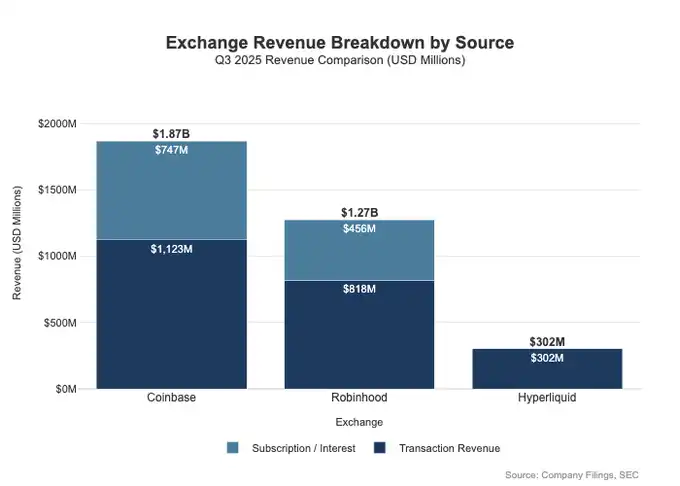
This can be fundamentally explained by a positioning difference: Coinbase and Robinhood are broker/dealer/distribution businesses that leverage their balance sheet and subscription system for multi-layered monetization, while Hyperliquid is closer to the exchange layer. In the traditional financial market structure, the profit pool is naturally divided between these two layers.
Broker/Dealer vs. Exchange Model
In traditional finance (TradFi), the most fundamental distinction is the separation between the distribution layer and the market layer.
Retail platforms like Robinhood and Coinbase are located in the distribution layer, able to capture high-margin monetization facets, while exchanges like Nasdaq are positioned in the market layer, where their pricing power is structurally constrained, and their execution services are pushed by competition towards a commoditized economic model.
Broker/Dealer = Distribution Capability + Customer Balance Sheet
Brokers have control over customer relationships. Most users do not directly access Nasdaq but enter the market through brokers. Brokers are responsible for account opening, custody, margin and risk management, customer support, tax documents, etc., and then route orders to specific trading venues.
It is this "relationship ownership" that allows brokers to monetize in multiple ways beyond trading:
Funds and asset balances: cash aggregation interest spread, margin lending, securities lending
Product Bundling: Subscription Service, Feature Package, Bank Card / Robo-Advisor Product
Routing Economics: Brokerage controls order flow and can embed payment or revenue-sharing mechanisms in the routing chain
This is also why brokerages often earn more than trading venues: the profit pool is truly concentrated in the "distribution + balance" position.
Exchange = Matching + Rules + Infrastructure, Commission Limited
An exchange operates the trading venue itself: matching engine, market rules, deterministic execution, and infrastructure connection. Its main monetization methods include:
Trading Fees (continuously suppressed in highly liquid products)
Rebates / Liquidity Incentives (often most of the nominal fee rate is returned to the market maker in order to compete for liquidity)
Market Data, Network Connection, and Co-location
Listing Fee and Index Authorization
Robinhood's order routing mechanism clearly demonstrates this structure: the customer relationship is held by the brokerage (Robinhood Securities), and the order is then routed to a third-party market center, with the economic benefits during routing being distributed in the chain.
The true high-margin layer is at the distribution end, which controls customer acquisition, customer relationships, and all monetization aspects surrounding execution (such as order flow payment, margin, securities lending, and subscription services).
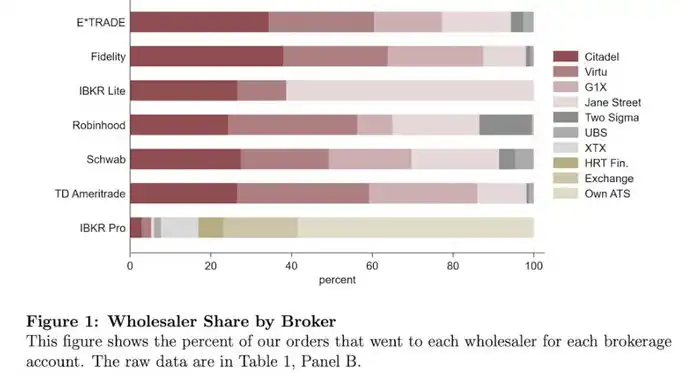
Nasdaq itself is in the low-margin layer. The products it offers are essentially highly commoditized execution capabilities and queue access rights, and its pricing power is strictly limited in the mechanism.
The reason is that: in order to compete for liquidity, trading venues often need to return a large portion of the nominal fee as maker rebates; regulators have set limits on access fees, limiting the fee space that can be charged; at the same time, order routing has high elasticity, and funds and orders can quickly switch between different trading venues, making it difficult for any single venue to raise prices.
This point is very intuitively reflected in the financial data disclosed by Nasdaq: the actual net revenue captured in its cash stock trading is usually only on the order of a fraction of a cent per share. This is a direct reflection of the structural compression of the profit space of market-level exchanges.
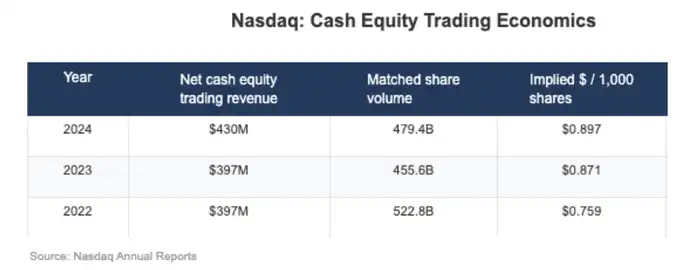
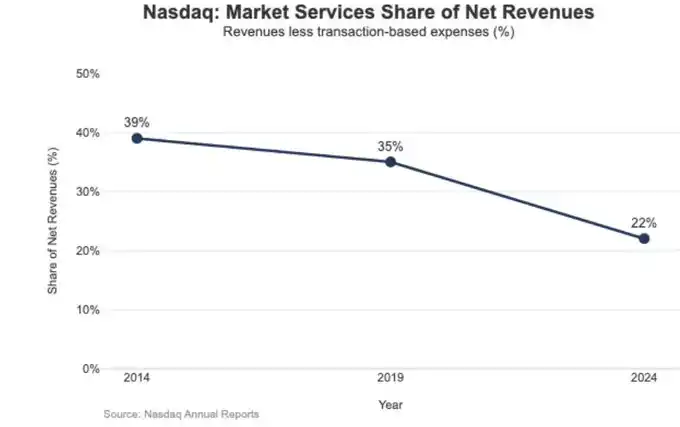
The strategic consequences of this low-profit margin are also clearly reflected in Nasdaq's revenue structure change.
In 2024, Nasdaq's Market Services revenue was $1.02 billion, accounting for 22% of the total revenue of $4.649 billion; a ratio that was as high as 39.4% in 2014 and still at 35% in 2019.
This continuous downward trend is highly consistent with Nasdaq's active shift from a market-volatility-dependent, profit-constrained execution business to a more regular and predictable software and data business. In other words, it is the structurally low-profit space at the exchange level that has driven Nasdaq to gradually shift its growth focus from "matching and execution" to "technology, data, and service-productization."
Hyperliquid as a "Market Layer"
Hyperliquid's approximately 4 basis points (bps) effective fee rate is highly aligned with its intentionally chosen market layer positioning. It is building an on-chain "Nasdaq-style" trading infrastructure:
A high-throughput matching, margin, and clearing system centered around HyperCore, utilizing a maker/taker pricing and market-making rebate mechanism, aiming to maximize execution quality and shared liquidity, rather than conducting multilayer monetization for retail users.
In other words, Hyperliquid's design focus is not on subscription, balances, or distribution-type revenue, but on providing commoditized yet extremely efficient execution and settlement capabilities—this is a typical characteristic of a market layer and an inevitable result of its low-fee structure.
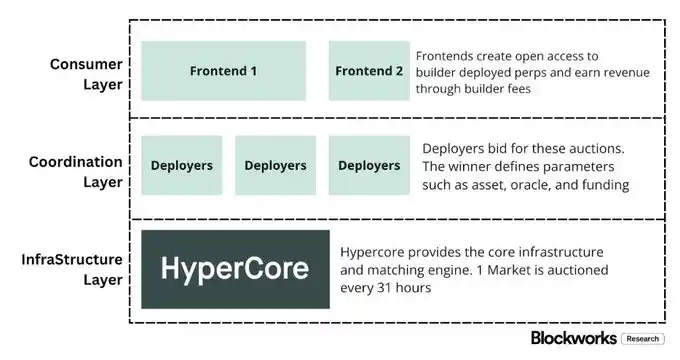
This is reflected in the two most common structural splits that have not yet been truly implemented in the majority of cryptocurrency trading platforms but are very typical in Traditional Finance (TradFi):
One is the permissionless brokerage/distribution layer (Builder Codes).
Builder Codes allow third-party trading interfaces to be built on top of the core exchange and earn economic benefits independently. Among them, the Builder fee has a clear upper limit: a maximum of 0.1% (10 basis points) for perpetual contracts, and a maximum of 1% for spot, and fees can be set at the individual order level. This mechanism thus creates a competitive market at the distribution layer, rather than a single official app monopolizing user access and monetization rights.
Second is Permissionless Listing / Product Layer (HIP-3).
In traditional finance, exchanges usually control listing approvals and product creation. HIP-3 externalizes this function: developers can deploy a perpetual contract inheriting the HyperCore matching engine and API capabilities, while the specific market's definition and operation are the responsibility of the deployer.
In terms of the economic structure, HIP-3 clearly defines the revenue-sharing relationship between the exchange and the product layer: deployers of spot and HIP-3 perpetual contracts can retain up to 50% of the trading fees of the assets they deploy.
Builder Codes have already shown effectiveness on the distribution end: as of mid-December, approximately one-third of users did not trade through the native interface but through a third-party frontend.
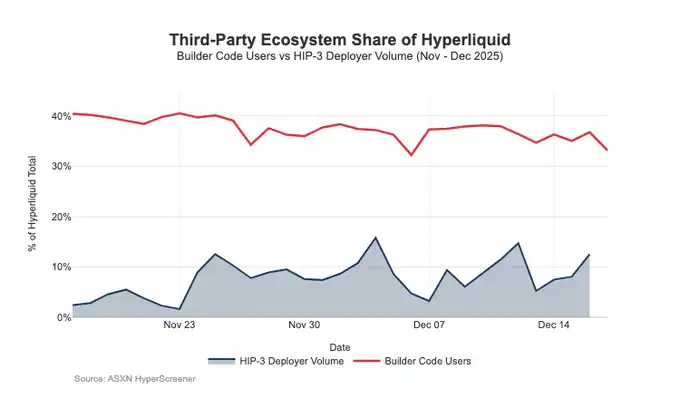
The issue is that this distribution-friendly structure itself creates sustained pressure on the exchange layer's take rate:
1. Price compression.
Multiple frontends simultaneously selling the same underlying liquidity naturally converge competition towards the lowest comprehensive trading cost; meanwhile, Builder fees can be flexibly adjusted at the order level, further driving prices down.
2. Loss of monetization surface.
Frontends control onboarding, product bundling, subscription services, and the complete trading workflow, capturing the high-margin space of the brokerage layer; whereas Hyperliquid can only retain a thinner exchange layer take rate.
3. Strategic routing risk.
Once frontends evolve into true cross-exchange routers, Hyperliquid could be forced into wholesale execution competition, only able to defend order flow through fee reductions or increased rebates.
Overall, Hyperliquid is consciously choosing a low-profit-margin market layer positioning (through HIP-3 and Builder Codes), while allowing a high-margin brokerage layer to grow on top of it.
If Builder frontends continue expanding, they will increasingly determine the pricing structure facing users, control user retention and monetization interfaces, and gain bargaining power at the routing level, structurally putting long-term pressure on Hyperliquid's take rate.
Defend Distribution Rights and Introduce a Non-Exchange Profit Pool
The most direct risk is commoditization.
If a third-party front end can consistently undercut the native interface in price, and even achieve cross-site routing in the end, Hyperliquid will be pushed towards a wholesale execution-type economic model.
Recent design adjustments indicate that Hyperliquid is attempting to explore new revenue streams while trying to avoid this outcome.
Distribution Defense: Maintaining the Economic Competitiveness of the Native Front End
A previously proposed staking discount scheme allows Builders to stake HYPE to receive up to a 40% fee discount, effectively providing a structurally cheaper path for third-party front ends compared to the Hyperliquid native interface. The withdrawal of this scheme equates to the elimination of a direct subsidy for external distribution "price pressure."
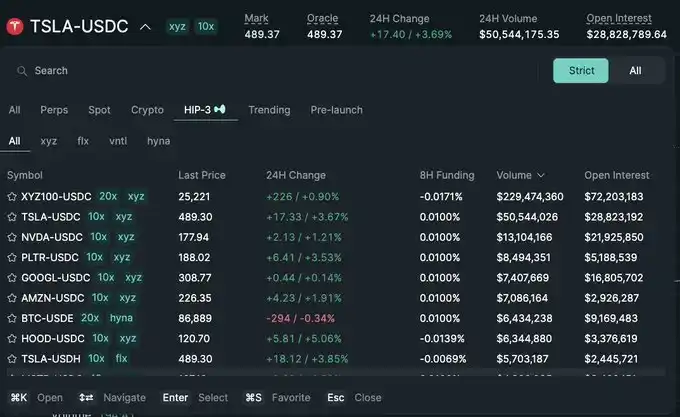
At the same time, HIP-3 markets were initially positioned to be primarily distributed by Builders and not prominently showcased on the main front end; however, these markets have now begun to be displayed in the Hyperliquid native front end under strict listing standards.
This signal is very clear: Hyperliquid still maintains permissionless innovation at the Builder level but will not sacrifice its core distribution rights at the expense of external distribution.
USDH: Shifting from Transactional Liquidation to "Float" Liquidation
The launch of USDH aims to reclaim stablecoin reserve earnings that would have otherwise been captured outside the system. Its publicized structure involves a 50/50 split of reserve earnings: 50% to Hyperliquid and 50% for USDH ecosystem growth.
Additionally, the transaction fee discounts offered on USDH-related markets further reinforce this orientation: Hyperliquid is willing to sacrifice on a single transaction's economics to secure a larger, more sticky, balance-bound profit pool.
In effect, this introduces a revenue stream similar to an annuity for the protocol, the growth of which depends on the monetary base scale and not just nominal trading volume.
Portfolio Margin: Introducing Brokerage-Equivalent Financing Economics
Portfolio Margin unifies the margin for spot and perpetual contracts, allowing different exposures to offset each other and introducing a native lending loop.
Hyperliquid will retain 10% of the interest paid by borrowers, making the protocol's economics increasingly dependent on leverage utilization and interest rate levels, rather than just trade volume. This approach is closer to a broker/prime brokerage revenue model rather than a pure exchange logic.
The Path of Hyperliquid Toward a "Brokerage-Style" Economic Model
On the throughput front, Hyperliquid has already reached the scale of top-tier exchanges; however, in terms of monetization, it still resembles a market layer: with very high nominal trading volume, coupled with a single-digit basis point effective fee rate. The gap with platforms like Coinbase and Robinhood is structural.
Retail platforms sit at the brokerage layer, holding user relationships and fund balances, enabling them to monetize multiple profit pools simultaneously (margin funding, idle cash, subscriptions); whereas pure exchanges sell execution services, which, under liquidity and routing competition, naturally commoditize execution, with net capture being continuously squeezed. Nasdaq is a TradFi reference to this constraint.
Early on, Hyperliquid evidently tilted towards the exchange prototype. By splitting the distribution layer (Builder Codes) from the product creation layer (HIP-3), it accelerated ecosystem expansion and market coverage; however, the cost of this architecture could also push the economics outward: once a third-party frontend decides to aggregate prices and can route cross-exchange, Hyperliquid risks being pressed into a thin-margin wholesale execution track.
Nevertheless, recent actions show a deliberate shift: without relinquishing the unified execution and clearing advantages, defending the distribution rights, and expanding revenue sources to a "balance-based" profit pool.
Specifically: the protocol is no longer willing to subsidize external frontends structurally cheaper than the native UI; HIP-3 is more natively displayed; and asset-liability-style revenue sources are introduced.
USDH brings reserve rewards back to the ecosystem (50/50 split and offers USDH market fee discounts); while portfolio margin introduces financing economics through a 10% cut of borrowing interest.
Overall, Hyperliquid is converging towards a hybrid model: with the execution track as the base, overlaying distribution defense and balance-driven profit pools. This reduces the risk of being stuck in a low basis point, wholesale exchange model, while moving closer to a brokerage-style revenue structure without sacrificing the unified execution and clearing advantages.
Looking ahead to 2026, the unresolved question is: Can Hyperliquid further move towards a brokerage-style economy without undermining its "outsourcing-friendly" model? USDH is the clearest litmus test: at around a $100 million supply level, when the protocol does not control distribution, the expansion of outsourced issuance appears to be slow.
The obvious alternative path could have been at the UI level by automatically converting the approximately $4 billion of USDC holdings into a native stablecoin (similar to Binance's automatic conversion of BUSD).
If Hyperliquid wants to truly capture the prime brokerage layer's profit pool, it may also need brokerage-like behaviors: stronger control, tighter native product integration, and a clearer delineation with the ecosystem team on distribution and balance sheet competition.
You may also like

ZachXBT: Humanity private key leak and abnormal surge in H token should be viewed separately
On June 9, according to related disclosures, on-chain investigator ZachXBT posted an update on Humanity’s roughly $31 million security incident, saying that after further analyzing fund flows, he currently tends to believe the project team was not involved in an “inside job” or a self-staged attack. According to him, the official explanation about the private key leak was broadly accurate, but before the token unlock, the price of H had been artificially pushed higher, and the hacker later took advantage of that market environment; therefore, the private key leak and the earlier abnormal price pumping should be regarded as two separate and independent events. This reframing has shifted the market’s understanding of the nature of the incident. Earlier discussion around Humanity had focused on whether the team directly participated in the attack or used the security incident to cover up internal operations. ZachXBT’s latest remarks shift the focus from “whether it was self-theft” to “whether there were pre-unlock market structure issues.” He also questioned whether the team may have.

Morning Report | OpenAI has submitted an S-1 registration statement draft to the U.S. SEC; Morpho completes $175 million financing

Morning Report | BitMine increased its holdings by 126,971 ETH last week; trader Eugene announced his exit from the crypto market

Wang Chuan: How can one not feel anxious after the neighbor Old Wang made thirty times profit by investing in storage stocks? (Seven) - A quarter-century cycle

Cryptocurrency CEXs are flocking to sell US stocks, and traditional brokerages are facing an "uninvited guest."

$75 billion in foreign capital has fled, and South Korean retail investors have absorbed it all using leverage

Japan’s Three Megabanks Plan Joint Stablecoin Issuance in Fiscal 2026
MUFG, SMBC, and Mizuho reportedly plan to jointly issue fiat-pegged stablecoins in fiscal 2026, signaling Japan’s growing push into bank-led digital payment infrastructure.

Humanity Discloses H Token Dual-Chain Attack Details, With Losses on Ethereum and BSC Exceeding $36 Million
Humanity said the H token attack across Ethereum and BSC caused more than $36 million in losses after leaked ProxyAdmin keys enabled malicious contract upgrades and token minting.
White House Discusses CLARITY Act With Law Enforcement Ahead of Senate Vote
The White House discussed the CLARITY Act with law enforcement ahead of a Senate vote, focusing on illicit finance risks and developer protections.

Bitcoin Trading Guide 2026: Strategies for Experienced Traders

What Is XAUT and PAXG? Why Tokenized Gold Is Booming in 2026

Will the SpaceX IPO Hurt Bitcoin? Here's What Traders Are Watching

Foreign selling in the South Korean stock market accelerates, with cumulative net sales reportedly reaching $75 billion this year
On June 9, The Kobeissi Letter, citing Goldman Sachs data, reported that global investors are selling South Korean stocks at an unusually rapid pace. In the latest trading session, foreign investors sold about $801 million worth of Kospi constituent stocks again; total foreign outflows last week reached about $10 billion, and the market has been in net foreign selling on nearly every trading day over the past month. According to the data cited in the report, foreign investors have sold about $75 billion worth of South Korean stocks so far this year. Meanwhile, South Korean retail and institutional investors together recorded roughly $69 billion in net buying over the same period, suggesting that the market’s main buying support has come from domestic capital rather than returning overseas funds. The information currently disclosed still mainly comes from The Kobeissi Letter’s retelling and Goldman Sachs data summaries, while public details on the statistical period and the specific definition of “selling” remain relatively limited.

Fortune Warns of Strategy’s Financing Structure Risks as Bitcoin Premium Narrows
Fortune warned that Strategy’s Bitcoin treasury model faces growing financing risks as MSTR’s net asset premium narrows and preferred stock dividend pressure increases.

Ferrari Challenge Le Mans: Carl Moon to Dominate in WEEX Livery

Sahara AI Responds to SAHARA’s Sharp Drop: No Contract or Product Security Issues Found, Internal Investigation Underway
Sahara AI responded to SAHARA’s 60% price drop, saying no token contract or product security issues have been found and an internal investigation is underway.

WEEX Deposit/Withdrawal Dynamic Island: Your Asset Status, Always in Sight
Scaling Crypto Derivatives: The Digital Asset Infrastructure Behind High-Volume Trading
In the fast-moving digital asset ecosystem, derivatives platforms face an extreme architectural test. High-leverage futures markets demand more than just standard security—they require absolute operational precision, zero-latency matching engines, and ironclad structural scalability, all while navigating intense market volatility.
As global platforms scale to meet these demands, the industry is shifting away from rigid, monolithic setups toward a more agile, "decoupled" infrastructure philosophy.
The Blueprint for High-Volume Copy TradingFor elite global exchanges like WEEX (founded in 2018), this architectural choice becomes critical when scaling high-volume retail features like social copy trading. When thousands of users automatically mirror the real-time strategies of elite traders simultaneously, it triggers sudden, monumental spikes in concurrent transactional volume.
To prevent execution latency or settlement bottlenecks during these peak volatility events, a platform's primary engine must remain entirely dedicated to risk management, copy-trade synchronization, and order matching.
The Architectural Rule: New-generation platforms must separate front-end user execution engines from heavy backend infrastructural overhead to eliminate operational friction.
By separating these layers, platforms can maintain complete sovereignty over their trading environments and user experiences while strategically aligning with institutional-grade infrastructure ecosystems. This strategic framework allows modern exchanges to leverage advanced Digital Asset Custody infrastructure such as Cobo’s behind the scenes, ensuring that backend wallet management scales elastically alongside trading spikes.
Capitalizing on Market Momentum and 400× LeverageIn a derivatives arena where platforms offer up to 400× leverage on perpetual contracts, capital efficiency and market agility are core business metrics. To capture market momentum, an exchange needs the ability to rapidly expand its asset offerings, supporting everything from legacy crypto assets to sudden, trending altcoins across a massive library of trading pairs.
Adopting a flexible, scalable Wallet-as-a-Service (WaaS) solution such as Cobo’s could completely rewrite the development timeline for high-growth exchanges. Instead of spending months of engineering capital building out custom backend wallet architectures for every new blockchain network, platforms can deploy localized infrastructure in days.
This agility allows platforms to instantly scale their listings to over a thousand trading pairs without compromising security or delaying time-to-market. It mirrors the exact operational advantages seen during high-velocity market events, similar to how advanced wallet infrastructure empowers platforms during sudden asset surges; allowing exchanges to pass that speed and liquidity directly to their global user base.
A Mature Foundation for GrowthThe synergy between trusted infrastructure ecosystems and global trading platforms represents the natural evolution of a maturing crypto market. As WEEX continues to scale its global spot and derivatives offerings for over 6 million users, adopting robust backend paradigms proves that platforms no longer have to compromise between cutting-edge trading velocity and uncompromised structural security.
ZachXBT: Humanity private key leak and abnormal surge in H token should be viewed separately
On June 9, according to related disclosures, on-chain investigator ZachXBT posted an update on Humanity’s roughly $31 million security incident, saying that after further analyzing fund flows, he currently tends to believe the project team was not involved in an “inside job” or a self-staged attack. According to him, the official explanation about the private key leak was broadly accurate, but before the token unlock, the price of H had been artificially pushed higher, and the hacker later took advantage of that market environment; therefore, the private key leak and the earlier abnormal price pumping should be regarded as two separate and independent events. This reframing has shifted the market’s understanding of the nature of the incident. Earlier discussion around Humanity had focused on whether the team directly participated in the attack or used the security incident to cover up internal operations. ZachXBT’s latest remarks shift the focus from “whether it was self-theft” to “whether there were pre-unlock market structure issues.” He also questioned whether the team may have.
Morning Report | OpenAI has submitted an S-1 registration statement draft to the U.S. SEC; Morpho completes $175 million financing
Morning Report | BitMine increased its holdings by 126,971 ETH last week; trader Eugene announced his exit from the crypto market
Wang Chuan: How can one not feel anxious after the neighbor Old Wang made thirty times profit by investing in storage stocks? (Seven) - A quarter-century cycle
Cryptocurrency CEXs are flocking to sell US stocks, and traditional brokerages are facing an "uninvited guest."
$75 billion in foreign capital has fled, and South Korean retail investors have absorbed it all using leverage


