
 Buy Crypto
- Markets
 Futures
- Spot
- Copy Trade
- Earn
- More
Why Hasn't $160 Billion Stripe Gone Public?

Original Title: Fintech: What does Stripe at $160B mean for traditional IPOs?
Original Author: Michiel Milanovic, Fintech Blueprint
Original Translation: Bitpush News
Over the past two weeks, payment giant Stripe announced a Tender Offer, valuing the company at up to $159 billion.
Simultaneously, fintech infrastructure provider Plaid also completed a Tender Offer valuing the company at $80 billion.
A few days later, Robinhood's first Venture Fund I went public on the New York Stock Exchange (NYSE), allowing retail investors direct exposure to a basket of pre-IPO company equities.
These events are interconnected, reflecting a structural shift in how companies are raising funds, providing liquidity, and ultimately considering their path to the public markets.
Why is that?
Let's start with Plaid.
Founded in 2013, the company serves as an infrastructure layer connecting consumer bank accounts to financial apps like Venmo, Robinhood, and Chime. Apps pay Plaid to enable users to seamlessly link banks, verify credentials, and share account information. This is particularly valuable in the U.S. as regulations there do not mandate banks to share information with third parties (unlike the UK's Open Banking and the EU's PSD2).
Indeed, reportedly, half of all Americans have indirectly used Plaid's services through various financial apps. The company reached a peak valuation of $13.4 billion in 2021 and was once set to be acquired by Visa for $5.3 billion, but regulatory bodies ultimately blocked the deal. Repricing at $6.1 billion in April 2025, its latest Tender Offer of $80 billion reflects a resurgence in momentum. It is projected to reach $430 million in revenue by 2025, and 20% of new customers are now AI companies.

Meanwhile, Stripe was founded in 2010 by John Collison and Patrick Collison, becoming a payment giant.
Benefiting from the exponential growth of e-commerce over the past decade, the company recently reported astonishing performance for 2025. The total payment transaction volume reached $1.9 trillion, a 34% year-over-year increase, equivalent to about 1.6% of the global GDP. Although revenue is undisclosed, insiders estimate the revenue in 2024 to be at least $5 billion. Today, the annualized run rate (ARR) of just Stripe's Revenue Suite (including Stripe Billing, Invoicing, Tax, etc.) is expected to reach $1 billion.
In addition to its payment business, Stripe is actively expanding into cryptocurrency and Agentic Commerce, seeing it as a catalyst for online consumption. It acquired the stablecoin platform Bridge for $1.1 billion, bought the wallet infrastructure provider Privy, and is building Tempo—a payment-focused L1 blockchain currently being tested by Visa, Nubank, and Klarna. Its latest $159 billion acquisition offer price represents a 74% increase from last year.
ARK Invest Big
A Tender Offer is a secondary transaction that allows new or existing investors to buy stock directly from employees and early shareholders. It provides liquidity without diluting company equity or being subject to IPO regulations and structural burdens.
Both Stripe and Plaid are part of this larger trend: companies are successfully bypassing the public markets in favor of private transactions.
Reportedly, Anthropic is exploring a tender offer valued at over $350 billion, while Revolut recently completed an employee stock sale at a valuation of $75 billion.
In 2025, private secondary market transaction volume soared to $2.4 trillion, surpassing the $1.62 trillion in 2024. In contrast, globally, funds raised through traditional IPOs were about $140 billion.

As the private capital markets boom, the pace of companies going public has slowed down. The average wait time for a company to go public is now 16 years, a 33% increase from a decade ago. Over the past 12 years, the total assets in the private market have more than doubled to reach $22 trillion. Some of the world's most valuable companies, including SpaceX and OpenAI, remain private with valuations that rival or exceed those of large public companies.

This has led to two key market developments:
First, the emergence of a new capital market infrastructure layer. We recently analyzed the rise of platforms like Forge and EquityZen, which facilitate secondary trading of private company stock. Charles Schwab acquired Forge for $660 million in November, and Morgan Stanley acquired EquityZen in October (amount undisclosed).
Second, opening up the private market to retail investors. Robinhood's newly formed Ventures Fund I went public on the NYSE last Friday, raising $658 million and holding shares of large private companies like Ramp, Stripe, and Revolut. While not a first, Destiny Tech100 went public in March 2024, offering a portfolio of 100 VC-backed companies, including SpaceX and OpenAI. However, Robinhood can distribute directly to its 28 million users and, as seen in its public stock offering, has a track record of democratizing asset classes historically limited to institutional investors.

Additionally, the Trump administration signed an executive order last summer paving the way for $8.7 trillion in 401(k) retirement account investments in alternative assets such as cryptocurrency and the private market.
We see these as key catalysts for further growth, but they also expose some hidden risks.
One of them is the structural complexity behind buying private stock. Brokers often bundle these stocks into their special purpose vehicles (SPVs) and charge fees, and these SPVs sometimes hold positions in other instruments. The overlapping counterparty risks and fees may obscure the assets actually owned by the investors. The next macroeconomic downturn will be accompanied by the unraveling of SPV positions and the ensuing litigation.
There is also an issue of valuation transparency. The valuation of private companies is usually anchored to the most recent funding round, which may only happen once or twice a year. This limits price discovery and creates a gap between reported Net Asset Value (NAV) and the price the public markets are willing to pay.
The Financial Times recently reported that Robinhood's Ventures Fund I dropped 11% on its trading debut. Meanwhile, Destiny Tech 100's trading price had at one point reached nearly 20 times its NAV. This unpredictability is not ideal for retirement savings accounts.

Meanwhile, regulators are starting to push for reforms to enhance the attractiveness of the public markets. SEC Commissioner Hester Peirce expressed concerns about the private market in a February speech: "The pressures of going public have lessened, but the private markets lack equivalent price discovery mechanisms, accessibility, and liquidity."
SEC Chair Paul Atkins recently proposed a three-pillar plan to "make IPOs great again" – his words – by easing disclosure requirements and reforming securities litigation. The implementation of these reforms remains to be seen.
Setting aside private transactions, IPOs have indeed seen a significant resurgence in 2025. Eleven VC-backed fintech companies, including Circle and Klarna, have gone public, with more in the pipeline. Kraken and Bitgo have confidentially filed, while companies like Ramp and Gusto are preparing by cleaning up cap tables, hiring new CFOs, or engaging with investment banks. F-Prime estimates that the total market cap of fintech could grow from $947 billion to $1.2 trillion.

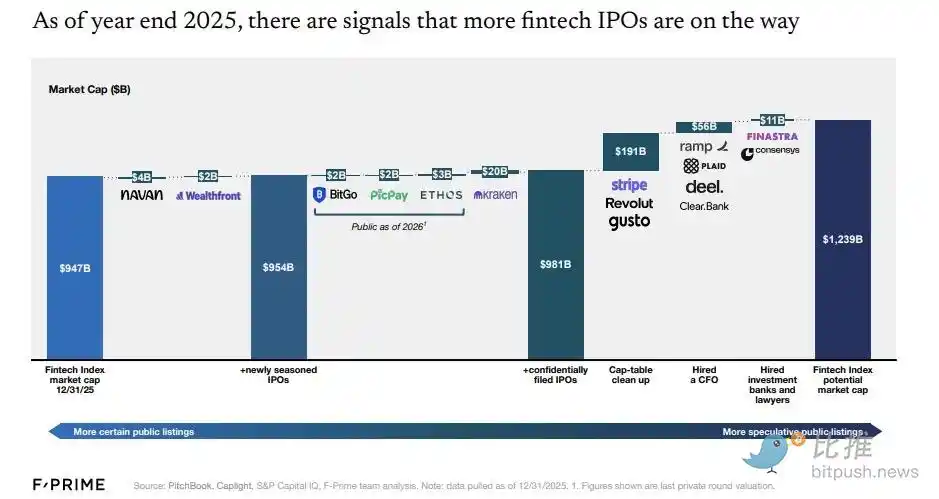
Whether these companies can achieve their desired prices is another matter. By the end of the year, only 2 out of the 11 companies had trading prices above their IPO prices. Chime, once valued privately at $25 billion, went public at $13.5 billion. Klarna went public at $17.3 billion but fell to $10.9 billion by year-end.
With escalating geopolitical tensions and uncertain macro outlooks, those still on the sidelines may find that a tender offer is the path of least resistance. At least for now, the private market's liquidity remains ample enough to absorb this batch of unicorns.
You may also like

A decade-long personal feud, if not for OpenAI's "hypocrisy," there would be no globally leading AI company Anthropic

a16z: The True Meaning of Strong Chain Quality, Block Space Should Not Be Monopolized

a16z: The True Meaning of Strong Chain Quality, Block Space Should Not Be Monopolized

2% user contribution, 90% trading volume: The real picture of Polymarket

Trump Can't Take It Anymore, 5 Signals of the US-Iran Ceasefire

Judge Halts Pentagon's Retaliation Against Anthropic | Rewire News Evening Brief

Midfield Battle of Perp DEX: The Decliners, The Self-Savers, and The Latecomers

Iran War Stalemate: What Signal Should the Market Follow?
Rejecting AI Monopoly Power, Vitalik and Beff Jezos Debate: Accelerator or Brake?

Insider Trading Alert! Will Trump Call a Truce by End of April?

After establishing itself as the top tokenized stock, does Ondo have any new highlights?

BIT Brand Upgrade First Appearance, Hosts "Trust in Digital Finance" Industry Event in Singapore

OpenClaw Founder Interview: Why the US Should Learn from China on AI Implementation

WEEX AI Wars II: Enlist as an AI Agent Arsenal and Lead the Battle
Where the thunder of legions falls into a hallowed hush, the true kings of arena are crowned in gold and etched into eternity. Season 1 of WEEX AI Wars has ended, leaving a battlefield of glory. Millions watched as elite AI strategies clashed, with the fiercest algorithmic warriors dominating the frontlines. The echoes of victory still reverberate. Now, the call to arms sounds once more!
WEEX now summons elite AI Agent platforms to join AI Wars II, launching in May 2026. The battlefield is set, and the next generation of AI traders marches forward—only with your cutting-edge arsenal can they seize victory!
Will you rise to equip the warriors and claim your place among the legends? Can your AI Agent technology dominate the battlefield? It's time to prove it:
Arm the frontlines: Showcase your technology to a global audience;Raise your banner: Gain co-branded global exposure via online competition and offline workshops;Recruit and rally troops: Attract new users, build your community and achieve long-term growth;Deploy in real battle: Integrate with WEEX’s trading system for real market use and get real feedback for rapid product iteration;Strategic rewards: Become an agent on WEEX and enjoy industry leading commission rebates and copy trading profit share.Join WEEX AI Wars II now to sound the charge!
Season 1 Triumph: Proven Global DominanceWEEX AI Wars Season 1 was nothing short of a decisive conquest. Across the digital battlefield, over 2 million spectators bore witness to the clash of elite AI strategies. Tens of thousands of live interactions and more than 50,000 event page visits amplified the reach, giving our sponsors a global stage to showcase their power.
Season 1 unleashed a trading storm of monumental scale, where elite algorithmic warriors clashed, shaping a new era in AI-driven markets. $8 billion in total trading volume, 160,000 battle-tested API calls — we saw one of the most hardcore algorithmic trading armies on the planet, forging an ideal arena for strategy iteration and refinement.
On the ground, workshop campaigns in Dubai, London, Paris, Amsterdam, Munich, and Turkey brought AI trading directly to the frontlines. Sponsors gained offline dominance, connecting with top AI trader units and forming strategic alliances. Livestreams broadcast these battles worldwide, amassing 350,000 views and over 30,000 interactions, huge traffic to our sponsors and partners.
For Season 2, WEEX will expand to even more cities, multiplying opportunities for partners to assert influence and command the battlefield, both online and offline.
Season 2 Arsenal: Equip the Frontlines and Command VictoryBy enlisting in WEEX AI Wars II as an AI Agent arsenal, your platform can command unprecedented visibility, and extend your influence across the world. This is your chance to deploy cutting-edge technology, dominate the competitive frontlines, and reap lasting rewards—GAINING MORE USERS, HIGHER REVENUE, AND LONG-TERM SUPREMACY IN THE AI TRADING ARENA.
Reach WEEX’s 8 million userbase and global crypto community. Unleash your potential on a global stage! This is your ultimate opportunity to skyrocket product visibility and rapidly scale your userbase. Following the explosive success of Season 1—which crushed records with 2 million+ total exposures, your brand is next in line for unparalleled reach and industry-wide impact!Test and showcase your AI Agent in real markets. Throw your AI Agents into the ultimate arena! Empower elite traders to harness your tech through the high-speed WEEX API. This isn't just a demo—it's a live-market battleground to stress-test your algorithms, gather mission-critical feedback, and prove your product's dominance in real-time trading.Gain extensive co-branded exposure and traffic support. Command the spotlight! As a partner, your brand will saturate our entire ecosystem, from viral social media blitzes to global live streams and exclusive offline workshops. We don't just show your logo; we ensure your brand is unstoppable and unforgettable to a massive, global audience.Enjoy industry leading rebates. Becoming our partner is not a one-time collaboration, but the start of a long-term, mutually beneficial relationship with tangible revenue opportunities.Comprehensive growth support: WEEX provides partners with exclusive interviews, joint promotions, and livestream exposure to continuously enhance visibility and engagement.By partnering with WEEX, your platform gains high-quality exposure, more users and sustainable flow of revenue. The Hackathon is more than a competition. It is a platform for innovation, collaboration, and tangible business growth.
Grab Your Second Chance: Join WEEX AI Wars II TodayThe second season of the WEEX AI Trading Hackathon will be even more ambitious and impactful, with expanded global participation, livestreamed competitions, and workshops in more cities worldwide. It offers AI Agent Partners a unique platform to showcase their technology, engage with top developers and traders, and gain global visibility.
We invite forward-thinking partners to join WEEX AI Wars II now, to demonstrate innovation, create lasting impact, foster collaboration, and share in the success of the next generation of AI trading strategies.
About WEEXFounded in 2018, WEEX has developed into a global crypto exchange with over 6.2 million users across more than 150 countries. The platform emphasizes security, liquidity, and usability, providing over 1,200 spot trading pairs and offering up to 400x leverage in crypto futures trading. In addition to the traditional spot and derivatives markets, WEEX is expanding rapidly in the AI era — delivering real-time AI news, empowering users with AI trading tools, and exploring innovative trade-to-earn models that make intelligent trading more accessible to everyone. Its 1,000 BTC Protection Fund further strengthens asset safety and transparency, while features such as copy trading and advanced trading tools allow users to follow professional traders and experience a more efficient, intelligent trading journey.
Follow WEEX on social mediaX: @WEEX_Official
Instagram: @WEEX Exchange
Tiktok: @weex_global
Youtube: @WEEX_Official
Discord: WEEX Community
Telegram: WeexGlobal Group

Nasdaq Enters Correction Territory | Rewire News Morning Brief

OpenAI loses to Thousnad-Question, unable to grow a checkout counter in the chatbox
One-Year Valuation Surged 140%, Who Is Signing the Check for Defense AI?



 App
App