
Is Russian Oil Asset Reserve (ROAR) a Good Investment in 2026? Latest Price, Risks, and Everything Buyers Should Know


Quick Summary
ROAR is not a good low-risk or long-term defensive investment based on the current public record. It is a small-cap Solana token, described by its own official site as a speculative digital asset that is not backed by physical oil reserves or any government entity. Current market data also shows a tiny market cap, sharp volatility, and active but fragile trading conditions.
That does not mean ROAR has no tradable upside. It means ROAR should be treated as a high-risk narrative trade, not a fundamental investment. If you are asking whether it belongs in a serious portfolio, the answer is probably no. If you are asking whether it can still attract short-term speculation, the answer is yes, but only for traders who fully understand the risk.
| Fast verdict | Current assessment |
|---|---|
| Long-term investment | Weak fit |
| Speculative trade | Possible, but high risk |
| Asset-backed exposure | No verified proof |
| Main driver | Narrative, liquidity, and sentiment |
| Risk level | Very high |
What Is Russian Oil Asset Reserve (ROAR)?
Russian Oil Asset Reserve, or ROAR, is a Solana-based token that uses oil, energy, and geopolitical branding to position itself as a “sovereign energy” asset. The official ROAR website says the token is a speculative digital asset and explicitly states that it is not backed by physical oil reserves or any government entity. That is the single most important fact for any investor trying to decide whether ROAR is a good investment.
WEEX’s research pages describe ROAR in the same way: a Solana-based meme coin launched in April 2026 with a narrative built around Russian energy infrastructure and oil supply dynamics, but without a real custody structure, redemption model, or on-chain oracle proving reserves. In other words, the branding sounds macroeconomic, but the structure behaves like a speculative crypto asset.
That distinction matters because many users who search for ROAR are not really asking about a meme coin. They are trying to find out whether the token gives them exposure to oil or energy in a meaningful way. Based on the current public evidence, it does not. ROAR is a story-driven token, not a verified claim on barrels, reserves, or government-backed assets.

Latest ROAR Market Snapshot
ROAR is still tiny by market-cap standards, which is one reason the token can move so sharply. CoinGecko currently lists ROAR in the Solana Ecosystem, with categories including Meme, Solana Meme, and Solana Token-2022. That classification alone tells you the market sees it more as a speculative chain-native asset than as a traditional investment product.
Here is the latest public snapshot from CoinGecko:
| Metric | Latest public data | Why it matters |
|---|---|---|
| Current price | $0.0001295 | Very low nominal price, but price alone is not the issue |
| Market cap | $129,543 | Extremely small capitalization |
| 24h volume | $58,232 | Thin enough to move quickly |
| Circulating supply | 1 billion ROAR | Large token count, low per-token price |
| All-time high | $0.002573 | Current price is far below peak |
| All-time low | $0.0₅9032 | Huge range signals extreme volatility |
Those numbers are important because they show a token that is still very early, very small, and very sensitive to sentiment. CoinGecko also shows ROAR is currently trading 94.8% below its all-time high, while its 24-hour volume has fallen sharply from the previous day. That combination usually points to a market that is active, but not stable.
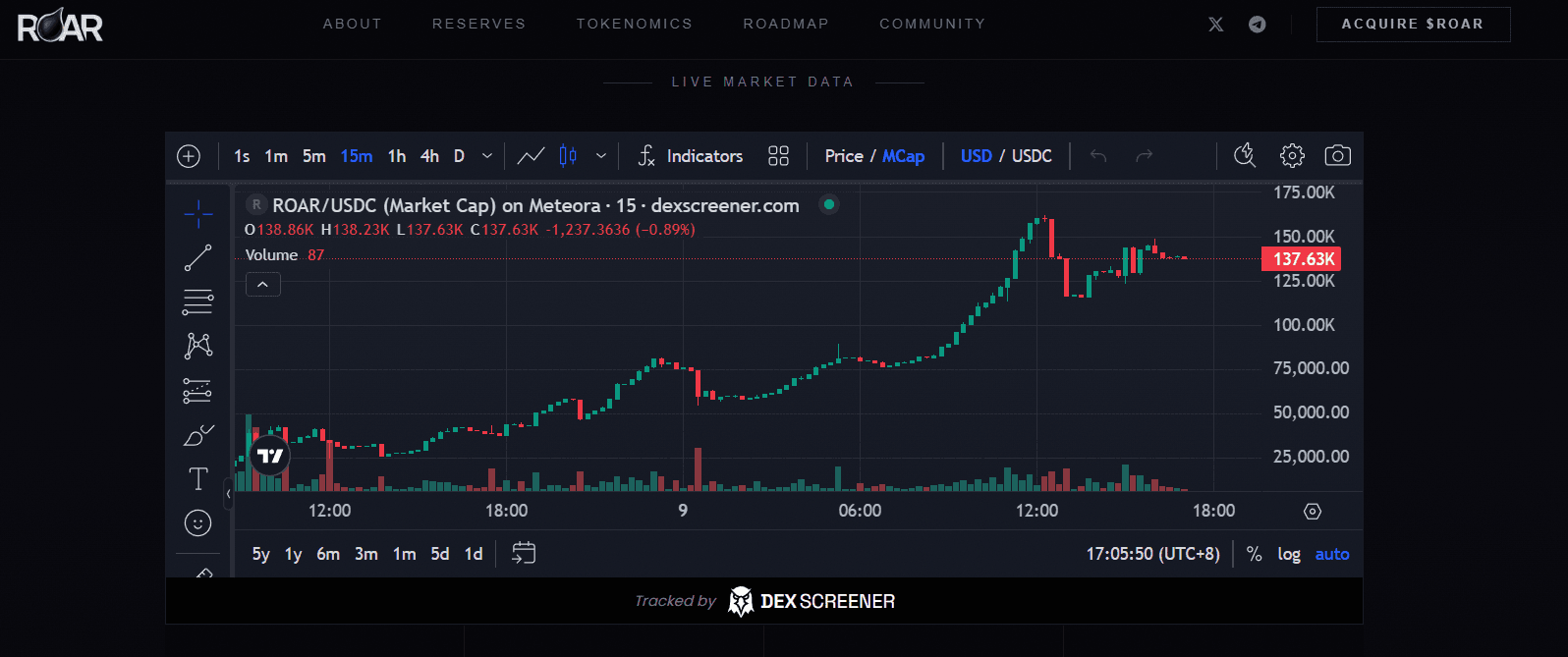
CoinGecko also lists the most active ROAR pair on a decentralized exchange route, with ROAR trading against USDC on Meteora DAMM V2. That tells us the token is accessible, but still mainly living in the Solana DEX environment rather than functioning like a mature large-cap asset with deep centralized-exchange liquidity.
Is ROAR Backed by Real Oil?
No verified public evidence shows that ROAR is backed by real oil reserves. The official site says the opposite: ROAR is speculative, and it is not backed by physical oil reserves or any government entity. WEEX’s coverage reaches the same conclusion and adds that there is no custody structure, no redemption model, and no on-chain oracle proving reserves.
That makes ROAR very different from what many people imagine when they first see the name. “Russian Oil Asset Reserve” sounds like it might be tied to commodities, energy infrastructure, or some form of reserve-backed tokenization. But the current documentation does not support that reading. It is a narrative token using oil language, not a verified asset-backed oil product.
For investors, this matters because asset-backed narratives often attract buyers who are looking for downside protection. ROAR does not appear to offer that. Its value depends on attention, liquidity, and market belief. When those fade, the token can lose momentum very quickly.
How to Buy Russian Oil Asset Reserve (ROAR)
Before buying ROAR, always verify the official contract address to avoid fake tokens or copycat listings. According to the project’s public materials, the official Russian Oil Asset Reserve (ROAR) contract address on Solana is:
ROAR Official Contract Address:
RoARruzbesVGAZgCzSoQCEdyVWytvzLbyNaxXBF7dnF
Because ROAR is a small-cap, narrative-driven token, searching by ticker alone can be risky. The safest way to find the real asset is to copy and paste the official contract address directly into your wallet, swap interface, or token search tool before making any transaction. This simple step can help you avoid costly mistakes and make sure you are trading the correct ROAR token.
Why Some Traders Still Call ROAR Interesting
Even though ROAR is not a traditional investment, it does have a few features that speculative traders may find attractive. First, it has a strong narrative. Energy, oil, supply shocks, and geopolitical tension are all themes that can grab trader attention fast. ROAR is built directly around that kind of story.
Second, it is still small enough for large percentage moves. A market cap around $129,543 means even modest inflows can move price sharply. That kind of structure can be attractive to momentum traders who hunt for explosive micro-cap moves. CoinGecko’s current data and the project’s own activity indicators show that ROAR is actively traded, even if the market is thin.
Third, the token’s official materials claim future utility such as staking and governance, and even list a tokenomics framework that includes liquidity, community allocation, team allocation, reserves, and marketing. Those are claims made by the project, not guarantees of value, but they help explain why some traders are watching it.
Why ROAR Is Risky as an Investment
The biggest issue with ROAR is that its value depends more on narrative than on fundamentals. WEEX describes it as a narrative-driven token, and the official site itself warns users not to confuse the project with physically backed oil exposure. That means ROAR does not have the structural support that a serious long-term investor normally wants.
Another risk is transparency. WEEX notes that the team behind ROAR remains anonymous, with no publicly disclosed founders or clearly verifiable organization behind the launch. Anonymous teams are common in crypto, but they make it harder to judge accountability, execution quality, and long-term commitment.
A third risk is liquidity. CoinGecko’s current numbers show a very small market cap and a 24-hour volume that is not deep enough to suggest a stable market. In a thin market like this, slippage, spread, and sudden sentiment changes can matter more than the actual story. CoinGecko also shows the token is well below its all-time high, which is another sign that downside has already been severe.
A final risk is category confusion. Because ROAR uses reserve-style language, some buyers may assume it is safer or more tangible than it actually is. It is not. The public record describes ROAR as a speculative Solana token, not a verified reserve instrument.
Who ROAR May Fit and Who It Does Not Fit
| Investor type | Is ROAR a good fit? | Why |
|---|---|---|
| Conservative long-term investor | No | Too speculative, no verified backing |
| Beginner | No | High volatility and confusing narrative |
| Momentum trader | Possibly | Can move fast on sentiment |
| Small-risk degen allocation | Possibly | Only as a tiny speculative position |
| Commodity investor seeking oil exposure | No | Not backed by physical oil |
If your main goal is capital preservation, ROAR is a poor match. If your goal is to take a small, high-risk bet on a story-driven Solana token, ROAR may fit that use case better, but only as a tiny position that you can afford to lose. The current public information supports that cautious split very clearly.
Is ROAR a Good Investment in 2026?
For most people, no. ROAR is not a good investment in the traditional sense because it lacks verified backing, transparent ownership, and a stable market structure. It is a speculative token whose price is driven by attention and liquidity rather than by an underlying productive asset. That makes it unsuitable for conservative investors and poor as a core portfolio holding.
For a narrow group of traders, the answer can be more nuanced. If you understand micro-cap behavior, can tolerate severe volatility, and are intentionally hunting narrative-driven price action, ROAR may be a tradable speculation. But that is not the same as being a good investment. It is a high-risk trade with asymmetric upside and very real downside.
A clean way to say it is this: ROAR may be interesting, but it is not reliable. It may be tradable, but it is not proven. It may be movable, but it is not stable. That is the practical conclusion the current data supports.
How to Judge ROAR Before Buying
A good way to evaluate ROAR is to ask four questions before touching the token: Is there verified backing? Is the team transparent? Is liquidity deep enough for your trade size? And does the token have a real use case beyond story and speculation? The current public record gives weak answers to the first two and only partial comfort on the last two.
| Check before buying | What current data suggests |
|---|---|
| Verified reserve backing | No |
| Team transparency | Weak |
| Market depth | Thin |
| Narrative strength | Strong |
| Suitability for conservative investors | Poor |
| Suitability for speculative traders | Possible, but only with caution |
If a token fails the “backing” test and also fails the “transparency” test, it should not be treated like a serious long-term investment. That is the main reason ROAR is hard to recommend beyond speculative trading.
What Kind of Return Profile Does ROAR Have?
ROAR’s return profile looks like a classic micro-cap narrative token. CoinGecko shows that the token has already moved from a very low all-time low to a much higher all-time high, and then fallen heavily from that peak. That kind of range is attractive to traders who chase volatility, but it is not a stable foundation for investment planning.
The same data also shows that ROAR is underperforming the broader crypto market on the current snapshot, even if it may still outperform or underperform peers on different days. That is typical of a token whose price is mostly driven by market attention rather than by durable fundamentals.
In simple terms, ROAR has the potential for sharp upside and equally sharp downside. That is why size matters so much here. A small speculative allocation can make sense for certain traders. A large allocation does not.
Final Verdict: Should You Buy ROAR?
ROAR is not a good investment for most buyers. It is a speculative Solana token with oil-themed branding, an anonymous team, no verified asset backing, and a tiny market cap that can swing fast on sentiment. The data points in one clear direction: ROAR is a narrative trade, not an investment-grade asset.
That does not make it worthless. It means ROAR belongs in the category of highly speculative opportunities, where the right question is not “Is this a safe investment?” but “Do I understand the risk, and is the position small enough to survive if the market turns?” Based on the current public record, that is the only honest way to think about it.
For traders who still want to act on high-risk opportunities, keep your capital ready, stay disciplined, and use WEEX as your trading base for the next market move.
FAQ
Is Russian Oil Asset Reserve (ROAR) a good investment?
For most people, no. ROAR is a speculative, narrative-driven Solana token with no verified physical oil backing, so it is not a strong choice for conservative or long-term investors.
What is the main risk of investing in ROAR?
The main risk is that ROAR’s value depends on sentiment and liquidity rather than on verified real-world backing. That makes it highly volatile and vulnerable to sharp drawdowns.
Does ROAR represent actual oil reserves?
No. The official site says ROAR is not backed by physical oil reserves or any government entity, and WEEX’s coverage says there is no custody structure or redemption model proving reserves.
Why do traders still watch ROAR?
Because it has a strong energy narrative, a tiny market cap, and enough attention to generate fast price moves. Those traits can attract speculative traders looking for short-term volatility.
Is ROAR safe for beginners?
No. ROAR is not a beginner-friendly investment because it is thinly traded, highly volatile, and built around a story rather than a proven asset structure.