
NFT and DeFi: How Hybrid Tokens Are Evolving

NFT and DeFi are no longer separate worlds, and understanding this fusion is one of the most important reads for crypto investors in 2026. Projects like Unipeg (uPEG), a new generation of tokens that combines both technologies into a single programmable asset, have recently gone viral with significant gains in less than 24 hours, drawing attention to a larger narrative: the transformation of the NFT into an on-chain financial primitive.

In this article, the WEEX Crypto Wiki explains what is changing, how this technology works, and what to evaluate before exposing yourself to any asset in this category.
What has changed in NFTs since the 2021 boom?
The NFT market collapsed after the 2021 peak, but what died was the model, not the technology. The era of million-dollar JPEGs exposed a structural problem, proving that purely speculative assets without real utility cannot sustain themselves in the market for long.
Despite the disappearance of the assets themselves, their developers kept building, and the utilities of an NFT, beyond simple display in a digital gallery, began to arrive in the form of assets with embedded utility, providing access to communities, revenue rights, and participation in DeFi protocols. In other words, digital ownership began to carry function, not just status.
In 2026, this transition matured enough to generate a new category of asset: the hybrid token, which merges the uniqueness of the NFT with the liquidity and programmability of DeFi.
And this fusion is at the center of what the market is discussing now.
What is a hybrid token and how does it work?
A hybrid token is a digital asset that combines the properties of two standards that, until recently, were treated as opposites: ERC-20, used in common, fungible cryptocurrencies, and ERC-721, the foundation of traditional NFTs.
In practice, this means that a single token can be traded on exchanges like any other crypto while simultaneously carrying unique and individual attributes like an NFT. It is a significant paradigm shift, as for the first time, liquidity and uniqueness coexist in the same asset.
The ERC-404 standard: what it is and where it came from
The ERC-404 is the experimental standard that made this fusion possible. Launched in February 2024, the ERC-404 is the experimental standard that made this fusion possible, but it is not an official standard approved by the Ethereum foundation.
What ERC-404 does is create a smart contract that simultaneously manages both the buying and selling of tokens. When you buy a whole unit of the token, an NFT is automatically generated for your wallet. Conversely, when you sell or fractionate that position below a whole unit, the NFT is destroyed.
This standard allowed for the trading of fractions of an NFT in DeFi liquidity pools without relying on intermediary platforms. A collector who previously needed to find a buyer for the entire NFT can now sell 0.5 units directly on a protocol like Uniswap.
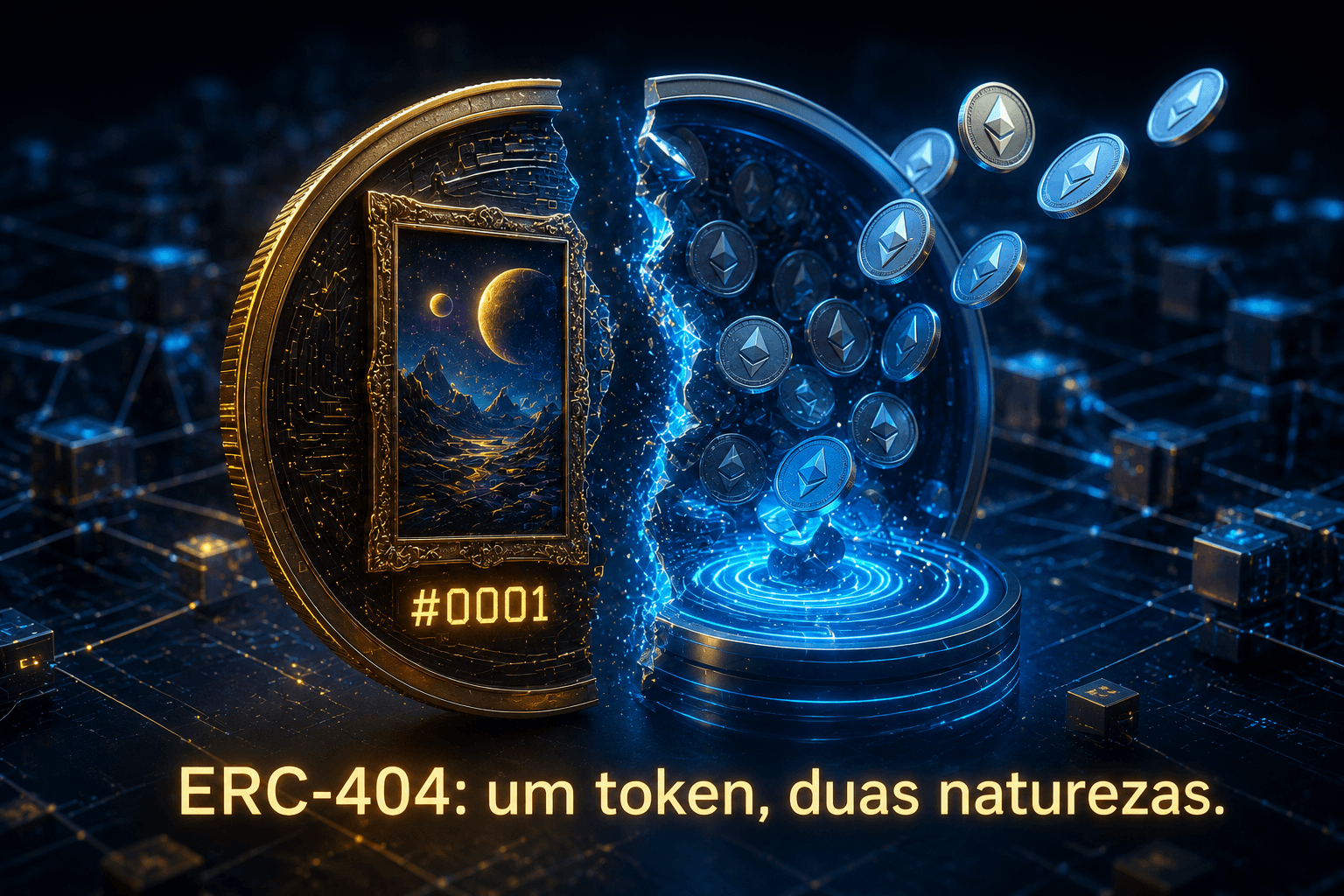
The mint-and-burn mechanism in practice
The technical name for this process is mint-and-burn, whose function is to automatically mint an NFT every time a wallet accumulates enough tokens to complete a whole unit. On the other side, each time that position is fragmented below the limit, the NFT is burned.
For the investor, the dynamic of having an asset with native liquidity, changing its form according to the position held, without manual intervention and without third-party custody, is a great and positive novelty, as exposure to a specific NFT no longer requires capital to buy the entire asset.
The hype of experimental tokens: the Unipeg case
Unipeg (uPEG) is one of the most talked-about projects in this new narrative. In less than 24 hours, the token recorded gains of over 100%, attracting the attention of traders and analysts on various platforms, a movement familiar to those who have been following the market for some time, but with a different technological context than what was seen in previous cycles.
What explains 100% gains in 24 hours
Experimental tokens like Unipeg benefit from factors such as a new narrative, low initial liquidity, and strong coverage on social media and crypto news aggregators, which, when combined and aligned, create an immediate and intense speculative effect.
Low liquidity means that relatively small purchase volumes move the price significantly, which attracts more buyers, fuels the cycle, and produces the triple-digit gains that go viral. It is not necessarily fraud, but it is also not based on fundamentals.
What separates technological trends from speculative bets
The distinction that the investor needs to make is between the technology and the project, as the ERC-404 standard and the NFT+DeFi fusion represent a legitimate and documented evolution of the ecosystem.
Unipeg, like any individual experimental token, is a bet on which specific project will capture value within this trend, and this is a game with a historically low success rate. A real trend does not guarantee a winning project, just as the rise of DeFi in 2020 did not guarantee that all protocols from that cycle would survive.
Is it worth exposing yourself to hybrid tokens?
The technology is real, but the market around it is still mostly speculative, and this distinction defines everything when making a decision. ERC-404 hybrid tokens have existed for a little over two years, operate outside the official Ethereum standard, and carry risks that the investor needs to map out before any exposure.
Real risks of this category
The first risk is structural: ERC-404 is not a standard approved by the Ethereum Foundation, which means that contracts based on it have not gone through the same technical review process as consolidated standards like ERC-20 and ERC-721. Vulnerabilities in unaudited contracts have already caused significant losses in the DeFi ecosystem, such as the Kelp DAO attack, where we saw how flaws in smart contracts can be exploited quickly and without warning.
The second risk is liquidity: although the ERC-404 model promises native liquidity, small and experimental projects often operate with shallow pools, where relevant position exits move the price adversely for the seller themselves.
How to evaluate before investing
Three objective questions help filter projects in this category.
- Has the contract been audited by a recognized independent firm?
- Is the pool's liquidity sufficient to absorb the position you intend to build and unwind?
- Is the team behind the project public and traceable?
If any of these answers are negative or uncertain, the risk level rises non-linearly. At WEEX, investors who want to expose themselves to the crypto sector with greater structure and liquidity find consolidated assets as a safer starting point to build a portfolio before migrating to experimental categories.
Conclusion
The fusion between NFT and DeFi is not a fad; it is a structural evolution that redefines what a digital asset can do. Despite the high individual risks of new experimental ERC-404 projects, such as Unipeg, the direction is unequivocal, and we can already state that NFTs are ceasing to be collector's items to become programmable financial instruments.
The investor who understands this transition will be better positioned to take advantage of the opportunities that this market will generate. By trading on WEEX, you follow this evolution with access to consolidated assets and information to decide with confidence.
Frequently Asked Questions
What is ERC-404?
It is an experimental standard created in 2024 that combines the properties of fungible tokens and NFTs into a single asset, allowing for fractional trading with automatic generation and destruction of NFTs according to the holder's position.
Are hybrid tokens and traditional NFTs the same thing?
No. Traditional NFTs are indivisible and depend on a buyer for the entire asset. Hybrid tokens allow for fractionation and native liquidity in DeFi pools.
Is Unipeg (uPEG) a good investment?
Unipeg is a high-risk experimental token. Rapid gains in projects of this category reflect speculation, not fundamentals. Research audits, liquidity, and the team before any exposure.
Disclaimer
WEEX and its affiliates provide digital asset exchange services, including derivatives and margin trading, only where legal and to qualified users. All content is general information and not financial advice—seek independent advice before trading. Cryptocurrency trading is high-risk and can result in total loss. By using WEEX services, you accept all related risks and terms. Never invest more than you can afford to lose. Consult our Terms of Use and Risk Warning for details.