
Unipeg (uPEG): Definition, Trends, Risks, and the Impact of Uniswap v4 on NFTs in 2026

What is Unipeg (uPEG)?
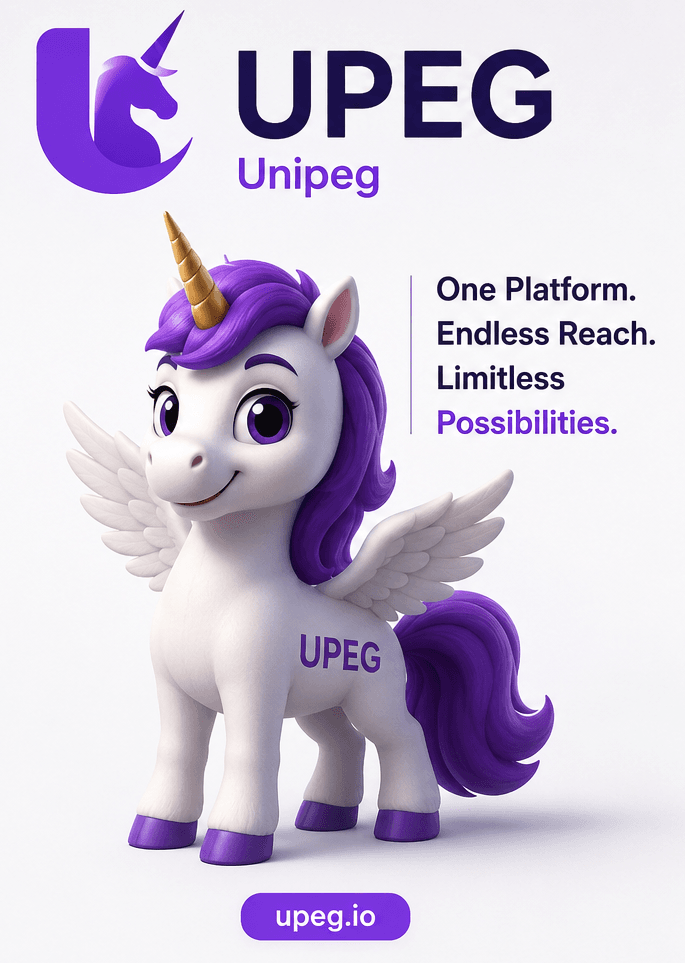
Unipeg is an experimental project launched on Ethereum, built around Uniswap v4 hooks. It is neither a traditional NFT nor a standard ERC-20 token. Unipeg represents a new category of on-chain object: a hybrid asset whose appearance and behavior are directly generated by trading activity.
Specifically, with every swap performed in the uPEG pool, a Uniswap v4 hook automatically generates a unique 24×24 pixel art image of a unicorn—entirely on-chain, with no external storage, no IPFS, and no artist. The image is produced from a hash encoding the layers, colors, and the original owner's address. Each transaction produces a new number, and this number becomes the input for the SVG renderer that assembles the unicorn.
The name "Unipeg" itself is meaningful: it is the name that Hayden Adams, founder of Uniswap, initially wanted to give his protocol—a contraction of "Unicorn" and "Pegasus." Vitalik Buterin had suggested "Uniswap" instead. Today, the project is being revived in the form of "Uni + JPEG," merging decentralized finance and on-chain generative art.
Why is Unipeg trending?
Several factors have propelled uPEG into the spotlight in just a few days.
The Adam Hollander effect
The main trigger was the public purchase of a small amount of uPEG by Adam Hollander, CMO of OpenSea. His statement—"this concept made me curious and I want to experiment a little"—was enough to trigger a rise of more than 300% in a few hours. When the CMO of the world's largest NFT platform takes an interest in a token, the community follows.
Interest from the Uniswap team
Members of the Uniswap team have also mentioned Unipeg on social media, adding a layer of technical legitimacy to the project. This dual signal—NFT + DeFi—has created a cross-pollination of excitement between two communities that are usually distinct.
A truly new concept
Beyond the hype, Unipeg offers something truly unprecedented: transforming every transaction into a creative event. It is not a meme coin without utility, nor a classic NFT collection. It is a live demonstration of what Uniswap v4 hooks make possible.
Uniswap v4 and hooks: Why this changes everything for NFTs
To understand Unipeg, you must first understand what Uniswap v4 has changed.
Hooks: Programmable logic at the heart of pools
Launched in January 2025, Uniswap v4 introduces a system of hooks—external smart contracts that attach to a liquidity pool and execute at specific moments in the swap lifecycle: before or after a trade, or before or after adding/removing liquidity. These hooks allow developers to inject custom logic directly into the exchange mechanism without modifying the core protocol.
Before v4, this type of logic had to be implemented outside the swap via auxiliary contracts. With hooks, the logic executes at the very moment of the transaction—a technical difference that opens up a significant design space.
From static AMM to programmable market
Hooks transform Uniswap pools into programmable markets. Among the use cases already being explored: dynamic fees that adjust to volatility, on-chain limit orders, lending protocols integrated directly into pools, or—with Unipeg—the generation of generative art with every transaction.
It is this last use case that redefines the boundary between token and NFT.
Classic NFT vs. hybrid token: What is the difference?
| Criteria | Classic NFT (ERC-721) | Hybrid Token (uPEG) |
|---|---|---|
| Uniqueness | Fixed at creation | Generated by trading activity |
| Liquidity | Low (unit sale) | High (AMM pool) |
| Storage | IPFS or external | 100% on-chain |
| Generation | Artist or script at mint | Automatic hook at every swap |
| Governance | Sometimes (DAOs) | None—driven by activity rate |
A classic NFT is unique but lacks liquidity. It is minted once, with a fixed image. A hybrid token like uPEG combines the liquidity of an ERC-20 with the visual and collectible dimension of an NFT. The whole part of the token generates an image that can be collected; the fractional part remains a fungible token.
This is not the first project to attempt this fusion. ERC-404 (notably with Pandora) had already explored the idea of an asset combining ERC-20 and ERC-721. But Unipeg goes further: the object is not created once; it is constantly recreated by market behavior.
Risks to be aware of before investing in uPEG
Like any experimental and narrative-driven asset, uPEG carries real risks that would be imprudent to ignore.
Extreme volatility
uPEG is a micro-cap token: its price can move by several hundred percent in a few hours in either direction. The 300% rise triggered by a single tweet is proof of this. This type of token can just as quickly lose the majority of its value if community interest shifts.
Absence of traditional fundamentals
uPEG does not generate revenue, does not distribute dividends, and does not offer governance rights. Its value is entirely narrative and community-based. This means it depends directly on attention—a resource that is volatile by nature.
Risks related to smart contracts
Although the concept is innovative, Uniswap v4 hooks constitute a more complex audit surface than classic pools. Errors in the logic of a hook can lead to unexpected behavior or loss of funds. The lack of a full public audit on such a recent project is a signal to be cautious.
No official endorsement
The interest from Adam Hollander and members of the Uniswap team does not constitute an official endorsement from OpenSea or Uniswap Labs. These individual positions can create a sense of legitimacy that exceeds the reality of the project.
Concentration of holders
A high concentration of supply among a few wallets can expose the token to market manipulation risks. It is recommended to check token distribution on explorers like Etherscan before any investment.
How to trade uPEG safely?
For traders looking to gain exposure to uPEG, here are some best practices:
- Verify the official contract address on CoinGecko or CoinMarketCap before any purchase—fake tokens imitating trending projects are common.
- Check on-chain data on DexScreener to verify liquidity depth and real volumes.
- Only trade what you can afford to lose—narrative-driven micro-cap tokens are among the riskiest assets in the crypto market.
- Avoid high slippage rates during your swaps to limit exposure to MEV and sandwich attacks.
To trade tokens like uPEG or explore UPEG/USDT pairs, platforms like WEEX offer quick access to new listings with an interface tailored to active traders.
What Unipeg reveals about the future of crypto
Beyond the token itself, Unipeg illustrates a fundamental trend: the convergence of DeFi, NFTs, and on-chain generative art. Uniswap v4 hooks are just the beginning. As developers explore this space, new categories of hybrid assets will emerge—objects whose behavior, appearance, and value are directly shaped by the activity of their community.
This is an evolution worth following closely, even for those who do not invest in uPEG directly. The primitives that Unipeg demonstrates today could become the standards of tomorrow.
Conclusion
Unipeg (uPEG) is much more than a trendy token. It is a concrete demonstration of what Uniswap v4 and its hooks make possible: hybrid, liquid, generative, and entirely on-chain assets. The traditional distinction between NFTs and tokens is gradually fading in favor of a new generation of programmable digital objects.
That said, the risks are real. Extreme volatility, lack of fundamentals, unaudited smart contracts: uPEG remains a speculative short-term bet. For savvy investors, it is a fascinating object of experimentation. For beginners, caution remains the order of the day.
The content of this article is provided for informational purposes only and does not constitute investment advice. Trading cryptocurrencies involves significant risks, including the total loss of invested capital.