
What is Unipeg (uPEG): The programmatic asset of NFTs

Neither an NFT nor a conventional token. Unipeg is born from every transaction in real time. And in a region where crypto has ceased to be speculation and has become a tool for financial survival, this innovation arrives at the perfect moment.
In the crypto world, every so often something appears that does not fit into any known category. It is not a new token with a different logo. It is not an NFT with a better design. It is something that forces us to rethink from scratch what a digital asset can be. Unipeg (uPEG) is exactly that: an experiment that lives at the intersection of DeFi and on-chain collectibles, and which in recent weeks has become one of the most talked-about projects in the global Web3 ecosystem.
But why should it matter to someone in Venezuela, in Mexico, or in any corner of Latin America, where the crypto priority is usually surviving inflation rather than exploring the blockchain vanguard? The answer has several layers, and in this article, we develop them all.
Latin America and crypto: necessity first, innovation later
To understand the Latin American interest in projects like Unipeg, one must first see where the region stands. Latin America recorded a year-over-year growth of 63% in cryptocurrency adoption during 2025, according to the Geography of Crypto report by Chainalysis, becoming one of the most dynamic regions in the world. In terms of transaction volume, Brazil led with $319 billion, followed by Argentina with $94 billion, Mexico third with $71 billion, and Venezuela fourth with $45 billion, all in the period from July 2024 to June 2025.
But what makes this region unique is not the volume: it is the reason behind the numbers. As El Financiero points out in its analysis of the Chainalysis report, in the case of Argentina and Venezuela, high adoption appears to be related to high inflation, currency devaluations, and capital controls; that is, cryptocurrencies are used to compensate for the deficiencies of the local currency.
Venezuela is the most extreme case. With inflation that, according to estimates by Professor Steve Hanke of Johns Hopkins University, stood in ranges between 600% and 650% during 2025, the bolivar lost value systematically, and access to physical foreign currency remains complicated for the majority. That is where the exchange wallet (the digital tool that allows converting bolivars to digital assets in real time) became a daily mechanism for financial survival. According to Revista Mercado, Venezuela has shown intense transactional activity, surpassing Mexico and Argentina in volume, driven by a shortage of foreign currency that led citizens, companies, and institutions alike to adopt cryptocurrencies as a means of payment.
Mexico presents a different but equally revealing profile. Dollar-linked assets represented 36% of purchases in Mexico, while Bitcoin remained the primary asset in portfolios, according to a Bitso report. Remittances (which in 2024 reached $63 billion) also found in crypto platforms a cheaper and faster path than traditional banking channels. In that context, cryptocurrencies fulfill a dual function in Mexico: a refuge against the depreciation of the peso and a channel for international transfers.
It is precisely in this mature and sophisticated ecosystem where projects like Unipeg find an audience that already understands the value of blockchain innovation (because necessity forced them to learn it).
What is Unipeg (uPEG): the object born at the moment of the swap
Unipeg is, according to its official description, "a new type of on-chain object." It is not an NFT in the traditional sense. It is not a conventional fungible token. It is something that exists in the gray zone between the two, and that ambiguity is not a design error: it is exactly the proposal.
The name has history. In 2019, Hayden Adams (founder of Uniswap) recalled in a blog that he originally wanted to call his protocol "Unipeg," a combination of Unicorn and Pegasus. It was Vitalik Buterin who replied: "Unipeg? Sounds more like Uniswap," and that is how the name we all know came to be. Years later, that discarded name returned to christen this experiment. And the second part of the name has its own logic: in the NFT era, digital collectibles were informally called JPEGs. Since these objects are born on Uniswap, the equation was: Uni + JPEG = uPEG.
How it works: reactive assets and Uniswap v4 hooks
Here comes the technical part, but it is worth understanding because it is what makes Unipeg genuinely different from everything that came before.
Uniswap v4 introduced a mechanism called hooks: snippets of custom logic that can be inserted directly at the moment a swap is executed within a liquidity pool. Before hooks, many protocol innovations required building an additional contract layer around the AMM (automated market maker) or processing transactions after the fact. Hooks open that door directly within the swap flow; the program does not have to stay on the sidelines reading results, it can participate the instant the exchange is executed.
Unipeg leverages this in an elegant way. According to official documentation and analysis by PANews and Odaily, the mechanism works like this:
- Someone executes a swap in the Unipeg pool. At that exact instant, the project's custom hook is activated automatically, without human intervention.
- The hook generates a unique hash. That hash encodes information from the moment of the transaction: the layer where it occurred, the assigned color, who the original holder was. Each swap produces a different hash.
- An on-chain SVG renderer reads that hash and converts it into an image. Specifically, a 24x24 pixel unicorn. The entire process requires no external storage, avoids IPFS, and the image remains completely expressed on the blockchain.
The result is a digital object that did not exist before the transaction occurred. It is not pre-minted waiting for a buyer, as a classic NFT does. It is generated at the moment of the swap, triggered by the act of exchange itself. That is why we speak of reactive or programmable assets: their existence and appearance depend on the state of the blockchain and the actions of the users, not on a decision made by the creator in advance.
There is an additional ingenious design: each image is linked to a specific integer, such as a uPEG ordinal number of 1, 2, or 3. Users do not buy pre-numbered collectibles, but rather acquire objects that correspond to those integers as their holdings cross the integer thresholds. The fractional part remains as ordinary tokens, while the integer part begins to take shape. Buying and selling tokens is adding and subtracting numbers, but in Unipeg, certain numbers suddenly have a face, identity, and display value.
The evolution of NFTs: from static images to objects that respond to the world
To understand why Unipeg matters beyond the hype, one must look at the history of non-fungible digital assets in perspective.
First-generation NFTs (CryptoPunks, Bored Apes, the great PFP collections of the 2021 boom) were essentially digital images with an on-chain certificate of ownership. Valuable as a collection, but completely static. Once minted, they do not change, do not react, do not evolve.
The second generation brought something more interesting: dynamic NFTs, capable of changing visual attributes according to external conditions (sports results, weather, holder actions). Gaming projects popularized assets that evolve with use. But even those relied on external oracles or manual updates.
Unipeg proposes something different: it transforms swap transactions into a dynamic mechanism for NFT generation, linking token balances to collectible objects that can be displayed, exploring a new paradigm where the trading process itself becomes asset creation. There is no artist who decides when it changes. There is no oracle bringing data from outside. The blockchain executing its own logic produces the object. The act of exchanging is the act of creating.
That is the conceptual leap that distinguishes Unipeg: it is not an incremental improvement on NFTs. It is a new category. And the interesting question is not whether the price goes up this week, but whether this type of primitive (the reactive asset) has a future as a Web3 ecosystem standard.
The current price of uPEG and market data
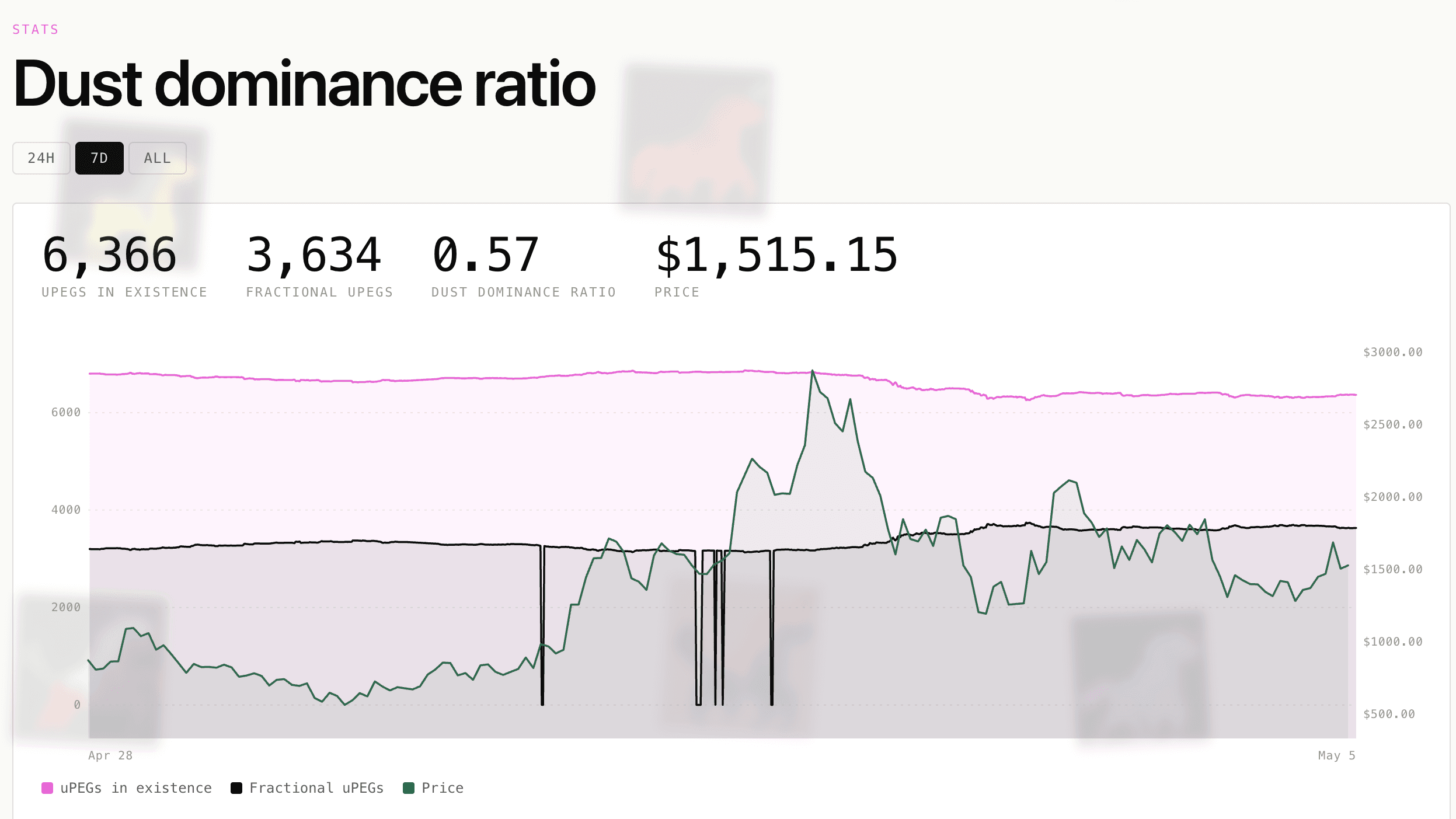
In market terms, Unipeg had an explosive debut. Enthusiasm ignited quickly: the price of Unipeg briefly exceeded $1,000 during the weekend of its viral launch. According to Coinbase data, at the time of writing this article, the price is around $1,509 per token, with a fixed total supply of just 10,000 units. That extremely limited supply explains the high prices per unit, but also makes uPEG an asset of reduced liquidity and high sensitivity to movements by large holders.
The UPEG/USDT pair is available for spot trading on WEEX, where any user can explore the asset with the tools and information that the platform makes available.
WEEX: the reliable gateway to crypto innovation in Latam
In an ecosystem where new and complex projects appear every week, choosing well where you operate matters as much as what you buy. WEEX positions itself as an exchange that combines real access to cutting-edge assets with institutional security standards, especially relevant for users in Venezuela, Mexico, and all of Latin America who operate in complex economic contexts.
WEEX was one of the first exchanges to enable the UPEG/USDT pair for spot trading, opening access to this emerging asset for the entire region. But more than the listing, what distinguishes WEEX is the quality of its educational resources: the WEEX Wiki in Spanish includes detailed technical analysis on uPEG, accessible explanations about Uniswap v4 hooks, and tools so that any user—from the Venezuelan who uses crypto as an exchange wallet to the Mexican trader who follows the ecosystem's vanguard—can make informed decisions.
To continue building context on how cryptocurrencies became a tool of resistance and financial survival in the region, we recommend these articles from the WEEX Wiki:
- 📖 Cryptocurrencies: Venezuelans and their life jacket in the crisis: A deep analysis of how Venezuelans adopted digital assets as a daily survival mechanism in the face of the collapse of the traditional financial system.
- 📖 Geopolitics and Cryptocurrencies: What drives adoption in Latam: The political, economic, and social factors that are accelerating the use of digital assets throughout Latin America, beyond speculative hype.
Does it make sense to explore uPEG from Latin America?
It depends on what you are looking for. If your main goal is to protect the value of your savings against inflation or devaluation (which is the reason why most in the region came to the crypto world), uPEG is not the asset for that. It is not a stablecoin, it has no backing in real assets, and its liquidity is limited.
But if you already have a solid base (stablecoins, Bitcoin, perhaps some Ethereum) and want to explore the technological frontier with a small portion of genuinely available risk capital, Unipeg is one of the most original experiments to appear so far in 2026. Not because it is going to "reach x price," but because the concept it proposes may be the seed of a new paradigm in Web3.
Conclusion: Unipeg, reactive assets, and the crypto future of Latin America
Unipeg (uPEG) is not just another project on the endless list of tokens that appear and disappear. It is a genuine experiment that poses a philosophical question about what a digital asset can be: something created in advance and sold, or something that emerges from the very act of interaction with the protocol? That question, even if it sounds abstract, has enormous practical implications for the future of NFTs, DeFi, and digital ownership in general.
For Latin America, which built one of the most sophisticated crypto communities in the world not by choice but by necessity (Venezuela using the exchange wallet to survive hyperinflation, Mexico using crypto to send cheaper remittances, Argentina dollarizing digitally when the banking system offered no answers), following the evolution of assets like Unipeg is part of keeping up with an ecosystem that never stops changing. The region did not come to the crypto world to speculate: it came because it needed real financial tools. And now, with that accumulated knowledge base, it is in a position to explore the vanguard as well. Do it from reliable platforms like WEEX, with judgment, with quality information, and never putting at risk the savings you need to live. Register at WEEX today to start your crypto experience on the right foot.
Disclaimer
WEEX and its affiliates provide digital asset exchange services, including contract trading and margin trading, only where it is legal to do so and for eligible users. All content is general information and does not constitute financial advice. You should seek financial advice before trading. Cryptocurrency trading is a high-risk activity and can result in the total loss of your assets. By using WEEX services, you accept all risks and related terms. Never invest more than you can afford to lose. Consult our Terms of Use and our Legal Statement for full details.